
Welcome to Miss Angie’s
Halloween Your Way! 🎃💜
Supporting communication, connection, sensory needs & FUN — in the way that works for your child.
Halloween doesn’t have to look, sound or feel the same for every child.
Some children may talk their way through Halloween. Others may communicate with gestures, signs, pictures, AAC, pointing, eye gaze, sounds or movement. Some may love costumes, crowds and doorbells; others may prefer a quieter celebration, familiar clothes or just a few minutes of Halloween fun.
On this page, you’ll find simple ways to use the goodies in your child’s Halloween bag to encourage communication, connection, play, imitation, joint attention and turn-taking — while respecting your child’s individual sensory needs, interests and communication style.
No pressure to perform. No “right” way to participate. Just
PLAY • CONNECT • COMMUNICATE — your child’s way.
What’s in Your Treat Bag? 🎃
Every item can become an opportunity to CONNECT • COMMUNICATE • PLAY!
The treats and toys in your child’s bag can create natural opportunities for communication, shared attention, imitation, making choices, requesting, turn-taking and play.
Your child might communicate by speaking, vocalizing, signing, gesturing, pointing, using AAC, looking toward something, reaching — or simply showing you what interests them.
There is no need to require a word, sign or response before giving your child an item. Instead, model the communication, pause and give your child an opportunity to respond in their own way.
Follow Their Lead 💜
If your child loves the Slinky, stay with the Slinky. If bubbles are the big hit, keep blowing bubbles. You don’t need to work through every activity or turn play into a lesson.
Connection comes first. Communication can grow from there.
Communication Can Look Many Ways 💜
Communication is more than spoken words. Your child may tell you what they want, enjoy, notice or need in many different ways.
Watch for communication through:
Speech & vocalizations — words, word approximations, sounds, laughter or other vocal play
Gestures & signs — pointing, reaching, waving, signing or leading you toward something
AAC & pictures — selecting a symbol, picture, word or message on a communication system
Body movement & actions — moving closer, moving away, bringing you an object or showing you what they want
Eye gaze & shared attention — looking toward an object, looking between you and something interesting, or sharing a moment of enjoyment
Model It — Don’t Make Them Earn It
If your child reaches for the bubbles, you might model “bubbles,” “open,” “more” or “go” with speech, sign or AAC — and then give them the bubbles.
They do not have to copy you first.
If your child hands you the Slinky, you might say or model “go!” and send it down the stairs.
If they smile, laugh, come back for more or hand it to you again, that is communication too.
Try This: Model • Pause • Respond
MODEL: Give your child a simple word, sign, gesture or AAC model.
PAUSE: Give them time to notice and respond.
RESPOND: Honor their communication — even when it looks different from the response you expected.
The goal isn’t to make your child communicate a certain way. The goal is to create more opportunities for meaningful communication and connection.
I think this is an important section for Essential because it teaches the parent how to use all those item ideas without turning the Halloween bag into nine therapy assignments.
Use the Goodies — Your Child’s Way 🎃
There is no single “right” way to play. Choose an item your child enjoys and use it to create natural moments for communication and connection.
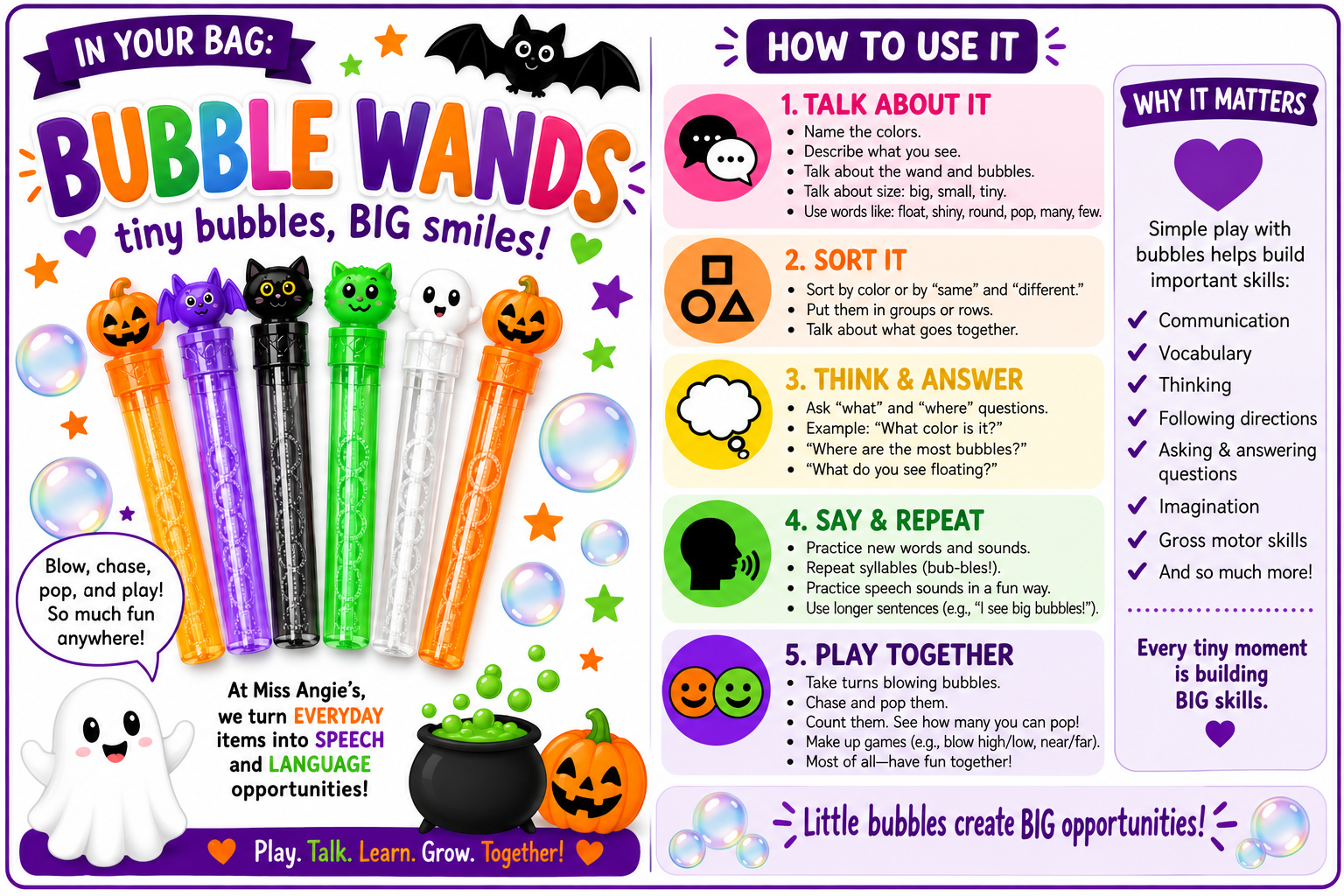
🫧 Bubbles
COMMUNICATE: Model more, go, stop, pop, open, bubbles
IMITATE: Pop, blow, clap or copy a simple movement
TAKE TURNS: “My turn” → “your turn”
AAC: Model MORE, GO, AGAIN, STOP without requiring your child to select it
CONNECT: Pause before blowing again and notice how your child lets you know they want more
REGULATE: If watching bubbles is calming, simply enjoy them together
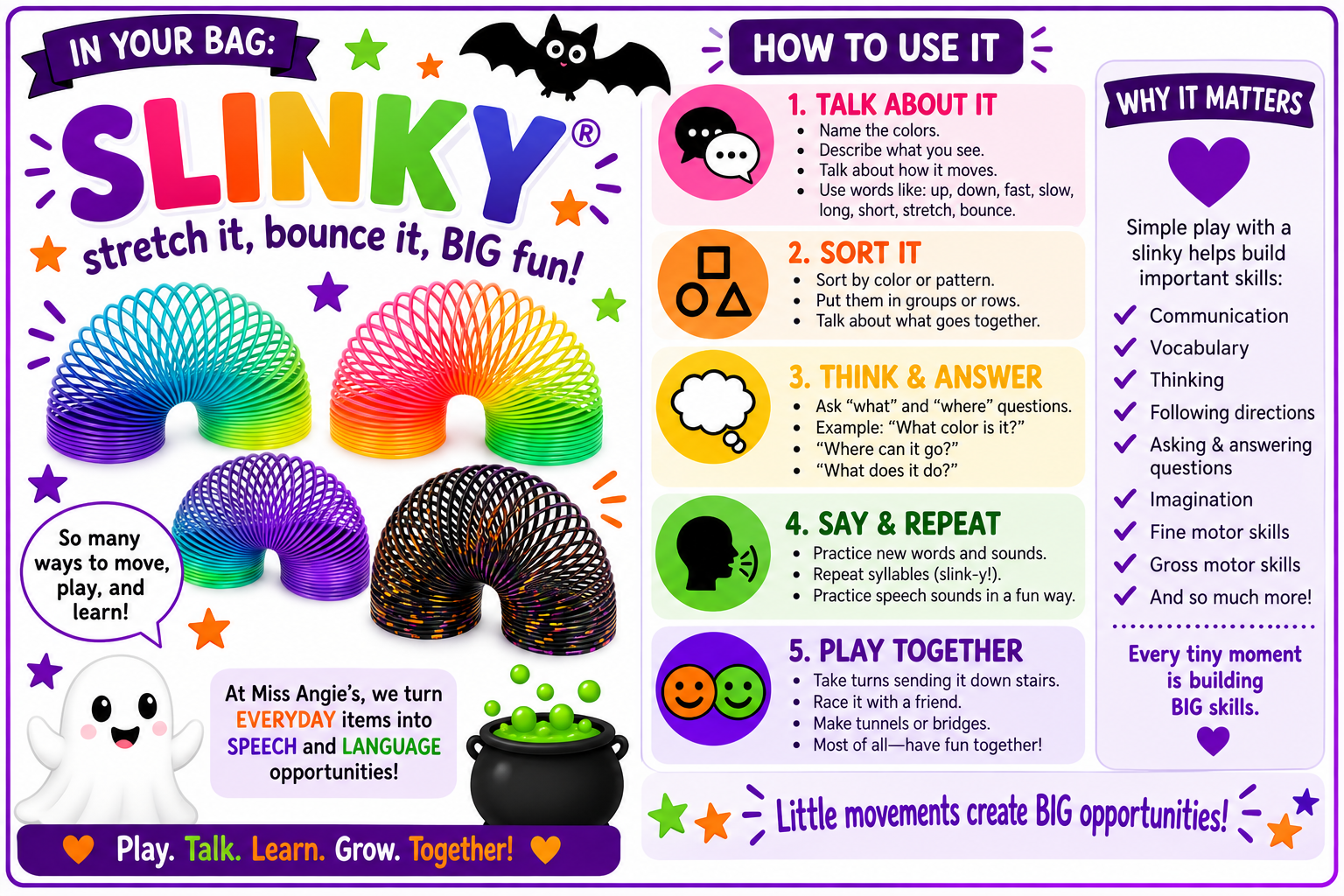
🌈 Slinky
COMMUNICATE: Model go, stop, more, again, up, down
IMITATE: Stretch, shake, drop or bounce it
TAKE TURNS: Send it back and forth or take turns dropping it
AAC: Model GO, MORE, AGAIN without requiring a response
CONNECT: Try “Ready, set…” and pause before GO!
REGULATE: Repetitive stretching or watching the Slinky move may simply be enjoyable — let that be enough
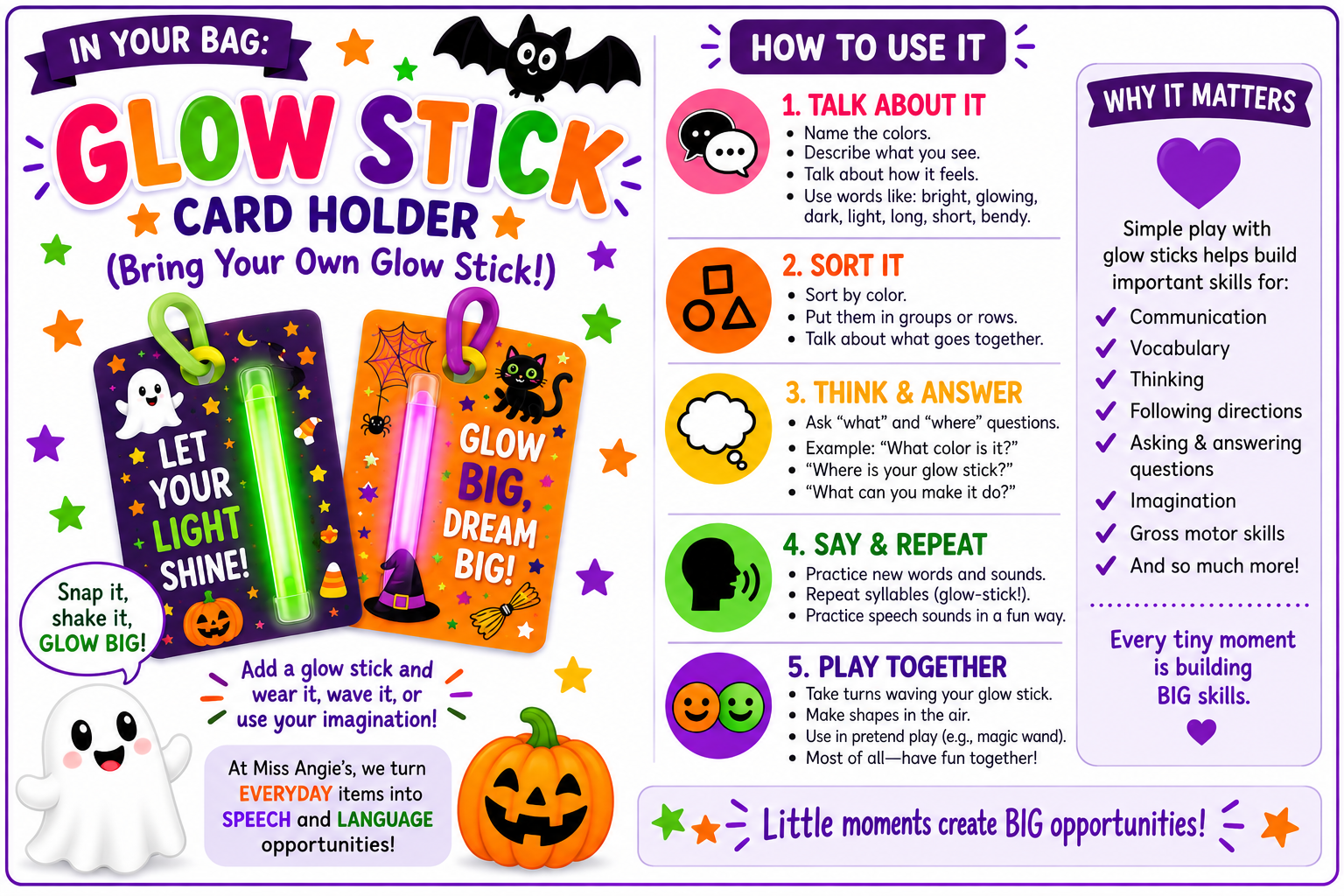
✨ Glow Stick
COMMUNICATE: Model on, off, light, dark, more, color names
IMITATE: Wave it, shake it, make circles or move it up/down
TAKE TURNS: Copy each other’s movements
AAC: Model ON, MORE, LOOK, GO
CONNECT: Turn down the lights and notice what captures your child’s attention
REGULATE: A dim room and gentle glowing light may be more comfortable than bright Halloween lights
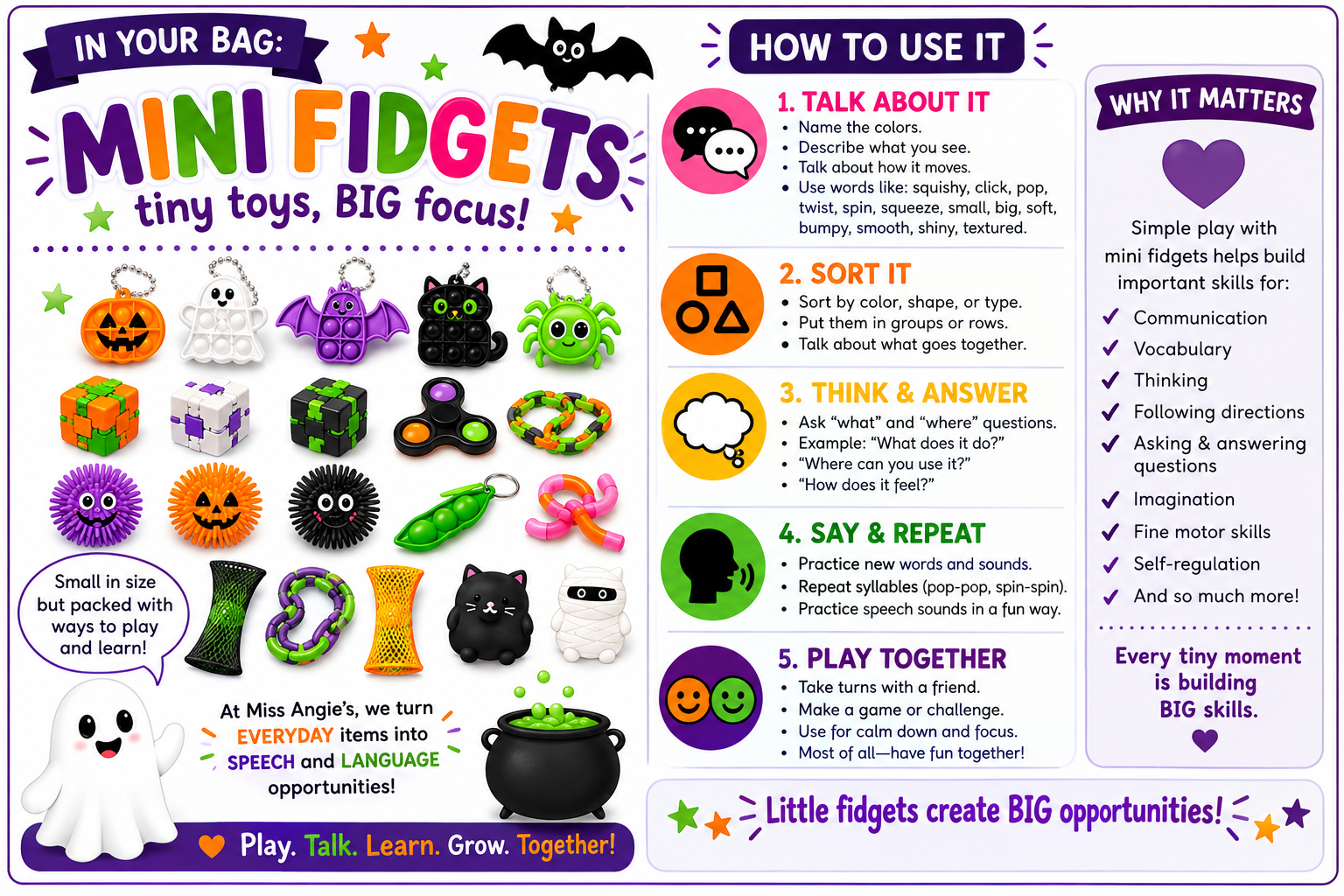
👻 Mini Fidget
COMMUNICATE: Model more, help, open, push, turn, squeeze
IMITATE: Copy what your child does with the toy
TAKE TURNS: Join in if your child welcomes it — independent play is okay too
AAC: Model words that match what your child is doing rather than directing the play
CONNECT: Follow your child’s interest instead of showing them the “right” way to use it
REGULATE: If the fidget helps your child feel calm or organized, allow it to serve that purpose
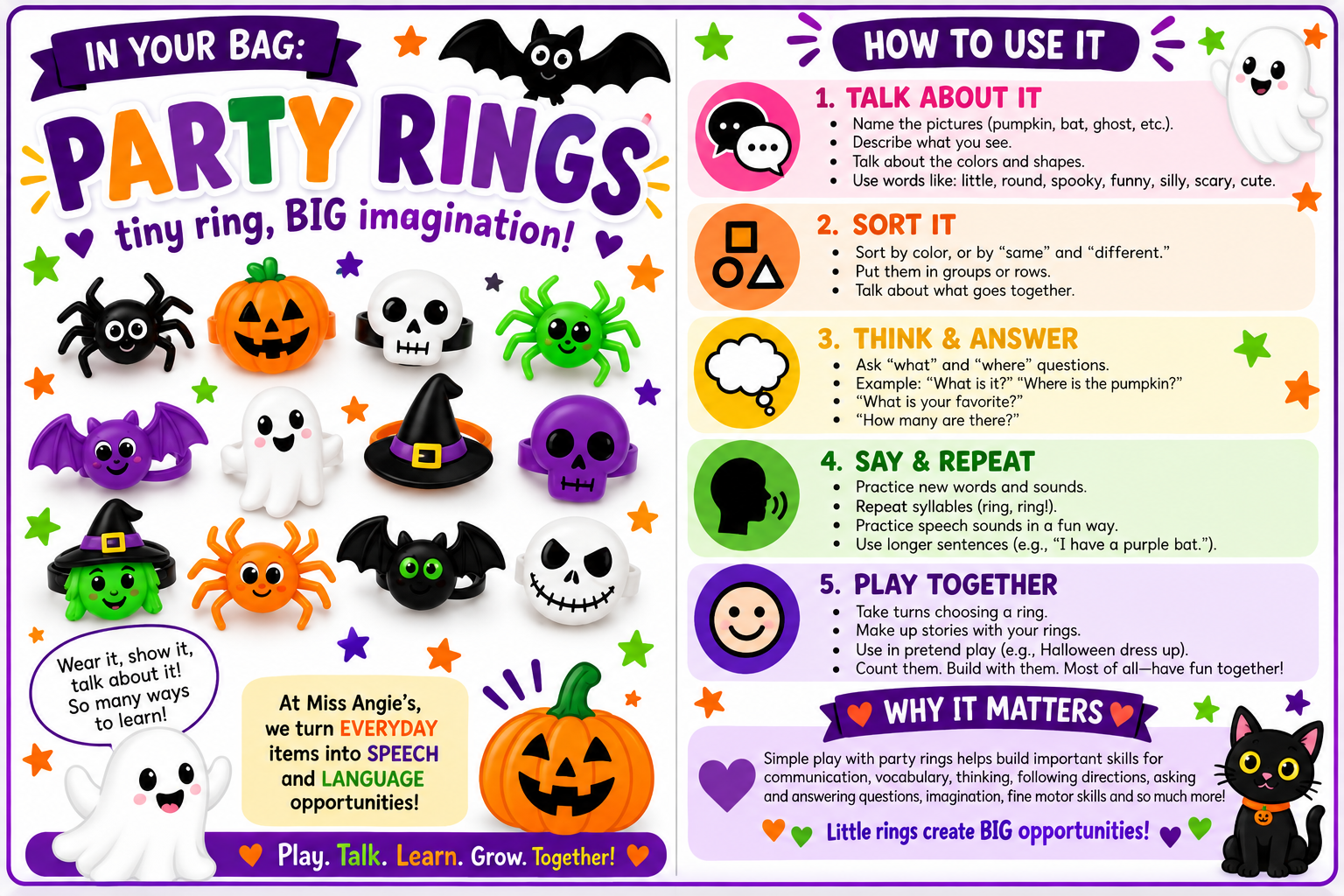
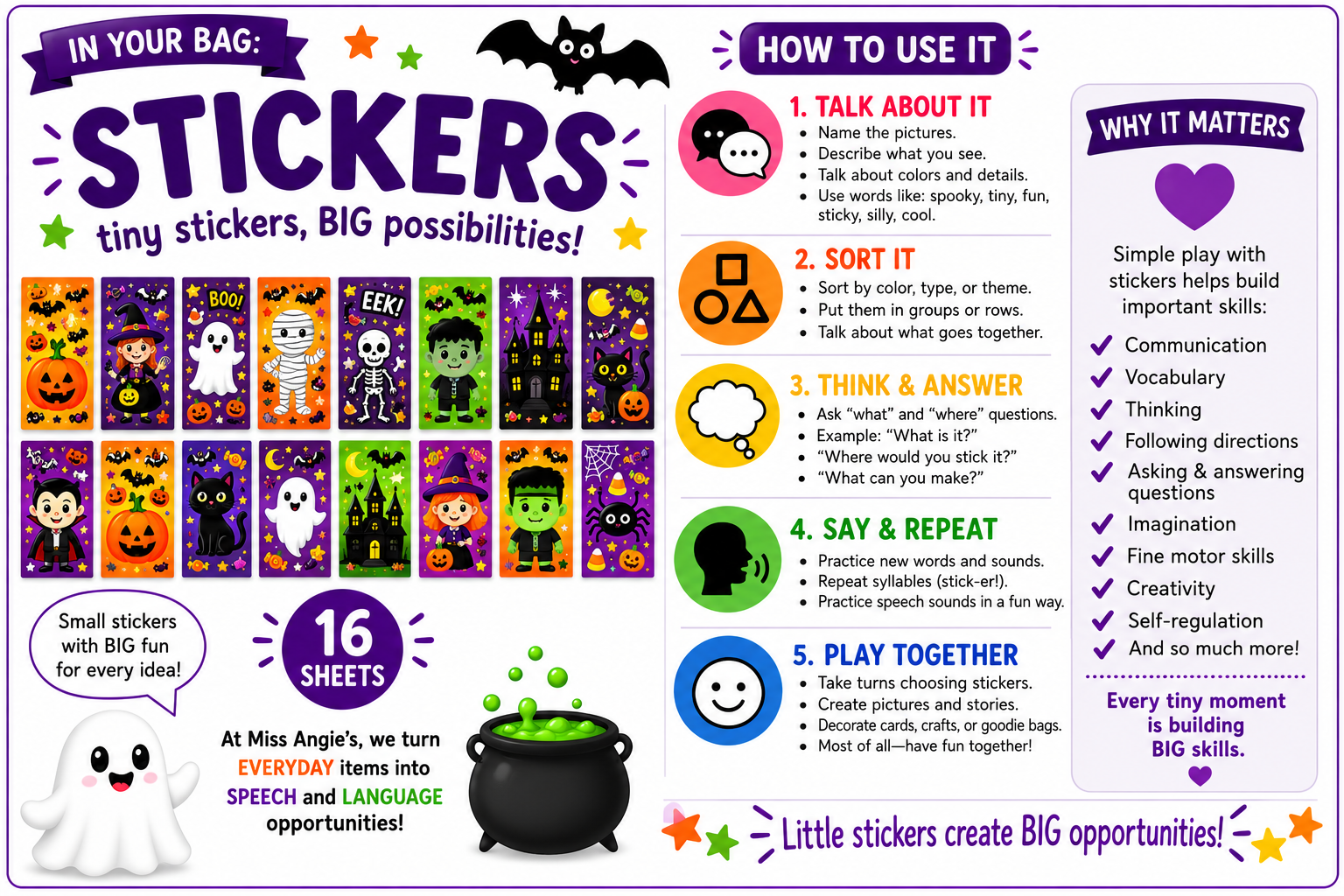
🎃 Stickers & Rings
COMMUNICATE: Offer choices: ghost or pumpkin? orange or purple?
IMITATE: Copy actions such as stick, peel, put on, take off
TAKE TURNS: Choose one for yourself, then offer your child a turn
AAC: Model the choices or action words on your child’s AAC system without requiring a response
CONNECT: Notice what your child chooses or creates and join their play rather than changing it
REGULATE: If your child prefers lining up, sorting, holding or repeatedly peeling and sticking, let them explore in the way that feels enjoyable
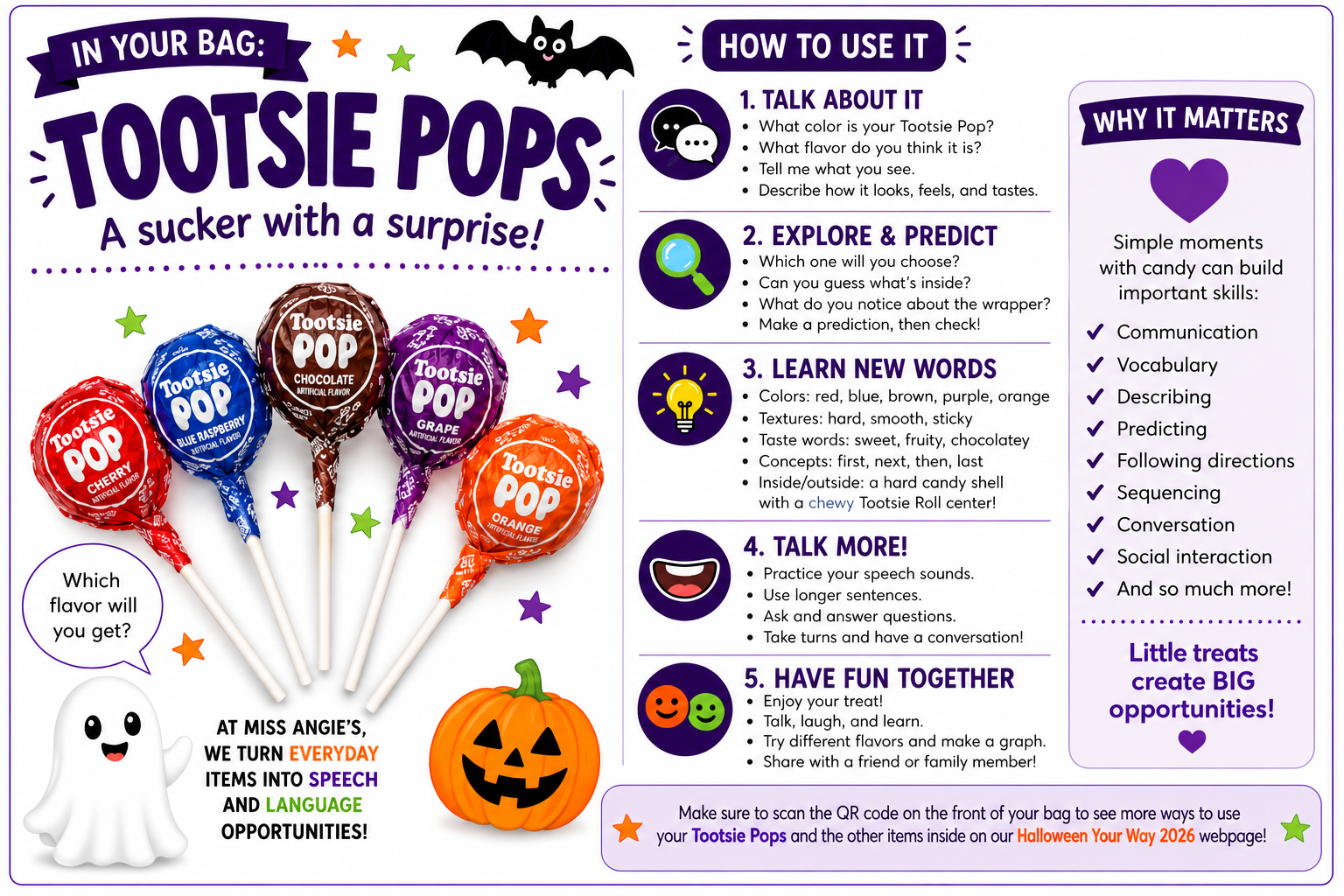
🍭 Tootsie Pops
COMMUNICATE: Model open, want, more, eat, lick, all done and color or flavor words
IMITATE: Model simple actions such as open, lick, smell or turn
TAKE TURNS: Take turns choosing, describing or exploring different flavors
AAC: Model WANT, OPEN, MORE, LIKE, DON’T LIKE, ALL DONE without requiring your child to select them
CONNECT: Notice how your child communicates preferences — reaching, looking, pushing away, pointing, signing, using AAC or speaking all provide information
REGULATE: Your child does not have to taste or eat the candy. Looking, smelling, touching — or choosing not to interact with it — is okay
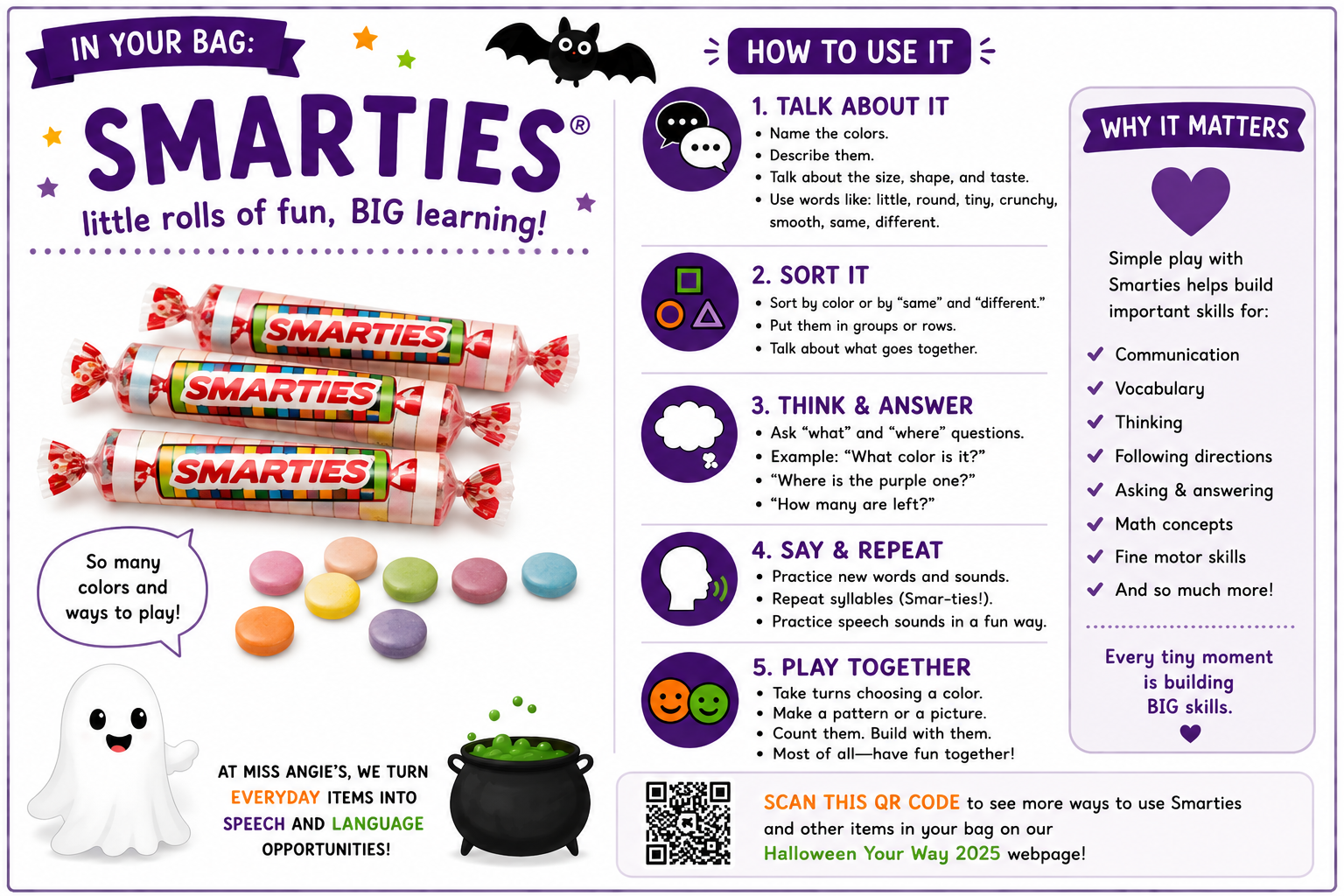
🍬 Smarties
COMMUNICATE: Model more, eat, open, red, blue, yellow, same, different
IMITATE: Try simple actions such as pick up, put in, take out or stack
TAKE TURNS: Take turns choosing a color, adding to a pile or making a simple pattern
AAC: Model words such as MORE, WANT, COLOR, SAME, DIFFERENT, ALL DONE
CONNECT: Follow what interests your child — sorting, counting, stacking, tasting or simply examining the candy
REGULATE: There is no need to complete a sorting or counting activity. Stop or change the activity when your child shows you they are finished
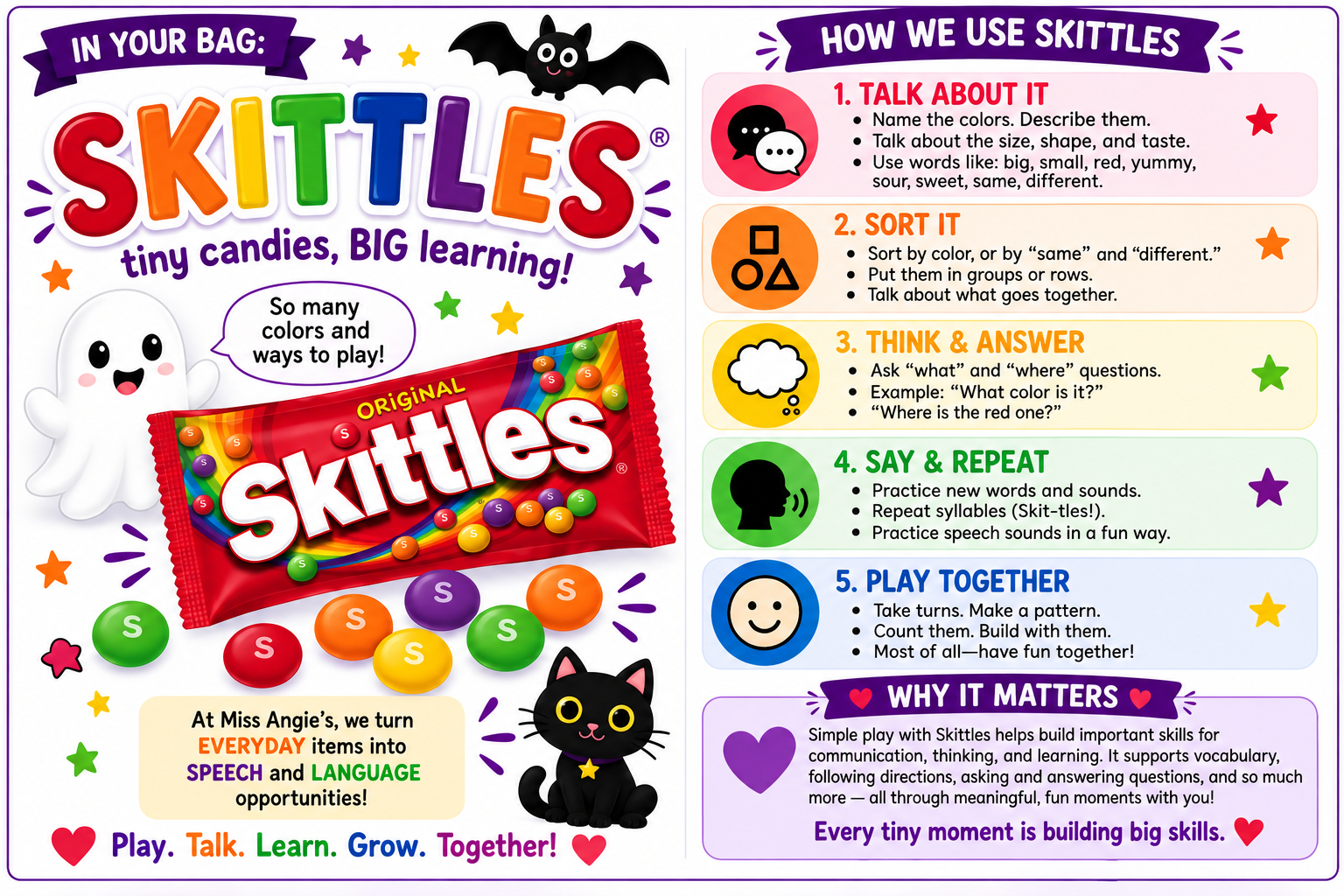
🌈 Skittles
COMMUNICATE: Model color words along with more, want, eat, same, different
IMITATE: Copy simple actions such as sort, roll, line up or put in
TAKE TURNS: Take turns choosing colors, rolling a Skittle or adding one to a group
AAC: Model WANT, MORE, COLOR, LIKE, DON’T LIKE, FINISHED as they naturally come up
CONNECT: Let your child choose what to do with them and join what they are already doing
REGULATE: Eating or tasting is never required. Your child can explore the candy in whatever way is comfortable for them
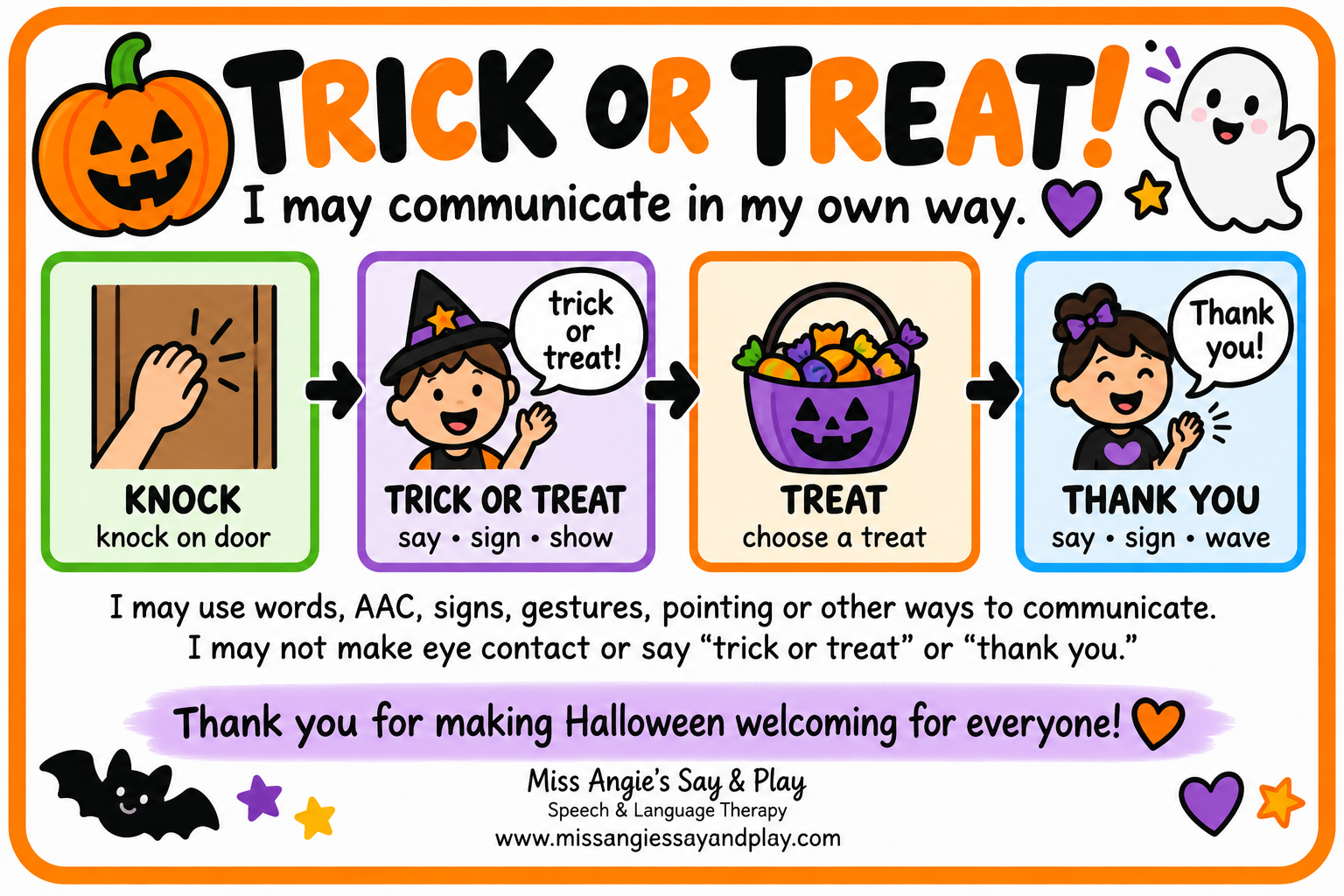
Halloween Communication Card 🎃💜
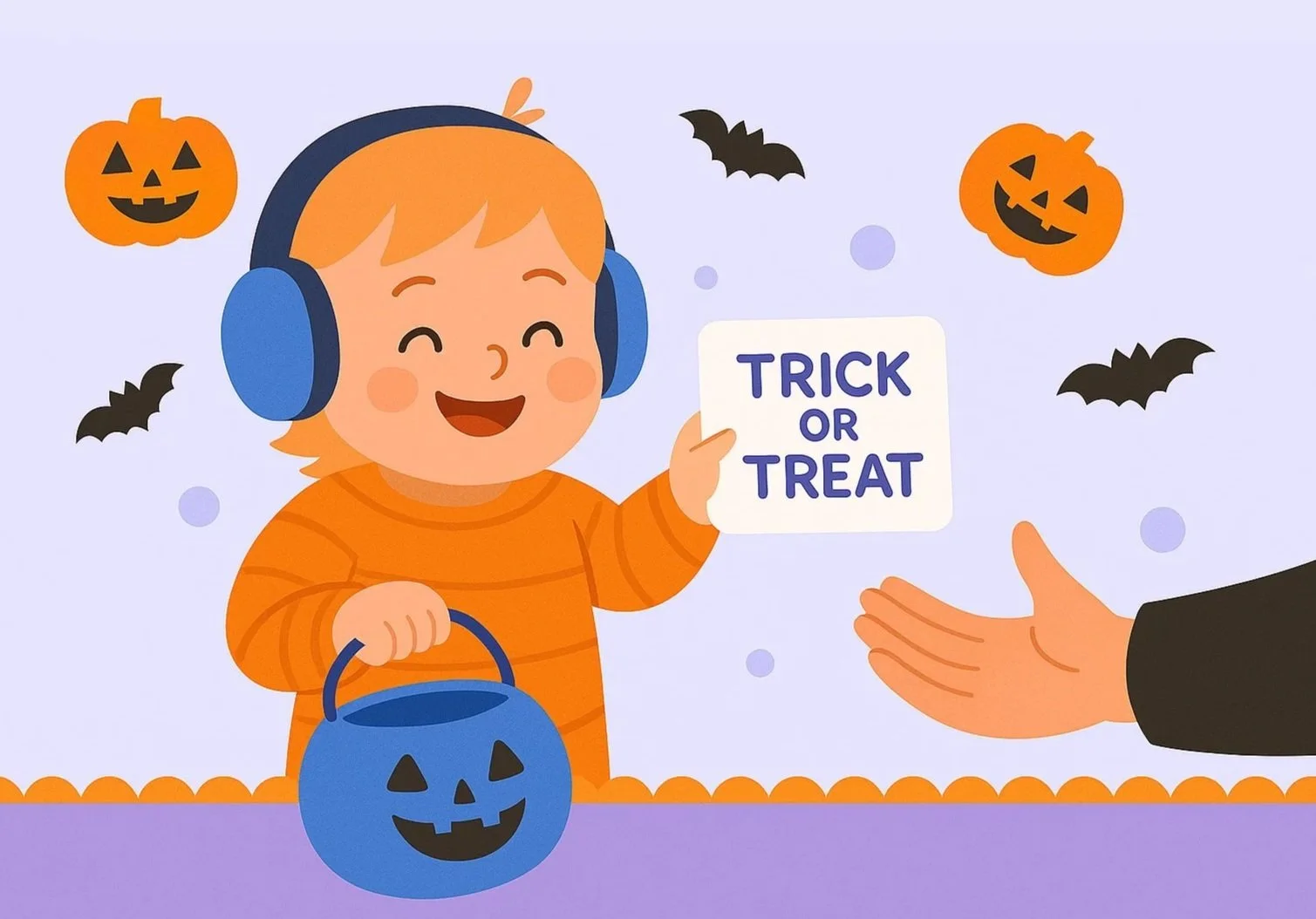
This card is completely optional and can be used in whatever way works best for your child. Your child can wear it, carry it or hand it to the person at the door. You can also hold it for them.
There is no need for your child to say “trick or treat,” say “thank you” or make eye contact. The card can help communicate for them while also providing a simple visual sequence for what happens at the door.
💜 Remember
You do not need to use every idea or turn every toy into a therapy activity.
If your child wants to watch the Slinky fall again and again — join them.
If they want you to blow bubbles but never say more — notice how they do tell you they want more.
If they use AAC, signs or gestures — model communication without requiring them to copy you.
If the fidget is helping them regulate — let it simply be a fidget.
Follow their lead. Join their play. Model communication. Pause. Notice. Respond.
Sometimes the most meaningful communication happens when we stop trying to make it happen and simply create a reason to connect.
🎃 Trick-or-Treating Doesn’t Have to Look One Way
Halloween can be exciting, fun — and sometimes overwhelming. Costumes, unfamiliar decorations, doorbells, crowds, flashing lights, new smells and changes in routine can be a lot to take in.
A successful Halloween does not have to look the same for every child.
Your child may:
Wear a full costume, part of a costume, comfortable clothes — or no costume at all.
Say “trick or treat,” use AAC, sign, gesture, hold out a bag, reach, point — or simply approach with you.
Say “thank you,” wave, smile or communicate appreciation in another way.
Look at the person handing out candy — or not make eye contact at all.
Wear headphones or other sensory supports.
Stay close to you rather than approaching a door independently.
Need extra time to approach a house, choose a treat or move on.
Enjoy three houses and be completely finished — while another child may want to visit the whole neighborhood.
Decide that trick-or-treating isn't enjoyable and celebrate Halloween another way.
💜 Make Halloween Work for Your Child
Practice ahead of time. Walk through what will happen, practice knocking on your own door or use pictures or a simple visual sequence such as walk → knock → treat → next house.
Bring familiar supports. AAC, headphones, a favorite fidget or comfort item can come along.
Follow your child’s cues. Moving away, covering their ears, becoming unusually quiet, dropping to the ground, seeking repetitive movement or trying to leave may be ways of communicating “I need a break” or “I’m done.”
Build in breaks. A few quiet minutes in the stroller, wagon, car or at home may help your child regulate before deciding whether to continue.
Skip what doesn’t work. Your child does not have to tolerate a scary decoration, crowded porch or loud house just because everyone else is going there.
🍬 Communication Counts — However It Happens
There is no requirement to say “trick or treat” to participate in Halloween.
Speech, AAC, signs, gestures, pointing, reaching, eye gaze, holding out a treat bag — or having a caregiver communicate for them — can all be part of participating.
And there is no need to require eye contact before giving a child a treat.
🎃 The Goal?
Not the perfect costume.
Not the perfect “trick or treat.”
Not the number of houses visited.
The goal is for your child to participate in Halloween in a way that feels safe, comfortable and enjoyable for them.
Sometimes the best Halloween memory is simply knowing when your child has had enough. 💜
👻 Practice Through Play
New experiences can feel easier when children have opportunities to explore them before they happen. Halloween is perfect for practicing through play — without expecting your child to perform.
Try Pretend Trick-or-Treating at Home
Use a bedroom or bathroom door and practice:
Walk to the door → Knock → Door opens → Get a treat → Put it in the bag → Move on
Your child can practice whichever parts they enjoy. They do not need to say “trick or treat” or “thank you.”
🎃 Let the Toys Do It
Have a favorite stuffed animal, doll or character go trick-or-treating first.
“Bear knocks!”
“Door opens!”
“Bear gets candy!”
“Bye-bye!”
Watching a familiar toy experience the routine can introduce what might happen without placing demands on your child.
🗣️ Practice Different Ways to Communicate
Before Halloween, explore ways your child might communicate at the door:
Speech • AAC • Sign • Gesture • Point • Reach • Hold out their bag
You can also model simple messages such as TRICK OR TREAT, CANDY, WANT, THANK YOU, MORE, NO, and ALL DONE using your child’s usual communication system.
💜 Keep Practice Playful
Your child doesn't have to master the routine before Halloween.
Practice is about making the experience more familiar — not teaching your child that there is only one “correct” way to participate.
Thanks for Connecting, Communicating & Playing with Me! 🎃💜
I hope these ideas help you and your child enjoy the Halloween goodies in a way that works for your child.
Communication doesn’t have to look or sound one particular way. A look, gesture, movement, sign, AAC message, sound or spoken word can all be meaningful ways to connect.
You don’t need special therapy materials — or a perfectly planned activity — to support communication. Sometimes a Slinky, some bubbles, a favorite fidget, a few pieces of candy and a shared moment together are all you need.
Follow their lead. Notice what they communicate. Join in the fun.
Happy Halloween! 🎃💜
Miss Angie
Have Questions About Your Child’s Communication?
Every child develops differently. If you have questions about your child's speech, language or communication development, I'm happy to help you determine whether a speech and language screening may be appropriate.

Looking for more speech & language tips, developmental information and ways to support communication at home?