
Welcome to Miss Angie's Toy Box!
Toys that inspire play, learning, and communication—at every age!
Parents frequently ask me which toys I recommend to help their children develop speech and language skills.
As a speech-language pathologist, I use play-based activities every day to encourage communication, language development, and learning.
Here, you'll find some of my favorite toys, books, and games, organized by age, along with practical ways to use them to encourage your child's development.
Each recommendation includes ideas for building receptive and expressive language, speech sound production, attention, play skills, and other developmental abilities, when appropriate.
Whether you're shopping for a holiday, birthday, or simply looking for new ways to play, I hope you'll find something useful!
Remember: It's not just the toy—it's how you use it!
— Miss Angie, MS, CCC-SLP
As an Amazon Associate I earn from qualifying purchases. Some links on this page are affiliate links, which means I may earn a small commission at no additional cost to you.
🌱 Look for the Leaf!
When you see the 🌱 Grow With Me! symbol next to a toy, it means that toy offers opportunities for learning and communication across multiple developmental stages.
As your child grows, look for new ways to use familiar toys to encourage speech, language, play, and social interaction.
Same toy, new skills!
Explore Toys by Age
Birth–6 Months: Discovering the World
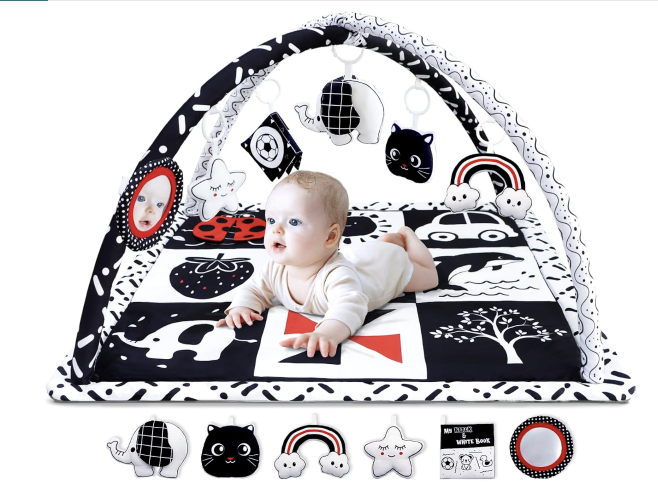
🌱 Black & White Baby Activity Gym
-
Did You Know? Why Black and White?
Newborn babies don't see the world the same way we do! At birth, their vision is still developing. Babies see best at approximately 8–12 inches from their faces, and their ability to distinguish colors is limited.
High-contrast patterns, especially black and white, are easier for newborns to notice than soft pastels or subtle color combinations. As babies grow, their color vision, ability to focus, and visual tracking skills gradually improve.
That's why black-and-white activity gyms are wonderful for newborns! The bold patterns encourage visual attention, while the hanging toys provide opportunities for looking, reaching, and exploring.
But here's the most important part: Your baby learns communication through YOU!
A toy may capture your baby's attention, but your face, voice, and interactions help build the foundations for speech and language development.
💜 Let's Play! (Birth–3 Months)
1. Look at That! — Visual Attention
Position your baby comfortably beneath the activity gym while they are awake and supervised. Allow time to look at the contrasting patterns.
Move a removable toy slowly within your baby's field of vision, watching for attempts to follow it with their eyes.
Try saying:
"Look!"
"I see it!"
"There it is!"
"Wow!"
2. Let's Talk! — Early Vocalizations
Position your face close to your baby's face so they can see your expressions.
Talk using a warm, animated voice. When your baby coos or makes a sound, imitate it and pause.
Try saying:
"Oooo!"
"Ahhhh!"
"You said ooo!"
"My turn! Your turn!"
These early vocal exchanges help establish the foundations of conversational turn-taking.
3. Hello, Baby! — Social Interaction
Smile, make gentle facial expressions, and talk to your baby while they explore the gym.
Pause occasionally and watch for responses such as eye contact, movements, smiles, or vocalizations.
Remember, communication begins long before a baby says their first word!
💜 Let's Play! (3–6 Months)
1. Reach for It! — Attention & Exploration
Encourage your baby to look toward and reach for the hanging toys.
As your baby explores, describe what is happening.
Try saying:
"Reach!"
"You got it!"
"Shake, shake, shake!"
"It moves!"
2. Ready, Set, Go! — Anticipation
Gently move a removable toy to capture your baby's attention.
Say, "Ready … set … GO!" and move the toy.
Repeat the routine, adding a pause before "GO!" Watch for your baby's excitement, movement, or vocal response.
These playful routines help babies begin recognizing familiar language patterns.
3. Copycat Sounds — Vocal Turn-Taking
Listen for your baby's coos, squeals, and early babbling sounds.
Imitate their sounds, then pause to give them an opportunity to respond.
Try adding playful sounds such as:
"Oooo!"
"Ahhh!"
"Baaa!"
"Mmmm!"
Your baby doesn't need to imitate you perfectly. The goal is to enjoy back-and-forth communication!
🌱 Grow With Me! (6–12 Months)
Don't put that activity gym away just yet!
As your baby grows, you can use its removable toys to encourage new communication skills.
Try these activities:
Where Is It? Hide a removable toy partially beneath a cloth and encourage your baby to find it.
Give It to Me! Practice simple exchanges using words such as "give," "take," and "more."
Bang, Shake, Drop! Demonstrate actions while modeling simple words and fun sound effects.
Name That Toy! Repeatedly label familiar objects as your baby looks at, reaches for, or explores them.
As your baby becomes more mobile, use the removable toys for supervised floor play rather than relying on the overhead gym.
Continue exploring ways to play in our 6–12 Months Toy Box!
💜 Miss Angie's Reminder
It's not just the toy—it's how you use it!
You don't need expensive toys or complicated activities to encourage communication. A few minutes of playful interaction, talking, smiling, and responding to your baby's sounds can make everyday playtime a meaningful learning experience.
Safety Note: Always follow the manufacturer's age and safety instructions. Use the activity gym only during supervised, awake play. Remove hanging components when directed by the manufacturer or when your baby begins pushing up on hands and knees. Keep toys and activity gyms out of your baby's sleep space.
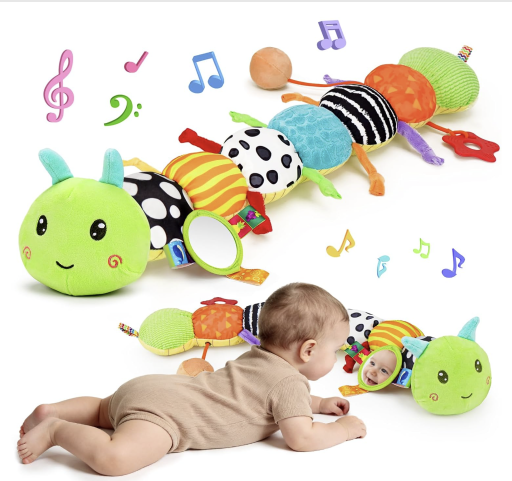
Musical Stuffed Caterpillar New Born Tummy Time Toys
-
Musical Sensory Caterpillar
💜 Why Miss Angie Loves It!
Did You Know? Babies Learn Through Their Senses!
Long before babies begin talking, they're learning about the world through looking, listening, touching, and moving.
This colorful caterpillar offers several sensory experiences, including crinkly textures, rattling sounds, a mirror, and musical features.
Each feature creates opportunities for parents to encourage early communication through playful interaction.
Why is this important for speech and language development?
When babies hear a sound, look toward an object, or react to something interesting, caregivers can respond with words, facial expressions, and playful sounds.
These simple exchanges help develop attention, listening, anticipation, and the foundations of conversational turn-taking.
💜 Let's Play! (Birth–3 Months)
1. What's That Sound? — Auditory Attention
Gently shake the caterpillar's rattle or activate its musical feature at a comfortable volume.
Pause and watch for your baby's response.
Try saying:
"Listen!"
"Shake, shake!"
"Did you hear that?"
"More?"
Give your baby time to respond through eye movements, facial expressions, or body movements.
2. Crinkle, Crinkle! — Sensory Exploration
Gently crinkle the caterpillar near your baby while they are awake and alert.
Allow your baby to look toward the sound and explore the texture with your help.
Try saying:
"Crinkle, crinkle!"
"I hear it!"
"Touch!"
"So soft!"
3. Hello, Baby! — Social Interaction
Position the baby-safe mirror where your baby can comfortably see it.
Smile and talk to your baby while pointing toward the reflection.
Try saying:
"Hello!"
"There's baby!"
"Hi, baby!"
"I see you!"
At this age, the goal is visual attention and social interaction, not recognizing themselves.
💜 Let's Play! (3–6 Months)
1. Reach for Me! — Visual Attention & Exploration
Place the caterpillar within your baby's view during supervised floor play or tummy time.
Encourage your baby to look toward and reach for different parts of the toy.
Try saying:
"Reach!"
"You got it!"
"Touch the caterpillar!"
"Wow!"
2. Ready, Set, Go! — Anticipation & Early Language
Create a predictable routine by gently shaking the caterpillar after saying:
"Ready … set … GO!"
Pause before "GO!" and watch for your baby's anticipation, movement, or vocalization.
Repeat the activity several times.
Predictable routines help babies become familiar with language patterns and develop early communication expectations.
3. Let's Make Sounds! — Vocal Play
Use the caterpillar's different sounds to encourage playful vocal exchanges.
Try saying:
"Oooo!"
"Ahhhh!"
"Bzzz!"
"La, la, la!"
When your baby coos or squeals, imitate their sound and wait for another response.
4. Tummy Time Talk — Early Interaction
Place the caterpillar where your baby can comfortably see it during supervised tummy time.
Move it slowly or activate a gentle sound to encourage attention.
Talk about what your baby is doing:
"Look up!"
"You found it!"
"There's the caterpillar!"
"You did it!"
Keep tummy time positive, brief when needed, and responsive to your baby's comfort.
🌱 Grow With Me! (6–12 Months)
As your baby becomes more mobile and begins exploring toys independently, the caterpillar can support new communication skills.
Try these activities:
Find the Sound! Make a rattling or crinkling sound and encourage your baby to locate its source.
My Turn, Your Turn! Take turns shaking or crinkling the caterpillar.
Where's the Caterpillar? Partially hide the toy beneath a cloth and encourage your baby to find it.
Action Words! Model simple words such as "shake," "touch," "go," "stop," and "more."
Copy My Sounds! Pair actions with playful sounds such as "shhh," "bzzz," and "ooo."
As your baby grows, use fewer words at a time and repeat familiar sounds and phrases during play.
Continue exploring ways to play in our 6–12 Months Toy Box!
💜 Miss Angie's Reminder
It's not just the toy—it's how you use it!
Your baby doesn't need to activate every feature or play with the caterpillar independently. The greatest learning opportunities happen when you join in, describe what's happening, and respond to your baby's attempts to communicate.
Safety Note: Always supervise play, follow the manufacturer's age recommendations, check that all components are securely attached, and keep the toy out of your baby's sleep space. Use musical features at a gentle volume and avoid placing sounds close to your baby's ears.
Infant Rattles and Teething Toys/Senory
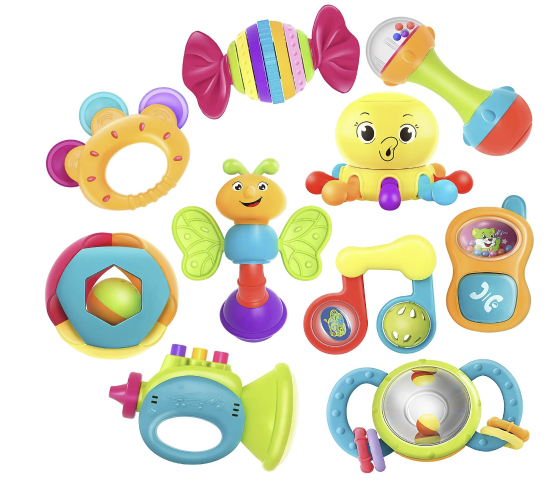
-
Did You Know? Babies Explore the World With Their Mouths!
I love rattles and teethers because they encourage so many important developmental skills through simple, everyday play!
As babies begin reaching, grasping, shaking, and bringing objects to their mouths, they're learning about their bodies and the world around them.
Cause and Effect: When babies shake a rattle and hear a sound, they begin discovering that their actions can make something happen. This understanding helps lay the foundation for intentional communication.
Oral Sensory Exploration: Babies naturally explore safe objects with their mouths. Different shapes and textures provide sensory experiences as they develop awareness and coordination of their lips, tongue, and jaw. This exploration is part of normal development, although chewing on toys does not directly teach speech sounds.
Fine Motor Development: Grasping, holding, and transferring toys between hands supports coordination and purposeful exploration.
Early Communication: Each shake, smile, squeal, or movement gives parents an opportunity to model language, respond to their baby, and encourage back-and-forth interaction.
What I especially love: One set provides several opportunities for sensory exploration, motor development, and language-rich play as your baby grows!
💜 Let's Play! (Birth–3 Months)
1. Listen! — Auditory Attention
Gently shake a rattle within your baby's hearing range.
Pause and observe whether your baby becomes still, moves, or looks toward the sound.
Try saying:
"Listen!"
"Shake, shake!"
"I hear it!"
"There it is!"
2. Look at That! — Visual Attention
Hold a colorful rattle approximately 8–12 inches from your baby's face.
Slowly move it from side to side, giving your baby time to look toward or follow it.
Try saying:
"Look!"
"Here it comes!"
"There it goes!"
3. My Turn, Your Turn! — Early Interaction
Shake the rattle, pause, and wait for your baby's response.
If your baby coos, imitate the sound.
Your baby's response might be a movement, facial expression, or vocalization. All are opportunities for interaction!
💜 Let's Play! (3–6 Months)
1. Shake, Shake, Shake! — Cause and Effect
Place an easy-to-grasp rattle in your baby's hand when developmentally ready.
Allow your baby to explore how movement produces sound.
Try saying:
"Shake!"
"You did it!"
"Shake, shake, shake!"
"Stop!"
2. Mouth, Touch, Explore! — Oral Sensory Development
Offer an age-appropriate teether and allow your baby to explore it independently while supervised.
Describe what your baby is doing:
"You found it!"
"In your mouth!"
"Bumpy!"
"Soft!"
Follow your baby's lead rather than directing how they should mouth or chew the toy.
3. Ready, Set, Go! — Anticipation
Hold the rattle and say:
"Ready … set … GO!"
Shake it on "GO!" and pause before repeating.
Watch for smiles, excitement, movements, or vocalizations as your baby begins anticipating the familiar routine.
4. Copycat Sounds — Vocal Turn-Taking
Shake the rattle and make a playful sound such as "ooo!" or "ahh!"
Pause and listen for your baby's response.
Imitate any coos or squeals to keep the interaction going.
🌱 Grow With Me! (6–12 Months)
As your baby develops more purposeful movements, these rattles and teethers can be used in new ways!
Give and Take: Encourage simple exchanges using "give," "take," and "thank you."
Where's the Rattle? Partially hide a rattle beneath a cloth and encourage your baby to find it.
Shake and Stop: Model "go" and "stop" while shaking a rattle.
Choose One! Present two different rattles and let your baby reach for the one they prefer.
My Turn, Your Turn: Practice simple back-and-forth exchanges with a favorite rattle.
Continue exploring ways to play in our 6–12 Months Toy Box!
💜 Miss Angie's Reminder
It's not just the toy—it's how you use it!
You don't need to teach your baby how to play perfectly. Follow their interests, respond to their movements and sounds, and turn everyday exploration into opportunities for connection and communication.
Safety Note: Follow the manufacturer's age recommendations for each item. Inspect rattles and teethers regularly for damage or loose parts, clean them according to instructions, and always supervise mouthing and play. Never attach toys around a baby's neck or place them in a sleep space.
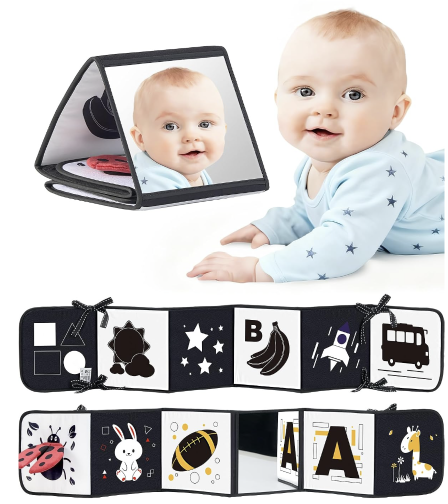
🌱High Contrast Black & White Mirror & Baby Book
-
Did You Know? Babies Love Faces!
During the first few months of life, babies are naturally drawn to faces and high-contrast patterns. Because their vision is still developing, bold black-and-white pictures are easier to notice than subtle colors.
A baby-safe mirror adds another wonderful opportunity for exploration! Babies are fascinated by faces, including their own reflections, even though they don't yet recognize themselves in the mirror.
This simple toy encourages visual attention, early social interaction, and the foundations of communication.
Remember: Your face is even more important than the pictures! Sit beside your baby, smile, talk, and respond to their sounds.
💜 Let's Play! (Birth–3 Months)
1. Look at That! — Visual Attention
Place the book approximately 8–12 inches from your baby's face during supervised, awake play. Give your baby time to look at the contrasting patterns.
Slowly shift the book from one position to another and watch whether your baby follows it.
Try saying:
"Look!"
"I see you!"
"There it is!"
"Wow!"
2. Hello, Baby! — Face-to-Face Interaction
Position yourself beside the mirror so your baby can see your face and reflection.
Smile, raise your eyebrows, and make playful expressions.
Try saying:
"Hello!"
"There's baby!"
"I see you!"
"Big smile!"
Pause and watch for your baby's responses, such as eye movements, changes in expression, or little sounds.
3. Let's Talk! — Early Vocalizations
As your baby looks at the pictures, make gentle, playful sounds.
Try "oooo," "ahhh," and "mmmm."
If your baby coos, imitate the sound and pause to give them another turn.
These early vocal exchanges help build the foundation for conversational turn-taking.
💜 Let's Play! (3–6 Months)
1. Who's That? — Social Interaction
Place the mirror where your baby can comfortably see it during supervised tummy time.
Point toward the reflection and say:
"Who's that?"
"It's baby!"
"Hi, baby!"
"Peekaboo!"
Watch for smiles, excitement, and vocalizations.
2. Look, Look! — Visual Tracking & Language
Slowly move the book within your baby's visual field, allowing time to follow the pictures.
Use simple, repetitive words:
"Look up!"
"Look down!"
"Here it is!"
"You found it!"
3. My Turn, Your Turn! — Early Communication
Sit facing your baby with the mirror nearby.
Make a playful sound, pause, and wait for your baby's response.
Imitate any coos, squeals, or early babbling sounds.
The goal isn't perfect imitation. It's helping your baby discover that communication goes back and forth!
🌱 Grow With Me! (6–12 Months)
This toy can continue supporting development as your baby grows!
Try these activities:
Peekaboo! Cover and uncover your face while saying "Where's Mommy?" or "Peekaboo!"
Where's Baby? Point to your baby's reflection and say their name.
Find the Picture! Label familiar pictures and encourage your baby to look toward or touch them.
Turn the Page! Help your baby participate in turning pages while saying "turn," "more," and "again."
Copy Me! Make simple facial expressions and playful sounds, encouraging back-and-forth interaction.
Continue exploring ways to play in our 6–12 Months Toy Box!
💜 Miss Angie's Reminder
It's not just the toy—it's how you use it!
You don't need to read every page or teach your baby to identify pictures. At this age, sharing smiles, sounds, and attention is what makes the experience meaningful.
Safety Note: Use only baby-safe, shatter-resistant mirrors and age-appropriate books. Always supervise play, follow the manufacturer's instructions, and keep these items out of your baby's sleep space.
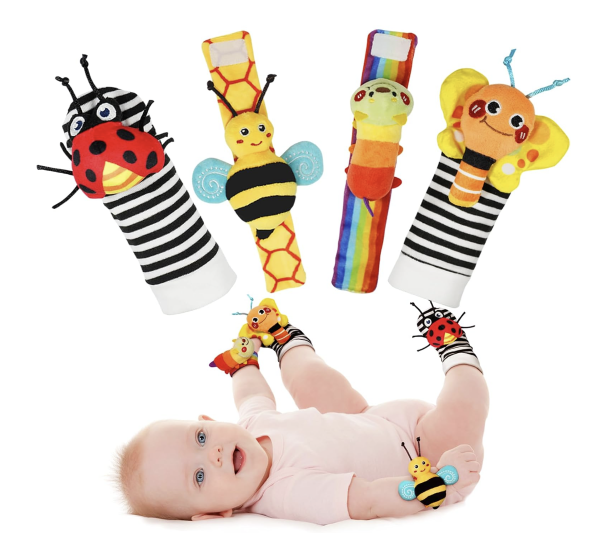
Wrist Rattles and Foot Finder Socks
-
Did You Know? Babies Learn Through Movement!
These adorable wrist rattles and foot finder socks are among my favorite toys for encouraging early development!
Babies are naturally curious about their hands and feet. As they begin moving their arms and legs, they discover that their movements can create sounds and interesting sensations.
The colorful garden bug characters, gentle rattling sounds, and soft crinkly textures encourage babies to look, listen, reach, kick, and explore.
But what does this have to do with speech and language?
Everything starts with interaction!
When a baby kicks and hears a rattle, they're beginning to discover cause and effect—"When I move, something happens!"
Parents can build on these discoveries by narrating their baby's movements, imitating sounds, and creating playful back-and-forth exchanges.
Try saying:
"Kick, kick, kick!"
"Shake, shake!"
"You did it!"
"I hear you!"
"Go, baby, go!"
These simple, repetitive phrases help babies become familiar with language while developing attention, listening, and early communication skills.
What I especially love: These toys encourage babies to explore their own movements while giving parents countless opportunities to talk, smile, respond, and celebrate those little discoveries.
Remember: It's not just the toy—it's how you use it!

🌱Sandra Boynton’s Big Blue Box Set
-
Did You Know? It's NEVER Too Early to Read to Your Baby!
Although these books are marketed for children ages 1–3, I love introducing books from birth! Babies don't need to understand the words or follow the story to benefit from being read to.
Reading together exposes babies to the rhythm and melody of language, familiar voices, facial expressions, and the back-and-forth interactions that form the foundation for communication.
Sandra Boynton's books are some of my favorites because they feature colorful, engaging illustrations, simple language, repetition, and playful sounds.
One of my absolute favorites is Moo, Baa, La La La!
The limited text and animal sounds make it especially useful for encouraging early listening, vocal play, and eventually sound imitation.
What I especially love: You don't have to read every word on every page! You can point to a picture, make an animal sound, pause, smile, and wait for your baby's response.
Reading should be an enjoyable interaction, not a task to complete.
💜 Let's Read! (Birth–3 Months)
1. Listen to My Voice! — Early Language Exposure
Hold your baby comfortably and read using a warm, animated voice.
Don't worry about finishing the book. Even a few pages provide opportunities for language exposure and bonding.
Try:
Changing your voice for different animals.
Emphasizing familiar sounds such as "moo" and "baa."
Pausing between phrases.
Smiling and making eye contact with your baby.
2. Look at That! — Visual Attention
Hold the book where your baby can comfortably see the illustrations.
Point to one picture at a time and label it.
Try saying:
"Look!"
"Cow!"
"Moooo!"
"Hi, cow!"
Give your baby time to look at the picture before turning the page.
3. Let's Make Sounds! — Early Vocalizations
When reading Moo, Baa, La La La!, exaggerate the animal sounds.
Pause after a sound and listen for your baby's response.
Your baby may coo, move, smile, or simply look toward your face.
Respond as though you're having a conversation!
💜 Let's Read! (3–6 Months)
1. Moo! Baa! — Vocal Play
Use the animal illustrations to model simple, playful sounds.
Try:
"Moooo!"
"Baaaa!"
"La, la, la!"
"Ooooo!"
Pause after each sound and give your baby an opportunity to vocalize.
If your baby makes a sound, imitate it and continue the interaction.
2. Look at the Cow! — Early Joint Attention Foundations
Point to a picture using your index finger.
Say, "Look! A cow!"
Pause and allow your baby time to look toward the picture.
This introduces an important early communication skill: learning to attend to something another person is showing them.
3. What's Next? — Anticipation
Read a familiar page using the same playful voice each time.
Pause before a favorite sound.
For example:
"The cow says …"
Pause, smile, and then enthusiastically say, "MOO!"
Over time, your baby may begin showing anticipation through smiles, movements, or vocalizations.
4. Turn the Page! — Participation
As your baby begins reaching and exploring objects, allow them to touch the book or help turn a sturdy page.
Model simple words:
"Turn!"
"More!"
"Again!"
"All done!"
Remember, babies may want to touch or mouth books. That's a normal part of exploration!
🌱 Grow With Me! (6–12 Months and Beyond)
These books become even more valuable as your child's communication skills develop!
6–12 Months:
Where's the Cow? Point to or name a familiar animal and watch whether your baby looks toward it.
Copy My Sound! Model "moo," "baa," and other playful sounds.
Point and Look! Use a distal point—pointing toward a picture from a distance—to encourage your baby to follow your gesture.
Turn the Page! Encourage participation with "turn," "more," and "again."
12–18 Months:
What's That? Encourage pointing, gestures, animal sounds, or early words.
Finish My Sound! Pause during a familiar phrase and give your child an opportunity to participate.
Find the Animal! Ask your child to locate familiar animals in the illustrations.
18–36 Months:
Name That Animal! Encourage animal names and sounds.
Let's Make a Sentence! Expand "cow" into "The cow says moo!"
Silly Sounds! Encourage playful imitation and participation in repeated phrases.
Continue exploring ways to read and play in our older age-group Toy Boxes!
💜 Miss Angie's Reminder
You don't have to read every word to make reading meaningful!
Follow your baby's interests. Point to pictures, make silly sounds, pause, and respond to their attempts to communicate.
And don't worry if your baby only attends for a minute or two. Short, enjoyable reading experiences are much more valuable than trying to finish a book when your baby has lost interest.
Remember: It's not just the book—it's how you share it!
Safety Note: Choose sturdy, age-appropriate books, supervise babies who are mouthing or handling books, and keep books out of the sleep space.

🌱Sandra Boynton’s Big Yellow Box Set
-
Did You Know? Reading Begins Long Before Talking!
I absolutely love Sandra Boynton's books! Her playful illustrations, rhythmic language, repetition, and humor make them wonderful for introducing babies to books.
Although these books are marketed for older babies and toddlers, it's NEVER too early to read to your child!
What makes this collection special is that each book offers different opportunities for language development:
The Going to Bed Book: Familiar routines, action words, and early sequencing.
Horns to Toes: Body-part vocabulary, movement, and imitation.
Opposites: Introducing descriptive language through contrasting concepts.
But Not the Hippopotamus: Repetition, anticipation, social interaction, and eventually participation in familiar phrases.
What I especially love: These books grow with your child! What begins as listening to your voice can eventually become pointing, identifying pictures, completing familiar phrases, and answering questions.
💜 Let's Read! (Birth–3 Months)
1. Listen to My Voice! — Early Language Exposure
Hold your baby comfortably and read using a warm, expressive voice.
Babies love hearing familiar voices! The rhythm and melody of your speech help introduce them to the patterns of language.
Try:
Reading slowly with exaggerated expression.
Changing your pitch and intonation.
Pausing to observe your baby's reactions.
Responding to coos, movements, and facial expressions.
2. Look at That! — Visual Attention
Hold the book approximately 8–12 inches from your baby's face.
Point to a large illustration and give your baby time to look.
Try saying:
"Look!"
"Hi, hippo!"
"There's a bear!"
"Wow!"
You don't need to read every word. Sometimes one picture and a few playful sounds are enough!
💜 Let's Read! (3–6 Months)
1. Head, Hands, Toes! — Body Awareness
Using Horns to Toes, gently touch or identify your baby's body parts as you look at the illustrations.
Try saying:
"Here's your nose!"
"Where are your toes?"
"Little hands!"
"Wiggle, wiggle!"
Pairing words with gentle movements helps babies experience language through multiple senses.
2. Time for Bed! — Familiar Routines
Use The Going to Bed Book to introduce simple vocabulary associated with everyday routines.
Try saying:
"Bath time!"
"Wash, wash!"
"Night-night!"
"Sleepy baby!"
Use these same words during your baby's actual routines to help connect language with familiar experiences.
3. What's Next? — Anticipation
Read a favorite page from But Not the Hippopotamus using an animated voice.
Pause at a familiar moment, smile, and watch for your baby's reaction.
Your baby may respond by looking, moving, smiling, or vocalizing.
These early interactions introduce the back-and-forth nature of communication.
4. My Turn, Your Turn! — Vocal Play
After reading a short phrase, pause and listen.
If your baby coos or squeals, imitate the sound!
Try:
"Oooo!"
"Ahhh!"
"Mmmm!"
"Yay!"
The goal isn't to get your baby to repeat words. It's to encourage enjoyable vocal exchanges.
🌱 Grow With Me! (6–12 Months and Beyond)
6–12 Months:
Point and Look! Use a distal point to encourage your baby to follow your gesture toward a picture.
Find the Baby's Toes! Pair body-part labels with gestures.
Turn the Page! Encourage participation using "turn," "more," and "again."
What's Next? Pause during familiar routines and watch for anticipation.
12–18 Months:
Where's Your Nose? Encourage identifying familiar body parts.
Find the Hippo! Ask your child to locate a familiar character.
Copy My Actions! Model waving, clapping, and other simple movements.
Finish My Phrase! Pause and allow your child to participate with a sound, gesture, or word.
18–36 Months:
Opposites! Explore concepts such as big/little, up/down, and fast/slow.
Tell Me What Happened! Talk about familiar events in the story.
What's Missing? Encourage your child to notice and describe details.
Let's Make a Sentence! Expand single words into short phrases and sentences.
💜 Miss Angie's Reminder
Reading isn't about finishing the book. It's about sharing the experience!
Follow your child's interests, point to pictures, make silly sounds, and pause to encourage participation.
You may read the same book dozens of times—and that's wonderful! Repetition helps children become familiar with language and eventually participate more independently.
Remember: It's not just the book—it's how you share it!
Safety Note: Supervise young babies when handling or mouthing books, and keep books out of their sleep space.
6–12 Months: Exploring & Interacting
🌱 Baby Crawly Toy with Lights and Music
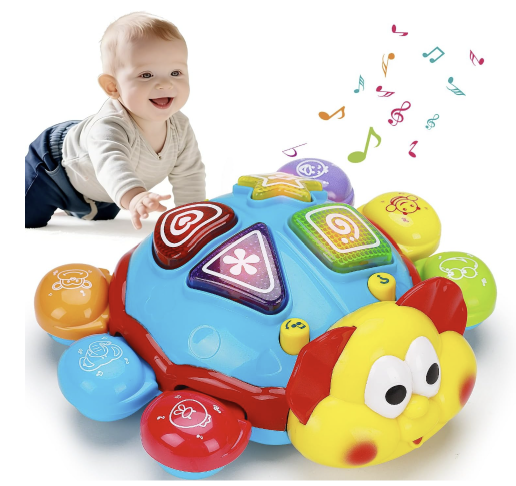
-
Did You Know? Movement and Communication Go Hand in Hand!
I love toys that encourage babies to become active participants in play rather than simply watching something happen!
This colorful musical ladybug moves, lights up, plays music, and offers interactive buttons with sounds and early learning activities.
But what makes it especially valuable is how parents can use these features to encourage communication!
Cause and Effect: Babies begin discovering that pressing a button can make something happen. This understanding helps lay the foundation for intentional communication.
Visual Tracking and Attention: Watching the ladybug move encourages babies to follow objects with their eyes and shift their attention.
Anticipation: Predictable routines such as "Ready, set, GO!" help babies begin anticipating what happens next.
Receptive Language: Parents can introduce simple action words such as "go," "stop," "push," "come," and "again."
Early Expressive Communication: Reaching, gestures, vocalizations, and eventually words can all become meaningful ways to request another turn.
What I especially love: The toy provides the excitement, but the caregiver provides the language!
💜 Let's Play! (6–12 Months)
1. Ready, Set, GO! — Anticipation
Place the ladybug on the floor where your baby can comfortably see it.
Say:
"Ready … set … GO!"
Activate the toy on "GO!"
Repeat the activity, pausing before activating it again.
Watch for your baby's excitement, movement, eye contact, or vocalizations.
2. Stop and Go! — Early Receptive Language
As the ladybug moves, say:
"Go, go, go!"
"Stop!"
"Here it comes!"
"There it goes!"
Pause the movement when possible and repeat the words during play.
3. Push the Button! — Cause and Effect
Help your baby discover that pressing a button activates a sound, light, or musical response.
Model simple language:
"Push!"
"You did it!"
"Music!"
"Again!"
Give your baby opportunities to explore independently when developmentally ready.
4. Where Did It Go? — Visual Attention
Watch the ladybug move across the floor.
Point toward it and say:
"Look!"
"Where did it go?"
"There it is!"
"Come back!"
Encourage your baby to follow your pointing gesture and locate the toy.
5. More, Please! — Early Requests
After the ladybug stops, pause before restarting it.
Watch for your baby's attempt to request another turn through reaching, looking, movement, or vocalization.
Model:
"More?"
"Again?"
"Go!"
"More ladybug!"
Respond to your baby's communication attempt without requiring a word or sign.
🌱 Grow With Me! (12–18 Months)
As your baby becomes more mobile and begins using gestures and first words, try:
Go and Stop: Encourage your child to use a gesture, sound, or word to start the ladybug.
Find the Ladybug: Ask "Where's the ladybug?" and encourage pointing.
Follow Me! Encourage movement toward the toy in a safe, open play area.
My Turn, Your Turn: Take turns activating the buttons.
Animal Sounds: Use the toy's animal-sound features to encourage listening and playful imitation.
🌱 Grow With Me! (18–24 Months)
Action Words: Model "go," "stop," "turn," "push," and "come."
Two-Word Combinations: Encourage phrases such as "bug go," "more music," and "push button."
Following Directions: Practice simple directions such as "Push the button" or "Find the bug."
Where Is It? Introduce location words such as "under," "behind," and "next to" during play.
💜 Miss Angie's Reminder
The toy may light up and make sounds, but YOU make the interaction meaningful!
Pause the music occasionally, talk about what's happening, and give your child opportunities to communicate.
Remember: It's not just the toy—it's how you use it!
Safety Note: Follow the manufacturer's stated age recommendation, supervise play, keep the volume comfortable, and use the toy on a safe floor surface away from stairs or other hazards.
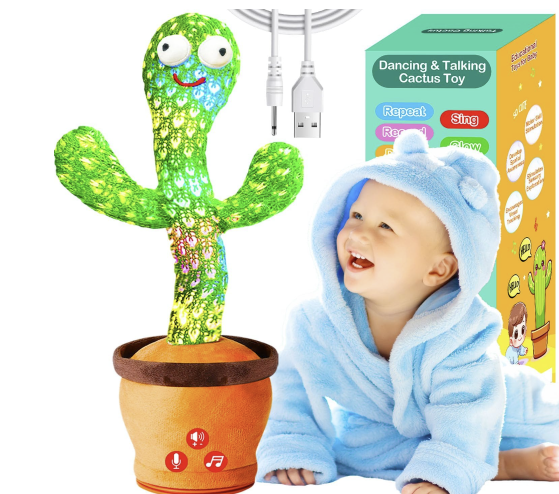
🌱 Dancing & Talking Cactus- Say It, Hear It, Dance!
-
Did You Know? Children Learn Through Imitation and Repetition!
This silly little cactus makes me smile! It dances, lights up, plays music, and—my favorite feature—repeats what you say in a funny voice.
I especially love toys that create opportunities for children to experiment with their voices and discover that their sounds can produce a response.
Vocal Exploration: Children can experiment with vowels, consonants, animal sounds, and silly noises and hear them repeated.
Cause and Effect: When a child vocalizes and the cactus responds, it provides an entertaining example of how an action produces a reaction.
Auditory Attention: Hearing familiar sounds repeated in an unexpected voice can encourage children to listen and notice differences.
Turn-Taking: Parents can use the cactus to model the back-and-forth pattern of communication.
Imitation: Children can practice copying sounds, actions, and movements during playful interactions.
Music and Movement: Dancing provides opportunities to introduce action words, body parts, and simple directions.
What I especially love: You don't need words to begin playing! A child can start with "ahh," "ooo," "mmm," or a silly sound and still participate in a meaningful communication activity.
💜 Let's Play! (12–18 Months)
1. Say It Again! — Vocal Exploration
Turn on the repeating feature.
Start with a simple sound:
"Ahhh!"
"Oooo!"
"Mmmm!"
"Baaa!"
Allow the cactus to repeat the sound.
Pause and see whether your child wants to try again.
Celebrate any vocal attempt rather than expecting perfect imitation.
2. My Turn, Your Turn! — Early Communication
Model a sound and allow the cactus to repeat it.
Then invite your child to take a turn.
Try:
"Mommy's turn!"
"Your turn!"
"Listen!"
"Again!"
Use gestures and facial expressions to help your child understand the exchange.
3. Ready, Set, GO! — Anticipation
Before activating the cactus, say:
"Ready … set … GO!"
Watch the cactus dance.
Pause and repeat.
Over time, your child may begin anticipating the movement and participating with a gesture, vocalization, or word.
4. Dance With Me! — Movement and Language
Play a short musical selection and encourage your child to move.
Model:
"Dance!"
"Clap!"
"Stomp!"
"Up!"
"Down!"
Join your child in the movements rather than simply watching the cactus perform.
🌱 Grow With Me! (18–24 Months)
1. Copy My Sounds! — Speech Sound Imitation
Try simple syllables:
"Ma!"
"Ba!"
"Pa!"
"Da!"
"Mama!"
"Bye-bye!"
Allow the cactus to repeat each sound.
Keep the activity playful and brief. If your child isn't interested in repeating a sound, move on!
2. Animal Sounds — Early Vocabulary
Make familiar animal sounds and listen to the cactus repeat them.
Try:
"Moo!"
"Baa!"
"Woof!"
"Meow!"
Pair each sound with a toy animal, picture, or gesture.
3. More, Please! — Functional Communication
After the cactus finishes dancing, pause.
Model:
"More!"
"Again!"
"Dance!"
"Go!"
Accept gestures, sounds, signs, or words as communication attempts.
4. Stop and Go! — Receptive Language
Use short musical activities to introduce:
"Go!"
"Stop!"
"Dance!"
"All done!"
Pause the activity when possible and give your child time to respond.
🌱 Grow With Me! (24–36 Months)
1. Two-Word Combinations — Expressive Language
Model short phrases:
"Cactus dance!"
"More music!"
"Go again!"
"Silly cactus!"
"My turn!"
Encourage your child to participate naturally without requiring repetition.
2. Silly Sound Game — Speech Sound Awareness
Experiment with repeated syllables:
"Ba-ba-ba!"
"Ma-ma-ma!"
"Pa-pa-pa!"
"La-la-la!"
Listen to the cactus repeat them.
Talk about whether the sounds are the same or different.
3. Who Said That? — Listening Skills
Have a parent say a familiar word and let the cactus repeat it.
Ask:
"Was that Mommy or the cactus?"
Help your child notice the difference between the two voices.
4. Let's Dance! — Following Directions
Practice simple instructions:
"Clap your hands!"
"Stomp your feet!"
"Touch your head!"
"Turn around!"
Demonstrate each action and encourage your child to join you.
🌱 Grow With Me! (3–5 Years)
1. Silly Sentences — Sentence Development
Record short, funny sentences and listen to the cactus repeat them.
Try:
"The cow wears shoes!"
"My dog can dance!"
"The cactus is silly!"
Encourage your child to create original sentences.
2. Speech Sound Practice — Articulation
Choose a sound your child is already working on successfully.
Practice a few familiar words containing that sound.
Record and replay the words for fun.
Remember, the cactus changes the voice, so it should not be used to judge whether a speech sound was produced correctly.
3. Describe It! — Expressive Language
Ask your child to describe the cactus.
Encourage words such as:
Green
Tall
Funny
Wiggly
Dancing
Expand descriptions into sentences:
"The green cactus is dancing!"
4. Tell Me What Happened! — Sequencing
After playing, ask:
"What did we do first?"
"What happened next?"
"What did the cactus do?"
Help your child organize events using "first," "next," and "last."
💜 Miss Angie's Reminder
The cactus can repeat your child's voice, but it cannot replace a real conversation!
The most important part of this activity is how YOU respond to your child.
Smile, imitate their sounds, pause, take turns, and celebrate communication attempts.
Keep the music and volume low enough that your child can hear your voice. Short periods of interactive play are often more useful than leaving an electronic toy running continuously.
Remember: It's not just the toy—it's how you use it!
Safety Note: Follow the exact manufacturer's minimum-age recommendation. Supervise play, keep the volume comfortable, inspect the electronic components regularly, and do not allow children to chew on the toy. Adults should handle charging, and the toy should never be placed in a child's sleep space.
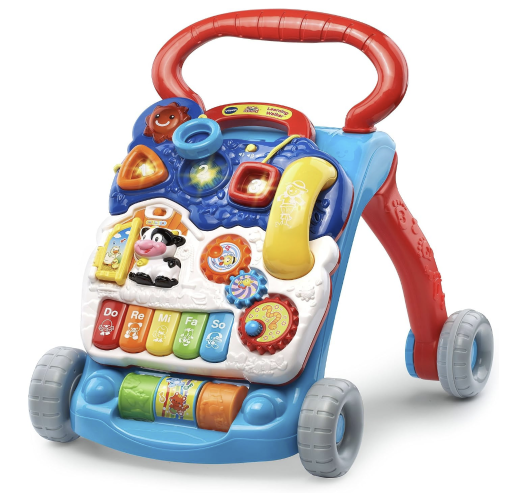
🌱VTech Sit-to-Stand Learning Walker- Little Steps, Big Discoveries!
-
Did You Know? Movement and Play Create Wonderful Opportunities for Language Learning!
I love toys that grow with children, and this one offers so many different ways to play!
The VTech Sit-to-Stand Learning Walker has a removable activity panel with colorful piano keys, shape sorters, spinning rollers, buttons, and a pretend telephone. As children become developmentally ready, the panel can be attached to the push walker for another way to explore.
But my favorite part isn't the music or the lights. It's the opportunities for interaction!
Cause and Effect: Pressing buttons, spinning rollers, and playing piano keys help children discover that their actions produce a response.
Receptive Language: Parents can introduce words such as "push," "turn," "open," "close," "up," "down," "go," and "stop."
Early Expressive Language: Reaching, pointing, vocalizing, and eventually using words can all become ways to request an activity or comment on what happens.
Imitation: The pretend telephone encourages children to imitate familiar actions, sounds, and eventually words.
Problem-Solving: Exploring the different controls and shape sorters gives children opportunities to experiment and discover how things work.
Joint Attention: Parents can point to interesting features, share excitement, and encourage their child to look between the toy and their communication partner.
What I especially love: The removable activity panel allows children to explore while sitting on the floor, long before they're ready to use the walker!
💜 Let's Play! (9–12 Months)
1. Push, Push, Push! — Cause and Effect
Remove the activity panel and place it on the floor within your baby's reach.
Demonstrate pressing one of the piano keys or buttons.
Say:
"Push!"
"Music!"
"You did it!"
"Again!"
Allow your baby time to explore and discover what happens.
2. Ring, Ring! — Early Social Interaction
Pick up the pretend telephone.
Hold it near your ear and say:
"Ring, ring!"
"Hello!"
"Hi, baby!"
"Bye-bye!"
Offer the telephone to your baby and watch for attempts to imitate your actions.
Even bringing the phone toward their ear is an early form of imitation!
3. Ready, Set, GO! — Anticipation
Choose a favorite button.
Say:
"Ready … set … GO!"
Press the button on "GO!"
Pause before repeating.
Watch for smiles, reaching, movements, or vocalizations that show your baby anticipates what will happen.
4. Spin It! — Action Words
Demonstrate how to spin the colorful rollers.
Model:
"Spin!"
"Round and round!"
"Stop!"
"Again!"
Give your baby opportunities to explore the rollers independently.
5. More Music! — Early Requests
Play a short musical selection, then pause.
Watch for your baby's attempt to request another turn.
Your baby may reach, look toward the toy, vocalize, or gesture.
Model "more" or "again" and respond to their communication attempt.
🌱 Grow With Me! (12–18 Months)
1. Hello! Who's Calling? — Pretend Play
Use the telephone to model familiar social routines.
Try:
"Ring, ring!"
"Hello, Daddy!"
"How are you?"
"Bye-bye!"
Pause and give your child an opportunity to participate with gestures, sounds, or words.
2. Find the Shape! — Receptive Language
Explore the shape sorters together.
Model:
"Circle!"
"Square!"
"Triangle!"
"Put it in!"
"Take it out!"
Begin by naming and demonstrating rather than expecting your child to identify every shape.
3. Go, Go, Go! — Movement and Language
When your child is developmentally ready to use the push walker, pair movement with simple action words.
Try:
"Go!"
"Stop!"
"Walk!"
"Turn!"
"Come here!"
Pause occasionally to encourage your child to look toward you or communicate before continuing.
4. My Turn, Your Turn! — Social Communication
Take turns pressing piano keys.
Model:
"My turn!"
"Your turn!"
"Push!"
"Again!"
Keep the interaction playful and brief.
🌱 Grow With Me! (18–24 Months)
1. Two-Word Combinations — Expressive Language
Expand your child's single words into short phrases.
Child: "Music!"
Parent: "More music!"
Child: "Go!"
Parent: "Walker go!"
Other examples:
"Push button!"
"Phone ring!"
"Blue circle!"
"Go fast!"
2. Follow My Directions! — Receptive Language
Practice simple directions:
"Push the button."
"Find the phone."
"Spin the roller."
"Put the shape in."
As your child's understanding develops, introduce two-step directions:
"Get the phone and give it to Mommy."
3. Let's Pretend! — Early Symbolic Play
Use the telephone to pretend to call familiar people.
"Let's call Grandma!"
"Ring, ring!"
"Grandma says hello!"
Encourage your child to imitate familiar words and phrases.
4. Stop and Go! — Early Concepts
During supervised walker play, introduce:
Fast/slow
Go/stop
Forward/backward
Near/far
Pair each word with the movement whenever possible.
🌱 Grow With Me! (24–36 Months)
1. Pretend Phone Conversations — Social Language
Encourage short pretend conversations.
"Hello! Who is this?"
"What are you doing?"
"Are you coming to play?"
"Bye-bye!"
Model appropriate greetings, responses, and conversational turn-taking.
2. Describe It! — Vocabulary Development
Talk about the colors, shapes, and actions on the activity panel.
Try:
"Find something blue."
"Which one is round?"
"What happens when you push this?"
"Tell me about the music."
3. First, Then! — Sequencing
Give simple directions involving two actions.
"First, push the button. Then, spin the roller."
"First, pick up the phone. Then, say hello."
4. Let's Make Music! — Listening and Imitation
Create simple patterns using the piano keys.
Play one note, then pause for your child to imitate.
Try two-note patterns as your child becomes more successful.
Use language such as:
"Same!"
"Different!"
"Again!"
"Your turn!"
💜 Miss Angie's Reminder
A toy doesn't need to do all the talking!
Electronic toys can provide wonderful opportunities for exploration, but children benefit most when parents join the activity.
Try turning the sound off occasionally and providing the language yourself.
Instead of allowing the toy to announce a shape or color repeatedly, point to it, name it, and give your child time to respond.
And remember, there's no need to rush walking. The activity panel alone offers plenty of learning opportunities!
Remember: It's not just the toy—it's how you use it!
Safety Note: Manufacturer-recommended age is 9–36 months. Use the push walker only when your child has the balance and motor readiness to use it safely. Always supervise closely, use a flat, unobstructed surface away from stairs, and follow the manufacturer's instructions for wheel-speed settings and assembly. A push walker should not be used to force or accelerate walking development.
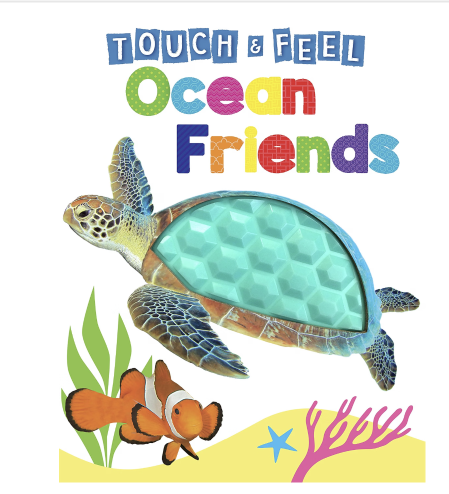
🌱 Ocean Friends – Touch and Feel Board Book
-
Dive into language development with this interactive touch-and-feel ocean book! Babies are naturally curious about different textures, colors, and pictures. Sensory books encourage little hands to explore while providing opportunities for meaningful interactions with caregivers.
I especially love using ocean-themed books to introduce movement words, descriptive vocabulary, joint attention, receptive language, and early imitation. The ocean animals also lend themselves to fun gestures and actions that help babies connect words with movement.
And remember, babies don't have to say words to be learning language! Looking, reaching, touching, smiling, and vocalizing are all important parts of early communication.
🐠 Did You Know?
Babies learn language more effectively when words are paired with meaningful experiences. When you say “Swim, swim!” while moving your hand like a fish, you're helping your baby connect spoken language with actions.
These early connections lay the foundation for understanding words, following directions, and eventually using language independently.
💜 Let's Play! (6–12 Months)
🐟 Swim, Swim, Swim!
Point to a fish and say, “Fish!” Then move your hand through the air while saying, “Swim, swim, swim!”
Encourage your baby to watch your movement. Older babies may begin attempting to imitate the action.
✋ Touch & Feel!
Help your baby explore the different textures. Use simple descriptive words such as “Soft!” “Bumpy!” and “Smooth!”
Pause to allow your baby to touch independently. Watch for smiles, reaching, or vocalizations, and respond as though you're having a conversation.
👀 Look! I Found It!
Point to an ocean animal and say, “Look! A fish!” Pause and allow your baby to shift their gaze toward the picture.
As your baby develops, encourage them to touch or point to the animal you name.
🌊 Up, Down & Around!
Use your finger to trace an ocean animal's movement across the page.
Say, “Up!” as your finger moves upward and “Down!” as it moves downward.
This introduces early spatial vocabulary through visual and movement-based experiences.
🗣️ My Turn, Your Turn!
Make playful sounds such as “Blub, blub!” or “Whoosh!” while looking at the pictures.
Pause and wait for your baby's response. Any vocalization, smile, gesture, or movement can become part of a back-and-forth interaction.
📖 More Ocean Friends!
When your baby shows interest in another page, model “More!” and “Turn!”
Encourage your baby to help turn the sturdy pages while you narrate what they're doing.
🌱 Grow With Me! — Same Book, New Skills!
12–18 Months: First Words & Discovery
Encourage pointing to named ocean animals.
Model simple words such as “fish,” “water,” “swim,” and “more.”
Pair words with actions: “Fish swims!” while moving your hand.
Practice simple directions such as “Touch the fish.”
Encourage imitation of playful sounds such as “Blub, blub!”
18–24 Months: Words & Early Combinations
Model two-word phrases such as “Big fish!” “Blue water!” and “Fish swims!”
Introduce action words such as swim, splash, dive, and float.
Ask simple questions such as “What's that?” and “Where's the fish?”
Expand your child's single-word responses. If they say “Fish,” you can respond, “Yes! Big fish!”
24–36 Months: Growing Language & Imagination
Compare animals by size, color, and texture.
Introduce early concepts such as big/little, fast/slow, and up/down.
Ask simple questions such as “Where does the fish live?”
Encourage pretend play by acting out swimming, splashing, and diving.
Practice following two-step directions, such as “Touch the fish, then find the turtle,” using animals actually pictured in the book.
3–5 Years: Learning Through Pretend Play
Describe ocean animals using multiple attributes.
Compare similarities and differences between animals.
Discuss habitats and how different animals move.
Practice answering who, what, where, and why questions.
Create imaginative stories about an underwater adventure.
Introduce early sequencing by asking, “What happened first? What happened next?”
💜 Miss Angie's Reminder
It's not just the book—it's how you use it!
You don't need to read every word to build language. Follow your child's interests, describe what they're touching, imitate their sounds, and make reading an interactive experience.
Even a few minutes of shared reading can provide meaningful opportunities for communication and connection.
Always supervise babies during sensory book exploration and follow the manufacturer's age and safety recommendations.
🌱 Baby Einstein Go Opus Go — 4-in-1 Crawl & Chase Octopus

-
Did You Know? Babies Learn Through Action, Repetition, and Interaction!
I love toys that grow with children, and this adorable octopus provides opportunities for learning from infancy through the preschool years!
Opus has four different play modes: Tummy Time, Sit & Play, Chase, and Dance. His soft arms respond to touch, activating lights, movement, and music.
But what makes this toy special isn't just what Opus can do. It's what YOU can do with your child while playing!
Cause and Effect: When babies touch Opus and something happens, they begin learning that their actions can produce a response.
Anticipation: Repeating familiar routines helps babies begin predicting what will happen next.
Early Communication: Reaching, looking, smiling, vocalizing, and eventually pointing or using words all provide opportunities for meaningful communication.
Joint Attention: Parents can encourage babies to shift their attention between Opus and the person sharing the experience.
Movement and Language: As babies grow, crawling, chasing, and dancing provide natural opportunities to introduce action words, directions, and early concepts.
What I especially love: This is a toy that can be used differently at each developmental stage. And because it responds to a child's touch, it encourages active exploration rather than simply watching lights and listening to music.
💜 Let's Play! (3–6 Months)
1. Touch and Discover! — Cause and Effect
Place Opus within comfortable reaching distance during supervised tummy time.
Gently demonstrate how touching one of his soft arms activates a response.
Say:
"Touch!"
"You did it!"
"Look!"
"Again!"
Give your baby time to explore independently.
2. Ready, Set, GO! — Anticipation
Before activating Opus, say:
"Ready … set … GO!"
Pause briefly before "GO!" and then touch his arm.
Repeat the routine and watch for your baby's reaction.
Your baby may smile, move, look toward Opus, or vocalize in anticipation.
3. Look at Opus! — Visual Attention
Position Opus where your baby can comfortably see him.
Point toward the octopus and describe what happens.
Try:
"Look!"
"He's spinning!"
"Pretty lights!"
"Wow!"
Pause occasionally so your baby can look, listen, and process the experience.
4. Let's Talk! — Early Vocal Turn-Taking
Activate Opus briefly, then allow a quiet moment.
Look toward your baby and make a playful sound:
"Oooo!"
"Ahhh!"
"Wheee!"
Wait for a response.
If your baby coos or squeals, imitate the sound and continue your little conversation.
🌱 Grow With Me! (6–12 Months)
As your baby begins sitting independently, reaching more purposefully, and becoming mobile, introduce new ways to play!
1. Push It! — Intentional Actions
Encourage your baby to activate Opus independently.
Model:
"Push!"
"On!"
"Again!"
"More!"
2. Where's Opus? — Joint Attention
Point toward Opus from a short distance.
Say, "Look! There's Opus!"
Give your baby time to follow your pointing gesture.
3. Go Get Him! — Movement and Language
When your baby is developmentally ready to crawl, introduce Chase Mode.
Model:
"Go!"
"Get Opus!"
"Come back!"
"You got him!"
Allow your baby to move at their own pace.
4. More Music! — Early Requests
Pause between activities.
Watch for reaching, looking, gestures, or vocalizations that communicate a desire for more.
Model "more" or "again," and respond to your baby's attempts to communicate.
🌱 Grow With Me! (12–24 Months)
1. Go and Stop! — Receptive Language
Pair Opus's movements with simple action words.
"Go, Opus, go!"
"Stop!"
Encourage your child to participate using gestures, sounds, or words.
2. My Turn, Your Turn! — Social Communication
Take turns activating Opus.
Model:
"My turn!"
"Your turn!"
"Push it!"
"Again!"
3. Let's Dance! — Imitation and Following Directions
Use Dance Mode to encourage movements such as:
Clap your hands.
Stomp your feet.
Wave your arms.
Turn around.
Model the movements and invite your child to imitate.
4. Two-Word Combinations — Expressive Language
Expand single words into short phrases:
"Opus go!"
"More music!"
"Blue arm!"
"Bug dance!"
🌱 Grow With Me! (2–5 Years)
Opus can continue supporting more advanced language skills!
1. Following Directions
Give one- and two-step directions:
"Touch the blue arm."
"Touch the red arm, then clap."
"Dance and then sit down."
2. Describing and Comparing
Talk about colors, numbers, shapes, and opposites.
"Which arm is blue?"
"Can you find a different color?"
"Are you moving fast or slow?"
"Let's dance quietly. Now loudly!"
3. Sequencing
Ask your child to describe what happened:
"First, we touched Opus. Then he played music. What happened next?"
4. Social Communication
Practice turn-taking, making requests, and commenting during play.
Encourage phrases such as:
"Can I have a turn?"
"Let's do it again!"
"I like that song!"
"Your turn to dance!"
💜 Miss Angie's Reminder
The lights and music may capture your child's attention, but the interaction is where language learning happens!
Electronic toys can sometimes do so much talking that children have fewer opportunities to communicate.
Try activating Opus briefly, then creating a quiet moment to talk, imitate your child's sounds, or wait for a response.
Remember: It's not just the toy—it's how you use it!
Safety Note: Manufacturer-recommended age is 3 months and older. Always supervise play, use a safe floor surface, keep the volume comfortable, and allow babies to explore movement at their own developmental pace. Never use the toy in a sleep space.
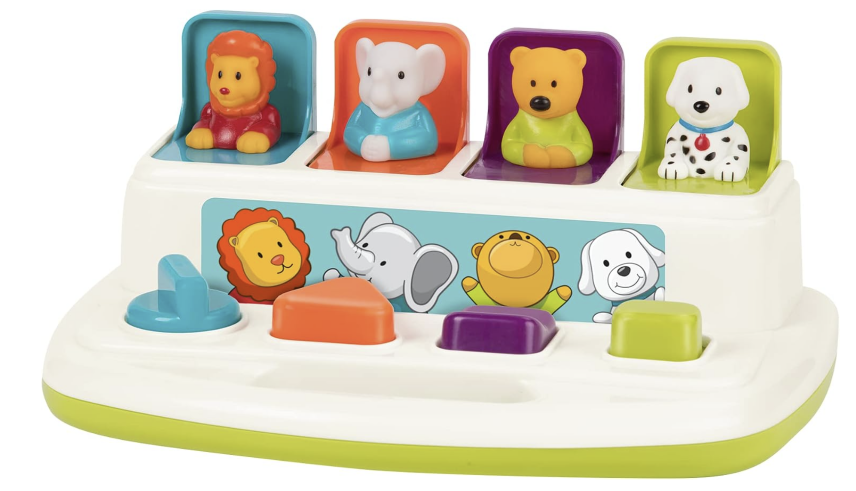
🌱 Battat Pop-Up Pals — Push, Turn, Flip & Discover!
-
Did You Know? A Simple Surprise Can Encourage Communication!
I love cause-and-effect toys, and this is one of my favorites!
The Battat Pop-Up Pals features four adorable animals that pop up when children manipulate different controls. Each animal requires a different action—turning, pressing, flipping, or sliding.
What makes this toy especially valuable is that children must figure out what to do to make something happen!
Cause and Effect: Children discover that their actions produce predictable results. This understanding supports purposeful exploration and provides opportunities to develop intentional communication.
Problem-Solving: Different controls require different movements, encouraging children to experiment and discover how each one works.
Fine Motor Development: Turning, pressing, flipping, and sliding help develop hand coordination and purposeful movement.
Receptive Language: Parents can introduce action words such as "push," "turn," "open," "close," "up," and "down."
Expressive Language: The surprise of an animal popping up creates natural opportunities for sounds, gestures, exclamations, and early words.
Joint Attention: The child and caregiver can share excitement about the animal appearing, creating opportunities for pointing, looking, and commenting.
What I especially love: No batteries, music, or flashing lights are needed! The child makes something happen, and the parent provides the language.
💜 Let's Play! (12–18 Months)
1. Peekaboo! — Anticipation and Early Communication
Begin with all four animals hidden.
Choose one control and say:
"Ready … set … POP!"
Activate the control and let the animal appear.
React with excitement!
"POP!"
"Hi!"
"There he is!"
"Wow!"
Pause before activating the next animal and watch for your child's reaction.
2. Push, Turn, Flip, Slide! — Action Words
Demonstrate one control at a time.
Pair each action with a simple word:
"Push!"
"Turn!"
"Flip!"
"Slide!"
Repeat the same word as your child attempts the movement.
There's no need to ask your child to repeat the word. Hearing language paired with meaningful actions is valuable!
3. Where Did He Go? — Early Object Permanence
After an animal appears, help your child close its door.
Say:
"Bye-bye!"
"Where did he go?"
"He's hiding!"
Then encourage your child to make the animal appear again.
4. More Animals! — Functional Communication
After one animal pops up, pause before activating another.
Model:
"More?"
"Again?"
"Open!"
"Go!"
Accept reaching, pointing, looking, gestures, sounds, or words as requests.
🌱 Grow With Me! (18–24 Months)
1. Find the Animal! — Receptive Language
Ask your child to find a particular animal.
"Where's the lion?"
"Can you find the monkey?"
If your child isn't familiar with the animal names, model them first.
2. Animal Sounds — Early Speech Imitation
Pair each animal with a playful sound when appropriate.
For example:
"Roar!"
"Oo-oo!"
"Ribbit!"
"Tweet!"
Pause and give your child an opportunity to imitate.
Animal sounds are wonderful early communication targets because they're playful and meaningful!
3. Up and Down! — Early Concepts
As the animals pop up and disappear, model:
"Up!"
"Down!"
"Open!"
"Close!"
"In!"
"Out!"
Repeat these words during play rather than turning the activity into a quiz.
4. My Turn, Your Turn! — Social Communication
Take turns activating the animals.
Model:
"My turn!"
"Your turn!"
"Ready?"
"Go!"
Keep turns short and fun.
🌱 Grow With Me! (24–36 Months)
1. Two- and Three-Word Combinations — Expressive Language
Expand your child's single words into short phrases.
Child: "Monkey!"
Parent: "Monkey popped!"
Child: "Open!"
Parent: "Open the door!"
Other phrases include:
"Lion go up!"
"Close the door!"
"More animals!"
"Monkey is hiding!"
2. Following Directions — Receptive Language
Begin with one-step directions:
"Push the button."
"Open the lion."
"Close the door."
Then introduce two-step directions:
"Open the monkey, then close the lion."
"Push the button and find the frog."
Adjust the difficulty to your child's developmental level.
3. Which One? — Colors and Describing
Talk about the colors of the controls and animals.
Try:
"Find the red one."
"Which animal is yellow?"
"Let's open the blue door."
Model color words before expecting your child to identify them independently.
4. What Happened? — Early Sequencing
After activating an animal, describe the action and result.
"First, you pushed the button. Then the animal popped up!"
Encourage your child to help tell what happened.
🌱 Grow With Me! (3–5 Years)
1. Predict What Happens — Reasoning
Ask:
"What do you think will happen if we turn this?"
"Which animal will pop up?"
"How can we make it open?"
2. Following Multistep Directions
Try:
"Open the lion, close the monkey, and then find the frog."
Adjust the number of steps to your child's abilities.
3. Describe and Compare
Encourage descriptions:
"Which animal is bigger?"
"How are these animals different?"
"Which control do you have to turn?"
"Which one do you push?"
4. Explain How It Works — Sequencing and Language Organization
Ask your child to teach someone else how to use the toy.
Encourage:
"First, you turn the knob. Then the animal pops up. Last, you close the door."
💜 Miss Angie's Reminder
Sometimes the simplest toys create the richest language opportunities!
Resist the temptation to activate every animal for your child.
Give them time to explore, experiment, and problem-solve.
When an animal pops up, share their excitement! Point, smile, make a silly sound, and describe what happened.
And remember, you don't have to ask questions constantly. Sometimes a simple "WOW! You did it!" encourages more interaction than asking, "What's that?" over and over.
Remember: It's not just the toy—it's how you use it!
Safety Note: Follow the manufacturer's age recommendation, supervise play, and check that all moving parts are intact. Allow children to explore the controls at their own pace without forcing their hands or fingers.
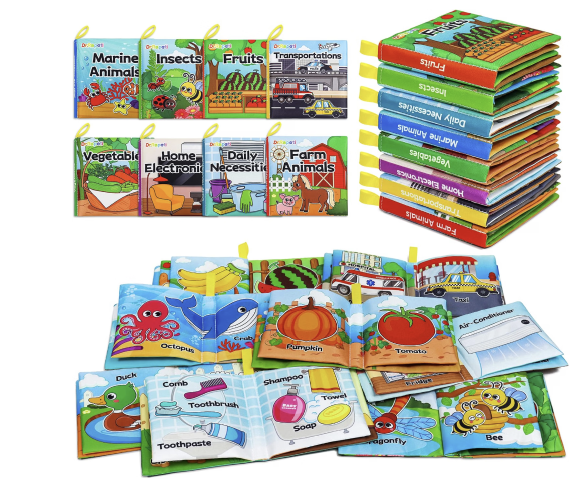
🌱 8-Pack Soft Books — Cloth, Bath & Crinkle Books
-
Little hands, big discoveries!
Soft cloth and crinkle books are wonderful early learning tools because babies can explore them through touch, movement, sound, and shared interaction.
I especially love these books for encouraging sensory exploration, visual attention, grasping, fine motor development, early joint attention, auditory awareness, and the beginnings of receptive language.
During the 6–12-month period, babies are learning to reach for objects, manipulate them, explore different textures, and discover that their actions can produce interesting results.
A crinkly page is a perfect example! When your baby squeezes the page and hears a sound, they're beginning to explore cause and effect.
And when you respond by saying, “Crinkle, crinkle!” or “You did it!” you're turning a simple sensory experience into an opportunity for communication.
My recommendation? Start with ONE book at a time!
Although this collection includes eight books, there's no need to introduce all eight at once. Choose one with interesting textures, contrasting pictures, or crinkly pages and let your baby explore.
At this age, the goal isn't to identify pictures or learn colors. It's to explore, interact, and discover!
🧠 Did You Know?
Babies begin developing the foundations of language long before they say their first words.
During the 6–12-month period, many babies become increasingly interested in how objects feel, sound, and move.
They may squeeze a crinkly page repeatedly, transfer a book from one hand to another, mouth its edges, or attempt to turn the pages.
These seemingly simple actions support sensory processing, motor development, attention, and early problem-solving.
But here's what makes these experiences especially valuable for communication:
When you respond to what your baby is doing, you're helping them connect their actions with your words and reactions.
For example, your baby squeezes a page.
You say, “Crinkle!”
Your baby squeezes it again.
You respond, “You did it again!”
That back-and-forth exchange is an early form of conversation.
And remember, babies don't need to understand every word you say. Hearing simple, repetitive language paired with meaningful actions helps build the foundation for future comprehension and expressive language.
💜 Let's Play! (6–12 Months)
📚 One Book, Lots of Discoveries!
Choose just one soft book.
Allow your baby to explore it by touching, squeezing, grasping, or mouthing it if the book is designed for that type of use.
Describe what your baby is doing using simple words.
“Touch!”
“Squeeze!”
“Look!”
Follow your baby's interests rather than trying to direct every action.
👂 Crinkle, Crinkle!
Gently squeeze a crinkly page and say, “Crinkle, crinkle!”
Pause and watch your baby's reaction.
They may look toward the sound, smile, reach for the book, or attempt to squeeze it themselves.
When they do, respond enthusiastically!
“You did it!”
This encourages auditory attention, cause-and-effect exploration, and early social interaction.
🙈 Peekaboo Pages!
Hold the book in front of your face.
Say, “Where's Mommy?” or “Where's Daddy?”
Lower the book and say, “Peekaboo!”
Pause and repeat.
As your baby becomes familiar with the routine, watch for anticipation, smiles, vocalizations, or attempts to move the book.
This encourages social engagement, anticipation, and early turn-taking.
🤲 Touch and Feel!
Guide your baby's attention toward different textures in the book, if included.
Let them explore independently.
Model simple words such as “Soft!” “Touch!” and “Feel!”
You can also describe their reactions.
“You like that!”
Avoid requiring your baby to touch a particular texture. Allow them to explore at their own pace.
🗣️ Your Turn, My Turn!
Squeeze a crinkly page and pause.
Allow your baby an opportunity to squeeze it.
When they do, imitate their action.
You can say, “My turn!” and “Your turn!”
Even if your baby doesn't understand those phrases yet, they're experiencing the rhythm of reciprocal interaction.
👀 Look at That!
Open the book to a page with an interesting picture.
Point and say, “Look!”
Pause and see whether your baby looks toward the picture.
If the picture shows a familiar animal or object, label it simply.
“Dog!”
“Ball!”
There's no need to ask your baby to identify or name the picture. At this age, we're introducing the connection between visual attention and spoken language.
📖 Turn the Page!
Demonstrate turning a soft page while saying, “Turn!”
Allow your baby to grasp or manipulate the page.
Younger babies may need assistance, while older babies may begin attempting to turn pages independently.
Celebrate their efforts rather than expecting perfect page turning.
🛁 Splish, Splash, Read!
If the collection includes books specifically designed for bath use, bring one into the bathtub.
Model simple words such as “Splash!” “Wet!” and “Water!”
Allow your baby to touch and explore the book while you interact.
Pair the experience with playful sounds and familiar routines.
Only use books in water if the manufacturer identifies them as waterproof or bath-safe. Keep your baby within arm's reach throughout bath time.
🌱 Grow With Me! — Same Books, New Skills!
12–18 Months: First Words & Discovery
As your baby becomes a toddler, begin shifting from primarily sensory exploration toward purposeful picture interaction.
Start with one book and two or three familiar pictures.
Point to and label common objects such as dog, ball, and car.
Encourage looking toward, touching, or pointing to familiar pictures.
Introduce animal sounds such as “Moo!” and “Woof!”
Encourage simple directions such as “Turn the page” or “Find the dog,” with support as needed.
Model functional words such as more, open, turn, and all done.
Connect pictures to real-life objects during everyday routines.
18–24 Months: Words & Early Combinations
Encourage identifying and naming familiar pictures.
Introduce two-word combinations such as “Big dog,” “More book,” and “Red ball.”
Practice following simple directions involving pictures.
Encourage animal sounds and environmental sound imitation.
Introduce action words such as eat, sleep, run, and jump when appropriate to the pictures.
Allow your toddler to choose which book to explore.
Encourage increasingly independent page turning and shared reading.
24–36 Months: Growing Language & Imagination
Encourage naming and describing pictures.
Introduce colors, sizes, and other descriptive vocabulary.
Ask simple questions such as “What is this?” and “What is it doing?”
Encourage short phrases and sentences.
Practice identifying objects by function.
Compare familiar pictures using same/different and big/little.
Encourage simple pretend-play routines inspired by the pictures.
3–5 Years: Learning Through Pretend Play
Describe pictures using multiple attributes.
Practice answering who, what, where, and why questions.
Compare similarities and differences between pictured objects.
Introduce categorization and explain why objects belong together.
Create imaginative stories using familiar pictures.
Practice sequencing events using first, next, then, and last.
Encourage children to explain their ideas using complete sentences.
Explore rhyming and beginning sounds using familiar picture names.
💜 Miss Angie's Reminder
It's not just the book—it's how you use it!
At 6–12 months, babies don't need to sit quietly, identify pictures, or listen to an entire story.
Start with one book and let your baby explore!
Squeezing, crinkling, touching, mouthing, and manipulating the pages are all meaningful early learning experiences when the book is designed for safe infant use.
Respond to your baby's actions, imitate their sounds, and use simple, repetitive language.
As your baby grows, those same books can become tools for picture identification, early vocabulary, and more complex language development.
Remember: Before babies learn to read books, they learn to explore them—and those early shared experiences help build the foundation for communication!
Safety Note: Follow the manufacturer's age recommendations. Inspect cloth books regularly for loose stitching, damaged seams, or detachable components. Only use books specifically labeled as bath-safe in water, and always supervise play and bath time.
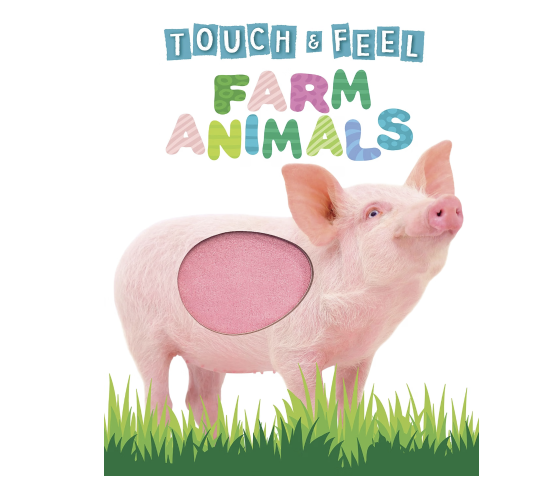
🌱 Touch and Feel Farm Animals — Interactive Board Book
-
Touch-and-feel books combine sensory exploration with early language development! Babies learn through their senses, and the different textures encourage little hands to reach, touch, and explore while sharing a book with a caregiver.
This type of interactive book provides wonderful opportunities to develop joint attention, receptive language, early vocabulary, sound imitation, and turn-taking. It also introduces babies to the idea that books are fun, interactive experiences—not just something to look at!
🐄 Did You Know?
Babies begin learning language long before they can say their first words! When you point to a cow, say “Cow!” and make a playful “Moooo!” sound, your baby is beginning to connect what they see and hear with meaning.
Repeated exposure to simple words, animal sounds, and familiar routines helps build the foundation for future communication.
💜 Let's Play! (6–12 Months)
🐑 Touch & Explore!
Guide your baby's attention to the different textures. Say, “Soft sheep!” or “Feel the cow!” Give your baby time to reach out and explore independently.
🐄 Make Animal Sounds!
Point to an animal and exaggerate its sound: “Moooo!” “Baaa!” “Oink, oink!” Pause and watch for your baby's response. A smile, squeal, movement, or vocalization is an early form of communication!
👀 Look, Point & Name!
Point to the animals and label them using short, simple phrases: “Look! A cow!” “There's a pig!” As your baby develops, encourage them to look toward or touch the animal you name.
🔄 My Turn, Your Turn!
Make an animal sound, pause, and wait. Your baby may respond with a coo, babble, smile, or movement. Respond enthusiastically and continue the interaction. These early back-and-forth exchanges build conversational skills.
📖 Turn the Page!
Encourage your baby to help turn the sturdy pages. Model simple words such as “Turn!” “Open!” and “More!” while following your baby's interests.
🌱 Grow With Me! — Same Book, New Skills!
12–18 Months: First Words & Discovery
Encourage pointing when you ask, “Where's the cow?”
Model animal names and sounds.
Practice simple directions such as “Touch the sheep.”
Encourage early words such as “cow,” “pig,” “more,” and “book.”
18–24 Months: Words & Early Combinations
Expand single words into two-word phrases: “Soft sheep!” “Big cow!”
Ask simple questions such as “What's that?”
Introduce action words: “Cow eats!” “Pig sleeps!”
Encourage your toddler to imitate animal sounds and complete familiar phrases.
24–36 Months: Growing Language & Imagination
Describe animals using size, color, and texture.
Compare animals: “Which one is soft?” “Which one is big?”
Ask simple questions: “What does a cow say?” “Where does the pig live?”
Encourage pretend play by acting out animal movements and sounds.
3–5 Years: Learning Through Pretend Play
Categorize farm animals and discuss where they live.
Describe similarities and differences.
Practice answering who, what, and where questions.
Create simple stories about the animals using beginning, middle, and end.
💜 Miss Angie's Reminder
It's not just the book—it's how you use it!
You don't have to read every word on every page. Follow your child's lead, talk about what catches their attention, and make reading an enjoyable back-and-forth experience.
Always supervise babies during book exploration and check the manufacturer's recommended age and safety information.
12–18 Months: First Words & Discovery
🌱 Fisher-Price Baby’s First Blocks & Rock-a-Stack Toy Set
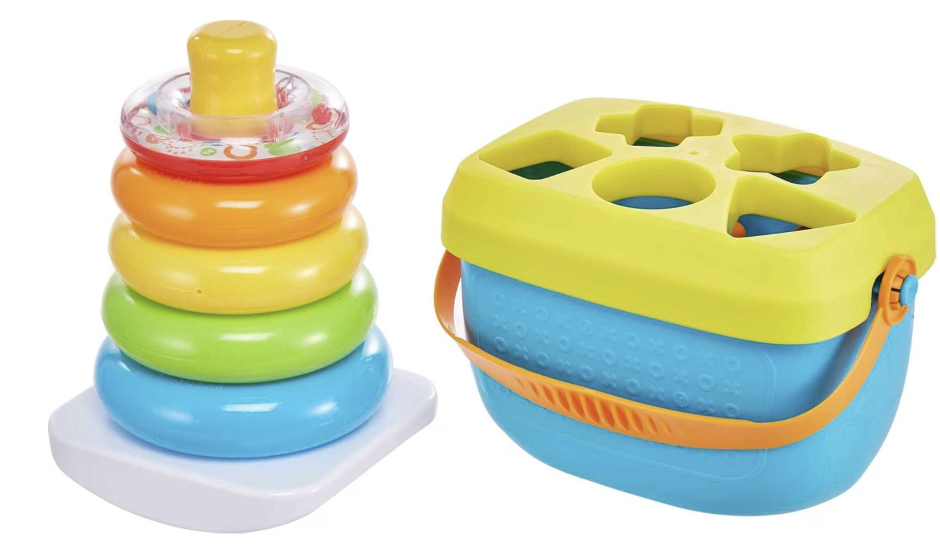
-
Sometimes the simplest toys provide the greatest opportunities for learning! This classic Fisher-Price combination includes two of my favorite types of developmental toys: a shape sorter and a stacking ring tower.
I love these toys because they encourage joint attention, receptive language, early expressive vocabulary, imitation, following directions, problem-solving, fine motor coordination, and turn-taking.
The best part? They don't require batteries, flashing lights, or music. The interaction between you and your child becomes the most important part of play!
As toddlers put blocks in, dump them out, stack rings, and knock things over, they're learning important early concepts such as in/out, on/off, up/down, more/all gone, big/little, and same/different.
🧠 Did You Know?
Although stacking rings and shape sorters are often marketed for babies as young as 6 months, how children interact with these toys changes significantly as they develop!
Younger babies typically explore toys by mouthing, grasping, shaking, and banging them. As they approach their first birthday, many begin understanding that objects can be intentionally placed inside containers, taken out, or stacked on top of one another.
This emerging understanding of how objects relate to one another is an important step in cognitive and play development.
That's why I especially love these toys for the 12–18-month stage! Toddlers are beginning to move beyond sensory exploration toward purposeful, functional play.
And every time they put a block IN, take a ring OFF, or ask for MORE, there's an opportunity to build language through meaningful interaction.
Remember, children develop at different rates, and exploring the toys in simpler ways is still valuable learning!
💜 Let's Play! (12–18 Months)
🪣 In, In, In!
Start with the shape-sorting bucket without the lid.
Give your toddler a block and demonstrate dropping it inside.
Say, “IN!” each time a block goes into the bucket.
Pause and allow your child to imitate the action. You can also hold out your hand and say, “Give me!” to encourage following simple directions.
Once your child understands the routine, pause before dropping the next block and see whether they vocalize, gesture, or attempt to say “in.”
🙃 Dump It Out!
Once several blocks are inside the bucket, turn it over and let them tumble out.
Exclaim, “OUT!” or “Uh-oh! All gone!”
Encourage your toddler to help dump the blocks and repeat the activity.
This is a wonderful opportunity to introduce in/out, full/empty, more, again, and all gone.
⭕ On, Off, On!
Use the Rock-a-Stack rings to introduce the concepts of on and off.
Place a ring on the post while saying, “ON!”
Remove it and say, “OFF!”
Let your child explore removing rings before expecting them to stack independently.
Model “More!” or “Again!” when your toddler wants to repeat the activity.
👏 Ready, Set... GO!
Hold a ring above the stacking post.
Say, “Ready... set...” and pause before saying “GO!” as you slide the ring down.
After several repetitions, wait expectantly to see whether your child looks at you, moves their body, vocalizes, or attempts to complete the familiar phrase.
Respond to any intentional communication before continuing.
🗣️ My Turn, Your Turn!
Take turns putting blocks into the bucket or rings onto the post.
Say, “My turn!” as you place a block inside, followed by “Your turn!”
Keep the exchanges short and playful.
This helps introduce early conversational turn-taking, waiting, and shared attention.
🔷 Find the Shape!
Begin with just two different blocks.
Hold up one and say, “Circle!” or “Square!” Then allow your child to explore.
You can introduce the shape-sorter lid and demonstrate matching a block to its opening, but don't expect independent shape sorting yet.
At this age, exploring, attempting, and problem-solving are more important than correctly identifying shapes.
🎨 Colorful Play!
Label colors naturally as your toddler plays.
“Red ring!” “Blue block!”
You can also describe size: “Big ring!” “Little ring!”
Your child doesn't need to identify colors or sizes correctly. You're building familiarity with descriptive vocabulary through meaningful experiences.
🌱 Grow With Me! — Same Toys, New Skills!
18–24 Months: Words & Early Combinations
Encourage two-word combinations such as “More blocks,” “Blue ring,” and “Block in.”
Practice following simple directions: “Put the ring on” or “Give me the circle.”
Introduce sorting and matching with adult assistance.
Encourage independent stacking and simple problem-solving.
Model action words such as put, take, drop, stack, and dump.
Begin contrasting big/little and in/out during play.
24–36 Months: Growing Language & Imagination
Sort blocks by shape or color.
Practice matching shapes to the correct openings.
Stack rings from largest to smallest with decreasing assistance.
Follow two-step directions: “Get the red ring and put it on.”
Describe objects using color, shape, and size.
Encourage three-word combinations such as “Put block in” or “Big ring on.”
Introduce early counting during play without requiring perfect counting accuracy.
3–5 Years: Learning Through Pretend Play
Sort blocks by two attributes, such as color and shape.
Create simple patterns using the rings or blocks.
Practice following multistep directions.
Compare objects using bigger/smaller, same/different, and more/less.
Describe how to build a tower or complete the shape sorter.
Encourage sequencing language: first, next, then, and last.
Practice problem-solving by asking, “Why doesn't this shape fit?” or “What could we try next?”
💜 Miss Angie's Reminder
It's not just the toy—it's how you use it!
Your toddler doesn't need to sort every shape correctly or stack all the rings in order to learn from these toys.
Sometimes the most valuable learning happens when a child repeatedly puts blocks in, dumps them out, and laughs while doing it all over again!
Follow your child's lead, model simple language, and give them time to explore and solve problems independently.
Remember: Play is the work of childhood!
This set is recommended by the manufacturer for ages 6 months and older. Always supervise play and follow the manufacturer's safety instructions.
🌱 Fisher-Price Corn Popper Blue Push Toy with Popping Action
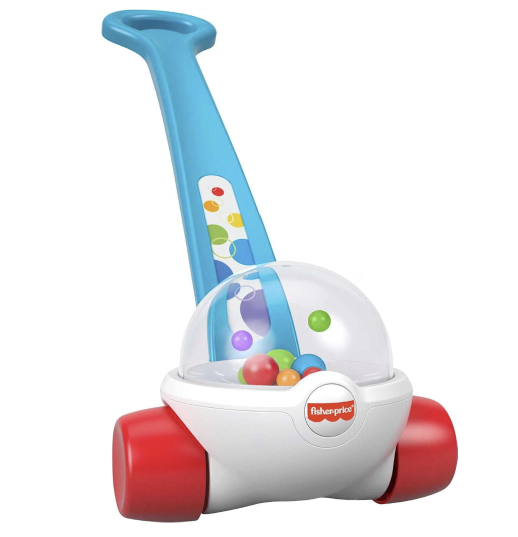
-
Pop, pop, pop! Sometimes the simplest toys create the biggest opportunities for learning!
The Fisher-Price Corn Popper is a classic push-along toy that encourages toddlers to move, explore, and discover how their actions make things happen. As children push the toy, colorful balls bounce inside the clear dome, creating exciting popping sounds.
I especially love this toy for encouraging cause-and-effect understanding, auditory and visual attention, gross motor coordination, joint attention, receptive language, and early expressive communication.
It also creates wonderful opportunities to introduce action words and early concepts such as go, stop, push, pop, fast, slow, more, again, and all done.
Best of all, the toy doesn't do anything until your child makes it happen!
🧠 Did You Know?
Movement and language development are closely connected through play!
As toddlers become more mobile, they gain new opportunities to explore their environment, interact with caregivers, and learn words associated with their actions.
The Corn Popper provides immediate feedback: Push the toy, and the balls pop! Stop pushing, and the popping stops!
This helps children understand cause and effect while creating natural opportunities to learn words such as go, stop, push, and again.
And here's something important: Children don't need to say these words to benefit from hearing them!
When you consistently pair a word with an action, you're helping your child connect language with meaning.
💜 Let's Play! (12–18 Months)
🚶 Push, Push, Push!
Encourage your toddler to push the Corn Popper across a clear, level floor.
As they move, say, “Push! Push! Push!”
Pause occasionally and model “Stop!” followed by “Go!”
Keep your language simple and repetitive so your child can begin associating the words with the actions.
🛑 Ready, Set... GO!
Before your toddler begins pushing, say, “Ready... set...” and pause.
Wait expectantly for a look, movement, gesture, vocalization, or attempt to say “go.”
Then enthusiastically say “GO!” as your child starts moving.
Repeat this routine to encourage anticipation, intentional communication, and early word imitation.
👂 Listen! Pop, Pop, Pop!
Draw attention to the popping sounds.
Say, “Listen! Pop, pop, pop!”
Pause when the toy stops moving and say, “Quiet!”
Begin pushing again and exclaim, “Pop, pop, pop!”
This introduces auditory awareness and the contrast between sound and silence.
🐢 Slow... Fast!
Demonstrate pushing the toy slowly while saying, “Sloooow!”
Then move it a little faster and say, “Fast!”
Allow your toddler to explore how different speeds change the popping action.
At this age, you're introducing the concepts through movement rather than expecting your child to understand or demonstrate them independently.
🗣️ More Pops, Please!
After a short period of play, pause and wait.
Watch for your child to gesture, vocalize, look toward the toy, or attempt to communicate that they want to continue.
Model “More!” or “Again!” and resume the activity.
Respond to all intentional communication rather than requiring your toddler to say a word before continuing.
👀 Look at the Balls!
When the toy is stationary, draw attention to the colorful balls inside the dome.
Say, “Look! Balls!” or “See the red ball?”
Allow your toddler to look and explore visually.
You can label colors naturally, but don't expect color identification at this age.
🤝 Follow Me!
Invite your toddler to push the Corn Popper while you walk a short distance ahead.
Say, “Come here!” or “Follow me!”
You can also model simple directions such as “Stop!” and “Turn!” with gestures.
Keep the activity playful and adjust it to your child's walking abilities.
🌱 Grow With Me! — Same Toy, New Skills!
18–24 Months: Words & Early Combinations
Encourage two-word combinations such as “Go fast!” “More pops!” and “Push toy!”
Practice following simple directions such as “Push it,” “Stop,” and “Come here.”
Introduce opposites such as fast/slow and go/stop.
Encourage imitation of action words such as push, walk, turn, and stop.
Use familiar verbal routines such as “Ready, set, go!” and pause for your child to complete them.
Encourage requesting “more,” “again,” or “help” during play.
24–36 Months: Growing Language & Imagination
Follow two-step directions such as “Push the toy to Daddy, then bring it back.”
Practice describing actions: “I'm pushing fast!” or “The balls are popping!”
Introduce spatial concepts such as around, beside, behind, and between.
Create simple movement paths around furniture or other safe obstacles.
Encourage turn-taking with siblings or caregivers.
Introduce early pretend play by having your child push the toy while pretending to clean the floor or complete a delivery.
Ask simple questions such as “What happens when you push it?” and “How can you make it stop?”
3–5 Years: Learning Through Pretend Play
If your child still enjoys this toy, it can be incorporated into more advanced movement and language games!
Create an obstacle course and practice following multistep directions.
Introduce sequencing language: first, next, then, and last.
Practice describing how to make the balls pop.
Compare fast and slow movement.
Encourage prediction: “What do you think will happen if you stop pushing?”
Incorporate the toy into pretend cleaning or other imaginative play scenarios.
💜 Miss Angie's Reminder
It's not just the toy—it's how you use it!
The Corn Popper may seem like a simple walking toy, but every push, pause, and pop creates an opportunity for language development.
You don't need to turn playtime into a lesson. Walk alongside your child, model simple words, pause for communication, and enjoy the excitement together.
Sometimes a little movement leads to a lot of communication!
Recommended by the manufacturer for ages 12 months and older. Use on a clear, level surface with adult supervision. This toy is not a walking support device; children should have sufficient balance to push it safely. Follow the manufacturer's assembly and safety instructions.
🌱 Wooden Toddler Puzzles — 6-Piece Montessori-Style Puzzle Set
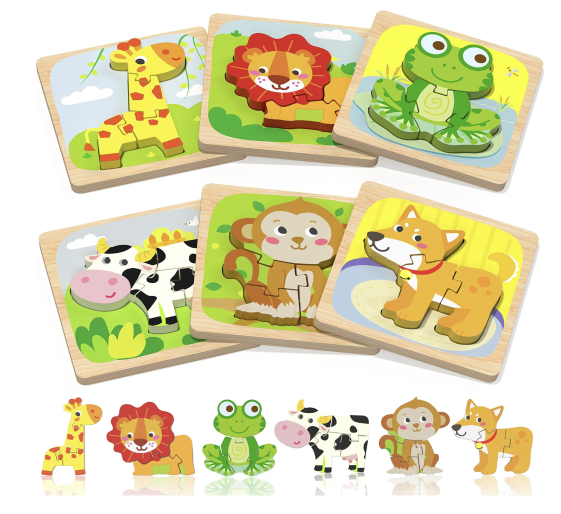
-
Sometimes the simplest toys provide the richest learning opportunities! Wooden puzzles encourage toddlers to explore how objects fit together while developing important early communication and problem-solving skills.
I especially love simple puzzles because they encourage joint attention, receptive and expressive vocabulary, visual discrimination, matching, fine motor coordination, following directions, and persistence.
As children remove pieces, examine them, and attempt to put them back, caregivers have natural opportunities to introduce words such as in, out, turn, push, help, more, again, fit, and all done.
One of my biggest recommendations is to start small! Even though this set includes six puzzles, I would begin with just ONE puzzle and only ONE or TWO pieces. Young toddlers don't need a table full of puzzle pieces to learn. Limiting the number of pieces helps reduce distractions, encourages attention to the task, and gives children opportunities to experience success.
As your child develops, you can gradually introduce additional pieces and more challenging puzzles.
🧠 Did You Know?
Before children can complete puzzles independently, they must develop an understanding of how objects relate to one another.
Younger babies often explore objects through mouthing, banging, and manipulating them. As children approach their first birthday, many begin experimenting with placing objects into containers and matching objects to spaces.
During the 12–18-month period, toddlers may begin removing puzzle pieces, attempting to replace them, and recognizing that certain pieces belong in particular locations.
Completing a puzzle independently is not the goal at this age!
Instead, we're encouraging exploration, visual attention, trial and error, and the beginning of purposeful problem-solving.
And here's something parents may not realize: Too many puzzle pieces can make the activity unnecessarily difficult.
When a toddler is presented with six puzzles and multiple pieces, they must visually scan, select, and manipulate many objects at once. That can be overwhelming for a child who is just beginning to understand matching.
By presenting only one or two pieces, you're helping your child focus on the relationship between the piece and its corresponding space.
As your child becomes more successful, gradually increase the number of pieces.
💜 Let's Play! (12–18 Months)
🧩 Start Small! One Puzzle, One or Two Pieces!
Choose one puzzle from the set.
Remove all but one or two pieces and set the extras out of sight.
Begin by allowing your toddler to explore the selected pieces.
Demonstrate removing a piece while saying, “OUT!”
Then show how to return it to its corresponding space while saying, “IN!”
Repeat the activity several times before introducing additional pieces.
Remember, repetition builds familiarity and confidence!
👏 Put It In!
Select one puzzle piece and its corresponding opening.
Demonstrate placing the piece into its space while saying, “IN!”
Remove the piece and encourage your toddler to try.
Provide assistance as needed, but allow time for independent exploration.
The goal is learning how objects fit together—not completing the entire puzzle.
👀 Look! It Fits!
Hold a piece near its matching opening.
Say, “Look!” and slowly guide the piece toward the correct space.
Celebrate when it fits: “It fits!” or “You did it!”
This encourages joint attention, visual matching, and early problem-solving.
🗣️ What's That?
As your toddler explores a puzzle piece, label the picture or object it represents.
Use short, simple language such as “Dog!” “Car!” or “Apple!” depending on the pictures included in your particular puzzle.
Repeat the label naturally rather than asking your toddler to name every piece.
At this age, understanding words generally develops ahead of using them.
🤲 Give Me!
Hold out your hand and say, “Give me!”
Encourage your toddler to hand you a puzzle piece.
Respond with “Thank you!” and return the piece.
You can also model “Take it!” as you offer the piece back.
This supports following simple directions, social interaction, and turn-taking.
🔄 Turn, Turn, Turn!
If a piece doesn't fit, demonstrate gently turning it.
Say, “Turn!” as you rotate the piece.
Then try placing it into the opening again.
This introduces an action word while encouraging problem-solving and motor planning.
💜 Help, Please!
When your toddler has difficulty fitting a piece, pause and observe.
They may look toward you, reach for your hand, vocalize, or gesture for assistance.
Model “Help!” and provide just enough support for them to succeed.
Respond to their communication without requiring them to say the word.
This is a wonderful opportunity to encourage intentional communication and requesting assistance.
🎉 All Done!
When your toddler loses interest or finishes exploring, model “All done!”
You can also encourage them to help put the pieces away.
This introduces a useful functional phrase while establishing a predictable beginning and end to the activity.
🌱 Grow With Me! — Same Toy, New Skills!
18–24 Months: Words & Early Combinations
Gradually increase the number of puzzle pieces as your child demonstrates success.
Encourage matching puzzle pieces to their corresponding spaces with increasing independence.
Practice identifying familiar pictures or objects.
Introduce two-word combinations such as “Dog in,” “More puzzle,” and “Help me.”
Follow simple directions such as “Get the dog” or “Put it in.”
Model action words such as turn, push, take, put, and find.
Encourage persistence and independent problem-solving before offering assistance.
24–36 Months: Growing Language & Imagination
Encourage completing simple puzzles with less assistance.
Introduce puzzles with additional pieces as your child's skills develop.
Practice naming and describing the pictures.
Introduce color, size, and category vocabulary.
Follow two-step directions such as “Find the car and put it in.”
Ask simple questions such as “Where does this go?” and “What is this?”
Encourage short phrases and sentences to describe actions.
Introduce categorization by grouping puzzle pictures according to their features or functions.
3–5 Years: Learning Through Pretend Play
Encourage independent puzzle completion and explaining how pieces fit.
Introduce more complex puzzles as appropriate.
Describe objects using multiple attributes.
Compare similarities and differences between puzzle pictures.
Practice following multistep directions.
Introduce problem-solving questions such as “Why doesn't this piece fit?” and “What could you try next?”
Use puzzle pictures as prompts for imaginative storytelling.
Practice sequencing and describing steps using first, next, then, and last.
Expand vocabulary by discussing object functions, categories, and associations.
💜 Miss Angie's Reminder
It's not just the toy—it's how you use it!
Your toddler doesn't need to complete a puzzle independently to benefit from playing with one.
Start with one puzzle and just one or two pieces. Give your child time to explore, experiment, and experience success before adding more.
Removing pieces, attempting to replace them, turning them around, and asking for help are all meaningful learning experiences.
Follow your child's lead, model simple language, and gradually increase the challenge as their skills develop.
The goal isn't to finish the puzzle. The goal is to learn through the process!
Safety Note: Check the exact product's manufacturer-recommended age and inspect all pieces before use. Avoid puzzles with small or detachable parts that present a choking hazard, particularly for children under 3. Always supervise play.
🌱 Wooden Toddler Puzzles — 6-Piece Montessori-Style Puzzle Set
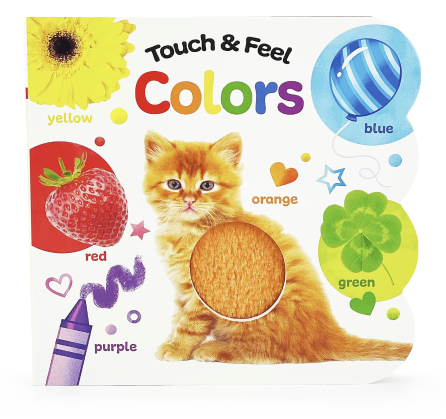
-
Colors are everywhere, and this interactive touch-and-feel book provides a wonderful introduction to the colorful world around us!
I love sensory books because they encourage babies to actively participate in shared reading. Instead of simply looking at pictures, babies can reach, touch, explore different textures, and interact with their caregivers.
This book provides opportunities to develop joint attention, visual attention, receptive language, early vocabulary, sensory exploration, and descriptive language.
As children grow, the same book can be used to introduce color identification, matching, sorting, categorization, and early word combinations.
🌈 Did You Know?
Babies can notice differences in colors long before they understand or name them!
During the first year, the goal isn't to teach babies to identify colors correctly. Instead, it's to help them connect words with meaningful experiences.
When you say, “Look! Red!” while pointing to a picture, or “Soft!” as your baby touches a texture, you're helping build connections between language and what they're seeing and feeling.
Color naming typically develops later in toddlerhood and the preschool years, so there's no need to quiz your baby!
💜 Let's Play! (6–12 Months)
👀 Look at That Color!
Point to a colorful picture and say, “Look! Red!” or “Wow! Yellow!”
Use an animated voice and pause to see whether your baby looks toward the picture.
The goal is shared attention, not identifying colors.
✋ Touch, Touch, Touch!
Encourage your baby to explore the different textures.
Model simple words such as “Soft!” “Bumpy!” or “Smooth!” when appropriate to the texture.
Allow your baby time to explore independently while you describe what they're doing.
🌈 Find the Same Color!
Hold up a familiar, baby-safe object that matches a color in the book.
Say, “Look! Blue!” while pointing to the picture. Then show the object and say, “Blue ball!”
Your baby doesn't need to match the colors independently. You're introducing the idea that words can describe different objects.
🗣️ My Turn, Your Turn!
Point to a picture, label it, and pause.
Watch for your baby's response. They may smile, reach, babble, or look toward you.
Respond to their communication: “You see it!” “Yes! Pretty!”
These early exchanges help establish the foundation for conversation.
📖 Turn the Page!
Encourage your baby to help turn the pages.
Use simple language such as “Turn!” “Open!” “More!” and “All done!”
Repeat the words naturally during your reading routine.
👏 Tap, Tap, Tap!
Gently tap a picture while saying, “Tap, tap, tap!”
Pause and encourage your baby to imitate the movement.
This combines early imitation, motor coordination, and shared attention.
🌱 Grow With Me! — Same Book, New Skills!
12–18 Months: First Words & Discovery
Encourage pointing to familiar pictures.
Continue labeling colors naturally without expecting accurate identification.
Introduce simple directions such as “Touch the red one,” with visual support.
Match familiar objects to pictures while modeling their names.
Encourage early words such as “book,” “more,” and names of familiar objects.
18–24 Months: Words & Early Combinations
Introduce color words during play and daily routines.
Encourage matching two objects of the same color.
Model simple two-word phrases such as “Red ball!” and “Blue car!”
Introduce descriptive words such as soft, rough, big, and little.
Expand your child's language. If they say “Ball,” respond, “Yes! Blue ball!”
24–36 Months: Growing Language & Imagination
Practice identifying and naming familiar colors as the child becomes ready.
Sort toys or household objects by color.
Introduce directions such as “Find something yellow!”
Compare objects using color, size, and texture.
Encourage two- and three-word descriptions such as “Big red ball!”
Play simple matching games using the pictures and objects around the house.
3–5 Years: Learning Through Pretend Play
Identify and name colors with increasing accuracy.
Sort objects using more than one attribute, such as color and size.
Describe objects using multiple details: “The little blue car.”
Practice following two- and three-step directions involving colors.
Introduce similarities and differences: “How are these two objects alike?”
Play “I Spy” using color clues.
Encourage children to explain their choices: “Why did you put those together?”
💜 Miss Angie's Reminder
It's not just the book—it's how you use it!
Don't worry about teaching your baby to name colors. At this age, the most important part of reading is the interaction between you and your child.
Point, label, touch, describe, and respond to your baby's interests.
As your child grows, this same little book can become a wonderful tool for teaching colors, categories, descriptive language, and early reasoning skills.
Always supervise babies during sensory book exploration and follow the manufacturer's age and safety recommendations.
🌱 The First Years Stack & Count Stacking Cups — 8 Count
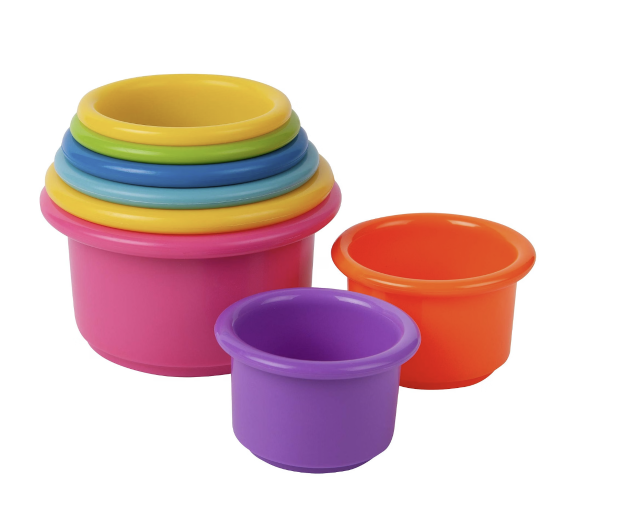
-
Sometimes the simplest toys offer the most opportunities for learning! These eight colorful stacking cups can be stacked into towers, nested inside one another, used to hide objects, or taken into the bathtub for pouring and splashing.
I love how one inexpensive toy can encourage joint attention, imitation, receptive and expressive language, problem-solving, object permanence, fine motor coordination, and early spatial concepts.
Stacking cups are especially useful for introducing words such as up, down, in, out, on, off, more, again, big, little, full, and empty.
And because the cups have holes in their bottoms, they offer an entirely different sensory and language experience during water play!
🧠 Did You Know?
Although stacking cups are often marketed for babies younger than 12 months, the way children use them changes as they develop.
Younger babies may primarily explore the cups by mouthing, banging, and shaking them. As they approach their first birthday, many begin intentionally putting objects into containers, taking them out, and experimenting with stacking and nesting.
By 12–18 months, children are developing more purposeful play skills. They may attempt to build a tower, fit one cup inside another, or search for an object hidden underneath a cup.
These activities help develop spatial awareness, problem-solving, object permanence, and an understanding of cause and effect.
And here's something important: Your toddler doesn't need to build a perfect tower! Knocking it down, trying again, and experimenting with different combinations are all valuable learning experiences.
💜 Let's Play! (12–18 Months)
🏗️ Up, Up, Up... DOWN!
Stack two or three cups while saying, “Up! Up! Up!”
Pause before placing the final cup.
Then encourage your toddler to knock the tower over while you enthusiastically say, “DOWN!”
Repeat the activity and encourage your child to participate in building the tower.
This is a wonderful opportunity to model up, down, more, again, and uh-oh!
🥤 In or Out?
Start with two cups of noticeably different sizes.
Demonstrate putting the smaller cup inside the larger one while saying, “IN!”
Take it out and say, “OUT!”
Allow your toddler to experiment. If the cups don't fit, give them time to problem-solve before offering assistance.
You can also model “Help!” when your child needs assistance.
🙈 Where Did It Go?
Hide a familiar, age-appropriate toy underneath one of the cups.
Ask, “Where's the toy?”
Encourage your toddler to lift the cup and discover what's underneath.
Celebrate with “There it is!” or “You found it!”
Once your child understands the game, try hiding the toy under one of two cups.
This activity supports object permanence, attention, early problem-solving, and understanding simple questions.
💦 Rain, Rain, Rain!
Take the cups into the bathtub or use them at a supervised water table.
Fill a cup with water and lift it so the water drains through the holes.
Say, “Rain, rain, rain!” or “Drip, drip, drip!”
Encourage your toddler to watch, touch the falling water, and attempt to imitate the action.
Introduce words such as wet, water, pour, splash, full, and empty.
👏 Ready, Set... GO!
Build a short tower together.
Say, “Ready... set...” and pause expectantly before saying “GO!” as the tower falls.
After several repetitions, wait to see whether your toddler vocalizes, gestures, looks toward you, or attempts to say “go.”
Respond to any intentional communication and continue the game.
🗣️ My Turn, Your Turn!
Take turns adding cups to a tower.
Say, “My turn!” as you place a cup, then “Your turn!” while offering one to your child.
If your toddler prefers knocking the tower down, incorporate that into the turn-taking game.
The goal is shared interaction, not perfect stacking!
🔍 Big Cup, Little Cup!
Select the largest and smallest cups.
Hold them side by side and say, “BIG cup!” and “Little cup!”
Encourage your toddler to explore the difference in size.
Demonstrate placing the smaller cup inside the larger one.
At this age, you're introducing the concepts rather than expecting your child to identify sizes independently.
🌱 Grow With Me! — Same Toy, New Skills!
18–24 Months: Words & Early Combinations
Encourage two-word combinations such as “More cups,” “Big cup,” and “Tower down!”
Practice stacking and nesting cups with increasing independence.
Introduce simple directions such as “Put the cup on” and “Give me the big cup.”
Encourage imitation of action words such as stack, pour, splash, hide, and fall.
Hide familiar objects under cups and encourage your toddler to find them.
Introduce early pretend play by using cups to give a doll or stuffed animal a pretend drink.
24–36 Months: Growing Language & Imagination
Stack or nest cups by size, from largest to smallest or smallest to largest.
Practice following two-step directions: “Get the little cup and put it inside the big cup.”
Introduce descriptive phrases such as “Big blue cup” or “Tall cup tower.”
Use cups for pretend cooking, serving drinks, or feeding stuffed animals.
Practice counting cups during play without requiring accurate counting.
Compare concepts such as tall/short, full/empty, more/less, and big/little.
Play simple memory games by hiding an object under one of several cups.
3–5 Years: Learning Through Pretend Play
Arrange cups by size and explain the order.
Create simple color or size patterns.
Practice counting objects and matching quantities to the numbers on the cups.
Follow multistep directions involving size, color, and position.
Introduce spatial vocabulary such as beside, between, behind, and under.
Use the cups for pretend restaurants, cooking activities, and imaginative play.
Encourage problem-solving by asking, “How can we make the tower taller?” or “Why doesn't this cup fit?”
Practice sequencing language: first, next, then, and last.
💜 Miss Angie's Reminder
It's not just the toy—it's how you use it!
Your toddler doesn't need to stack all eight cups or put them in the correct order to benefit from this toy.
If your child wants to build a tower and knock it down twenty times, that's okay! Each repetition offers another opportunity to practice communication, problem-solving, and shared attention.
Follow your child's lead, model simple language, and give them time to explore.
Sometimes the best toys are the simplest ones!
Manufacturer's listed age is 9 months and older. Always supervise play, especially during water activities. Never leave a child unattended in or near water, even for a moment. Follow the manufacturer's safety recommendations.
🌱 Move2Play Feed the Fish — Interactive Feeding Toy
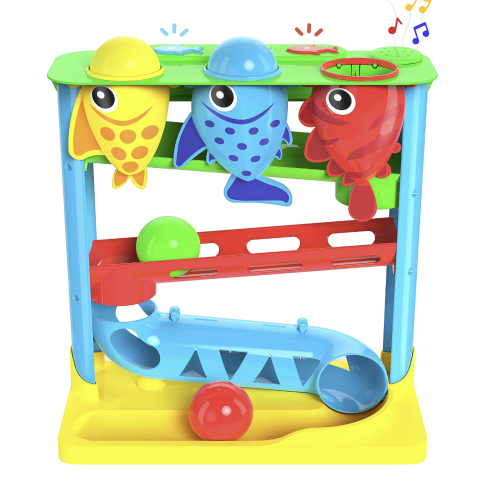
-
Feed the fish! This colorful interactive toy encourages toddlers to place balls into the mouths of three hungry fish, creating opportunities for purposeful play, early communication, and problem-solving.
I especially like the feeding concept because it introduces functional play and the beginnings of pretend play, while encouraging joint attention, imitation, turn-taking, receptive language, and early expressive vocabulary.
As children feed the fish, caregivers can model simple, meaningful words such as eat, in, more, hungry, fish, ball, and all gone.
However, this is one electronic toy where I have some important recommendations about how to use it!
⚠️ A Note from Miss Angie About Electronic Toys
1. Slow Down the Music!
Many electronic toys feature fast-paced music and speech that can make it difficult for young children to process and imitate the language they hear.
If the toy has a setting to turn off the music or lower the volume, I recommend using it.
If the music cannot be disabled independently, consider using the toy without batteries for quieter, caregiver-led play, provided the feeding mechanism still works safely.
2. Less Is More!
This toy advertises more than 40 prerecorded phrases and songs. That's a lot of auditory information for a young toddler!
If the toy allows you to select specific recordings, I recommend choosing just three or four simple, repetitive ones.
If it doesn't, don't worry! Instead, choose three or four words or phrases that YOU consistently model during play.
For example:
“Eat!”
“More fish!”
“Ball in!”
“All gone!”
Repetition helps children become familiar with words and associate them with meaningful actions.
3. You Are More Important Than the Toy!
Electronic toys can be entertaining, but they cannot replace the back-and-forth interactions children need to develop communication skills.
Pause, make eye contact when your child naturally looks toward you, respond to their gestures and vocalizations, and give them opportunities to initiate communication.
The goal is not to have your child listen to 40 different phrases. It's to help them understand and eventually use a few meaningful words!
🧠 Did You Know?
Around their first birthday, many children begin moving from exploratory play toward more purposeful, functional play.
Instead of simply mouthing, shaking, or banging objects, they increasingly understand that objects can be used in specific ways.
For example, putting a ball into a fish's mouth demonstrates an emerging understanding of how objects and actions relate to one another.
As children develop, this can become early pretend play: “The fish is hungry!” “Feed the fish!” “Yummy!”
These playful routines provide opportunities to build receptive language, expressive vocabulary, and social interaction.
💜 Let's Play! (12–18 Months)
🐟 Feed the Fish!
Begin by demonstrating how to place a ball into one fish's mouth.
Say, “Eat!” as the ball goes in.
Offer your toddler another ball and pause to allow them to imitate the action.
Repeat the same simple word each time rather than introducing several different phrases.
🟠 Ball In!
Hold up a ball and say, “Ball!”
Then place it into the fish's mouth while saying, “IN!”
After several demonstrations, encourage your toddler to place the ball independently.
This activity supports object release, imitation, early vocabulary, and understanding spatial concepts.
😋 Hungry Fish!
Point to one fish and say, “Hungry!”
Pretend the fish is asking for food.
Say, “Eat, eat, eat!” as your child feeds it.
You can exaggerate chewing sounds such as “Nom, nom, nom!” to encourage playful vocal imitation.
👏 Ready, Set... FEED!
Hold a ball near the fish.
Say, “Ready... set...” and pause before saying “FEED!”
Watch for a gesture, vocalization, movement, or attempt to complete the phrase.
Respond to your child's communication and continue the activity.
🗣️ More, Please!
After feeding one fish, pause and wait.
Your toddler may reach, point, vocalize, or look toward the balls.
Model “More!” and offer another ball.
Remember, pointing and reaching are meaningful communication attempts. Don't require your child to say a word before continuing.
🤝 My Turn, Your Turn!
Take turns feeding the fish.
Say, “My turn!” as you place a ball into the fish's mouth.
Then offer your child a ball and say, “Your turn!”
Keep the activity short and enjoyable while encouraging shared attention and reciprocal interaction.
🎨 Which Fish?
Point to two fish and ask, “Which one?”
Allow your toddler to choose by reaching, pointing, or looking.
Label the selected fish and say, “Feed this one!”
You can also model the fish's color without expecting your child to identify colors independently.
🌱 Grow With Me! — Same Toy, New Skills!
18–24 Months: Words & Early Combinations
Encourage two-word phrases such as “Fish eat,” “More balls,” and “Hungry fish.”
Practice following simple directions such as “Feed the fish” and “Get the ball.”
Introduce action words such as eat, feed, put, take, and give.
Encourage your toddler to choose which fish to feed.
Model simple pretend-play routines: “Fish hungry!” “Yummy!”
Practice turn-taking with caregivers and siblings.
24–36 Months: Growing Language & Imagination
Expand language into three-word phrases such as “Feed the blue fish.”
Follow two-step directions: “Get a ball and feed the fish.”
Introduce descriptive words such as hungry, full, big, little, and colorful.
Encourage pretend conversations between the fish.
Ask simple questions such as “Who is hungry?” and “What does the fish want?”
Introduce early counting by feeding each fish one or two balls.
3–5 Years: Learning Through Pretend Play
Create imaginative stories about the hungry fish.
Encourage children to explain what each fish wants.
Practice following multistep directions involving colors and quantities.
Introduce sequencing language: first, next, then, and last.
Compare the fish using descriptive vocabulary.
Encourage problem-solving: “What should we do if all the fish are hungry?”
Practice conversational turn-taking through pretend dialogue.
💜 Miss Angie's Reminder
It's not just the toy—it's how you use it!
Electronic toys can be fun, but more sounds, more music, and more words do not automatically mean more language learning.
For young children, I prefer simple language, meaningful repetition, and opportunities for interaction.
If you can reduce or eliminate the prerecorded music, wonderful! If not, focus on slowing down your own language, using a few consistent words, and creating opportunities for your child to communicate.
Remember: Your voice, your responses, and your interactions are more valuable than any prerecorded song!
Always follow the manufacturer's age and safety recommendations, supervise play, and keep battery compartments secured. Do not modify the toy's electrical components.
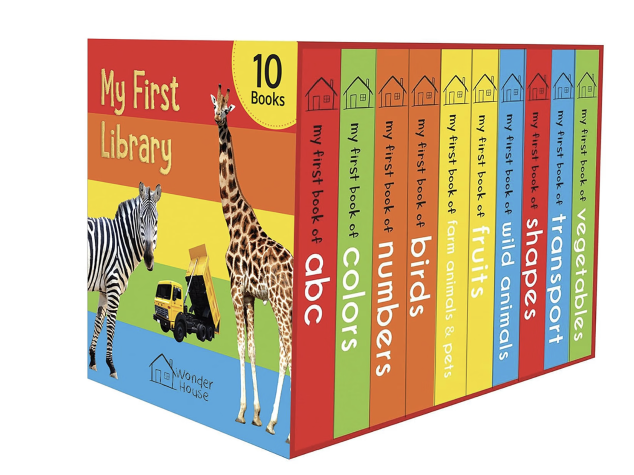
🌱 My First Library: Boxset of 10 Board Books — Wonder House Books
-
Ten little books, so many opportunities for language development!
This colorful collection of board books introduces children to familiar objects, animals, foods, vehicles, colors, shapes, letters, numbers, and more.
I especially love these books for encouraging joint attention, pointing, receptive and expressive vocabulary, picture identification, imitation, early categorization, and shared reading.
The variety of topics allows caregivers to choose pictures that match their child's interests and everyday experiences.
My biggest recommendation? Start with ONE book and just a few familiar pictures!
Although this set includes books about ABCs, numbers, colors, and shapes, I recommend beginning with animals, familiar foods, or vehicles for children 12–18 months old.
Why? Because these pictures represent things children are more likely to encounter in their everyday lives. A child can see a dog in a book, hear it bark outside, and watch a caregiver point to it while saying “Dog!”
These meaningful connections help build early vocabulary and language comprehension.
Save the more structured learning activities involving letters, numbers, and shapes for later developmental stages, while allowing your child to explore those books naturally if interested.
🧠 Did You Know?
Children generally understand many words before they can say them!
During the 12–18-month period, toddlers are developing their ability to connect spoken words with familiar people, objects, and actions.
When you point to a picture of a dog and say “Dog!” your child begins connecting the word with the image.
But language learning becomes even more meaningful when you connect the picture to real life.
For example, after looking at a picture of a banana, point to a banana during snack time and say, “Banana! Yum!”
These repeated connections help children understand that words represent real objects and experiences.
And here's something important: Learning to identify familiar objects and understand meaningful words is generally more useful at this stage than memorizing letters or numbers.
There's no need to rush into academic concepts. Early language development is built through everyday interactions, play, and shared experiences.
Remember, recognizing a picture is different from naming it! Your child may be able to point to a dog long before they can say “dog.” Both are important developmental steps.
💜 Let's Play! (12–18 Months)
📚 Start with Familiar Favorites!
Choose ONE book from the collection.
I recommend starting with the Farm Animals & Pets, Fruits, or Transport books.
Select just two or three pictures and spend time looking at them together.
Point and label: “Dog!” “Banana!” “Car!”
Revisit the same pictures over several days before introducing additional ones.
👆 Where's the Dog?
Begin with two familiar pictures.
Say, “Where's the dog?” and pause.
Your child may look toward, touch, or point to the correct picture.
If they don't respond, point to it yourself and say, “Dog! There's the dog!”
Avoid repeatedly quizzing your child. Model the word, celebrate participation, and keep reading enjoyable.
🐄 Make That Sound!
Use the animal books to introduce playful sounds.
Point to a cow and say, “Moooo!”
Point to a dog and say, “Woof, woof!”
Pause and watch for your child's response.
Animal sounds can provide a wonderful bridge toward early spoken vocabulary.
🚗 Beep, Beep!
Use the transportation book to introduce environmental sounds and actions.
Point to a car and say, “Beep, beep!”
Pretend to drive a car with your hand while saying, “Go!”
Introduce simple words such as car, bus, go, stop, and beep.
Pairing sounds and gestures with pictures makes reading more interactive.
🍎 Book to Real Life!
Choose a familiar picture from the fruits or vegetables books.
Then find the actual food during a meal or snack.
Point to the picture and say, “Apple!”
Show the real apple and repeat, “Apple! Yum!”
This helps children connect pictures and spoken words with real objects.
🗣️ My Turn, Your Turn!
Point to a picture and name it.
Pause and allow your toddler time to respond.
They may point, smile, vocalize, imitate a sound, or attempt a word.
Respond to their communication and continue the interaction.
Remember, a conversation doesn't require two people who can already talk!
📖 Turn the Page!
Encourage your toddler to help turn the sturdy pages.
Model words such as “Turn!” “Open!” “More!” and “All done!”
Pause before turning the next page to encourage your child to communicate that they want to continue.
💜 Let Your Child Choose!
Offer two books and ask, “Which one?”
Allow your toddler to choose by reaching, pointing, or looking.
Label their choice: “Animals! You want animals!”
Giving children meaningful choices encourages intentional communication and helps them understand that their actions influence what happens next.
🌱 Grow With Me! — Same Books, New Skills!
18–24 Months: Words & Early Combinations
Increase the number of familiar pictures your child can identify.
Encourage naming familiar objects and animals.
Introduce two-word phrases such as “Big dog,” “Red car,” and “More apples.”
Practice identifying objects by function: “Which one do we eat?”
Encourage animal sounds and environmental sound imitation.
Follow simple directions such as “Find the banana.”
Connect pictures to real-life objects during everyday routines.
Continue introducing new topics based on your child's interests.
24–36 Months: Growing Language & Imagination
Encourage naming pictures across different categories.
Introduce descriptive vocabulary such as colors, sizes, and shapes.
Practice sorting real objects into categories such as animals, foods, and vehicles.
Ask simple questions such as “What is this?” “Where does it go?” and “What do we do with it?”
Encourage three- and four-word phrases.
Compare familiar objects using big/little and same/different.
Introduce early counting during play without expecting perfect counting accuracy.
Begin exploring the Colors, Shapes, and Numbers books through playful, meaningful activities.
3–5 Years: Learning Through Pretend Play
Name and describe objects using multiple attributes.
Practice categorization and explain why objects belong together.
Identify similarities and differences between pictures.
Discuss object functions: “What do we use a bus for?”
Practice answering who, what, where, and why questions.
Explore the ABCs book by identifying familiar letters, especially those in your child's name.
Introduce early phonological awareness by listening for beginning sounds in familiar words.
Use the Numbers book to practice counting objects and connecting quantities with written numerals.
Create simple stories using pictures from different books.
Encourage children to explain their ideas using complete sentences.
💜 Miss Angie's Reminder
It's not just the book—it's how you use it!
You don't need to introduce all ten books at once, name every picture, or ask your child to repeat every word.
For children 12–18 months old, start with one book featuring familiar animals, foods, or vehicles—not formal ABC or number lessons.
Choose two or three pictures, model simple words, and connect what your child sees in the book to real-life experiences.
As your child grows, gradually introduce additional books and more complex language activities.
Remember: Meaningful vocabulary comes before memorizing academic concepts. Build language first, and let the learning grow from there!
Always supervise young children during book exploration and follow the publisher's age and safety recommendations.
🌱 My First Book of Nursery Rhymes — Little Hippo Books
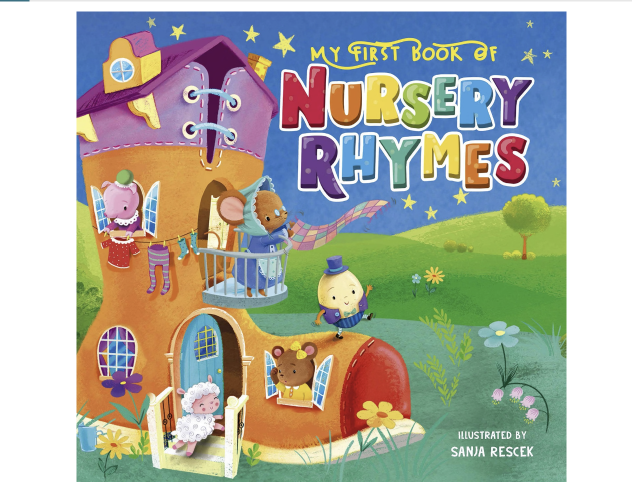
-
One of the reasons I absolutely LOVE nursery rhymes is their repetition of words and phrases, predictable cadence, and rhythm!
Think about it: When children hear the same words and phrases repeated in a familiar rhythm, they begin to anticipate what comes next. That predictability creates wonderful opportunities for listening, language comprehension, vocal imitation, and eventually verbal participation.
The natural rhythm and cadence of nursery rhymes also highlight the patterns, syllables, and stress of spoken language. These are important foundations for speech development and later phonological awareness.
And here's what I especially love: You can slow down, pause, exaggerate a word, or repeat a favorite phrase without losing the fun of the rhyme!
This beautifully illustrated board book introduces classic nursery rhymes that families can enjoy together.
I especially love this book for encouraging auditory attention, early language comprehension, vocal imitation, joint attention, anticipation, gesture imitation, early turn-taking, and the foundations of phonological awareness.
For a young toddler, joining in might mean moving their hands, making a sound, attempting one word, or simply smiling in anticipation. Every one of those responses can be part of a meaningful communication exchange.
My recommendation? Start with just ONE or TWO nursery rhymes!
Choose familiar rhymes with simple actions, such as The Itsy Bitsy Spider or Twinkle, Twinkle Little Star.
Sing or recite them slowly, exaggerate meaningful words, and pair the language with gestures.
Repeat the same rhymes over several days before introducing new ones. Familiarity and repetition are what make nursery rhymes so valuable for early language learning!
🧠 Did You Know?
Long before children can identify rhyming words, they are developing an awareness of the sounds, rhythms, and patterns of spoken language.
Nursery rhymes provide repeated opportunities to hear these patterns in a playful, meaningful way.
During the 12–18-month period, children may begin anticipating familiar parts of songs, imitating gestures, attempting simple sounds, or vocalizing during pauses.
For example, when you sing a familiar rhyme and pause before an exciting action, your toddler may smile, move their hands, vocalize, or look toward you in anticipation.
That's an early form of communication!
These interactions help children learn that communication involves listening, responding, taking turns, and sharing experiences.
And while nursery rhymes provide early exposure to rhyme and sound patterns, we are not expecting toddlers this age to recognize rhyming words or recite entire verses.
Those skills develop much later.
For now, we're building the foundation through enjoyable, repetitive interactions.
💜 Let's Play! (12–18 Months)
🎵 Slow Down the Rhyme!
Choose one familiar nursery rhyme.
Sing or recite it at a comfortable, slower pace.
Emphasize meaningful words and allow time for your toddler to process what they're hearing.
Use facial expressions and gestures to make the experience engaging.
Remember, faster isn't better! Slower, predictable language gives children more opportunities to participate.
🕷️ The Itsy Bitsy Spider — Let's Move!
Use your fingers to imitate a spider climbing.
Encourage your toddler to watch or attempt the movements.
Pair simple words with actions:
“Up!”
“Down!”
“Rain!”
Pause before a familiar movement and watch for your child's response.
Gesture imitation can develop before spoken word imitation, making this a wonderful early communication activity.
⭐ Twinkle, Twinkle — Look Up!
Use gentle hand movements to represent twinkling stars.
Point upward and say, “Star!”
Encourage your toddler to imitate the hand movement if interested.
You can also look at stars in a picture book or point to star decorations around your home.
This connects familiar language with meaningful gestures and objects.
🐷 This Little Piggy — Toe Time!
Gently touch your toddler's toes while reciting the familiar rhyme.
Pause before the playful ending.
Watch for anticipation, smiles, movement, or vocalizations.
Allow your toddler to request another turn through reaching, gestures, sounds, or words.
Always respect your child's comfort with touch and tickling.
🐑 Mary Had a Little Lamb — Baa, Baa!
Point to the lamb in the illustration.
Say, “Lamb!”
Then model “Baa, baa!”
Pause and give your toddler time to respond.
They may attempt the sound, smile, point, or vocalize.
Simple animal sounds can be easier to imitate than longer words and help encourage early speech attempts.
⏸️ Ready, Set... Pause!
Choose a rhyme your toddler knows well.
Sing or recite the familiar portion, then pause before an anticipated word or action.
Look expectantly and allow time for a response.
Your child may vocalize, gesture, move, or attempt a word.
Respond to their participation and continue the rhyme.
Important: Don't turn every pause into a test. The goal is enjoyable interaction, not requiring a verbal response.
📖 Look, Point, and Name!
Open the book to a familiar nursery rhyme.
Point to one or two interesting pictures.
Label them using simple words such as “Spider!” “Star!” “Lamb!” or “Clock!”
Allow your toddler to look, touch, or point.
There's no need to read every word on the page. You can simplify the language while maintaining the familiar rhythm of the rhyme.
🤝 My Turn, Your Turn!
Make a simple sound or movement associated with a familiar rhyme.
Pause and allow your toddler to respond.
Imitate their vocalization or movement.
Continue the playful exchange.
This encourages reciprocal interaction and teaches children that communication involves taking turns.
🌱 Grow With Me! — Same Book, New Skills!
18–24 Months: Words & Early Combinations
Encourage imitation of familiar gestures and movements.
Model single words and short phrases associated with nursery rhymes.
Pause during familiar routines to encourage participation.
Introduce action words such as up, down, fall, jump, and go.
Encourage animal sounds and environmental sound imitation.
Practice identifying familiar pictures from the rhymes.
Begin combining words with actions, such as “Spider up!” or “Star up!”
24–36 Months: Growing Language & Imagination
Encourage joining in with familiar words or short portions of nursery rhymes.
Introduce simple questions about characters and actions.
Practice identifying objects and characters in the illustrations.
Encourage two- and three-word phrases related to the rhymes.
Introduce simple sequencing concepts such as first, next, and last.
Act out familiar nursery rhymes using toys, puppets, or gestures.
Continue exposing children to rhyming words through playful repetition without requiring them to identify rhymes.
3–5 Years: Learning Through Pretend Play
Encourage reciting familiar nursery rhymes with increasing independence.
Practice recognizing and generating simple rhyming words as developmentally appropriate.
Identify words that sound the same at the end.
Clap syllables in familiar words.
Practice identifying beginning sounds in familiar vocabulary.
Retell nursery rhymes using pictures or props.
Sequence events from familiar rhymes.
Answer who, what, where, why, and how questions.
Create silly alternative endings to familiar rhymes.
Encourage children to invent their own rhyming words, including playful nonsense words.
6+ Years: Building Advanced Communication Skills
Explore more complex rhyming patterns and word families.
Identify and manipulate sounds within words.
Compare words that rhyme and explain how their ending sounds are alike.
Practice phonemic awareness through sound substitution and deletion activities.
Discuss unfamiliar vocabulary and figurative language in traditional rhymes.
Compare different versions of familiar nursery rhymes.
Create original rhymes, poems, or short stories.
Explore how rhythm and rhyme contribute to reading fluency and written language.
💜 Miss Angie's Reminder
It's not just the book—it's how you use it!
Nursery rhymes don't have to be sung perfectly, and your child doesn't need to memorize the words.
Start with one or two rhymes. Slow down, use gestures, and repeat them often!
Pause to encourage participation, respond to your child's movements and vocalizations, and make the experience playful.
If your toddler wants to hear the same rhyme ten times, that's perfectly fine! Familiarity creates opportunities for anticipation, imitation, and communication.
And don't worry if your child prefers moving around rather than sitting still. Nursery rhymes can be enjoyed while playing, rocking, walking, or participating in everyday routines.
Remember: The goal isn't to teach your toddler to recite nursery rhymes. It's to use familiar rhythms, words, and movements to encourage meaningful communication!
Always supervise young children during book exploration and follow the publisher's age and safety recommendations.
18–24 Months: Words & Early Combinations
🌱 Atoylink ABC Wooden Building Blocks — 30-Piece Set with Pull Toy Car
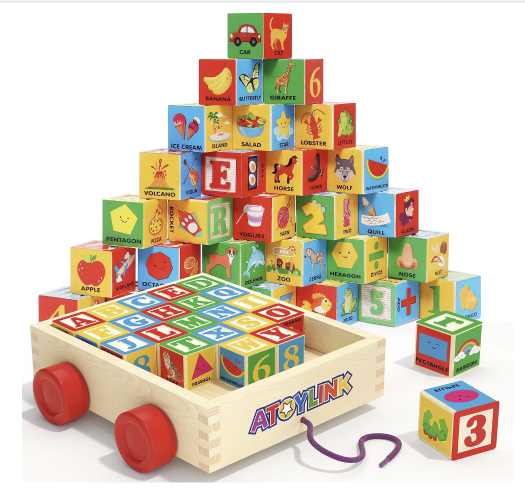
-
Sometimes the simplest toys offer the greatest opportunities for learning!
Traditional wooden building blocks are among my favorite toys because they encourage children to develop hand-eye coordination, fine motor control, visual-spatial awareness, motor planning, problem-solving, and early language skills through hands-on exploration.
What I particularly love about this Atoylink set is that it includes 30 wooden blocks and a pull-along storage wagon. Children can stack, build, knock down, load, unload, and transport the blocks, creating numerous opportunities for purposeful play.
And here's something I feel strongly about: Young children need opportunities to learn how to stack blocks WITHOUT magnets!
Magnetic building toys can be wonderful for older children, but the magnets help hold the pieces together.
With traditional wooden blocks, children must learn to align the blocks, balance them, control their movements, and release each block carefully.
If the tower falls, they receive immediate feedback and have an opportunity to try again.
That trial-and-error process is an important part of learning!
At 18–24 months, block play also provides wonderful opportunities to model early word combinations such as:
“More blocks!”
“Block on!”
“Big tower!”
“Fall down!”
“Put in!”
“Pull wagon!”
My recommendation? Start with just THREE or FOUR blocks, not all 30!
Allow your child to experiment with stacking, balancing, and knocking down a small tower before introducing additional blocks.
The alphabet, numbers, and pictures are wonderful features for later development, but there's no need to teach letters, spelling, or counting at this age.
🧠 Did You Know?
Building a tower involves much more than placing one block on top of another!
Children must coordinate what they see with how they move their hands.
They need to judge where to place each block, adjust their movements, and release it without knocking over the structure.
These experiences develop visual-motor integration, motor planning, spatial awareness, and problem-solving.
And when a tower falls, something important happens!
Your child begins learning about cause and effect.
They may notice that a block placed too close to the edge makes the tower unstable or that moving too quickly causes it to fall.
Through repeated attempts, they gradually learn to adjust their movements.
This is one reason I prefer traditional nonmagnetic blocks for early stacking experiences.
Magnetic blocks can support wonderful construction activities, but they change the balancing demands because the pieces are attracted to one another.
With ordinary wooden blocks, children must discover how to create a stable structure through their own movements and experimentation.
And here's the language connection:
When you describe what your child is doing using short, meaningful phrases, you're helping them connect words with actions.
“Block up!”
“More blocks!”
“Uh-oh! Fall down!”
These simple phrases are especially appropriate for children who are beginning to combine words.
💜 Let's Play! (18–24 Months)
🧱 Start Small — Three or Four Blocks!
Begin with just three or four wooden blocks.
Place the remaining blocks out of sight to reduce distractions.
Demonstrate stacking two blocks while saying, “Block on!”
Then offer your child another block.
Allow them to experiment with placing it on top.
If the tower falls, say, “Uh-oh! Fall down!”
Encourage another attempt without immediately correcting the placement.
The goal isn't to build the tallest tower. It's to learn HOW to build one!
⬆️ Up, Up, Up!
As your child stacks blocks, model:
“Up!”
“More up!”
“Block on!”
“Big tower!”
Use gestures to emphasize the direction of movement.
Pause between blocks to give your child an opportunity to initiate another turn or attempt a word combination.
This activity introduces spatial vocabulary and early two-word phrases.
💥 Ready, Set... CRASH!
Build a small tower together.
Say, “Ready... set...” and pause.
Watch for your child's anticipation.
Then say, “CRASH!” as the tower falls.
Encourage your child to knock it down and rebuild it.
Model phrases such as:
“Fall down!”
“Do again!”
“More blocks!”
“Big crash!”
This encourages anticipation, cause-and-effect learning, turn-taking, and early expressive language.
🚗 Load the Wagon!
Place the wooden wagon beside your child.
Demonstrate putting one block into the wagon while saying, “Block in!”
Encourage your child to add another block.
Then remove a block and say, “Block out!”
Continue using simple phrases such as:
“Put in!”
“Take out!”
“More blocks!”
“All gone!”
This activity supports spatial concepts, following directions, and functional vocabulary.
🚶 Pull, Pull, STOP!
Place a few blocks into the wagon.
Demonstrate pulling it while saying, “Go!”
Then stop and say, “STOP!”
Encourage your child to participate in the routine.
Introduce phrases such as:
“Pull wagon!”
“Go fast!”
“Stop now!”
“More blocks!”
This activity encourages action vocabulary, listening, and early word combinations.
🤲 My Turn, Your Turn!
Build a tower together.
Place one block and say, “My turn!”
Offer your child another block and say, “Your turn!”
Continue alternating turns.
If your child wants to build independently, allow them to do so while you narrate their actions.
Turn-taking should be encouraged naturally rather than becoming a requirement that interrupts enjoyable play.
👀 Uh-Oh! Why Did It Fall?
Build a small tower and allow your child to experiment.
If a block falls, pause before helping.
Say, “Uh-oh! Fell down!”
Then model, “Try again!”
You can demonstrate moving a block toward the center while saying, “Move it!”
Allow your child time to attempt another placement.
Avoid fixing every mistake. Experimentation is how children learn!
🏠 Build Something!
Use a few blocks to create a simple structure.
Build a small wall, road, or garage for a toy car.
Model phrases such as:
“Build wall!”
“Car in!”
“Car out!”
“Big house!”
Encourage your child to imitate actions and explore simple pretend-play routines.
🌱 Grow With Me! — Same Toy, New Skills!
24–36 Months: Growing Language & Imagination
Gradually increase the number of blocks available during play.
Encourage building taller towers and simple structures.
Introduce three- and four-word phrases such as “Put the block on.”
Practice following two-step directions: “Get a block and put it in the wagon.”
Introduce spatial concepts such as on, under, beside, behind, and between.
Compare structures using tall/short, big/little, and more/less.
Encourage pretend play by building houses, garages, bridges, and roads.
Begin sorting blocks by pictures or other visible features.
Practice problem-solving when structures become unstable.
3–5 Years: Learning Through Pretend Play
Encourage building increasingly complex structures.
Practice planning a structure before beginning construction.
Introduce descriptive language involving size, shape, position, and quantity.
Follow multistep directions to construct specific designs.
Encourage children to explain how they built their structures.
Introduce early counting by counting blocks during play.
Explore letters and numbers printed on the blocks.
Match letters or pictures to the included cards when developmentally appropriate.
Practice identifying beginning sounds in familiar picture names.
Encourage imaginative storytelling using the structures they create.
Introduce problem-solving questions such as “Why did the tower fall?” and “How can we make it stronger?”
6+ Years: Building Advanced Communication Skills
Design and build more elaborate structures.
Follow written or verbal construction directions.
Practice describing designs using precise spatial vocabulary.
Encourage explaining and justifying construction decisions.
Explore symmetry, patterns, measurement, and basic engineering concepts.
Use the alphabet blocks for spelling and word-building activities.
Practice phonemic awareness by changing, adding, or removing sounds in words.
Create categories using the pictures on the blocks.
Develop storytelling activities involving characters, settings, problems, and solutions.
Encourage cooperative construction projects that require planning, negotiation, and communication.
💜 Miss Angie's Reminder
It's not just the toy—it's how you use it!
Children don't need magnetic blocks, elaborate building sets, or complicated instructions to learn important skills.
Traditional wooden blocks give children the opportunity to discover how stacking and balancing actually work.
Start with three or four blocks and allow your child to experiment.
Let towers fall!
Let your child try again!
Resist the temptation to immediately straighten every block or fix every unstable structure.
And remember, at 18–24 months, we're not focusing on memorizing the alphabet or numbers printed on the blocks.
We're encouraging purposeful play, problem-solving, early vocabulary, and meaningful word combinations.
The goal isn't to build the perfect tower. It's to learn through building, experimenting, and trying again!
Safety Note: Follow the manufacturer's age recommendations and inspect the blocks and wagon regularly for splinters, loose parts, paint damage, and other hazards. Supervise play, particularly when using the pull cord, and keep cords away from the neck. Use the matching cards only when appropriate for your child's developmental level and the manufacturer's safety guidance.
🌱 Wanborns Wooden Airliner with Lights & Sound — Ages 18 Months+
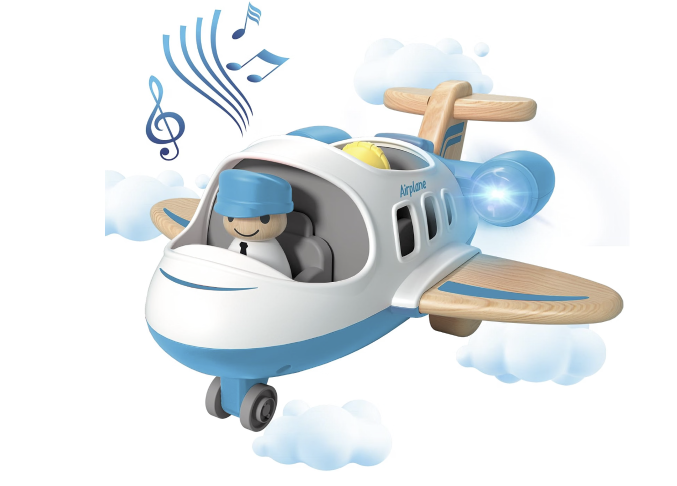
-
Sometimes the simplest toys offer the greatest opportunities for learning!
Traditional wooden building blocks are among my favorite toys because they encourage children to develop hand-eye coordination, fine motor control, visual-spatial awareness, motor planning, problem-solving, and early language skills through hands-on exploration.
What I particularly love about this Atoylink set is that it includes 30 wooden blocks and a pull-along storage wagon. Children can stack, build, knock down, load, unload, and transport the blocks, creating numerous opportunities for purposeful play.
And here's something I feel strongly about: Young children need opportunities to learn how to stack blocks WITHOUT magnets!
Magnetic building toys can be wonderful for older children, but the magnets help hold the pieces together.
With traditional wooden blocks, children must learn to align the blocks, balance them, control their movements, and release each block carefully.
If the tower falls, they receive immediate feedback and have an opportunity to try again.
That trial-and-error process is an important part of learning!
At 18–24 months, block play also provides wonderful opportunities to model early word combinations such as:
“More blocks!”
“Block on!”
“Big tower!”
“Fall down!”
“Put in!”
“Pull wagon!”
My recommendation? Start with just THREE or FOUR blocks, not all 30!
Allow your child to experiment with stacking, balancing, and knocking down a small tower before introducing additional blocks.
The alphabet, numbers, and pictures are wonderful features for later development, but there's no need to teach letters, spelling, or counting at this age.
🧠 Did You Know?
Building a tower involves much more than placing one block on top of another!
Children must coordinate what they see with how they move their hands.
They need to judge where to place each block, adjust their movements, and release it without knocking over the structure.
These experiences develop visual-motor integration, motor planning, spatial awareness, and problem-solving.
And when a tower falls, something important happens!
Your child begins learning about cause and effect.
They may notice that a block placed too close to the edge makes the tower unstable or that moving too quickly causes it to fall.
Through repeated attempts, they gradually learn to adjust their movements.
This is one reason I prefer traditional nonmagnetic blocks for early stacking experiences.
Magnetic blocks can support wonderful construction activities, but they change the balancing demands because the pieces are attracted to one another.
With ordinary wooden blocks, children must discover how to create a stable structure through their own movements and experimentation.
And here's the language connection:
When you describe what your child is doing using short, meaningful phrases, you're helping them connect words with actions.
“Block up!”
“More blocks!”
“Uh-oh! Fall down!”
These simple phrases are especially appropriate for children who are beginning to combine words.
💜 Let's Play! (18–24 Months)
🧱 Start Small — Three or Four Blocks!
Begin with just three or four wooden blocks.
Place the remaining blocks out of sight to reduce distractions.
Demonstrate stacking two blocks while saying, “Block on!”
Then offer your child another block.
Allow them to experiment with placing it on top.
If the tower falls, say, “Uh-oh! Fall down!”
Encourage another attempt without immediately correcting the placement.
The goal isn't to build the tallest tower. It's to learn HOW to build one!
⬆️ Up, Up, Up!
As your child stacks blocks, model:
“Up!”
“More up!”
“Block on!”
“Big tower!”
Use gestures to emphasize the direction of movement.
Pause between blocks to give your child an opportunity to initiate another turn or attempt a word combination.
This activity introduces spatial vocabulary and early two-word phrases.
💥 Ready, Set... CRASH!
Build a small tower together.
Say, “Ready... set...” and pause.
Watch for your child's anticipation.
Then say, “CRASH!” as the tower falls.
Encourage your child to knock it down and rebuild it.
Model phrases such as:
“Fall down!”
“Do again!”
“More blocks!”
“Big crash!”
This encourages anticipation, cause-and-effect learning, turn-taking, and early expressive language.
🚗 Load the Wagon!
Place the wooden wagon beside your child.
Demonstrate putting one block into the wagon while saying, “Block in!”
Encourage your child to add another block.
Then remove a block and say, “Block out!”
Continue using simple phrases such as:
“Put in!”
“Take out!”
“More blocks!”
“All gone!”
This activity supports spatial concepts, following directions, and functional vocabulary.
🚶 Pull, Pull, STOP!
Place a few blocks into the wagon.
Demonstrate pulling it while saying, “Go!”
Then stop and say, “STOP!”
Encourage your child to participate in the routine.
Introduce phrases such as:
“Pull wagon!”
“Go fast!”
“Stop now!”
“More blocks!”
This activity encourages action vocabulary, listening, and early word combinations.
🤲 My Turn, Your Turn!
Build a tower together.
Place one block and say, “My turn!”
Offer your child another block and say, “Your turn!”
Continue alternating turns.
If your child wants to build independently, allow them to do so while you narrate their actions.
Turn-taking should be encouraged naturally rather than becoming a requirement that interrupts enjoyable play.
👀 Uh-Oh! Why Did It Fall?
Build a small tower and allow your child to experiment.
If a block falls, pause before helping.
Say, “Uh-oh! Fell down!”
Then model, “Try again!”
You can demonstrate moving a block toward the center while saying, “Move it!”
Allow your child time to attempt another placement.
Avoid fixing every mistake. Experimentation is how children learn!
🏠 Build Something!
Use a few blocks to create a simple structure.
Build a small wall, road, or garage for a toy car.
Model phrases such as:
“Build wall!”
“Car in!”
“Car out!”
“Big house!”
Encourage your child to imitate actions and explore simple pretend-play routines.
🌱 Grow With Me! — Same Toy, New Skills!
24–36 Months: Growing Language & Imagination
Gradually increase the number of blocks available during play.
Encourage building taller towers and simple structures.
Introduce three- and four-word phrases such as “Put the block on.”
Practice following two-step directions: “Get a block and put it in the wagon.”
Introduce spatial concepts such as on, under, beside, behind, and between.
Compare structures using tall/short, big/little, and more/less.
Encourage pretend play by building houses, garages, bridges, and roads.
Begin sorting blocks by pictures or other visible features.
Practice problem-solving when structures become unstable.
3–5 Years: Learning Through Pretend Play
Encourage building increasingly complex structures.
Practice planning a structure before beginning construction.
Introduce descriptive language involving size, shape, position, and quantity.
Follow multistep directions to construct specific designs.
Encourage children to explain how they built their structures.
Introduce early counting by counting blocks during play.
Explore letters and numbers printed on the blocks.
Match letters or pictures to the included cards when developmentally appropriate.
Practice identifying beginning sounds in familiar picture names.
Encourage imaginative storytelling using the structures they create.
Introduce problem-solving questions such as “Why did the tower fall?” and “How can we make it stronger?”
6+ Years: Building Advanced Communication Skills
Design and build more elaborate structures.
Follow written or verbal construction directions.
Practice describing designs using precise spatial vocabulary.
Encourage explaining and justifying construction decisions.
Explore symmetry, patterns, measurement, and basic engineering concepts.
Use the alphabet blocks for spelling and word-building activities.
Practice phonemic awareness by changing, adding, or removing sounds in words.
Create categories using the pictures on the blocks.
Develop storytelling activities involving characters, settings, problems, and solutions.
Encourage cooperative construction projects that require planning, negotiation, and communication.
💜 Miss Angie's Reminder
It's not just the toy—it's how you use it!
Children don't need magnetic blocks, elaborate building sets, or complicated instructions to learn important skills.
Traditional wooden blocks give children the opportunity to discover how stacking and balancing actually work.
Start with three or four blocks and allow your child to experiment.
Let towers fall!
Let your child try again!
Resist the temptation to immediately straighten every block or fix every unstable structure.
And remember, at 18–24 months, we're not focusing on memorizing the alphabet or numbers printed on the blocks.
We're encouraging purposeful play, problem-solving, early vocabulary, and meaningful word combinations.
The goal isn't to build the perfect tower. It's to learn through building, experimenting, and trying again!
Safety Note: Follow the manufacturer's age recommendations and inspect the blocks and wagon regularly for splinters, loose parts, paint damage, and other hazards. Supervise play, particularly when using the pull cord, and keep cords away from the neck. Use the matching cards only when appropriate for your child's developmental level and the manufacturer's safety guidance.
🌱NUBUNI 3-Piece Pop-Up Play Tent, Crawl Tunnel & Ball Pit
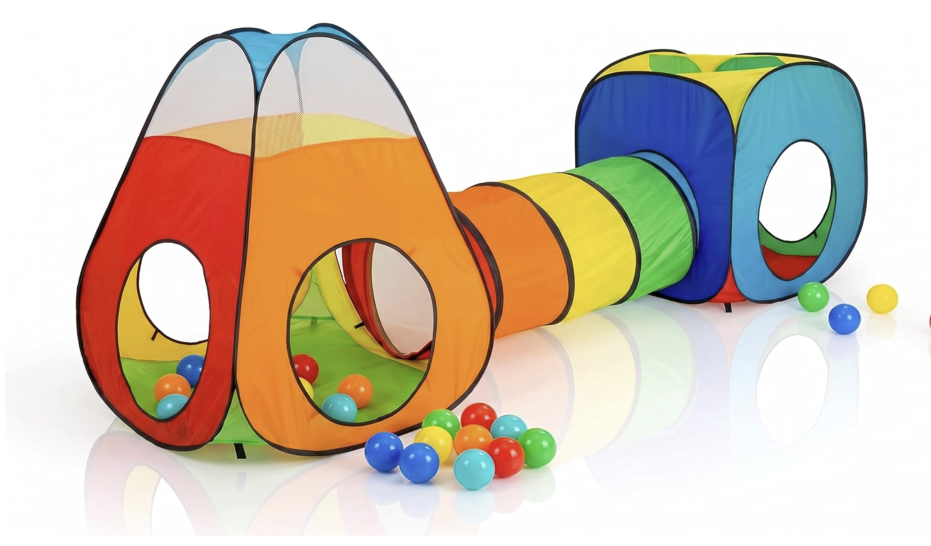
-
Three play spaces, endless opportunities for language! 💜
What makes this toy so special is that children aren't just sitting and playing with an object. They're moving, exploring, interacting, and discovering how their bodies relate to the world around them.
The NUBUNI 3-Piece Play Tent includes a playhouse, crawl-through tunnel, and ball-pit area that can be used individually or connected together.
And each section offers different opportunities for speech and language development!
🏠 The Playhouse: Encourages greetings, early pretend play, social interaction, and functional communication.
🌈 The Crawl Tunnel: Introduces movement vocabulary, spatial concepts, following directions, and anticipation.
🔵 The Ball Pit: Encourages requesting, action words, turn-taking, and early word combinations.
At 18–24 months, many children are beginning to use more words, combine familiar words into short phrases, and understand increasingly complex language.
This play set provides natural opportunities to model:
“Come in!”
“Go through!”
“Ball in!”
“More balls!”
“Where's Mommy?”
“I see you!”
“Go again!”
“All done!”
And here's something I particularly love: You don't have to set up all three sections at once!
Start with just the playhouse or tunnel. Allow your child to explore and become comfortable with it.
Then introduce another section when they're ready.
This helps keep play manageable while giving parents opportunities to follow their child's interests.
And unlike electronic toys that do the talking for children, this play set encourages children and caregivers to communicate with each other!
🧠 Did You Know?
Movement and language development are closely connected!
Young children learn many early words by experiencing actions rather than simply hearing adults name them.
Think about words such as:
In. Out. Up. Down. Through. Go. Stop.
These words become much more meaningful when children can actually experience the movements they describe.
When your child crawls through a tunnel and hears “Go THROUGH!”, they're connecting language with a physical experience.
When they emerge from the tunnel and hear “You're OUT!”, they're learning another spatial concept.
When they place a ball into the pit and hear “Ball IN!”, they're experiencing that relationship firsthand.
Repeated, meaningful experiences help children develop receptive and expressive vocabulary.
And here's another important developmental connection: Anticipation encourages communication!
Imagine your child waiting at the entrance of the tunnel.
You say:
“Ready... set...”
Then pause.
Your child may look at you, smile, gesture, vocalize, or attempt to say “GO!”
Those are all meaningful communication opportunities!
You can respond enthusiastically:
“GO! Through the tunnel!”
Miss Angie's Tip: The pause is important, but it shouldn't become a demand.
Give your child a brief opportunity to participate, then continue the fun whether or not they produce a word.
Communication develops through enjoyable, responsive interactions—not pressure to perform.
And remember, children don't need to master every spatial concept at this age. We're introducing vocabulary naturally through play and repetition.
💜 Let's Play! (18–24 Months)
🏠 1. Knock, Knock! Who's There?
Begin with the playhouse section.
Sit outside while your child explores inside, or reverse roles.
Gently knock on the entrance.
Say:
“Knock, knock!”
“Who's there?”
“It's Mommy!”
“Hello!”
“Come in!”
Encourage your child to greet you through a wave, smile, vocalization, or word.
You can also practice:
“Bye-bye!”
“See you!”
“Come back!”
Language Focus: Greetings, social interaction, anticipation, early pretend play, and functional communication.
🌈 2. Ready, Set... GO!
Use the crawl tunnel by itself.
Position yourself where your child can see you at the other end.
Say:
“Ready... set...”
Pause briefly.
Then say:
“GO!”
As your child crawls through, model:
“Go through!”
“Keep going!”
“Here you come!”
“You're out!”
Repeat as long as your child remains interested.
You may hear your child begin to anticipate or imitate “go!”
Language Focus: Action words, anticipation, motor imitation, and early word combinations.
👀 3. Where Did You Go?
Encourage your child to crawl into the playhouse or tunnel.
Pretend you can't find them.
Say:
“Where are you?”
“Where's my baby?”
Pause.
When they appear, say:
“There you are!”
“I see you!”
“Found you!”
Then switch roles and allow your child to look for you.
This simple hide-and-find game can be especially motivating for toddlers.
Language Focus: Joint attention, social reciprocity, early question understanding, and familiar phrases.
🔵 4. Ball IN! Ball OUT!
Introduce the ball-pit section with five or six large, age-appropriate play balls.
You don't need to fill the pit!
Sit beside your child and demonstrate putting one ball inside.
Say:
“Ball IN!”
Then remove it.
“Ball OUT!”
Encourage your child to repeat the actions.
Model:
“Put in!”
“Take out!”
“More balls!”
“All gone!”
Language Focus: Spatial concepts, action words, early word combinations, and receptive language.
💜 5. More Balls, Please!
Begin with two or three balls in the pit.
Keep a few additional balls beside you.
When your child reaches or gestures for another, model:
“More ball!”
“Want ball!”
“More, please!”
Give the child the ball while responding to their communication.
If they attempt a word, celebrate the effort!
But remember, pointing, reaching, signing, and vocalizing are also meaningful communication attempts.
Language Focus: Requesting, intentional communication, functional vocabulary, and early expressive language.
🧸 6. Teddy Goes Through!
Bring a favorite stuffed animal to the play area.
Show your child Teddy sitting outside the tunnel.
Say:
“Teddy go?”
“Go, Teddy!”
Move Teddy through the tunnel.
“Through tunnel!”
“Here he comes!”
“Hi, Teddy!”
Then allow your child to help Teddy travel through the tunnel or into the playhouse.
You can also model:
“Teddy in!”
“Teddy out!”
“Teddy sleep!”
Language Focus: Early pretend play, action vocabulary, simple sentence models, and symbolic play.
🚪 7. Come In! Go Out!
Use the playhouse entrance to introduce simple directions.
Model:
“Come in!”
“Go out!”
“Sit down!”
“Stand up!”
“Come here!”
Demonstrate the actions as needed.
Keep the activity playful rather than turning it into a test.
For children who are just beginning to understand directions, use gestures and familiar routines to support comprehension.
Language Focus: Following simple directions, spatial vocabulary, action words, and receptive language.
🔴 8. Find the Ball!
Place one or two balls in easy-to-see locations within the play area.
Say:
“Where's ball?”
“Find ball!”
“Look inside!”
When your child retrieves one, model:
“Found it!”
“Got ball!”
“Another ball!”
As your child becomes more familiar with the activity, introduce different locations.
Language Focus: Object identification, early questions, spatial concepts, and functional vocabulary.
🎵 9. The Tunnel Train!
Pretend the tunnel is part of a train adventure.
Say:
“Choo-choo!”
“Train coming!”
“Go, go, go!”
“Stop!”
You can sing a simple, repetitive train song while your child crawls through.
Add pauses to encourage anticipation.
Children may imitate environmental sounds before they're able to produce longer words.
And that's perfectly appropriate!
Language Focus: Environmental sound imitation, rhythm, repetition, action words, and early pretend play.
🧺 10. All Done! Clean-Up Time!
At the end of play, encourage your child to help collect the balls and familiar toys.
Say:
“Get ball!”
“Put in!”
“More balls!”
“All done!”
“Bye-bye, Teddy!”
You can sing a short cleanup song while putting materials away.
Young children benefit from predictable routines and repeated language.
Language Focus: Functional vocabulary, following directions, sequencing foundations, and participation in daily routines.
🌱 Grow With Me! — Same Toy, New Skills!
24–36 Months: Growing Language & Imagination
As your child's language develops, the play set can support increasingly complex communication.
Model longer phrases: “I'm going through!” and “Put the ball inside.”
Practice two-step directions: “Get Teddy and put him in the house.”
Introduce more spatial concepts, including behind, beside, and under.
Encourage simple pretend play: Teddy is sleeping, the puppy is hiding, or Mommy is visiting.
Practice early question forms: “Where's Teddy?” and “Who's inside?”
Introduce simple sequences: “First crawl through, then get a ball.”
Encourage color vocabulary using appropriately sized play balls.
Practice turn-taking with siblings or caregivers.
Encourage children to describe what they're doing.
Introduce simple obstacle-course activities with adult assistance.
3–5 Years: Learning Through Pretend Play
At this age, the playhouse can become an entire imaginary world!
Transform the playhouse into a grocery store, doctor's office, restaurant, or campsite.
Practice conversational exchanges during pretend play.
Follow two- and three-step directions.
Introduce more complex spatial vocabulary.
Create obstacle courses with verbal instructions.
Practice sequencing: “First I went through the tunnel, then I found the ball.”
Encourage descriptive language involving colors, sizes, and locations.
Practice sorting and simple patterns using play balls.
Introduce cooperative games requiring turn-taking and shared planning.
Encourage children to explain the rules of a game.
Practice answering who, what, where, when, and why questions.
6+ Years: Building Advanced Communication Skills
For older children who still fit comfortably and enjoy using the set, the play areas can become part of more challenging language activities.
Design obstacle courses and explain the steps.
Practice giving detailed directions to another person.
Use precise spatial vocabulary.
Create imaginative stories involving the playhouse and tunnel.
Practice sequencing and retelling events.
Introduce problem-solving challenges.
Encourage collaborative planning and negotiation.
Practice explaining game rules clearly.
Use balls for sorting, patterns, and basic mathematical language.
Develop storytelling skills using characters, settings, problems, and solutions.
💜 Miss Angie's Reminder
It's not just the toy—it's how you use it!
Sometimes the best language-building toys aren't toys that talk, sing, or light up.
They're toys that encourage children to move, explore, interact, and communicate!
The NUBUNI Play Tent offers three wonderful play environments, but you don't need to use them all at once.
Start with one section.
Follow your child's lead.
Model short, meaningful phrases.
“Go through!”
“Come in!”
“Ball out!”
“More, please!”
“Where's Teddy?”
And don't feel that you need to talk constantly!
Sometimes a smile, a pause, or an expectant look creates the perfect opportunity for your child to initiate communication.
The goal isn't to get your toddler to repeat every word you say.
The goal is to help your child discover that communication makes play more enjoyable and meaningful.
And as your child grows, the same play set can encourage pretend play, longer sentences, sequencing, following directions, and cooperative interaction.
One play set. Three play spaces. So many opportunities to connect, communicate, and grow! 💜
Safety Reminder: This recommendation is for the specific NUBUNI 3-piece version identified as ASIN B08CTZG2FP, which is listed for ages 12 months and older. Always follow the age and safety information on the exact product packaging. Adult assembly and continuous supervision are important, particularly around the pop-up frame, tunnel connections, and ball-pit area. Keep entrances unobstructed, inspect the frame and fabric regularly, and use only large, intact, age-appropriate balls. Balls are not included. Never use the play tent as an unsupervised sleep space.
🌱Old MacDonald Had a Farm — Sing-Along Musical Board Book
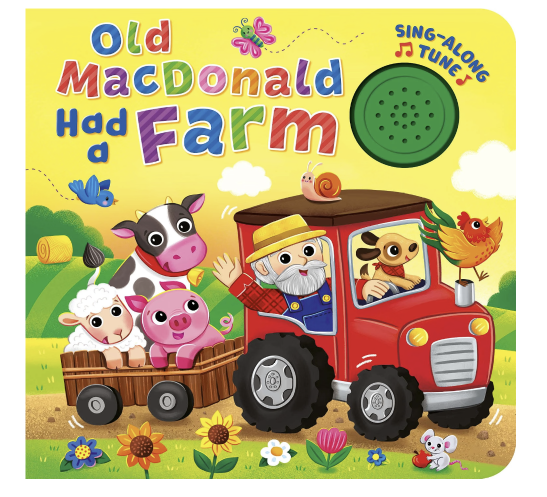
-
E-I-E-I-O! Let's sing, make animal sounds, and build language together! 🐮🐷🐤
Sometimes the most familiar childhood songs provide some of the best opportunities for early speech and language development!
Old MacDonald Had a Farm is a colorful board book featuring familiar farm animals and a button that plays the song's melody.
What I particularly love about this book is how it combines music, repetition, animal vocabulary, environmental sound imitation, joint attention, and early word combinations into one enjoyable activity.
At 18–24 months, many toddlers are expanding their vocabulary and beginning to combine familiar words into short phrases.
And animal sounds can be a wonderful starting point!
A child who isn't yet saying cow may be able to imitate “moo!”
A child who isn't saying sheep may attempt “baa!”
And a child who isn't ready to sing the entire song may happily participate with “E-I-E-I-O!”
These vocalizations are meaningful opportunities to practice speech sounds, syllable patterns, and communication.
Parents can model:
“Moo, moo!”
“Cow says moo!”
“Hi, pig!”
“Duck goes quack!”
“More song!”
“Sing again!”
And here's something I especially appreciate: The musical button plays the melody, allowing parents to provide the singing!
Rather than listening passively to a toy recite an entire song, children can hear a familiar tune while their caregiver sings, points to pictures, makes animal sounds, and encourages participation.
The real language-building opportunity comes from the interaction between the child and caregiver.
And there's another reason I chose this book for Miss Angie's Toy Box:
It pairs beautifully with the Fisher-Price Little People See 'n Say featured in this same age group!
The book introduces animals through music and repetition, while the See 'n Say provides opportunities to associate animal pictures with their corresponding sounds.
Together, they offer two enjoyable ways to reinforce the same vocabulary!
🧠 Did You Know?
Environmental sounds are an important part of early speech development!
Before children can consistently produce longer words and sentences, they may imitate familiar sounds such as:
“Moo!”
“Baa!”
“Oink!”
“Quack!”
“Beep-beep!”
“Uh-oh!”
These sounds are meaningful because they encourage children to experiment with their voices, imitate sound patterns, and participate in communication.
Animal sounds also offer opportunities to practice different speech movements.
For example:
“Moo!” encourages lip closure for /m/ followed by a sustained vowel.
“Baa!” provides an opportunity to practice /b/ followed by an open vowel.
“Peep-peep!” introduces repeated syllables beginning with /p/.
“Quack!” exposes children to a more complex sound sequence that may initially be approximated.
Not every child will produce these sounds accurately, and that's perfectly appropriate!
A child's attempt to imitate a sound is more important than perfect pronunciation at this stage.
And there's another important connection:
Music introduces children to the rhythm and patterns of spoken language.
Familiar songs contain predictable sequences, repeated phrases, and changes in rhythm and pitch.
These features can help children anticipate what comes next and participate through sounds, gestures, or words.
For example, when you sing about a cow and pause before “moo,” your child may anticipate the sound.
They might smile, look at you, move their mouth, vocalize, or attempt “moo!”
All of these are opportunities for communication.
Miss Angie's Tip: Sing slowly enough for your child to participate!
You don't have to follow the recording's exact tempo.
In fact, singing without the musical button sometimes makes it easier to slow down, pause, repeat favorite sounds, and follow your child's lead.
At this age, we're building familiarity with rhythm and sound patterns—not expecting children to identify rhymes or clap syllables independently.
💜 Let's Play! (18–24 Months)
🐮 1. What Does the Cow Say?
Open the book to a page featuring a cow.
Point to the picture.
Say:
“Look! Cow!”
“Hi, cow!”
“Cow says... MOO!”
Repeat the sound slowly.
“Moooo!”
Pause briefly to allow your child an opportunity to imitate.
If your child makes a sound approximation, respond enthusiastically.
“Yes! MOO!”
Language Focus: Animal vocabulary, environmental sound imitation, joint attention, and early expressive language.
🎵 2. Sing and Pause!
Begin singing the familiar song.
When you reach an animal sound, pause.
For example:
“And on his farm he had a cow...”
Continue the familiar tune, then pause just before the expected animal sound.
Look expectantly at your child.
If they vocalize, gesture, smile, or attempt the sound, respond naturally and continue singing.
If they don't respond, simply model the sound yourself.
“Here a MOO!”
Language Focus: Anticipation, auditory memory, vocal participation, and turn-taking.
🐷 3. Oink, Oink! Moo, Moo!
Choose two familiar animals from the book.
Model each sound.
“Cow—MOO!”
“Pig—OINK!”
Alternate between them.
You might say:
“Moo, moo!”
“Oink, oink!”
Encourage your child to imitate whichever sound interests them.
Some children may imitate the vowel or rhythm before producing the complete sound.
That's a meaningful beginning!
Language Focus: Auditory discrimination, sound imitation, and early speech sound practice.
👆 4. Find the Animal!
Show your child a page with familiar animals.
Say:
“Where's cow?”
“Find pig!”
“Show me duck!”
Allow your child to point, touch, or look toward the animal.
If they aren't ready to identify the animal independently, point to it yourself.
“There's cow!”
“Cow says moo!”
Avoid turning every page into a quiz.
The goal is to connect animal names with pictures through enjoyable interaction.
Language Focus: Receptive vocabulary, object identification, and following simple directions.
💜 5. More Song, Please!
Sing one short section of the song.
Then stop.
Wait briefly to see whether your child indicates they want more.
They may reach for the book, point to the button, look at you, vocalize, sign, or say a word.
Model:
“More song!”
“Sing again!”
“Want more?”
Then continue singing.
Don't require your child to say “more” before continuing.
Language Focus: Requesting, intentional communication, and early word combinations.
🐤 6. E-I-E-I-O!
The repeated “E-I-E-I-O” phrase provides a wonderful opportunity for vocal play.
Sing the phrase slowly and playfully.
Emphasize the changing vowel sounds.
“E-I-E-I-O!”
Your child may initially imitate only the final “O!”
That's perfectly fine!
You can also emphasize the rhythm with gentle clapping or tapping.
Language Focus: Vocal imitation, vowel exploration, auditory attention, and rhythm.
📖 7. Read the Pictures!
You don't have to sing the entire song every time you open the book.
Instead, explore the illustrations.
Point to familiar animals.
Model:
“Big cow!”
“Little duck!”
“Hi, sheep!”
“Pig eating!”
“Cow standing!”
Use descriptions that match the illustrations.
Follow your child's interests and spend extra time on favorite pages.
Language Focus: Descriptive vocabulary, action words, joint attention, and early two-word combinations.
🐮 8. Book to Toy: Find the Same Animal!
Place the Old MacDonald Had a Farm book beside your Fisher-Price Little People See 'n Say.
Show your child an animal in the book.
Say:
“Look! Cow!”
Then find the cow on the See 'n Say.
“Another cow!”
“Same animal!”
Use the See 'n Say to hear the animal sound.
Then imitate it together.
“MOO!”
Repeat with another familiar animal.
Begin with only two or three animals rather than trying to identify every animal on the toy.
Language Focus: Connecting pictures across materials, vocabulary generalization, auditory association, and sound imitation.
🎶 9. You Be the Farmer!
Pretend your child is Old MacDonald.
Say:
“Your farm!”
“Hi, farmer!”
“Cow on farm!”
Let your child choose an animal from the book.
Then sing about that animal.
You can also bring in toy farm animals or stuffed animals if available.
Model:
“Cow here!”
“Pig sleeping!”
“Duck go!”
Follow your child's lead as they begin to explore pretend play.
Language Focus: Early symbolic play, choice-making, action vocabulary, and simple phrases.
👋 10. Bye-Bye, Farm Animals!
At the end of the activity, say goodbye to the animals.
“Bye-bye, cow!”
“Bye, pig!”
“Night-night, sheep!”
“See you, duck!”
Encourage your child to wave or imitate a familiar sound.
Then close the book.
“All done!”
“More tomorrow!”
This creates a predictable ending to the activity.
Language Focus: Greetings, functional communication, familiar routines, and early word combinations.
🌱 Grow With Me! — Same Book, New Skills!
24–36 Months: Growing Language & Imagination
As your child's vocabulary expands, use the book to encourage longer phrases and more detailed language.
Model phrases such as “The cow says moo!”
Encourage children to name familiar farm animals.
Practice matching animals with their sounds.
Introduce simple descriptions such as big cow and little duck.
Practice answering “What?” and “Where?” questions.
Encourage children to choose which animal comes next in the song.
Introduce simple pretend farm routines.
Practice two-step directions using toy animals.
Encourage children to complete familiar portions of the song.
Introduce simple categories such as farm animals versus household pets.
3–5 Years: Learning Through Pretend Play
As children develop longer sentences and more advanced language skills, this familiar song can support new learning opportunities.
Encourage children to sing more of the song independently.
Introduce vocabulary related to farms, barns, farmers, and animal care.
Practice categorizing animals by where they live or what they eat.
Discuss similarities and differences between animals.
Introduce descriptive vocabulary involving size, color, and movement.
Practice answering who, what, where, when, and why questions.
Explore rhyming words and syllable patterns through playful listening activities.
Encourage children to create new verses using different animals.
Practice sequencing simple farm routines.
Use toy animals to create pretend farm stories.
Introduce early narrative skills by describing what happens on the farm.
6+ Years: Building Advanced Communication Skills
For older children, the familiar song can become a starting point for more advanced language and literacy activities.
Create original verses using different animals and actions.
Practice identifying and generating rhyming words.
Explore syllable segmentation and sound patterns.
Introduce more advanced farm and animal vocabulary.
Compare animals based on habitat, diet, and physical characteristics.
Practice categorization and explaining relationships.
Encourage storytelling using farm animals as characters.
Develop stories with a beginning, middle, and end.
Practice giving detailed descriptions and verbal explanations.
Discuss cause-and-effect relationships related to caring for animals.
Encourage children to create and perform their own farm-themed songs.
💜 Miss Angie's Reminder
It's not just the book—or the song—it's how you use them together!
Old MacDonald Had a Farm has entertained children for generations, and its familiar melody offers wonderful opportunities for early communication.
But here's what I want parents to remember:
You are the most important part of this activity!
The musical button can introduce the melody, but your voice, facial expressions, gestures, and interactions are what make the experience meaningful.
Sing slowly.
Point to the animals.
Make silly sounds.
Pause for your child to participate.
And don't worry if your toddler only says “moo” or “oink” instead of singing the entire song.
Those animal sounds are meaningful opportunities for early speech development!
You can also extend the experience by pairing the book with the Fisher-Price Little People See 'n Say featured in Miss Angie's Toy Box.
Read about the cow.
Find the cow on the See 'n Say.
Listen to its sound.
Then make the sound together!
The more meaningful ways children experience familiar vocabulary, the more opportunities they have to understand and use it.
One familiar song. Lots of animal sounds. Countless opportunities for communication and connection! 💜🐮🎶
Safety Reminder: Follow the publisher's age recommendations and supervise young children during use. Inspect the board book regularly for damage. The musical feature contains a battery-powered component; keep the battery compartment securely closed and discontinue use if it becomes loose or damaged. Encourage children to enjoy the book with a caregiver rather than repeatedly pressing the button without interaction.
🌱 Hape Pull-Along Frog Family — Wooden Push & Pull Toy
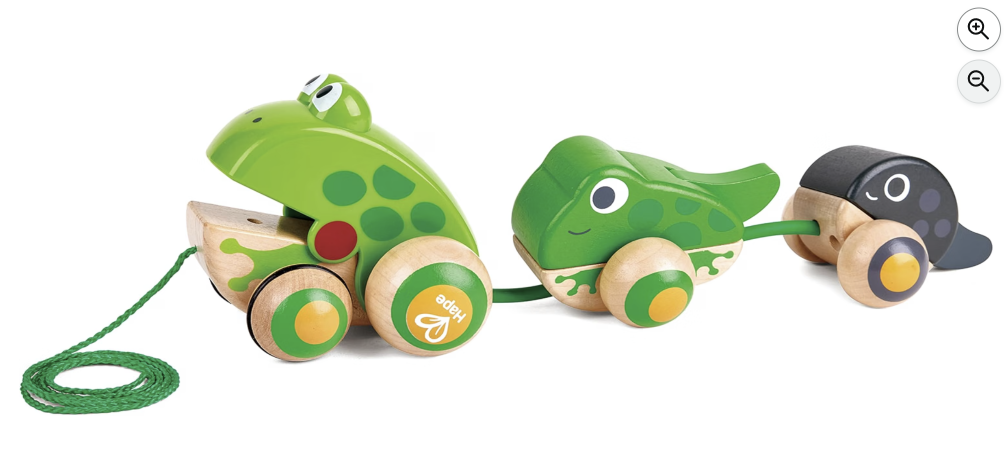
-
Hop along, little frogs! 🐸
Sometimes the best toys are the ones that encourage children to move, explore, and communicate at the same time!
This adorable wooden frog family features a mother frog, a young frog, and a tadpole. As children pull the toy, the mother frog opens and closes her mouth while the little ones wobble along behind her.
I especially love this toy because it encourages gross motor coordination, balance, cause-and-effect learning, joint attention, receptive and expressive language, imitation, following directions, and early pretend play.
One reason I've selected this toy specifically for the 18–24-month age group is that pulling a toy requires different motor skills than pushing one!
Although this toy is marketed for children as young as 12 months, many children at 12–14 months are still developing their walking skills. They may be able to push a toy forward but have difficulty maintaining their balance while pulling something behind them.
By 18–24 months, many toddlers are steadier on their feet and better able to coordinate walking with pulling an object.
And here's another reason I love it: No batteries, flashing lights, or prerecorded songs!
The child creates the action, and the caregiver provides the language.
At this age, we can introduce meaningful words and early combinations such as:
“Frog go!”
“Mommy frog!”
“Baby frog!”
“Go fast!”
“Stop frog!”
“Open mouth!”
“Come back!”
My recommendation? Don't just hand your toddler the toy and watch them pull it around. Join the adventure!
Walk alongside your child, describe what the frogs are doing, introduce simple directions, and create opportunities for your toddler to communicate.
🧠 Did You Know?
Pushing and pulling require different motor skills!
Around 12–14 months, many children are still developing independent walking and balance.
Pushing a toy forward is often easier at this stage, particularly when the toy provides a stable surface for support.
Pulling, however, requires children to coordinate walking, holding a string, and controlling an object moving behind or beside them.
They must maintain their balance while adjusting their movements and paying attention to where the toy is traveling.
By 18–24 months, many toddlers are steadier on their feet, making this a wonderful time to introduce pull-along toys!
Pulling encourages:
Balance and postural control
Gross motor coordination
Spatial awareness
Motor planning
Attention to movement
Cause-and-effect learning
And here's the language connection!
As children pull the frog family, caregivers can introduce meaningful words and phrases:
“Pull frog!”
“Frog follows!”
“Go slow!”
“Stop frog!”
“Come here!”
“Frog behind!”
Children also begin discovering that their actions influence what happens to the toy.
When they pull the string, the frogs move. When they stop, the frogs stop.
They may experiment with moving faster, slowing down, changing direction, or stopping and starting again.
These experiences provide natural opportunities for language development.
And because this toy represents a family of frogs, it also introduces early pretend play!
Your toddler may begin treating the frogs as characters rather than simply objects that move.
Although the toy represents different stages of a frog's development, understanding the complete frog life cycle is not an expectation for an 18–24-month-old.
For now, we're introducing familiar concepts such as mommy, baby, big, little, go, and stop. The science can come later!
Miss Angie's Tip: Begin on a clear, level floor. Demonstrate pulling the frogs slowly and allow your child to practice at their own pace.
There's no need to rush or encourage pulling before your child is walking steadily and comfortably.
Remember, a manufacturer's recommended age doesn't necessarily tell you when a child will get the greatest developmental benefit from a particular activity.
💜 Let's Play! (18–24 Months)
🐸 Ready, Set... GO!
Place the frog family on the floor.
Say, “Ready... set...” and pause.
Wait for your toddler to look, move, gesture, vocalize, or attempt “Go!”
Then pull the frogs forward while saying, “GO!”
Repeat the routine several times.
As your child becomes familiar with the activity, encourage them to initiate the movement.
This supports anticipation, intentional communication, and early word combinations.
🛑 Go, Go... STOP!
Walk alongside your toddler as they pull the frogs.
Say, “Go, go, go!”
Then model “STOP!” and stop moving.
Repeat the activity using exaggerated gestures and facial expressions.
Introduce combinations such as:
“Frog go!”
“Stop frog!”
“Go again!”
This encourages understanding of action words, listening, and participation in predictable routines.
👄 Open, Close!
Draw attention to the mother frog's moving mouth.
Say, “Look! Mouth open!”
Then, “Mouth closed!”
You can imitate the movement by opening and closing your own mouth.
Model:
“Open!”
“Close!”
“Frog eating!”
Encourage your child to imitate the actions if interested.
This provides opportunities for visual attention, action imitation, and early vocabulary.
👩👧 Mommy Frog, Baby Frog!
Point to the different frogs.
Say, “Mommy frog!”
Then point to a smaller frog and say, “Baby frog!”
Use familiar phrases such as:
“Hi, Mommy!”
“Hi, Baby!”
“Baby follows!”
You can connect these concepts to familiar family relationships without requiring your child to identify the frog's developmental stages.
🚶 Follow the Frog!
Pull the frog family a short distance.
Say, “Come on, frog!”
Encourage your toddler to follow.
Then switch roles and follow your child as they pull the frogs.
Model:
“Come here!”
“Follow me!”
“Frog coming!”
“Wait for me!”
This encourages action vocabulary, joint attention, and early social interaction.
⬆️ Around, Under, and Through!
Create a simple path using furniture or large, stable household objects.
Encourage your toddler to pull the frogs around an obstacle or through a wide opening.
Model:
“Go around!”
“Come through!”
“Frog under!”
“Come out!”
Begin with one simple direction and provide gestures or demonstrations as needed.
This introduces spatial vocabulary through meaningful movement.
😋 Hungry Frog!
Pretend the mother frog is hungry.
Say, “Frog hungry!”
Pretend to offer her food using an imaginary snack or an appropriately sized toy food item.
Model:
“Eat, frog!”
“Yummy!”
“More food!”
“All done!”
Encourage your toddler to imitate the pretend feeding action.
This introduces early symbolic play and functional language.
🤝 My Turn, Your Turn!
Take turns pulling the frog family.
Say, “My turn!” while pulling the toy a short distance.
Then offer it to your toddler and say, “Your turn!”
Model phrases such as:
“Frog go!”
“My frog!”
“Your turn!”
Allow your child plenty of opportunities to lead the activity.
The goal is enjoyable reciprocal interaction, not rigidly enforced turn-taking.
🌱 Grow With Me! — Same Toy, New Skills!
24–36 Months: Growing Language & Imagination
Encourage three- and four-word phrases such as “Mommy frog is walking.”
Follow two-step directions: “Pull the frog and stop by the chair.”
Introduce descriptive words such as fast, slow, big, little, and hungry.
Practice spatial concepts such as behind, beside, around, and under.
Create pretend adventures for the frog family.
Encourage simple questions such as “Where is the baby frog?”
Introduce early sequencing: “First we walk, then we stop.”
Practice identifying actions and describing what the frogs are doing.
3–5 Years: Learning Through Pretend Play
Create imaginative stories about the frog family.
Introduce the basic frog life cycle: tadpole, froglet, adult frog.
Discuss how the frogs change as they grow.
Practice sequencing the stages of frog development using pictures.
Encourage describing similarities and differences.
Introduce more complex spatial directions.
Practice answering who, what, where, why, and how questions.
Create obstacle courses and explain the route.
Encourage storytelling with a beginning, middle, and end.
6+ Years: Building Advanced Communication Skills
Explore the frog life cycle in greater detail.
Introduce vocabulary such as amphibian, habitat, metamorphosis, and adaptation.
Compare frogs with other animals.
Explain how a tadpole changes into an adult frog.
Practice sequencing and explaining scientific processes.
Use the frog family as characters in creative storytelling.
Encourage predicting, explaining, and justifying ideas.
Discuss cause-and-effect relationships using more complex sentences.
Create and describe a frog habitat or imaginary frog adventure.
💜 Miss Angie's Reminder
It's not just the toy—it's how you use it!
A simple pull-along toy can provide wonderful opportunities for movement, language development, and early pretend play.
And remember, pushing and pulling are different developmental skills!
Although some pull toys are marketed for children as young as 12 months, many children benefit from waiting until they're steadier on their feet before practicing pulling.
Start slowly, use a clear walking path, and follow your child's developmental readiness.
Model meaningful phrases such as “Frog go!” “Stop!” “Come back!” and “Baby frog!”
Pause occasionally to allow your child to initiate another turn, but don't interrupt every movement to ask a question.
And remember, while the frog family represents different stages of development, your toddler doesn't need to understand the frog life cycle yet.
At 18–24 months, we're focusing on movement, purposeful play, early vocabulary, and meaningful word combinations.
The goal isn't simply to pull the frogs across the floor. It's to turn that movement into opportunities for interaction and communication!
Safety Note: Follow the manufacturer's age recommendations. Supervise play with the pull cord, keep it away from the neck, and never allow children to sleep with the toy. Use on a clear, level surface away from stairs. This is a pull-along toy, not a weight-bearing walking aid.
🌱Amazing Airplane — Touch-and-Feel Board Book (Little Hippo Books)

-
One airplane to read about. Another airplane to play with. So many opportunities for language! ✈️💜
I love books that encourage children to do more than simply look at pictures!
Amazing Airplane is an airplane-shaped touch-and-feel board book featuring colorful illustrations, tactile textures, and short rhyming text.
It introduces children to the exciting world of airplanes while encouraging sensory exploration, early vocabulary, sound imitation, joint attention, and beginning language comprehension.
At 18–24 months, many toddlers are beginning to use more words, understand familiar directions, and combine words into short phrases.
This book gives parents opportunities to model:
“Big plane!”
“Plane up!”
“Fly high!”
“Go, plane!”
“Hello, pilot!”
“Bye-bye!”
“Plane down!”
And here's why I particularly love this book for Miss Angie's Toy Box:
It pairs beautifully with the wooden airliner toy featured in this same age group!
The wooden airplane has a visible pilot and passengers, making it possible to connect the people and actions in the book with hands-on play.
Read about an airplane, then pick up the toy and make it fly!
Talk about the pilot, the passengers, and where the airplane is going.
Children can begin connecting what they see in a book with something they can hold, move, and explore.
And that's an important part of early language development: helping children understand that words and pictures represent real objects, people, and actions.
You don't need the airplane toy to enjoy this book, but using them together creates additional opportunities for learning!
🧠 Did You Know?
Children learn vocabulary more effectively when they encounter words across different meaningful experiences!
For example, your child might hear the word airplane while looking at a picture in a book.
Later, they hear airplane again while watching you move a toy airplane through the air.
Then they might see an actual airplane flying overhead.
Each experience helps strengthen their understanding of the word.
This is one reason I love pairing books with toys!
It's called connecting language across contexts.
And there's another wonderful developmental benefit to this particular book:
Touch-and-feel books encourage active participation!
Toddlers aren't limited to listening. They can touch, explore, point, turn pages, and help guide the reading experience.
These actions create natural opportunities for joint attention—when a child and caregiver share interest in the same object or activity.
Joint attention supports early communication and language learning.
The book's rhyming text also introduces children to the rhythm and sound patterns of language.
At this age, children aren't expected to identify rhyming words or clap out syllables independently.
Instead, they're developing familiarity with the natural rhythm, repetition, and patterns of spoken language.
Miss Angie's Tip: You don't have to read every word on every page!
If your toddler wants to touch one picture repeatedly, follow their lead.
Describe what they're exploring.
“Feel it!”
“Look! Plane!”
“Big airplane!”
“Plane flies!”
Sometimes a few meaningful words shared during an enjoyable interaction are more valuable than rushing through an entire book.
💜 Let's Play! (18–24 Months)
✈️ 1. Where's the Airplane?
Show your child the cover.
Point to the airplane and say:
“Look! Airplane!”
“Big plane!”
“See plane?”
Encourage your child to look, point, touch, or attempt the word.
If your child says “pane” or another approximation, respond naturally:
“Yes! Airplane!”
You can also point to the airplane's wings and windows.
Language Focus: Object identification, receptive vocabulary, joint attention, and early word approximations.
🖐️ 2. Touch and Feel!
Explore the book's tactile areas together.
Allow your child to touch each texture.
Model simple words such as:
“Feel it!”
“Touch!”
“Soft!”
“Bumpy!”
“Smooth!”
Use whichever descriptions accurately match the textures on the page.
You might say:
“Touch here!”
“Feels soft!”
“More touching?”
Don't worry if your toddler isn't ready to name textures. Hearing these words during sensory exploration helps build understanding.
Language Focus: Sensory vocabulary, descriptive language, joint attention, and early word combinations.
💨 3. Airplane Sounds!
Make playful airplane sounds while looking at the illustrations.
“Whoooosh!”
“Zooooom!”
“Vroooom!”
“Up, up, up!”
Encourage your child to imitate the sounds if interested.
You can vary your voice by making the sounds longer, shorter, louder, or quieter.
Accept approximations and spontaneous vocalizations.
Language Focus: Environmental sound imitation, vocal play, auditory attention, and early speech imitation.
⬆️ 4. Up, Up, and Away!
Use your hand to pretend an airplane is flying.
Move your hand upward.
“Plane UP!”
Move it downward.
“Plane DOWN!”
Move it across the room.
“Plane GO!”
Then stop.
“Plane STOP!”
If you have the wooden airliner, use it to demonstrate these actions.
Language Focus: Action words, spatial vocabulary, receptive language, and early word combinations.
👨✈️ 5. Hello, Pilot!
Look for the pilot and other people illustrated in the book.
Point to them and model:
“Hi, pilot!”
“Hello!”
“Bye-bye!”
“People!”
“Plane go!”
If using the wooden airliner, show your child the pilot and passengers.
Explain simply:
“Pilot flies!”
“People ride!”
“Plane goes!”
At this age, we're introducing the words naturally rather than expecting children to understand everyone's role immediately.
Language Focus: People vocabulary, greetings, early comprehension, and simple sentence models.
📖 6. Read, Pause, and Listen!
Read a short section of the book with expression.
Emphasize repeated words, interesting sounds, and rhyming patterns.
Pause briefly at a familiar word or phrase.
For example:
“Up, up, and...”
“AWAY!”
If your child anticipates the word through a smile, gesture, sound, or verbal attempt, respond enthusiastically.
You can also repeat a favorite phrase several times.
Language Focus: Auditory attention, anticipation, rhythm, repetition, and early expressive language.
🛫 7. Book to Toy: Let's Fly!
This is one of my favorite activities for this particular book!
Place the Amazing Airplane book beside the wooden airliner toy.
Show your child an airplane illustration.
Say:
“Look! Airplane!”
Then point to the toy.
“Another airplane!”
Pick up the toy and move it through the air.
“Plane flies!”
“Up high!”
“Go, plane!”
“Plane down!”
Encourage your child to move the airplane while you model the words.
Language Focus: Connecting pictures with objects, vocabulary generalization, action words, and symbolic play.
🧳 8. Where Are We Going?
Use the wooden airplane to introduce simple pretend play.
Say:
“Let's go!”
“Plane go!”
“Bye-bye!”
“Going home!”
Pretend the airplane is traveling to Grandma's house, the park, or another familiar place.
Keep the language short and meaningful.
You might say:
“Go see Grandma!”
“Hi, Grandma!”
“Plane home!”
Allow your child to direct where the airplane travels.
Language Focus: Early pretend play, familiar people and places, functional phrases, and beginning sequencing.
🔍 9. Find the Same!
Place the book and wooden airplane side by side.
Point to a visible feature on the toy, such as a wing.
Say:
“Wing!”
Then point to the wing in the illustration.
“Wing!”
“Same!”
You can also compare the windows, wheels, or other features that are clearly visible in both.
For younger toddlers, simply demonstrate the connection.
As your child becomes more familiar with the activity, encourage them to point to matching features.
Language Focus: Vocabulary, visual attention, object-picture association, and early comparison concepts.
👋 10. Bye-Bye, Airplane!
When you're finished reading, close the book.
Say:
“All done!”
“Bye-bye, plane!”
“See you!”
If using the wooden airplane, pretend it is landing.
“Plane down!”
“Plane stop!”
“Night-night, plane!”
Put the toy away together.
This creates a predictable ending to the activity.
Language Focus: Functional communication, greetings, early routines, action words, and simple sequencing.
🌱 Grow With Me! — Same Book, New Skills!
24–36 Months: Growing Language & Imagination
As your child's vocabulary and sentence length increase, use the book to introduce more detailed language.
Encourage longer phrases such as “The airplane is flying.”
Identify the pilot and passengers.
Introduce action words such as flying, landing, and traveling.
Practice answering simple “What?” and “Where?” questions.
Compare the book's illustrations with the wooden airplane.
Introduce descriptive vocabulary such as big, little, fast, and slow.
Practice simple pretend-play routines involving takeoff and landing.
Introduce two-step directions using the toy airplane.
Encourage your child to finish familiar phrases from the book.
Begin talking about where the airplane might be going.
3–5 Years: Learning Through Pretend Play
The book and airplane can become the starting point for more elaborate language activities.
Discuss what pilots and passengers do.
Introduce vocabulary such as airport, runway, luggage, and destination.
Practice sequencing: First the passengers get on, then the airplane takes off, and finally it lands.
Encourage children to retell the story in their own words.
Introduce who, what, where, when, and why questions.
Compare different types of transportation.
Practice describing similarities and differences between the illustrated airplane and the toy.
Create pretend airport adventures.
Introduce problem-solving scenarios, such as forgetting a suitcase.
Explore rhyming words from the book when developmentally appropriate.
Encourage children to create their own short airplane stories.
6+ Years: Building Advanced Communication Skills
For older children, use the book as a familiar starting point for more advanced activities.
Create detailed stories involving airplane adventures.
Practice story grammar: characters, setting, problem, events, and resolution.
Introduce more advanced transportation and travel vocabulary.
Compare different types of aircraft.
Practice giving directions and explaining travel procedures.
Discuss cause-and-effect relationships.
Encourage sequencing and retelling with greater detail.
Explore rhyming patterns and sound similarities.
Practice predicting what might happen during a trip.
Use the wooden airplane as a prop for storytelling and role-playing.
Encourage children to explain their ideas using complete, organized sentences.
💜 Miss Angie's Reminder
It's not just the book—or the toy—it's how you use them together!
One of the most effective ways to encourage early language development is to help children connect what they see, hear, and experience.
Read about an airplane.
Point to the pictures.
Touch the textures.
Make airplane sounds.
Then pick up the wooden airplane and make it fly!
“Plane up!”
“Fly high!”
“Hello, pilot!”
“Bye-bye!”
“Plane down!”
You don't need to ask your toddler questions on every page or insist that they repeat every word.
Instead, follow their interests, model short phrases, and make the experience enjoyable.
And don't worry if your child wants to read the same book again and again!
Familiar books provide wonderful opportunities for repetition, anticipation, and vocabulary learning.
The Amazing Airplane book is a lovely language-building activity on its own.
But when paired with the wooden airliner, it creates something even more special:
An opportunity to take language from the pages of a book into the wonderful world of play! 💜✈️
Safety Reminder: Follow the publisher's age guidance and inspect the book regularly for damaged or loose components. Supervise toddlers during reading and play. If pairing the book with the wooden airliner, follow the toy manufacturer's safety instructions and keep its battery compartment securely closed.
🌱Peek-a-Who? — Nina Laden
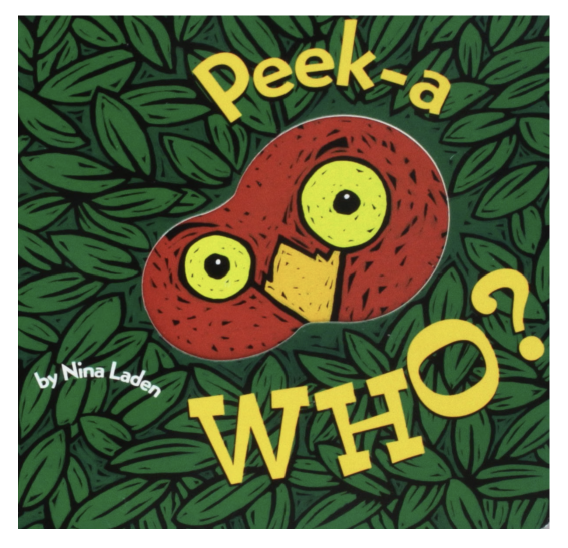
-
Peek-a... WHO? Let's look, listen, guess, and discover! 👀💜
Sometimes the simplest books create the most wonderful opportunities for language development!
Peek-a-Who? by Nina Laden is a sturdy board book filled with colorful illustrations, playful rhymes, and peek-through windows that offer little clues about what's hiding on the next page.
And there's a delightful surprise waiting at the end—a mirror!
What I particularly love about this book is that it encourages children to do something very important for communication:
Anticipate what comes next!
As children look through the openings, they begin noticing clues, recognizing familiar pictures, and anticipating the surprise revealed when the page turns.
At 18–24 months, many toddlers are beginning to understand familiar questions, imitate more sounds and words, and participate in predictable routines.
This book provides opportunities to model:
“Peek-a-WHO?”
“Who's there?”
“Look!”
“I see!”
“MOO!”
“BOO!”
“Turn page!”
“It's YOU!”
And here's another reason I love this book:
It encourages interaction without requiring children to produce words!
A child might point, smile, laugh, look expectantly, make a sound, or reach to turn the page.
All of these responses can become meaningful communication opportunities.
And because the book is short, repetitive, and predictable, it's wonderful for children who enjoy hearing the same familiar words and sounds again and again.
🧠 Did You Know?
Anticipation is an important part of early communication!
Think about a simple game of peekaboo.
An adult covers their face.
The child waits.
The adult says, “Peekaboo!”
And the child laughs, smiles, or reaches for another turn.
That familiar routine encourages shared attention, anticipation, and reciprocal interaction.
Peek-a-Who? uses a similar idea.
Children see a clue through a window, hear a familiar phrase, and discover the answer when the page turns.
Over time, they may begin to anticipate the reveal before it happens.
And here's another developmental connection:
Predictable language gives children opportunities to participate!
When a child hears the same phrase repeatedly, they become familiar with its rhythm and sequence.
Eventually, they may attempt a sound, gesture, or word at the expected moment.
For example, when you say:
“Peek-a...”
Your child may begin anticipating what comes next.
They might say “boo,” make a sound, smile, or reach to turn the page.
These are all meaningful ways to participate.
And let's talk about that mirror!
Mirrors can encourage social interaction, attention to faces, and playful imitation.
When your child sees their reflection, you can model:
“It's YOU!”
“Hi, baby!”
“There's your nose!”
“Big smile!”
The mirror creates a natural opportunity to talk about familiar body parts, facial expressions, and people.
Miss Angie's Tip: You don't have to ask “Who's that?” every time you turn a page.
Sometimes it's more effective to describe what your child sees and pause briefly.
“Look!”
“Cow!”
“MOO!”
Then wait to see how your child responds.
Remember, we're encouraging communication—not testing vocabulary!
💜 Let's Play! (18–24 Months)
👀 1. Peek-a... WHO?
Begin by showing your child the cover.
Point to the opening.
Say:
“Peek-a... WHO?”
Pause briefly.
Then turn the page to reveal the picture.
“Look!”
“There it is!”
“Found it!”
Allow your child to help turn the page when ready.
Language Focus: Anticipation, joint attention, early question understanding, and participation in predictable routines.
🐮 2. Moo! Who's There?
When you reach the cow, point to the picture.
Say:
“Look! Cow!”
“Cow says MOO!”
Repeat the sound playfully.
“Moooo!”
Pause to allow your child an opportunity to imitate.
If your child produces only part of the sound, respond naturally.
“Yes! MOO!”
Language Focus: Animal vocabulary, environmental sound imitation, early speech imitation, and receptive language.
👻 3. BOO!
Use the playful “boo” surprise to encourage vocal imitation.
Say:
“Peek-a... BOO!”
Repeat:
“BOO!”
“BOO!”
“Again!”
You can cover your own face briefly and reveal it while saying “BOO!”
Encourage your child to participate through a smile, gesture, vocalization, or word.
Language Focus: Early consonant-vowel imitation, social interaction, anticipation, and turn-taking.
📖 4. Turn the Page!
Encourage your child to help turn the sturdy board pages.
Model:
“Turn page!”
“Open!”
“Look!”
“What's next?”
If your child reaches toward the book, respond:
“Turn page!”
“Let's see!”
Allow your child to control the pace when possible.
Language Focus: Functional vocabulary, action words, requesting, and joint attention.
🔍 5. I See Something!
Before turning a page, look through the cutout window together.
Point to the visible clue.
Say:
“I see!”
“Look here!”
“What's that?”
For younger toddlers, simply describe what you see.
“See spots!”
“See eyes!”
Use descriptions that match the actual illustration.
Then turn the page and reveal the picture.
“It's a cow!”
Language Focus: Visual attention, descriptive vocabulary, early prediction, and object identification.
💜 6. More Peek-a-Who!
After a favorite page, pause briefly.
Wait to see whether your child indicates that they want to continue.
They may reach for the book, turn the page, vocalize, gesture, or say a word.
Model:
“More book!”
“Read more!”
“Again!”
Then continue.
Remember, children don't have to say “more” before the activity continues.
Language Focus: Requesting, intentional communication, early word combinations, and social interaction.
🪞 7. Peek-a-YOU!
When you reach the mirror at the end, point to your child's reflection.
Say:
“Peek-a-YOU!”
“It's YOU!”
“Hi!”
“Look at you!”
Encourage your child to smile, wave, or make a silly face.
You can also model:
“Big smile!”
“Hi, baby!”
“Wave bye-bye!”
Language Focus: Social interaction, self-recognition, imitation, familiar vocabulary, and early word combinations.
👃 8. Where's Your Nose?
Use the mirror to introduce familiar body parts.
Point to your own nose.
Say:
“My nose!”
Then point to your child's nose.
“Your nose!”
You can also model:
“Eyes!”
“Mouth!”
“Hair!”
“Ears!”
Encourage your child to touch or point to familiar body parts if interested.
Don't expect every child to identify all of these independently.
Language Focus: Body-part vocabulary, receptive language, imitation, and early possessive concepts.
🙈 9. Let's Play Peekaboo!
After reading, extend the activity into a familiar social game.
Cover your face with your hands.
Say:
“Where's Mommy?”
Pause.
Then uncover your face.
“PEEKABOO!”
Encourage your child to imitate.
You can also hide a favorite stuffed animal partially behind a cushion.
“Where's Teddy?”
“There he is!”
This helps children connect the language in the book with familiar real-life experiences.
Language Focus: Joint attention, social reciprocity, anticipation, and vocabulary generalization.
🎵 10. Silly Sounds and Rhymes!
Read the book's playful phrases with expression.
Emphasize the sounds and rhyming words.
Use changes in your voice to make the reading engaging.
You can say:
“Peek-a...”
Pause.
Then reveal the next sound or word.
If your child begins anticipating the phrase, encourage participation.
But don't worry if they aren't ready to finish the rhyme.
At this age, we're introducing the rhythm and sound patterns of language through enjoyable listening experiences.
Language Focus: Auditory attention, rhythm, repetition, sound imitation, and early phonological awareness foundations.
🌱 Grow With Me! — Same Book, New Skills!
24–36 Months: Growing Language & Imagination
As your child's vocabulary and sentence length increase, encourage more active participation.
Encourage your child to complete familiar phrases.
Practice naming the pictures revealed on each page.
Introduce longer phrases such as “I see a cow!”
Encourage children to answer simple “Who?” and “What?” questions.
Practice identifying clues before turning the page.
Introduce descriptive words related to the illustrations.
Encourage children to describe what they see in the mirror.
Practice identifying facial expressions and body parts.
Introduce simple prediction questions such as “What do you think is next?”
Encourage children to request favorite pages or repeat the book.
3–5 Years: Learning Through Pretend Play
The book can support more advanced language and early literacy skills.
Encourage children to predict what's hiding behind each page.
Discuss the clues that helped them make their guesses.
Practice answering who, what, where, and why questions.
Introduce rhyming words and playful sound patterns.
Encourage children to identify words that sound alike.
Practice describing pictures using complete sentences.
Create simple stories about the characters or objects.
Discuss facial expressions and emotions using the mirror.
Encourage children to create their own peekaboo guessing games.
Introduce sequencing by recalling what appeared first, next, and last.
Practice categorizing familiar animals and objects.
6+ Years: Building Advanced Communication Skills
For older children, use the familiar book as a springboard for creative language activities.
Create original rhyming clues for familiar objects.
Practice identifying and generating rhyming words.
Encourage children to explain how visual clues support predictions.
Create their own peek-through books.
Practice writing or dictating short descriptive riddles.
Develop stories using characters or objects from the book.
Practice sequencing and retelling events.
Introduce more complex descriptive vocabulary.
Encourage children to explain similarities and differences.
Practice giving clues without naming the object.
Explore wordplay and creative language through original guessing games.
💜 Miss Angie's Reminder
It's not just the book—it's how you share it!
Peek-a-Who? is a wonderful reminder that early language development doesn't require complicated toys or elaborate activities.
Sometimes all you need is a book, a familiar phrase, and a little anticipation!
“Peek-a... WHO?”
Pause.
Turn the page.
“MOO!”
Laugh together.
Then do it again!
And again!
Repetition is one of the ways young children learn language.
Don't worry if your child wants to look at the same page repeatedly or skip ahead to the mirror.
Follow their lead.
Model short phrases.
Celebrate their attempts to participate.
And remember that communication includes much more than spoken words.
A smile, a point, a gesture, or an excited vocalization can all be meaningful parts of the interaction.
The goal isn't to finish the book. The goal is to enjoy the experience together!
One little book, lots of surprises, and wonderful opportunities for communication and connection! 💜👀
Safety Reminder: Follow the publisher's age guidance and supervise young children during reading. Inspect the board pages, cutout openings, and mirror regularly for damage. Discontinue use if any components become loose or damaged. This book has die-cut windows rather than lift-up flaps, so children discover the surprises by turning the pages.
🌱Fisher-Price Little People See ’n Say — The Farmer Says
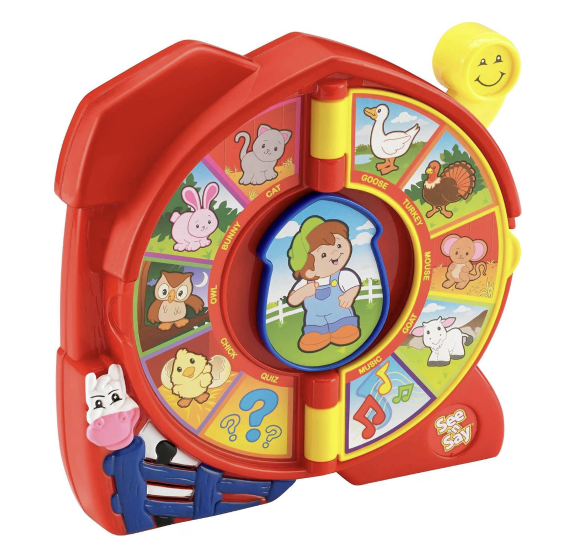
-
The cow says MOO! The sheep says BAA! And the duck says QUACK! 🐄🐑🦆
This classic Fisher-Price See ’n Say is one of my favorite ways to encourage environmental sound imitation, animal vocabulary, auditory attention, and early word combinations.
What makes this toy so valuable is that children can connect three important pieces of information:
What an animal looks like, what it's called, and the sound it makes!
For example:
🐄 Cow — “Moo!”
🐑 Sheep — “Baa!”
🐖 Pig — “Oink!”
🦆 Duck — “Quack!”
🐎 Horse — “Neigh!”
The See ’n Say features 16 animals, a pointer, and a lever children pull to hear animal sounds. It also includes familiar farm melodies and a quiz mode for more advanced learning.
I particularly love that the child can initiate the activity rather than simply watching a toy perform.
And here's something I emphasize frequently in speech therapy:
Environmental sounds are meaningful early communication!
When a toddler sees a cow and says “Moo!” they're demonstrating that they've learned to associate a sound with a specific animal.
That association is important for early vocabulary development.
Environmental sounds can also provide opportunities to practice different speech sounds and syllable patterns in a playful, meaningful way.
At 18–24 months, we can begin expanding these sounds into early word combinations:
“Cow moo!”
“Pig oink!”
“Big cow!”
“Duck go!”
“More moo!”
My recommendation? Start with just TWO or THREE familiar animals!
Although the toy includes 16 animals, your toddler doesn't need to learn them all at once.
Choose a few familiar animals, model their names and sounds, and allow your child plenty of opportunities to listen, watch, imitate, and explore.
🧠 Did You Know?
Environmental sounds can be an important stepping stone toward spoken language!
Before children consistently produce longer words and phrases, they may use familiar sounds to represent people, animals, vehicles, or actions.
Think about the sounds young children often enjoy:
“Moo!”
“Baa!”
“Woof!”
“Meow!”
“Beep-beep!”
“Uh-oh!”
These sounds are meaningful because children connect them with something they recognize.
For example, a child who says “Moo!” when seeing a cow is communicating about that animal, even if they aren't yet saying the word cow.
That's communication worth celebrating!
Environmental sounds also provide opportunities to practice a variety of speech movements and sound patterns.
For example:
“Moo!” encourages lip closure for /m/ followed by a prolonged vowel.
“Baa!” provides practice with the early-developing /b/ sound.
“Meow!” encourages changing vowel sounds within one vocalization.
“Woof!” introduces a different sound pattern that may be more challenging for some toddlers.
“Quack!” provides a more complex sound pattern that children may initially simplify.
Not every child will produce these sounds accurately, and that's perfectly fine!
A toddler might say “Ma!” for “Moo!” or “Wa!” for “Quack!”
The goal is meaningful sound imitation and communication—not perfect articulation!
And here's another important connection:
Receptive vocabulary often develops before expressive vocabulary.
A child may recognize a cow and understand the word cow before being able to say it.
That's why I encourage parents to pair the animal's name with its sound.
Instead of only saying “Moo!” try:
“Cow! Moo!”
“Big cow!”
“Cow says moo!”
Over time, children may begin connecting the animal's picture, name, and sound.
Miss Angie's Tip: Don't turn every interaction into a question!
Instead of repeatedly asking, “What's this?” or “What does the cow say?” provide enthusiastic models.
“Look! A cow!”
“Moooo!”
“Big cow!”
Then pause and allow your child an opportunity to participate.
They may look, point, gesture, vocalize, imitate the sound, or attempt the animal's name.
All of these responses can be meaningful steps toward communication.
💜 Let's Play! (18–24 Months)
🐄 Meet the Animals!
Begin with two or three familiar animals, such as a cow, sheep, and duck.
Point to the cow and say, “Cow!”
Then model an exaggerated “Moooo!”
Repeat with the other animals.
Keep your language simple:
“Cow! Moo!”
“Sheep! Baa!”
“Duck! Quack!”
Allow your child to look, point, vocalize, or imitate.
This activity encourages animal vocabulary, sound associations, and joint attention.
👂 Listen! What Do You Hear?
Help your child select a familiar animal and activate its sound.
Say, “Listen!”
After the sound plays, repeat it yourself.
“Moooo!”
Pause and give your child an opportunity to imitate.
If your child attempts the sound, respond enthusiastically and repeat it.
If they don't imitate, simply continue modeling.
This encourages auditory attention, listening, and environmental sound imitation.
🗣️ My Turn, Your Turn!
Choose a familiar animal.
Model its sound:
“Moo!”
Pause and look expectantly at your child.
If your child attempts the sound, imitate their production back to them.
For example:
Child: “Ma!”
Parent: “Moo! Cow says moo!”
Continue with other familiar sounds.
This encourages vocal imitation, reciprocal interaction, and early conversational turn-taking.
🐷 Animal Name + Animal Sound!
Point to an animal and model its name followed by its sound.
“Pig! Oink!”
“Cow! Moo!”
“Duck! Quack!”
As your child becomes familiar with the animals, begin modeling early combinations:
“Pig oink!”
“Cow moo!”
“Duck quack!”
Don't require your child to repeat the entire phrase.
A single word, sound approximation, gesture, or attempt is a meaningful opportunity for communication.
👀 Find the Cow!
Begin with two familiar animal pictures on the See ’n Say.
Say, “Where's cow?”
Pause and allow your child to look or point.
If needed, point to the cow yourself and say, “There's cow!”
Then model, “Moooo!”
Try another familiar animal.
This supports receptive vocabulary, visual recognition, and understanding simple questions.
Avoid making this a repeated testing activity. Alternate between naming animals, listening to sounds, and allowing your child to explore.
💜 More Moo, Please!
Choose an animal your child particularly enjoys.
Activate its sound and then pause.
Wait for your child to indicate that they want to hear it again.
They might reach, point, look toward you, vocalize, sign “more,” or say a word.
Model:
“More moo!”
“Do again!”
“More cow!”
Then activate the sound again.
This creates a natural opportunity for requesting and intentional communication.
🐑 Match the Sound to the Animal!
Use two familiar toy farm animals or pictures alongside the See ’n Say.
Activate one animal sound.
For example, play “Baa!”
Then model, “Sheep! Baa!”
Point to or pick up the matching sheep.
Encourage your child to participate by looking, reaching, or pointing.
Start with only two choices and provide plenty of assistance.
This encourages auditory-visual associations and receptive vocabulary.
🎵 Old MacDonald Had a Farm!
Sing a familiar portion of “Old MacDonald Had a Farm” using one or two animals.
Keep the pace slow.
For example:
“Old MacDonald had a farm...”
Pause before the animal sound.
“E-I-E-I-O!”
“And on his farm he had a cow...”
Then model:
“Moo, moo!”
Encourage your child to participate with a sound, gesture, or vocalization.
Repetition, rhythm, and predictable pauses make nursery rhymes and familiar songs wonderful opportunities for early language learning.
You don't need to sing the entire song!
One or two animals are plenty.
🐄 Let's Play Farm!
Bring out two or three toy farm animals.
Select the matching animals on the See ’n Say.
Then use the toy animals for simple pretend-play actions.
Model:
“Cow eats!”
“Pig sleeps!”
“Duck walks!”
“Cow says moo!”
This helps children connect pictures and sounds with three-dimensional objects and meaningful actions.
It also introduces early pretend play and two-word combinations.
🌱 Grow With Me! — Same Toy, New Skills!
24–36 Months: Growing Language & Imagination
Expand vocabulary to include additional farm animals.
Encourage longer phrases such as “The cow says moo!”
Practice identifying animals by their sounds.
Introduce animal actions such as eat, sleep, walk, run, and jump.
Compare animals using big/little, loud/quiet, and fast/slow.
Follow simple two-step directions involving animal pictures or matching toys.
Encourage children to answer “What does the cow say?” when ready.
Introduce simple categories such as farm animals versus pets.
Pair the See ’n Say with toy animals for pretend farm activities.
Begin using the quiz mode as an optional listening and identification game when developmentally appropriate.
3–5 Years: Learning Through Pretend Play
Identify and name a wider variety of animals.
Describe animals using color, size, body parts, and actions.
Compare similarities and differences between animals.
Introduce animal habitats and the foods animals eat.
Practice answering who, what, where, and why questions.
Encourage complete sentences such as “The horse lives on a farm.”
Use the animal pictures to practice categorization.
Introduce beginning sound awareness using familiar animal names.
Practice clapping syllables in words such as cow, chicken, and elephant.
Create simple stories involving farm animals.
Practice following multistep directions during farm-themed play.
6+ Years: Building Advanced Communication Skills
Classify animals according to habitat, diet, and physical characteristics.
Compare farm animals with wild animals and pets.
Introduce more advanced vocabulary related to animal care and farming.
Practice explaining similarities and differences.
Explore beginning sounds, ending sounds, and syllable patterns in animal names.
Use animal vocabulary for phonemic awareness activities.
Practice describing animals without naming them and having another person guess.
Create stories involving animal characters, settings, problems, and solutions.
Practice sequencing events and retelling stories.
Discuss cause-and-effect relationships involving animal behavior.
Encourage explaining and justifying answers using complete sentences.
💜 Miss Angie's Reminder
It's not just the toy—it's how you use it!
The See ’n Say is a wonderful tool for introducing animal vocabulary and encouraging environmental sound imitation.
But remember, your toddler doesn't need to know all 16 animals!
Start with two or three familiar animals.
Model their names.
Imitate their sounds.
Repeat them often!
And don't worry if your child doesn't produce the sounds perfectly.
“Moo!” might sound like “Ma!”
“Quack!” might sound like “Wa!”
Those attempts can still represent meaningful communication.
Environmental sounds are not just cute noises. They can help children develop sound imitation, word associations, and early expressive vocabulary.
As your child becomes more comfortable, begin expanding sounds into meaningful word combinations.
“Cow moo!”
“Big pig!”
“Duck go!”
And remember, there's no need to turn playtime into a quiz.
The electronic quiz mode can wait until your child is developmentally ready.
For now, focus on shared attention, listening, imitation, repetition, and enjoyable interactions.
The goal isn't to memorize every animal on the See ’n Say. It's to help your child connect what they SEE, what they HEAR, and what they SAY! 🐄💜
Safety Note: Follow the manufacturer's age recommendation of 18 months and older. Supervise play, inspect the toy for damage, and ensure the battery compartment remains securely closed. Keep sound volume comfortable and avoid holding the speaker close to your child's ears.
24–36 Months: Growing Language & Imagination
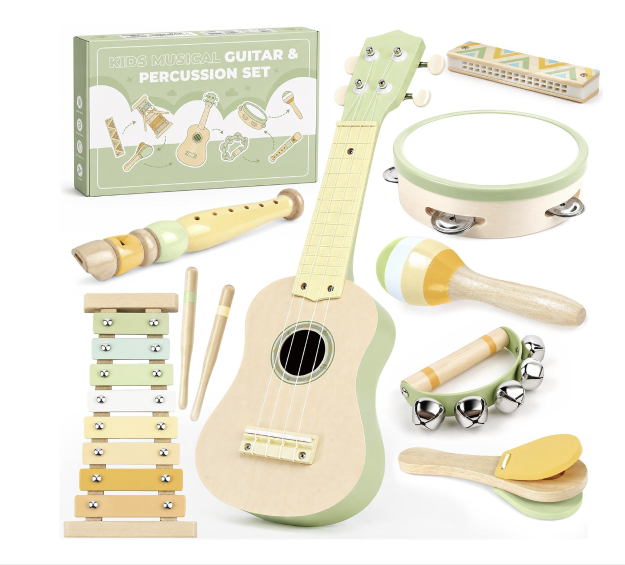
🌱Kids Guitar & Musical Instruments Set — 8-in-1
-
Shake it! Tap it! Strum it! Let's make some music! 🎸🥁🎶
Music and language development go hand in hand, and this colorful wooden musical instrument set offers so many opportunities to explore both!
With a child-sized guitar, xylophone, tambourine, maraca, bells, and other percussion and wind instruments, toddlers can discover different sounds while practicing important communication skills.
And here's what I particularly love:
The child makes the music—not the toy!
Instead of pushing a button and listening to prerecorded songs, children must actively shake, tap, strum, or blow to produce sounds.
That encourages exploration, motor planning, imitation, and purposeful interaction.
At 24–36 months, children are developing longer word combinations, following increasingly complex directions, and beginning to engage in more imaginative play.
Musical instruments create natural opportunities to practice all of these skills!
Parents can model:
“Shake, shake!”
“Tap the drum!”
“Play guitar!”
“Loud music!”
“Stop!”
“My turn!”
“Play again!”
And because each instrument produces a different sound, children can begin learning important descriptive concepts such as loud/quiet, fast/slow, and same/different.
This set also provides opportunities for pretend play. Your toddler can become a musician, perform a concert, lead a parade, or start a family band!
But remember, you don't have to know how to play an instrument or sing perfectly.
Your interaction with your child is far more important than the music you make!
🧠 Did You Know?
Music provides a wonderful foundation for speech and language learning!
Speech and music share several important features:
Rhythm: Speech has patterns of stressed and unstressed syllables.
Timing: Conversations require us to listen, pause, and respond.
Imitation: Children learn by watching and listening to others.
Auditory attention: Children learn to notice and distinguish sounds.
Sequencing: Both music and language involve sounds or actions occurring in a particular order.
Social interaction: Singing and making music together encourage shared attention and reciprocal communication.
When a parent taps a drum twice and pauses, a child has an opportunity to imitate the pattern.
When a parent sings a familiar song and pauses before a favorite word, a child has an opportunity to participate.
When a parent says “STOP!” and the music stops, a child begins connecting spoken language with actions.
These interactions support communication through enjoyable, meaningful play.
Here's another important connection:
Many toddlers learn new words more easily when those words are paired with actions.
Consider the word “shake.”
When a child hears “Shake!” while shaking a maraca, the word becomes connected to a meaningful experience.
The same is true for:
“Tap!”
“Blow!”
“Strum!”
“Ring!”
“Stop!”
“Go!”
Miss Angie's Tip: Don't feel that you need to use every instrument during one play session.
Start with one or two.
Allow your child time to explore.
Then join in, imitate what they're doing, and add simple language.
Sometimes the best language opportunities happen when you follow your child's rhythm!
💜 Let's Play! (24–36 Months)
🥁 1. Tap, Tap, STOP!
Choose a drum or tambourine.
Begin tapping while saying:
“Tap, tap, tap!”
Then suddenly stop.
“STOP!”
Pause.
Then say:
“Ready, set... GO!”
Begin tapping again.
After several repetitions, allow your child to take the lead.
You might notice them stopping before you even say the word!
Language Focus: Receptive language, action words, auditory attention, anticipation, and inhibitory control.
🎸 2. My Turn, Your Turn!
Choose a guitar, tambourine, or another instrument your child enjoys.
Play briefly.
Say:
“My turn!”
Then offer the instrument to your child.
“Your turn!”
Allow your child to explore before asking for another turn.
You can model:
“I play!”
“You play!”
“Play again!”
For children beginning to use longer phrases:
“It's my turn!”
“Now your turn!”
Language Focus: Turn-taking, pronouns, social communication, and early sentence development.
🪇 3. Shake It Fast! Shake It Slow!
Use a maraca or another securely constructed shaker.
Begin shaking slowly.
“Shake... shake... shake.”
Then increase your speed.
“Fast, fast, fast!”
Switch back.
“Slow!”
Encourage your child to imitate.
You can also introduce:
“Shake high!”
“Shake low!”
“Shake up!”
“Shake down!”
Language Focus: Descriptive vocabulary, action words, spatial concepts, and following directions.
🎶 4. Loud Music, Quiet Music!
Choose a drum or xylophone.
Demonstrate a gentle sound.
“Quiet music!”
Then demonstrate a somewhat louder sound at a comfortable volume.
“Loud music!”
Alternate between the two.
Encourage your child to imitate.
You can also model:
“Play softly!”
“Big sound!”
“Little sound!”
“Too loud!”
“That's quiet!”
Language Focus: Opposites, descriptive vocabulary, auditory discrimination, and expressive language.
Miss Angie's Tip: Loud doesn't have to mean extremely loud! Keep sounds comfortable for little ears.
🎵 5. Copy My Beat!
Use a drum, tambourine, or xylophone.
Start with a simple pattern.
“Tap, tap!”
Pause.
Encourage your child to copy.
Then try:
“Tap... tap... tap!”
Or:
“Tap, tap... STOP!”
If your child isn't ready to copy a pattern, simply imitate their playing instead.
This teaches them that their actions can influence what another person does.
As their skills develop, introduce short patterns for them to imitate.
Language Focus: Imitation, auditory memory, sequencing, attention, and reciprocal interaction.
🎤 6. Sing Along With Me!
Choose a familiar nursery rhyme or children's song.
Allow your child to play an instrument while you sing.
Try songs such as:
“Old MacDonald Had a Farm”
“The Wheels on the Bus”
“Twinkle, Twinkle, Little Star”
“If You're Happy and You Know It”
Pause before a familiar word or sound.
For example:
“Old MacDonald had a...”
Wait briefly.
Your child might say “farm,” make a sound, gesture, or simply smile.
Continue singing and celebrate their participation!
Language Focus: Auditory attention, familiar vocabulary, sound imitation, anticipation, and early word combinations.
🎼 7. Let's Start a Band!
Choose two or three instruments.
Give your child one and keep another for yourself.
Say:
“Let's make music!”
“I play guitar!”
“You play drum!”
“Play together!”
Then stop.
“Band is done!”
“Take a bow!”
You can invite another family member to join.
Introduce simple roles:
“Daddy plays drum!”
“Mommy shakes!”
“You play guitar!”
Language Focus: Pretend play, pronouns, action words, social interaction, and sentence expansion.
🔔 8. Listen! What's That Sound?
Choose two instruments with noticeably different sounds.
Allow your child to explore both.
Name each one as you play.
“Drum!”
“Tambourine!”
Then play one instrument while your child looks away, if they are comfortable doing so.
Ask:
“What do you hear?”
Offer the two instruments as choices.
“Drum or tambourine?”
If your child isn't ready to identify the sound, reveal the instrument and name it.
“It's the drum!”
“Boom, boom!”
Language Focus: Auditory discrimination, vocabulary, listening comprehension, and answering simple questions.
Miss Angie's Tip: At this age, identifying an instrument by sound alone may still be difficult. Keep the activity playful rather than expecting accurate answers.
🎨 9. Find the Instrument!
Place two or three instruments in front of your child.
Give simple directions:
“Find the guitar!”
“Get the drum!”
“Give me the maraca!”
Once your child is successful, add a second action.
“Get the drum and tap it!”
“Find the guitar and play!”
You can also introduce descriptive language:
“Find the yellow instrument!”
“Get the big one!”
Only use descriptions that match the instruments you have.
Language Focus: Receptive vocabulary, following one- and two-step directions, object identification, and descriptive concepts.
🎭 10. It's Concert Time!
Set up a pretend concert in your living room.
Your child can be the musician while stuffed animals become the audience.
Say:
“Time for music!”
“Play guitar!”
“Bear is watching!”
“Bunny likes music!”
When your child finishes, clap.
“Great concert!”
“Clap, clap!”
“Take a bow!”
You can also introduce:
“First, play music.”
“Then, take a bow.”
“Now it's Bear's turn!”
Allow your child to direct the pretend performance.
Language Focus: Imaginative play, sequencing, social communication, early storytelling, and sentence development.
🌱 Grow With Me! — Same Toy, New Skills!
3–5 Years: Learning Through Pretend Play
As children develop longer sentences, more complex play skills, and stronger listening abilities, these instruments can support new learning opportunities.
Create a marching band: Follow directions such as “March slowly, then stop and play!”
Practice rhythm patterns: Copy and create increasingly complex sequences.
Explore syllables: Tap once for each syllable in familiar words such as “ba-na-na” or “el-e-phant.”
Identify rhyming words: Sing familiar songs and discuss words that sound alike.
Practice describing: Compare instruments by sound, size, shape, and how they are played.
Follow multistep directions: “Get the tambourine, shake it three times, and put it down.”
Introduce sequencing: Discuss what happened first, next, and last during a pretend concert.
Explore emotions: Play gentle music for sleepy, happy, or calm feelings and discuss how music makes us feel.
Practice cooperative play: Assign instruments and roles during a family band performance.
Build storytelling skills: Pretend the band is preparing for a big concert and describe what happens.
6+ Years: Building Advanced Communication Skills
Older children can use the same instruments for increasingly sophisticated language, literacy, and social communication activities.
Create and repeat longer rhythm sequences.
Tap out syllables in multisyllabic words.
Explore the rhythm and stress patterns of spoken language.
Practice identifying and generating rhyming words.
Develop descriptive riddles about different instruments.
Compare and contrast instruments using specific vocabulary.
Practice giving and following complex directions.
Create original songs or short musical stories.
Develop narratives with a beginning, middle, and end.
Practice planning and organizing a pretend musical performance.
Assign roles, negotiate turns, and solve problems during group activities.
Explore how changes in volume, speed, and rhythm can communicate different feelings.
💜 Miss Angie's Reminder
It's not just the toy—it's how you use it!
You don't need to be musical to encourage language development through music.
You don't need to teach your toddler how to play the guitar correctly.
And you certainly don't need to turn every play session into a lesson!
Start by watching what your child enjoys.
If they love shaking the maraca, shake along with them.
If they repeatedly tap the drum, imitate their rhythm.
If they stop playing and look at you, use that moment to respond.
“More music?”
“Play again?”
“Your turn!”
And don't forget to pause!
Sometimes giving your child a few extra seconds to respond creates a wonderful opportunity for communication.
They might say a word, imitate a sound, point, gesture, or hand you an instrument.
All of those responses are meaningful!
The goal isn't to create a perfect song.
It's to create opportunities for listening, imitation, language, and connection.
A little music, a little movement, and a whole lot of communication! 💜🎶
Safety Reminder: Confirm the manufacturer's age recommendation and warnings for the exact set before use. Musical instrument sets may include small bells, detachable parts, strings, mallets, and other components that require special attention. Inspect instruments regularly for loose or damaged pieces, supervise play, and introduce only age-appropriate components. If the packaging carries an under-3 choking-hazard warning, do not offer that component to children younger than 3.
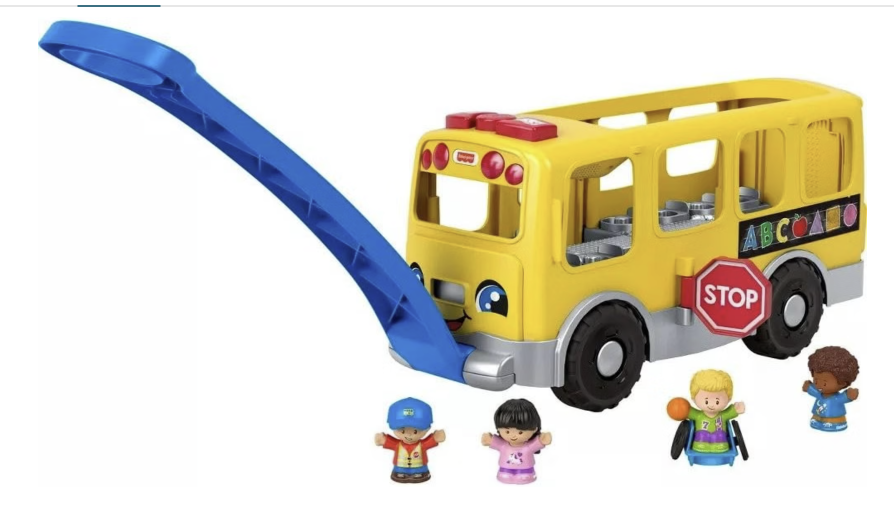
🌱Fisher-Price Little People Big Yellow School Bus
-
Beep, beep! All aboard! We're going to school! 🚌💜
There's something wonderful about toys that allow children to recreate the world around them!
The Fisher-Price Little People Big Yellow School Bus is a large, colorful school bus that comes with four Little People figures. It features an opening door, a stop sign, a wheelchair ramp, and a pull handle so children can take their passengers on exciting adventures.
It also includes interactive buttons with songs, sounds, and phrases.
But here's what I particularly love:
This toy provides opportunities to practice the language of everyday life!
At 24–36 months, toddlers are beginning to combine words into longer phrases, follow more complex directions, and use pretend play to represent familiar experiences.
And what could be more familiar than people getting on a bus, going somewhere, and coming home?
Parents can model:
“Bus goes!”
“Beep, beep!”
“Open door!”
“Get on!”
“Sit down!”
“Stop, bus!”
“Go to school!”
“Time to go home!”
The Little People figures also provide wonderful opportunities to practice early pronouns, action words, and social phrases.
“He's driving!”
“She's sitting!”
“My turn!”
“Come on!”
“Bye-bye!”
I especially appreciate the wheelchair ramp because it offers a natural opportunity to introduce different ways people get on and off a bus.
And with room for additional Little People figures, the bus can become part of increasingly elaborate pretend-play adventures as children grow.
One bus, lots of passengers, and endless opportunities for communication!
🧠 Did You Know?
Pretend play helps children connect language with real-life experiences!
When toddlers pretend that people are getting on a bus, riding to school, or visiting the park, they're practicing more than imaginative play.
They're beginning to understand and represent familiar sequences of events.
Think about a school bus routine:
First, the bus arrives.
Next, the door opens.
Then, the passengers get on.
The bus drives away.
Finally, everyone arrives at their destination.
These familiar sequences provide a foundation for understanding words such as:
“First”
“Next”
“Then”
“Last”
They also encourage children to connect people with actions.
“Driver drives.”
“Boy sits.”
“Girl waves.”
“Bus stops.”
These combinations help toddlers move beyond single-word vocabulary into more meaningful sentences.
And let's talk about social communication!
Pretend play creates natural opportunities to practice greetings, requests, turn-taking, and simple conversations.
“Hi!”
“Come in!”
“Sit here!”
“Bye-bye!”
“See you!”
Children can practice these familiar exchanges with the Little People figures before using them in everyday situations.
Miss Angie's Tip: This bus includes electronic songs and phrases, but don't feel that you need to keep the music playing throughout the activity.
Try turning the sounds off or pausing between activations when possible.
Use the quiet moments to model language, listen to your child's ideas, and encourage back-and-forth interaction.
The most valuable conversations come from the people playing together!
💜 Let's Play! (24–36 Months)
🚌 1. Beep, Beep! Here Comes the Bus!
Begin by pushing the bus toward your child.
Say:
“Look! Bus!”
“Big yellow bus!”
“Beep, beep!”
“Bus is coming!”
Then stop.
“Bus stopped!”
Pause before moving it again.
“Ready, set... GO!”
Encourage your child to push or pull the bus and imitate the sounds.
Language Focus: Vehicle vocabulary, environmental sound imitation, action words, anticipation, and early word combinations.
🚪 2. Open the Door! Close the Door!
Use the bus's opening door to model actions and opposites.
Say:
“Open door!”
“Get on!”
“Close door!”
“Bye-bye!”
Allow your child to open and close the door independently when possible.
You can expand the language:
“The door is open!”
“Close the bus door!”
“Everybody is inside!”
Language Focus: Action verbs, opposites, following directions, and sentence expansion.
👧 3. Everybody Get On!
Place two or three Little People figures beside the bus.
Help your child load the passengers.
Say:
“Boy gets on!”
“Girl gets on!”
“Sit down!”
“One more!”
“Everybody's on!”
Then pretend the bus drives away.
“Here we go!”
Language Focus: People vocabulary, action words, spatial concepts, and early sentence development.
🛑 4. STOP! GO!
Use the movable stop sign to introduce important action words.
Say:
“Bus goes!”
“Go, go, go!”
Then raise the stop sign.
“STOP!”
Pause.
“Bus stopped!”
Lower the sign.
“GO!”
Allow your child to operate the sign and tell you when the bus should move.
As your child becomes more comfortable, model:
“Stop the bus!”
“Now we can go!”
Language Focus: Receptive language, opposites, requesting, turn-taking, and early self-regulation.
🧍 5. Who's Driving?
Choose one Little People figure to be the driver.
Say:
“Driver drives!”
“He drives!”
“Bus goes!”
Then choose another figure.
“She's riding!”
“She's sitting!”
Switch the roles.
“Now she drives!”
“His turn!”
Don't worry if your child isn't using pronouns consistently yet. Continue modeling them naturally.
Language Focus: Pronouns, agent-action combinations, vocabulary, and early grammatical development.
🏫 6. Let's Go to School!
Pretend the bus is taking passengers to school.
Say:
“Time for school!”
“Get on the bus!”
“Drive to school!”
“Here we are!”
“Get off!”
“Bye-bye!”
Use a small block building or another familiar toy to represent the school if you have one nearby.
You can also pretend the bus is going to the park, library, or grocery store.
Language Focus: Pretend play, familiar routines, location vocabulary, and early sequencing.
💜 7. My Turn, Your Turn!
Choose one Little People figure for yourself and one for your child.
Say:
“My turn!”
Place your figure on the bus.
Then say:
“Your turn!”
Allow your child to place their figure.
Repeat the routine.
You can model:
“I get on!”
“You get on!”
“Now we ride!”
If your child wants to take several turns in a row, follow their lead and gradually introduce shared play.
Language Focus: Turn-taking, pronouns, social interaction, and early sentence structures.
♿ 8. Everyone Can Ride!
Explore the bus's wheelchair ramp together.
Say:
“Open ramp!”
“Ramp goes down!”
“Time to get on!”
“Ramp goes up!”
You can explain simply:
“Some people use a ramp to get on the bus.”
“Everyone can ride!”
Use the feature to introduce vocabulary about helping, accessibility, and different ways people move.
Language Focus: Action words, spatial concepts, descriptive language, and social understanding.
🔍 9. Where's My Friend?
Place a Little People figure inside the bus.
Ask:
“Where's the boy?”
“Is he on the bus?”
Open the door or look inside.
“There he is!”
“He's inside!”
Then move the figure outside.
“Now he's out!”
Allow your child to hide a figure and help you find it.
Language Focus: Answering “where” questions, spatial concepts, object permanence, and sentence development.
🎶 10. The Wheels on the Bus!
Sing the familiar song while your child plays with the bus.
“The wheels on the bus go round and round...”
Encourage your child to move the bus.
Introduce simple verses and actions:
“The doors on the bus go open and shut...”
“The people on the bus go up and down...”
“The horn on the bus goes beep, beep, beep...”
Pause before a familiar word.
“The horn goes...”
Wait briefly to see whether your child participates.
They might say “beep,” gesture, make a sound, or move the bus.
All are meaningful ways to join in!
Language Focus: Auditory attention, rhythm, sound imitation, action words, and predictable language routines.
🌱 Grow With Me! — Same Toy, New Skills!
3–5 Years: Learning Through Pretend Play
As children's language and imaginative play become more sophisticated, the school bus can support increasingly complex activities.
Create longer stories: Pretend the passengers are going on a field trip.
Practice sequencing: Describe what happens first, next, and last during a bus ride.
Answer WH questions: “Where is the bus going?” “Why did the bus stop?”
Practice pronouns: He, she, they, him, her, and them.
Introduce prepositions: In, out, behind, beside, between, and next to.
Follow multistep directions: “Put the girl on the bus, close the door, and drive to school.”
Explore emotions: How might a passenger feel on their first day of school?
Practice problem-solving: What should the driver do if someone misses the bus?
Encourage conversations: Pretend the driver and passengers are talking.
Introduce community helpers: Discuss bus drivers and their important jobs.
Explore safety concepts: Practice waiting, sitting safely, and following the driver's directions.
6+ Years: Building Advanced Communication Skills
Older children can use the bus and figures to practice more advanced language and social communication skills.
Create stories with a beginning, middle, and end.
Retell a familiar school-day routine in sequence.
Practice using transition words such as first, next, after, before, and finally.
Develop stories involving unexpected events and solutions.
Practice giving detailed directions to different destinations.
Compare school buses with other forms of transportation.
Discuss community roles and responsibilities.
Explore perspective-taking through different passengers' experiences.
Practice complex sentences using because, although, while, and if.
Create pretend conversations involving greetings, requests, and problem-solving.
Practice planning a route with multiple stops.
Use the figures as characters during articulation or language activities.
💜 Miss Angie's Reminder
It's not just the toy—it's how you use it!
The Fisher-Price Little People Big Yellow School Bus offers wonderful opportunities to connect play with familiar experiences.
But you don't need to create an elaborate activity every time your child plays.
Sometimes your toddler may simply want to open and close the door.
That's an opportunity to model:
“Open!”
“Close!”
“Again!”
Other times, they may enjoy putting the passengers on the bus and taking them off repeatedly.
You can model:
“Get on!”
“Get off!”
“More people!”
“Everybody out!”
And when your child begins creating their own pretend adventures, join in!
Ask fewer questions.
Make more comments.
Follow their ideas.
And give them time to respond.
Remember, a toy doesn't have to teach letters, numbers, or colors to be valuable for language development.
The real magic happens when children use toys to communicate, imagine, and connect with others.
Beep, beep! All aboard for language and learning! 💜🚌
Safety Reminder: Manufacturer recommended for ages 12 months–5 years. Supervise play, inspect the bus and figures regularly, and follow all battery and packaging instructions. The set includes four figures; additional figures are sold separately.
🌱7-in-1 Car Carrier Transport Truck & Vehicles
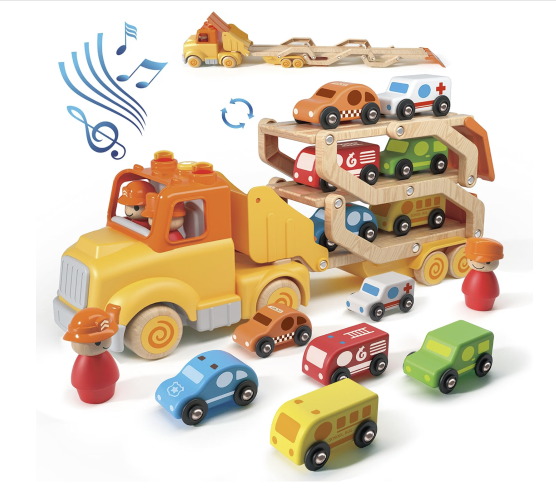
-
Beep, beep! Load 'em up! It's time to hit the road! 🚛🚗💜
If there's one thing I've learned from working with young children, it's that toy vehicles can create some wonderful opportunities for communication!
This car carrier transport truck comes with six smaller wooden vehicles and a fold-out trailer or ramp that children can use to load, transport, and unload their cars.
And here's what I particularly love:
The vehicles don't just move—they have a purpose!
Children can load the cars onto the truck, drive them to a destination, and unload them when they arrive.
That creates opportunities to introduce action words, spatial concepts, early sentences, and sequencing.
At 24–36 months, children are beginning to combine more words, follow increasingly complex directions, and develop imaginative play skills.
This toy encourages all three!
Parents can model:
“Car goes!”
“Truck is big!”
“Drive up!”
“Car goes down!”
“Put it on!”
“Load the truck!”
“Drive to the garage!”
“Cars are here!”
And because there are multiple vehicles, children can begin practicing important concepts such as more, all, one, another, first, and last.
I also love that this toy can be combined with blocks, toy people, and other vehicles to create roads, garages, bridges, and entire neighborhoods.
Although the truck includes lights and sounds, I encourage parents to make plenty of time for child-directed play without electronic sound effects.
The most important sounds are the ones you and your child make together!
🧠 Did You Know?
Play involving familiar sequences can support early language organization!
Think about what happens when a car carrier makes a delivery.
First, the vehicles are loaded.
Next, the truck drives away.
Then, the truck arrives.
Finally, the vehicles are unloaded.
This simple play routine gives children repeated opportunities to experience the order in which events happen.
At 24–36 months, children may not consistently use words such as “first,” “next,” and “last,” but they can begin understanding simple sequences through meaningful play.
Parents can model:
“First, load!”
“Now drive!”
“Stop!”
“Take cars off!”
These experiences help build foundations for more complex language and storytelling.
Here's another important connection:
Children learn spatial concepts more meaningfully when they can experience them.
For example:
“Car ON the truck!”
“Car UNDER the bridge!”
“Truck NEXT TO the house!”
“Car INSIDE the garage!”
Instead of simply hearing these words, children can see and perform the actions.
And as their language develops, they can begin combining spatial words with objects and actions.
“Car on truck!”
“Truck under bridge!”
“Blue car inside!”
Miss Angie's Tip: Don't feel that you need to use all six vehicles during every play session.
Start with two or three.
Allow your child to explore the truck, ramp, and vehicles.
Then introduce more pieces as their attention and play skills develop.
And remember, it's perfectly fine if your toddler wants to load and unload the same car repeatedly.
Repetition creates opportunities for learning!
💜 Let's Play! (24–36 Months)
🚗 1. Ready, Set... GO!
Choose one vehicle.
Place it on the floor.
Say:
“Ready...”
“Set...”
Pause.
“GO!”
Push the car forward.
“Vroom!”
“Car goes!”
“Fast car!”
Repeat the activity and encourage your child to participate.
They might say “go,” make a sound, gesture, or push the vehicle.
Language Focus: Anticipation, action words, environmental sound imitation, and early word combinations.
🚛 2. Load the Truck!
Open the carrier's loading area or ramp.
Place one vehicle on the truck.
Say:
“Car on!”
“Another car!”
“Load it up!”
“More cars!”
“Truck is full!”
Encourage your child to load the vehicles.
Model longer phrases when appropriate:
“Put the blue car on!”
“Let's load another car!”
Language Focus: Action verbs, requesting, spatial concepts, and sentence expansion.
🛝 3. Up the Ramp! Down the Ramp!
Use the fold-out ramp to demonstrate movement.
Say:
“Car goes UP!”
“Up, up, up!”
Then move the car down.
“Car goes DOWN!”
“Down, down, down!”
Repeat with different vehicles.
Encourage your child to move the cars independently.
Language Focus: Spatial vocabulary, opposites, action words, and following directions.
🛑 4. Stop! Go!
Drive the truck across the floor.
Say:
“Truck goes!”
“Go, go, go!”
Then stop.
“STOP!”
Pause.
“Truck stopped!”
Begin again.
“Ready, set... GO!”
Allow your child to decide when the truck moves.
Language Focus: Receptive language, opposites, turn-taking, anticipation, and early self-regulation.
🔴 5. Find the Car!
Place two or three vehicles in front of your child.
Name each one.
“Red car!”
“Blue car!”
“Big truck!”
Then give simple directions:
“Find the red car!”
“Get the blue one!”
“Give me the truck!”
If your child isn't ready to identify colors, focus on vehicle names and actions instead.
Language Focus: Receptive vocabulary, descriptive concepts, following directions, and object identification.
🏠 6. Let's Build a Garage!
Use wooden building blocks or a small box to create a garage.
Say:
“Build garage!”
“Car goes in!”
“Close the garage!”
“Car comes out!”
You can also create a parking area.
“Park here!”
“Two cars!”
“More cars!”
This activity pairs beautifully with traditional wooden building blocks.
Language Focus: Pretend play, spatial concepts, action verbs, and early sentence development.
🚦 7. Follow the Driver's Directions!
Begin with simple directions.
“Get the car!”
“Put it on!”
“Drive the truck!”
“Take it off!”
Then introduce two related actions.
“Get the car and load it!”
“Drive the truck and stop!”
“Take the car off and park it!”
Demonstrate the actions when needed.
Language Focus: Following one- and two-step directions, auditory memory, action vocabulary, and receptive language.
🤝 8. My Turn, Your Turn!
Choose one vehicle for yourself and another for your child.
Say:
“My turn!”
Drive your car up the ramp.
Then say:
“Your turn!”
Allow your child to drive their car.
Model:
“I drive!”
“You drive!”
“Now we load!”
“Let's go together!”
You can also take turns loading the carrier.
Language Focus: Turn-taking, pronouns, social communication, and early sentence development.
🔧 9. Oh No! The Car Broke Down!
Pretend one vehicle has stopped working.
Say:
“Oh no!”
“Car is broken!”
“Help!”
“Need a tow!”
Use the carrier truck to transport the vehicle to a pretend repair shop.
“Load the car!”
“Drive to shop!”
“Fix the car!”
“All better!”
Encourage your child to decide what happens next.
Language Focus: Pretend play, problem-solving, action words, and early storytelling.
📦 10. Special Delivery!
Pretend the truck is delivering vehicles to different places.
Use blocks or other toys to represent a house, school, or garage.
Say:
“Load the cars!”
“Drive to school!”
“Stop here!”
“Take cars off!”
“Delivery done!”
You can introduce simple sequencing language:
“First, load!”
“Then, drive!”
“Now unload!”
Allow your child to choose the destination and repeat the routine.
Language Focus: Sequencing, location vocabulary, pretend play, sentence development, and early narrative skills.
🌱 Grow With Me! — Same Toy, New Skills!
3–5 Years: Learning Through Pretend Play
As children's language and imaginative play become more sophisticated, this transport truck can support increasingly complex activities.
Create delivery adventures: Transport vehicles between pretend cities, garages, and dealerships.
Practice sequencing: Describe what happens first, next, and last during a delivery.
Follow multistep directions: “Load the blue car, close the carrier, and drive to the garage.”
Explore spatial concepts: Above, below, behind, beside, between, and underneath.
Compare vehicles: Discuss differences in size, color, type, and function.
Practice problem-solving: What happens if a vehicle breaks down or the road is blocked?
Introduce descriptive language: Explain what a vehicle looks like and how it moves.
Develop storytelling: Create adventures with a beginning, middle, and end.
Practice cooperative play: Assign roles such as driver, mechanic, and customer.
Explore community helpers: Discuss mechanics, truck drivers, and delivery workers.
Introduce early math concepts: Count vehicles, compare quantities, and create simple patterns.
6+ Years: Building Advanced Communication Skills
Older children can use the same vehicles to support more advanced language and reasoning activities.
Create detailed stories involving transportation and deliveries.
Practice organizing events in logical sequence.
Give precise directions for loading and unloading vehicles.
Follow increasingly complex spatial directions.
Explain cause-and-effect relationships.
Develop solutions to transportation problems.
Compare different types of vehicles and their functions.
Practice using complex sentences with because, before, after, while, and if.
Plan pretend delivery routes with multiple destinations.
Practice negotiation and cooperative planning.
Create imaginative stories involving unexpected events.
Use vehicles as props during articulation, language, and narrative activities.
💜 Miss Angie's Reminder
It's not just the toy—it's how you use it!
One of the things I love most about vehicle toys is how naturally children can create their own adventures.
Some toddlers may spend most of their time driving the truck back and forth.
Others may enjoy loading and unloading the vehicles repeatedly.
And some may begin creating elaborate pretend deliveries.
All of these play patterns offer opportunities for communication!
If your child enjoys driving, model:
“Go!”
“Stop!”
“Fast truck!”
If they love the ramp, model:
“Up!”
“Down!”
“Again!”
If they begin pretending, join their story!
And remember, you don't need to ask questions constantly.
Sometimes simply describing what your child is doing is the most effective way to encourage language.
“You loaded the car!”
“Truck is driving!”
“Oh no! It fell!”
Then pause and allow your child time to respond.
Follow their lead, model meaningful language, and enjoy the adventure together!
One big truck, six little vehicles, and so many opportunities for language, learning, and imagination! 💜🚛
Safety Reminder: Confirm the manufacturer's age recommendation and warnings on the exact product packaging before offering this set to a child younger than 3. Supervise play, inspect the vehicles and ramp for loose or damaged components, and keep the battery compartment securely fastened. This toy uses LR44 button batteries; if the battery compartment is damaged or can be opened by a child, discontinue use. Swallowed button batteries can cause life-threatening injuries and require immediate emergency medical attention.
🌱The Itsy Bitsy Spider — Oversized Finger Puppet Board Book
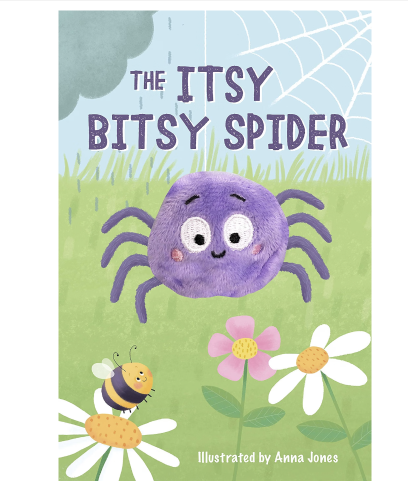
-
Up, up, up! Oh no, here comes the rain! 🕷️🌧️☀️
Some of the best language-building activities begin with a familiar nursery rhyme!
This delightful Itsy Bitsy Spider board book from Little Hippo Books brings the classic song to life with a soft, permanently attached spider finger puppet.
As parents read or sing, they can move the little spider through openings in the pages, making it appear to climb, hide, and explore.
And here's what I particularly love:
The spider becomes part of the conversation!
Instead of simply looking at pictures, children can watch the spider move, anticipate what happens next, and participate through gestures, sounds, words, and actions.
At 24–36 months, toddlers are beginning to combine more words, follow increasingly complex directions, and understand familiar sequences.
This book offers wonderful opportunities to practice all three!
Parents can model:
“Spider goes up!”
“Up, up, up!”
“Oh no! Rain!”
“Spider goes down!”
“Rain is gone!”
“Sun comes out!”
“Try again!”
“Go, spider, go!”
I especially love how easily parents can adjust the language to their child's developmental level.
For a child using single words, focus on:
“Up!”
“Down!”
“Rain!”
“Sun!”
For a child beginning to combine words, model:
“Spider up!”
“Rain falls!”
“Sun comes out!”
And for children using longer sentences:
“The spider is climbing up!”
“Oh no! The rain made him fall!”
The soft puppet adds another wonderful dimension: children can watch the spider greet them, hide, peek out, and participate in simple pretend conversations.
One familiar nursery rhyme, one little spider, and so many opportunities for communication!
🧠 Did You Know?
Nursery rhymes provide a wonderful foundation for early speech and language development!
They combine several important elements of communication:
Rhythm: Children hear the natural patterns and timing of language.
Repetition: Familiar words and phrases are repeated.
Anticipation: Children begin expecting what happens next.
Sound awareness: Children hear rhymes and repeated sound patterns.
Sequencing: Events occur in a predictable order.
Imitation: Children can copy movements, sounds, and words.
Social interaction: Singing together encourages shared attention and participation.
And here's something particularly important:
Children don't have to sing the words to participate!
A toddler may point upward when the spider climbs.
They may move their hands downward when the rain falls.
They may smile when the puppet appears.
Or they may attempt a familiar word such as “up,” “down,” or “again.”
All of these are meaningful ways to participate in a shared language experience.
Let's also talk about sequencing!
The familiar story follows a simple pattern:
The spider climbs.
The rain comes.
The spider goes down.
The sun appears.
The spider tries again.
These events provide an early foundation for understanding how stories are organized.
As children grow, they can begin describing what happened first, next, and last.
Miss Angie's Tip: You don't need to sing the entire song every time!
Sometimes it's more beneficial to stop and talk about what your child notices.
“Look! Spider!”
“Spider goes up!”
“Oh no!”
“Rain!”
Then pause and allow your child time to respond.
The goal isn't to perform the song perfectly. It's to enjoy communicating together!
💜 Let's Play! (24–36 Months)
🕷️ 1. Up, Up, Up!
Place your finger inside the attached spider puppet.
Slowly move the spider upward.
Say:
“Spider goes UP!”
“Up, up, up!”
“Climb, spider!”
“Go up!”
Pause when the spider reaches the top.
“Made it!”
Encourage your child to point upward or imitate the movement.
Language Focus: Action words, spatial concepts, imitation, and early word combinations.
🌧️ 2. Oh No! Here Comes the Rain!
Move your fingers downward to imitate falling rain.
Say:
“Rain!”
“Drip, drip, drip!”
“Rain comes down!”
“Oh no!”
Then move the spider downward.
“Spider goes DOWN!”
“Down, down, down!”
Encourage your child to imitate the rain using their fingers.
Language Focus: Environmental sound imitation, spatial vocabulary, action words, and cause-and-effect language.
☀️ 3. Here Comes the Sunshine!
After the rain, pause.
Then smile and say:
“Look!”
“Sun!”
“Sun comes out!”
“Rain is gone!”
Use your hands to make a big circle above your head.
Encourage your child to imitate.
Then move the spider upward again.
“Try again!”
Language Focus: Vocabulary, action words, opposites, gestures, and early sequencing.
👀 4. Where Did Spider Go?
Use the book's openings to make the puppet appear and disappear.
Say:
“Where's spider?”
“Spider hiding!”
Pause.
Then reveal the puppet.
“Peekaboo!”
“There he is!”
“Hi, spider!”
Allow your child to anticipate when the spider will appear.
Language Focus: Joint attention, anticipation, object permanence, social interaction, and early questions.
🎵 5. Sing and Move!
Sing the familiar nursery rhyme while moving the puppet.
Encourage your child to participate through gestures.
Move your hands upward when the spider climbs.
Move your fingers downward when the rain falls.
Make a circle with your arms when the sun appears.
You can slow the song down and emphasize important words:
“UP!”
“DOWN!”
“RAIN!”
“SUN!”
Language Focus: Auditory attention, rhythm, imitation, familiar vocabulary, and participation in predictable routines.
🗣️ 6. Finish My Phrase!
After several repetitions, pause before a familiar word.
Say:
“Spider goes...”
Wait briefly.
Then model:
“UP!”
Try another phrase:
“Rain comes...”
“DOWN!”
If your child attempts a word, sound, or gesture, acknowledge it naturally.
“Yes! UP!”
If they don't respond, simply continue.
Language Focus: Anticipation, expressive language, word combinations, and auditory memory.
Miss Angie's Tip: Avoid repeatedly asking your child to say a word. A brief pause gives them an opportunity to participate without pressure.
💜 7. Hello, Little Spider!
Use the puppet to greet your child.
Say:
“Hi!”
“I'm Spider!”
“What's your name?”
“Want to play?”
Move the puppet as though it's speaking.
Encourage your child to wave, respond, or interact.
You can also model:
“Hi, Spider!”
“Come here!”
“Bye-bye!”
“See you!”
Language Focus: Social communication, greetings, turn-taking, pretend dialogue, and early conversational skills.
🐻 8. Spider Meets a Friend!
Bring out a favorite stuffed animal or doll.
Move the spider toward the toy.
Say:
“Spider sees Bear!”
“Hi, Bear!”
“Bear says hello!”
“Let's play!”
Encourage your child to move the stuffed animal and participate in the interaction.
You can introduce simple pretend conversations:
“Where are you going?”
“Up the tree!”
“Come back!”
Language Focus: Symbolic play, social communication, early sentences, and imaginative language.
🧩 9. First, Next, Last!
After reading, briefly review what happened.
Use the puppet and simple gestures.
“First, spider goes up!”
“Then, rain comes!”
“Spider goes down!”
“Sun comes out!”
“Spider goes up again!”
For younger toddlers, focus on just two events:
“Spider up!”
“Rain down!”
As your child's language develops, introduce more of the sequence.
Language Focus: Sequencing, receptive language, early narrative development, and sentence expansion.
🌱 10. Try Again, Little Spider!
Use the spider's repeated attempts to introduce simple problem-solving language.
Move the spider upward.
Then make it slide down.
“Oh no!”
“Spider fell!”
Pause.
“What now?”
Then model:
“Try again!”
“Go, spider!”
“You did it!”
Connect the idea to familiar experiences.
“Blocks fell!”
“Try again!”
“Can't open it?”
“Let's try!”
Language Focus: Problem-solving vocabulary, action words, early reasoning, and emotional language.
🌱 Grow With Me! — Same Book, New Skills!
3–5 Years: Learning Through Pretend Play
As children's language and early literacy skills develop, this familiar nursery rhyme can support more sophisticated activities.
Retell the story: Describe what happened first, next, and last.
Practice sequencing: Arrange simple pictures representing the spider, rain, and sunshine.
Explore rhyming words: Listen for words that rhyme and generate new rhyming pairs.
Identify action words: Climb, fall, wash, dry, hide, and crawl.
Answer WH questions: “Where is the spider going?” “Why did the spider fall?”
Practice prediction: “What do you think will happen next?”
Introduce opposites: Up/down, wet/dry, high/low.
Discuss feelings: How might the spider feel when the rain comes?
Create pretend conversations: Have the spider talk to other toy animals.
Practice problem-solving: What could the spider do if it starts raining again?
Expand sentences: Encourage children to describe the events using longer, more detailed language.
6+ Years: Building Advanced Communication Skills
Older children can use the same book and puppet for more advanced language, literacy, and storytelling activities.
Retell the story using complete, organized sentences.
Practice sequencing with first, next, then, after, and finally.
Explain cause-and-effect relationships.
Generate rhyming words and identify shared ending sounds.
Explore syllables and rhythm in spoken language.
Create new verses or original adventures for the spider.
Develop stories with a beginning, middle, problem, and solution.
Practice perspective-taking by describing the spider's thoughts and feelings.
Compare the spider's experiences with familiar real-life situations.
Use increasingly complex sentences with because, when, before, and after.
Practice oral storytelling using the puppet as a character.
Use the puppet during articulation, language, or narrative activities.
💜 Miss Angie's Reminder
It's not just the book—it's how you share it!
One of the things I love most about this finger puppet book is that it encourages children to participate in a familiar story.
But remember, your child doesn't have to sing every word.
They don't have to imitate every gesture.
And they certainly don't have to sit perfectly still while you read!
Some toddlers may want to watch the spider move.
Others may want to touch the puppet.
Some may enjoy hearing the song over and over again.
And others may be most interested in making the spider disappear and reappear.
Follow their lead!
If your child loves watching the spider climb, model:
“Up!”
“Climb!”
“Go, spider!”
If they enjoy the rain, model:
“Rain!”
“Down!”
“Oh no!”
If they want the story repeated, model:
“Again!”
“More song!”
“Read again!”
And remember to pause occasionally.
Those little pauses provide opportunities for your child to participate through gestures, sounds, words, or actions.
Repetition, movement, and shared enjoyment can make familiar nursery rhymes powerful language-learning experiences.
One little spider, one familiar song, and wonderful opportunities for language, learning, and connection! 💜🕷️
Safety Reminder: The publisher recommends this book for ages 0–5. The plush spider finger puppet is permanently attached to the book. Supervise young children during reading and regularly inspect the puppet, stitching, and board pages for loose or damaged components. Discontinue use if any part becomes detached or damaged.
🌱Melissa & Doug Take-Along Sorting Barn
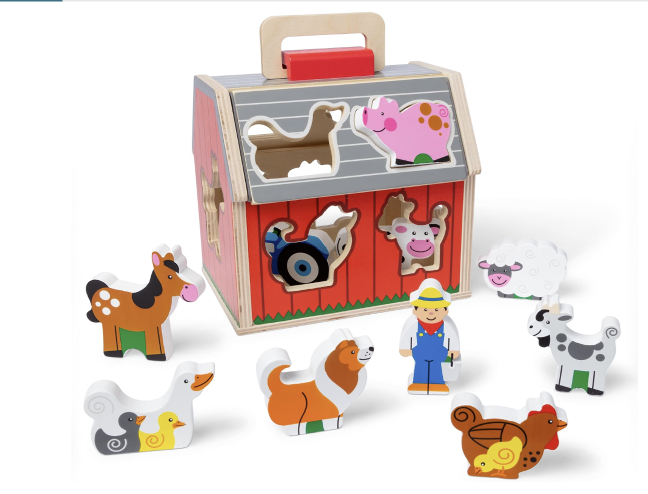
-
Moo! Oink! Neigh! Let's visit the farm! 🐷🐴🐥
This adorable wooden sorting barn combines two of my favorite types of play: hands-on problem-solving and imaginative pretend play!
The Melissa & Doug Take-Along Sorting Barn includes 10 chunky wooden farm-themed pieces that children can fit through shaped openings in the barn. The roof flips open so little hands can retrieve the pieces and start all over again.
But here's what I particularly love:
The animals don't have to stay inside the barn!
They stand upright, allowing children to create their own little farm adventures.
At 24–36 months, toddlers are beginning to use longer word combinations, understand more complex directions, and develop early pretend-play skills.
This toy provides wonderful opportunities to encourage all three!
Parents can model:
“Cow goes MOO!”
“Pig in!”
“Open the barn!”
“Horse is sleeping!”
“Farmer drives tractor!”
“Where's the sheep?”
“Here it is!”
I also love that the barn has a carrying handle. Children can bring their farm adventures from one room to another.
And because there are no batteries or prerecorded sounds, the child and caregiver create the conversation!
🧠 Did You Know?
Pretend play and language development are closely connected!
When a toddler pretends that a cow is eating, a horse is sleeping, or a farmer is driving a tractor, they're beginning to use objects to represent familiar experiences.
This type of symbolic play develops alongside important language skills.
Children begin moving beyond simply naming objects to describing what those objects are doing.
Instead of only saying “cow,” they may begin saying:
“Cow eat!”
“Cow sleep!”
“Cow go barn!”
These early word combinations help children communicate relationships between people, objects, and actions.
And what about the shape sorting?
Fitting the wooden pieces into their corresponding openings encourages visual discrimination, problem-solving, and persistence.
It also creates natural opportunities to model important concepts:
“In!”
“Out!”
“Turn it!”
“Try again!”
“It fits!”
“Too big!”
At this age, some children will need help rotating pieces to fit the openings. That's perfectly fine!
Miss Angie's Tip: Don't turn every animal into a naming question.
Instead of repeatedly asking, “What's this?” try modeling meaningful language during play.
“Oh! A pig!”
“Pig goes OINK!”
“Pig is hungry!”
“Let's feed pig!”
Your child is hearing vocabulary, sounds, actions, and early sentence structures—all during one simple interaction.
💜 Let's Play! (24–36 Months)
🐄 1. Who Lives on the Farm?
Begin with two or three animals rather than all 10 pieces.
Show your child a cow.
Say:
“Look! Cow!”
“Cow says MOO!”
“Hi, cow!”
Repeat with another familiar animal.
Encourage your child to imitate the sounds, names, or actions if interested.
Language Focus: Animal vocabulary, sound imitation, joint attention, and early word combinations.
🚪 2. In the Barn! Out of the Barn!
Use the barn's sorting openings and flip-up roof to model spatial concepts.
Say:
“Cow IN!”
“Open roof!”
“Cow OUT!”
“Close roof!”
Repeat the routine with different animals.
As your child's language develops, model:
“Put cow in!”
“Take pig out!”
“Open the barn!”
Language Focus: Spatial concepts, action words, following directions, and two- to three-word combinations.
🐷 3. What Does the Animal Say?
Place two or three animals in front of your child.
Choose one and model its sound.
“Pig says OINK!”
“Cow says MOO!”
“Horse says NEIGH!”
Then make a sound and see whether your child wants to find the matching animal.
“MOO! Who says MOO?”
If your child doesn't identify the animal, show them.
“Cow! MOO!”
Language Focus: Auditory association, receptive vocabulary, sound imitation, and answering simple questions.
🧩 4. Find the Right Spot!
Choose one wooden piece and help your child locate the matching opening.
Say:
“Where does it go?”
“Turn it!”
“Try here!”
“It fits!”
If the piece doesn't fit, model:
“Oops!”
“Try again!”
“Turn around!”
Allow your child time to experiment before helping.
Language Focus: Problem-solving vocabulary, action words, spatial language, and following directions.
🐴 5. The Animals Are Hungry!
Stand a few animals outside the barn.
Pretend they're eating grass.
Say:
“Cow eats!”
“Horse eats!”
“Yummy grass!”
“Pig is hungry!”
Invite your child to feed the animals pretend food.
You can expand their language naturally.
Child: “Cow eat!”
Parent: “Yes! Cow is eating!”
Language Focus: Action verbs, pretend play, sentence expansion, and early grammatical development.
🚜 6. The Farmer Is Busy!
Use the farmer and tractor pieces to create a little story.
Say:
“Farmer drives!”
“Tractor goes!”
“Vroom, vroom!”
“Farmer sees cow!”
“Hi, cow!”
Allow your child to decide where the tractor goes next.
Language Focus: Agent-action combinations, early storytelling, vocabulary, and symbolic play.
🐑 7. Where Did the Sheep Go?
Hide one animal inside the barn.
Say:
“Where's sheep?”
“Is sheep hiding?”
Open the roof.
“There it is!”
“Sheep is inside!”
Then let your child hide an animal for you to find.
Language Focus: Object permanence, answering “where” questions, spatial concepts, and turn-taking.
🐥 8. Follow the Farmer's Directions!
Begin with simple one-step directions.
“Get the cow!”
“Find the pig!”
“Put horse in!”
Then try two related actions:
“Get the cow and put it in!”
“Find the farmer and give him the tractor!”
For children who need more support, demonstrate the action while giving the direction.
Language Focus: Receptive language, following directions, vocabulary, and auditory memory.
🐶 9. Let's Make Animal Families!
Choose two or three animals and pretend they are visiting each other.
Say:
“Dog sees cow!”
“Hi, cow!”
“Come play!”
“Let's go!”
Encourage your child to move the animals and create simple interactions.
You can model social phrases such as:
“Hi!”
“Bye-bye!”
“Come here!”
“Your turn!”
Language Focus: Social communication, pretend dialogue, word combinations, and imaginative play.
🌙 10. Goodnight, Farm Animals!
Create a bedtime routine for the animals.
Say:
“Cow is tired!”
“Time for bed!”
“Night-night, cow!”
“Sleep, pig!”
Place the animals inside the barn one at a time.
Then close the roof.
“Everybody sleeping!”
“Shhh!”
This is a wonderful opportunity to connect pretend play with familiar daily routines.
Language Focus: Sequencing, routine vocabulary, action words, and early narrative development.
🌱 Grow With Me! — Same Toy, New Skills!
3–5 Years: Learning Through Pretend Play
As your child's language and imagination grow, the same barn can support more complex activities.
Tell farm stories: Create adventures with the farmer, tractor, and animals.
Practice sequencing: Describe what happens first, next, and last.
Answer WH questions: “Where is the cow?” “Why is the farmer driving?”
Describe animals: Discuss their appearance, sounds, and actions.
Sort into categories: Animals versus people and vehicles.
Compare and contrast: How are the horse and cow alike? How are they different?
Follow multistep directions: “Put the pig inside, close the roof, and give me the tractor.”
Practice positional concepts: Behind, beside, between, and next to.
Introduce problems and solutions: “The horse can't find the barn. What should we do?”
Create pretend conversations: Encourage the animals and farmer to talk to one another.
6+ Years: Building Advanced Communication Skills
For older children, use the familiar farm pieces as props for more sophisticated language activities.
Develop stories with a beginning, middle, and end.
Practice retelling events in the correct sequence.
Create problems and explain possible solutions.
Compare farm animals by habitat, appearance, diet, or function.
Practice describing an animal without naming it.
Use increasingly complex sentences with because, before, after, and while.
Explore perspective-taking by discussing what different characters might think or feel.
Practice following and giving detailed directions.
Develop creative writing or oral storytelling activities.
Use the animals as characters in articulation or language practice.
💜 Miss Angie's Reminder
It's not just the toy—it's how you use it!
One of the things I love most about this sorting barn is that children can play with it in so many different ways.
Some toddlers may spend most of their time putting the pieces in and taking them out.
Others may enjoy lining up the animals.
And some may immediately begin creating little farm adventures.
All of these interests can become opportunities for communication!
Follow your child's lead.
If they're sorting, model “in,” “out,” and “turn.”
If they're playing with the animals, introduce sounds, actions, and short sentences.
If they're pretending, join their story!
And remember, children don't have to correctly name every animal to benefit from the experience.
A smile, gesture, sound imitation, or attempt at a word is worth celebrating.
One little barn, 10 wooden play pieces, and endless opportunities for language, learning, and imagination! 💜🐄
Safety Reminder: Manufacturer recommended for ages 2–5 years. Supervise play, inspect wooden pieces for damage, and follow all packaging instructions and warnings.
🌱Diobee Baby Lift-the-Flap Book Set — 10 Books
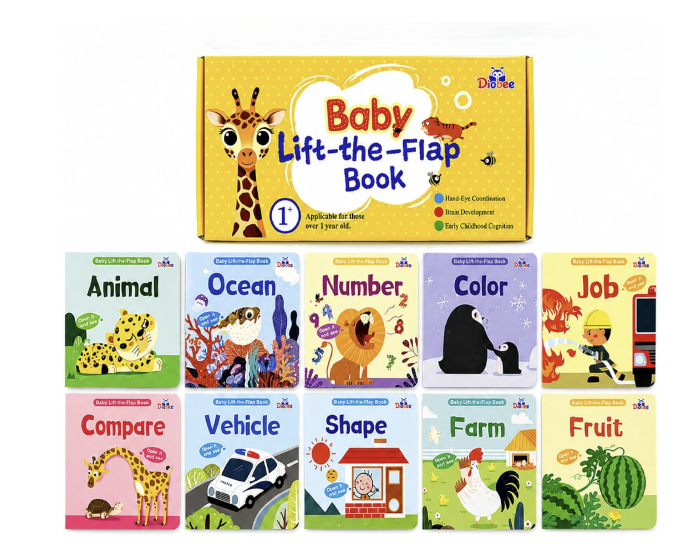
-
Lift it! Look inside! What will we discover? 👀💜
I love interactive books because they encourage children to become active participants in reading rather than simply sitting and listening!
This colorful Diobee Baby Lift-the-Flap Book Set includes 10 themed books:
Animal • Ocean • Number • Color • Job • Compare • Vehicle • Shape • Farm • Fruit
Each book introduces a different collection of vocabulary and concepts, giving parents opportunities to explore familiar words, actions, descriptions, and early language relationships.
And here's what I particularly love:
Children get to discover what's hiding behind the flaps!
That simple action creates opportunities for anticipation, joint attention, requesting, and back-and-forth interaction.
Parents can model:
“Open it!”
“Look!”
“What's hiding?”
“There it is!”
“Close it!”
“Do it again!”
At 24–36 months, children are developing longer word combinations, understanding more descriptive language, and beginning to answer simple questions.
These books provide natural opportunities to practice those skills through playful, hands-on reading.
I also love the variety!
One day, your child may be interested in animals.
Another day, they may want to explore vehicles.
And on another day, they may enjoy identifying familiar foods or discovering different shapes.
You don't need to read all 10 books at once!
Choose one based on your child's interests and enjoy exploring it together.
And remember, you don't have to read every word on every page.
Sometimes the most meaningful language opportunities happen when you stop reading and start talking about what your child notices!
🧠 Did You Know?
Interactive reading encourages children to participate in the communication process!
When a child lifts a flap, points to a picture, or looks toward a caregiver, they're creating an opportunity for shared attention.
Shared attention is an important foundation for language development because children learn words through meaningful interactions with people and objects.
For example, imagine your child lifts a flap and discovers a cow.
You might say:
“Look! Cow!”
“Cow says MOO!”
“Big cow!”
“Cow is eating!”
In just a few seconds, you've introduced a noun, an animal sound, a descriptive word, and an action.
And here's another important connection:
Children learn vocabulary more effectively when words are connected to meaningful experiences.
Rather than asking your child to name every picture, try describing what they're looking at.
If your child says:
“Car!”
You can expand:
“Yes! Blue car!”
Or:
“Car goes fast!”
This technique is called language expansion.
You're acknowledging what your child said while providing a slightly longer model.
Miss Angie's Tip: Don't feel that every flap needs to become a question.
Instead of repeatedly asking, “What's that?” try:
“Oh! A fish!”
“Fish swims!”
“Look at the big fish!”
Then pause and see what your child does.
They may point, smile, vocalize, gesture, or attempt a word.
All of these responses can be meaningful communication opportunities!
💜 Let's Play! (24–36 Months)
🐆 1. Animal Book — Who's Hiding?
Choose a page with a familiar animal.
Point to the flap.
Say:
“Who's hiding?”
“Open it!”
“Look! Animal!”
Name the animal shown.
Then introduce its sound or action when appropriate.
“Lion says ROAR!”
“Monkey climbs!”
“Bird flies!”
Allow your child to imitate sounds or actions.
If they don't imitate, continue modeling without pressure.
Language Focus: Animal vocabulary, sound imitation, action verbs, joint attention, and early word combinations.
🐠 2. Ocean Book — Under the Sea!
Explore the ocean animals together.
Point to a familiar picture.
Say:
“Look! Fish!”
“Fish swims!”
“Swim, swim!”
“Big fish!”
“Little fish!”
Use your hand to imitate a swimming fish.
Encourage your child to copy the movement.
You can also introduce:
“Under water!”
“Splash!”
“Fish goes down!”
Language Focus: Vocabulary, action words, descriptive concepts, movement imitation, and spatial language.
🔢 3. Number Book — Let's Count Together!
Choose a page with a small number of objects.
Point to each object as you count.
“One!”
“Two!”
“Three!”
Encourage your child to point along with you.
You can also model:
“One more!”
“Two cars!”
“More!”
“All gone!”
At this age, children may enjoy reciting numbers without yet understanding the quantity each number represents.
That's okay!
Focus on playful counting and connecting number words with real objects.
Language Focus: Early quantity concepts, counting vocabulary, pointing, joint attention, and one-to-one correspondence foundations.
🎨 4. Color Book — Find the Color!
Choose two familiar colors.
Point to one picture.
Say:
“Red!”
“Red apple!”
“Look! Blue!”
“Blue car!”
Encourage your child to find something nearby that matches the color.
For example:
“Book is red!”
“Your shirt is blue!”
If your child isn't identifying colors yet, simply continue naming them naturally.
Language Focus: Color vocabulary, descriptive word combinations, receptive language, and vocabulary generalization.
👩🚒 5. Job Book — Who Helps Us?
Explore the different community helpers pictured in the book.
Name each person and describe what they do.
For example:
“Firefighter helps!”
“Doctor helps people!”
“Teacher reads!”
“Chef cooks!”
Use the actual illustrations to guide your language.
You can also introduce simple pretend actions.
“Let's cook!”
“Stir, stir!”
“Let's drive!”
“Beep, beep!”
Language Focus: People vocabulary, action verbs, community helper concepts, and early pretend play.
🦒 6. Compare Book — Big or Little?
Choose a page that illustrates a clear difference between two objects.
Describe what you see.
“Big!”
“Little!”
“Tall!”
“Short!”
“Same!”
“Different!”
For example, if the page shows two animals of different sizes, say:
“Big animal!”
“Little animal!”
“Look! This one is bigger!”
Then find two objects nearby that demonstrate the same concept.
Language Focus: Opposites, descriptive vocabulary, comparison concepts, and early sentence development.
🚗 7. Vehicle Book — Ready, Set, GO!
Explore the different vehicles.
Name each one.
“Car!”
“Truck!”
“Bus!”
“Airplane!”
Then introduce sounds and actions.
“Car goes VROOM!”
“Bus says BEEP!”
“Plane flies!”
“Truck is big!”
Use your hands to imitate the movements.
You can also bring out a favorite toy vehicle and match it to a picture.
Language Focus: Vehicle vocabulary, environmental sound imitation, action verbs, and vocabulary generalization.
🔺 8. Shape Book — Shapes Everywhere!
Choose one or two shapes to explore.
Point to the illustration.
Say:
“Circle!”
“Round circle!”
“Square!”
“Four sides!”
Then look for matching shapes in your environment.
“Plate is round!”
“Look! Square block!”
“Circle wheel!”
If your child isn't ready to identify shapes independently, focus on noticing and naming them together.
Language Focus: Shape vocabulary, descriptive concepts, visual discrimination, and receptive language.
🐓 9. Farm Book — Old MacDonald Had a Farm!
Explore the farm animals and objects pictured in the book.
Name familiar animals.
“Cow!”
“Pig!”
“Chicken!”
Introduce animal sounds.
“MOO!”
“OINK!”
“CLUCK!”
Then sing a familiar verse of “Old MacDonald Had a Farm.”
Pause before an animal sound.
“And on that farm he had a cow...”
“E-I-E-I-O!”
“With a MOO MOO here...”
Allow your child to join in through sounds, words, gestures, or movement.
Language Focus: Animal vocabulary, sound imitation, auditory attention, familiar song participation, and early word combinations.
🍎 10. Fruit Book — Let's Go Shopping!
Explore the fruit pictures together.
Name familiar foods.
“Apple!”
“Banana!”
“Orange!”
“Watermelon!”
Introduce descriptive words.
“Red apple!”
“Yellow banana!”
“Big watermelon!”
Pretend you're shopping.
“I want apple!”
“Put it in!”
“More fruit!”
“Yummy!”
You can also connect the pictures to real fruit during snack time or grocery shopping.
Language Focus: Food vocabulary, requesting, descriptive language, pretend play, and vocabulary generalization.
🌱 Grow With Me! — Same Books, New Skills!
3–5 Years: Learning Through Pretend Play
As children's vocabulary, sentence length, and understanding of concepts grow, these books can support increasingly sophisticated language activities.
Animal: Describe habitats, actions, and animal characteristics.
Ocean: Compare sea creatures and discuss where they live.
Number: Practice counting objects, comparing quantities, and recognizing numerals.
Color: Identify colors, describe objects using multiple attributes, and sort by color.
Job: Discuss community helpers, their responsibilities, and the tools they use.
Compare: Practice opposites, similarities, differences, and comparative vocabulary.
Vehicle: Categorize transportation by land, air, and water.
Shape: Identify shapes, describe their features, and find examples in the environment.
Farm: Create stories about animals, farmers, and daily farm routines.
Fruit: Categorize foods, describe tastes and textures, and create pretend shopping activities.
You can also introduce more complex questions:
“Where does it live?”
“What does it do?”
“Why do we need it?”
“How are these alike?”
“How are they different?”
Encourage children to answer in complete sentences when developmentally appropriate.
6+ Years: Building Advanced Communication Skills
Older children can use the same books as visual supports for more advanced language and literacy activities.
Practice categorization and explaining why objects belong together.
Compare and contrast items using specific descriptive vocabulary.
Develop increasingly complex sentences.
Explain object functions and relationships.
Practice defining familiar and unfamiliar vocabulary.
Generate clues and descriptive riddles.
Develop short stories using pictures as prompts.
Practice sequencing and retelling events.
Explore synonyms, antonyms, and multiple-meaning words when appropriate.
Use pictures for articulation practice at the word, phrase, and sentence levels.
Practice explaining similarities and differences.
Develop reasoning and problem-solving skills.
Create original questions and answers based on the illustrations.
💜 Miss Angie's Reminder
It's not just the books—it's how you share them!
One of the things I love most about this collection is the variety.
With 10 different themes, parents can follow their child's interests while introducing a wide range of vocabulary and language concepts.
But remember:
You don't have to teach everything in one sitting!
If your child wants to open and close the same flap repeatedly, that's okay.
Model:
“Open!”
“Close!”
“Again!”
If they want to look at the same animal over and over, enjoy that moment together.
“Cow!”
“MOO!”
“Big cow!”
And if they skip pages or move from one book to another, follow their lead when possible.
The goal isn't to finish every page.
The goal is to encourage meaningful interaction.
Talk about what your child notices.
Expand on what they say.
Pause and give them opportunities to participate.
And most importantly, enjoy reading together!
Ten little books, countless discoveries, and wonderful opportunities for language, learning, and connection! 💜📚
Safety Reminder: The product packaging shown advertises ages 1+. Confirm the manufacturer's age guidance and warnings on the exact purchased set. Supervise young children during reading and inspect the flaps and pages regularly for loose, torn, or damaged pieces. Remove damaged books from use.
🌱Melissa & Doug Wooden Building Blocks — 100-Piece Set
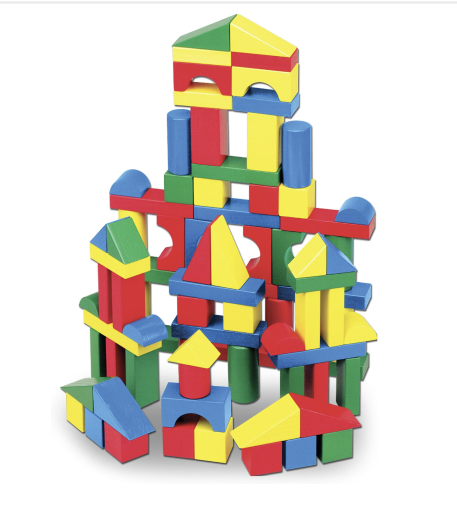
-
Sometimes the simplest toys offer the greatest opportunities for learning!
The Melissa & Doug Wooden Building Blocks Set includes 100 colorful wooden blocks in four colors and nine different shapes.
No batteries.
No flashing lights.
No prerecorded music.
Just good old-fashioned building blocks and a child's imagination!
And here's something I particularly love:
These are traditional wooden blocks—not magnetic blocks!
Children must carefully position and balance each block to keep their structures standing.
They learn that a wide block may provide a sturdy foundation, while a narrow block requires more careful placement.
They also discover what happens when a tower becomes too tall or a block isn't positioned securely.
These experiences encourage problem-solving, motor planning, visual-spatial awareness, and persistence.
But as a speech-language pathologist, what excites me most is the language that naturally develops during building activities!
At 24–36 months, children are beginning to combine more words, understand increasingly complex directions, and use objects in imaginative play.
Wooden blocks offer opportunities to model:
“More blocks!”
“Put it on!”
“Build tall!”
“Red block!”
“It fell down!”
“Try again!”
“Big tower!”
“Help me!”
And as your child's language grows, you can expand those phrases:
“Put the blue block on top!”
“Let's build a big house!”
“Oh no! Our tower fell down!”
“Let's make a road for the bus!”
I also love that blocks can be combined with toys your child already owns, such as cars, farm animals, and Little People figures.
A simple tower can become a house.
A row of blocks can become a road.
Two towers with a block across the top can become a bridge.
The possibilities are limited only by your child's imagination!
🧠 Did You Know?
Block play supports several important developmental skills at the same time!
When children build with traditional wooden blocks, they are learning through trial and error.
They begin discovering relationships between size, shape, position, and stability.
For example:
A wide block may be easier to balance.
A narrow block may fall when placed on an uneven surface.
A tall tower may become unstable.
A block placed across two supports can form a bridge.
These discoveries encourage early problem-solving and spatial reasoning.
And spatial language is an important part of language development!
Words such as:
“On”
“Under”
“Next to”
“Between”
“Behind”
“Top”
“Bottom”
“Inside”
help children understand and describe how objects relate to one another.
Block play provides a meaningful way to introduce these concepts because children can see and experience them.
Instead of simply telling your child what “on top” means, you can demonstrate:
“Look! Red block ON TOP!”
Then allow your child to try.
Here's another important connection:
As children's block-building skills become more complex, their pretend play often becomes more elaborate, too.
A two-year-old may begin by stacking blocks.
Later, those blocks may represent a house, garage, farm, or castle.
This shift toward symbolic play develops alongside increasingly complex language.
Miss Angie's Tip: You don't need to use all 100 blocks at once!
For many toddlers, beginning with just four to six blocks is plenty.
Too many pieces can become overwhelming.
Start small, follow your child's interests, and gradually introduce more blocks as their play develops.
💜 Let's Play! (24–36 Months)
🧱 1. Build It Up! Knock It Down!
Start with three or four blocks.
Stack them slowly.
Say:
“Block on!”
“Another block!”
“Up, up, up!”
“Big tower!”
Then allow your child to knock it down.
“BOOM!”
“It fell!”
“Oh no!”
“Build again!”
Pause to see whether your child requests another turn.
Language Focus: Action words, early word combinations, anticipation, cause and effect, and requesting.
🔴 2. Find the Color!
Choose two different-colored blocks.
Hold them up and name the colors.
“Red block!”
“Blue block!”
Place them in front of your child.
Say:
“Get red!”
“Find blue!”
“Put red on!”
For children beginning to use longer phrases, model:
“I want red!”
“Blue goes on top!”
“Give me the yellow block!”
Language Focus: Color vocabulary, receptive language, requesting, and early sentence development.
Miss Angie's Tip: Color naming is not the most important goal at this age. Children can learn tremendous amounts of language through blocks even if they aren't identifying colors yet.
🏗️ 3. Tall Tower, Short Tower!
Build two towers.
Make one tall and one short.
Say:
“Tall tower!”
“Short tower!”
“Look! This one's tall!”
“This one's short!”
Compare the towers.
“Which one is taller?”
If your child isn't ready to answer, model the comparison.
“This tower is taller!”
Then knock them down and build again.
Language Focus: Descriptive vocabulary, opposites, comparison concepts, and sentence expansion.
🚗 4. Let's Build a Road!
Arrange several blocks in a line to create a road.
Bring out a favorite toy car or bus.
Say:
“Make a road!”
“Car goes!”
“Drive, drive!”
“Stop!”
“Go!”
You can also build a garage using a few blocks.
“Car goes in!”
“Car comes out!”
“Park the car!”
If you have the Little People School Bus, this is a wonderful opportunity to combine the two toys!
Language Focus: Pretend play, action words, spatial concepts, and early sequencing.
🏠 5. Build a House!
Use a few blocks to create a simple house or enclosure.
Say:
“Let's build a house!”
“Wall goes here!”
“Make a door!”
“Put roof on!”
Then add a small toy figure or animal.
“Cow goes inside!”
“Baby is sleeping!”
“Knock, knock!”
“Come in!”
Allow your child to decide who lives in the house.
Language Focus: Symbolic play, vocabulary, spatial concepts, and early storytelling.
👀 6. Copy My Building!
Start with a very simple structure.
Place one block on top of another.
Say:
“Watch me!”
“Block on top!”
“Your turn!”
Encourage your child to copy your structure.
Then try placing two blocks side by side.
“Next to!”
“Two blocks!”
If your child isn't ready to imitate, copy what they're building instead.
This encourages reciprocal interaction without placing demands on the child.
Language Focus: Imitation, visual attention, spatial language, turn-taking, and following directions.
🟨 7. Let's Sort the Blocks!
Choose a small group of blocks.
Begin sorting by one feature.
For example, place all the red blocks together.
Say:
“Red here!”
“More red!”
“Blue over here!”
You can also sort by shape.
“Round ones!”
“Long blocks!”
“Square blocks!”
Once your child understands the activity, introduce simple comparisons.
“Same!”
“Different!”
Language Focus: Categorization, descriptive vocabulary, receptive language, and early concept development.
🌉 8. Build a Bridge!
Place two blocks a short distance apart.
Carefully place a longer block across the top.
Say:
“Two blocks!”
“Put one across!”
“Look! A bridge!”
Bring out a small toy vehicle that fits safely underneath.
“Car goes under!”
“Car comes out!”
“Drive across!”
Allow your child to experiment with different arrangements.
Language Focus: Spatial concepts, action words, problem-solving, and early sentence development.
🤝 9. My Turn, Your Turn!
Sit across from your child with a small pile of blocks.
Place one block down.
Say:
“My turn!”
Then offer your child a block.
“Your turn!”
Continue taking turns adding blocks.
Model:
“I put one!”
“You put one!”
“More blocks!”
“Let's build together!”
If the tower falls, respond playfully.
“Oops!”
“Try again!”
Language Focus: Turn-taking, pronouns, cooperative play, requesting, and social communication.
🐄 10. Let's Build a Farm!
Use blocks to create a fence, barn, or animal enclosure.
Add toy farm animals if available.
Say:
“Build a fence!”
“Cow goes in!”
“Horse is outside!”
“Pig is sleeping!”
“Farmer comes!”
“Open the gate!”
If you have the Melissa & Doug Sorting Barn, the wooden blocks can become additional fences, roads, or buildings for the farm.
Encourage your child to create their own little farm adventure.
Language Focus: Imaginative play, action verbs, spatial concepts, sentence expansion, and early narrative skills.
🌱 Grow With Me! — Same Toy, New Skills!
3–5 Years: Learning Through Pretend Play
As children's language, planning, and imaginative play become more sophisticated, wooden blocks can support increasingly complex activities.
Build more elaborate structures: Houses, bridges, castles, garages, and cities.
Practice following multistep directions: “Put two red blocks beside the blue block, then add a yellow block on top.”
Explore positional concepts: Between, behind, beside, underneath, above, and across.
Compare structures: Discuss which buildings are taller, shorter, wider, or narrower.
Practice sequencing: Explain the steps needed to build a structure.
Introduce patterns: Create repeating color or shape patterns.
Encourage problem-solving: Discuss why a tower fell and how to make it stronger.
Develop storytelling: Use buildings and toy figures to create pretend adventures.
Practice cooperative play: Work together to design and build a neighborhood.
Introduce early math vocabulary: More, fewer, equal, half, whole, and how many.
Build descriptive language: Explain the appearance, size, shape, and function of different structures.
6+ Years: Building Advanced Communication Skills
Older children can use wooden blocks to practice increasingly sophisticated language, reasoning, and executive functioning skills.
Plan and construct more complex buildings and structures.
Explain the steps required to complete a project.
Practice giving precise verbal directions to another person.
Follow increasingly complex directions involving spatial relationships.
Compare and contrast different building designs.
Explore cause-and-effect relationships and explain why structures collapse.
Practice predicting outcomes before testing a design.
Develop problem-solving strategies and explain their reasoning.
Use measurement and mathematical vocabulary.
Create elaborate stories involving block-built environments.
Practice negotiation and collaborative planning during group projects.
Describe structures using increasingly specific vocabulary.
Practice sequencing, organization, and verbal explanations.
Use blocks as props for articulation, language, or storytelling activities.
💜 Miss Angie's Reminder
It's not just the toy—it's how you use it!
One of the things I love most about traditional wooden blocks is their simplicity.
There are no instructions telling your child exactly what to build.
There are no flashing lights directing their attention.
And there are no prerecorded voices competing with yours.
Instead, children have the freedom to explore, experiment, and imagine.
Some toddlers may want to stack blocks.
Others may enjoy lining them up.
Some may spend more time knocking down structures than building them.
That's okay!
Each of these activities provides opportunities for communication.
If your child stacks, model:
“Up!”
“More!”
“On top!”
If they knock blocks down, model:
“Boom!”
“Fall down!”
“Again!”
If they begin building pretend houses or roads, join their imagination!
And remember, you don't need to correct every mistake or tell your child exactly where each block belongs.
Allow them to explore.
Let them discover what works.
Offer help when needed.
Celebrate their effort.
Sometimes a tower that falls teaches just as much as one that stays standing!
One box of blocks, countless possibilities, and a wonderful foundation for language, learning, and imagination! 💜🧱
Safety Reminder: Melissa & Doug currently lists this set for ages 2 and older. Confirm the age guidance on the purchased package, supervise play, and inspect blocks regularly for cracks, splinters, or other damage. Begin with a manageable number of blocks and provide a stable building surface.
🌱Sesame Street Beginnings — Four-Book Board Book Collection
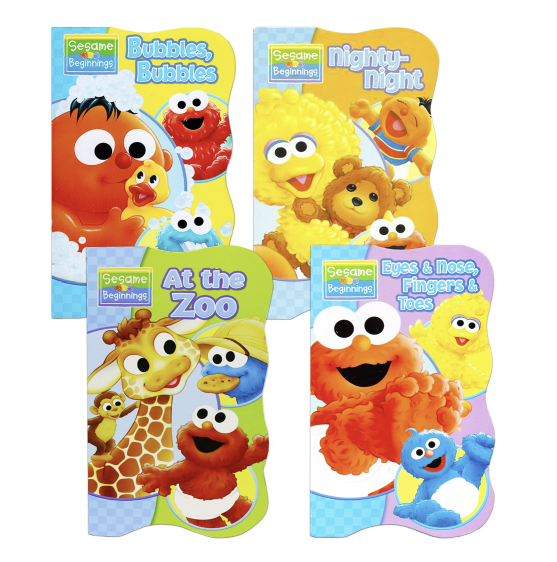
-
Read it! Talk about it! Act it out! Let's learn with our Sesame Street friends! 💜📚
There's something special about sharing books with familiar, lovable characters!
The Sesame Street Beginnings collection includes four colorful board books featuring favorite Sesame Street friends such as Elmo, Big Bird, Cookie Monster, and Abby Cadabby.
The collection includes:
Eyes, Nose, Fingers & Toes
At the Zoo
Bubbles, Bubbles
Nighty-Night
And here's what I particularly love:
Each book introduces language that children can immediately connect to their everyday experiences!
At 24–36 months, toddlers are developing longer word combinations, understanding more descriptive language, and beginning to talk about familiar activities.
These books provide wonderful opportunities to encourage those skills through shared reading.
Parents can model:
“Touch your nose!”
“Big elephant!”
“Pop bubbles!”
“More bubbles!”
“Time for bed!”
“Brush teeth!”
“Night-night, Elmo!”
I also love that the books are short and manageable for young children.
You don't have to read all four in one sitting.
Choose one based on your child's interests, enjoy the pictures together, and follow their lead.
And here's something important:
You don't have to read every word exactly as written!
Sometimes the best language opportunities happen when you pause, point to a picture, make a comment, or connect something in the book to your child's own experiences.
A book about bubbles becomes even more meaningful when you blow real bubbles afterward.
A book about body parts becomes a playful game in front of the mirror.
And a bedtime story can become part of a familiar evening routine.
Four little books, four wonderful themes, and so many opportunities for communication!
🧠 Did You Know?
Children learn language more effectively when words are connected to meaningful experiences!
Imagine reading a book about bubbles.
Your child sees a picture of a bubble.
You say:
“Bubble!”
“Pop!”
“More bubbles!”
Later, you bring out real bubbles and use the same words.
“Bubble!”
“Pop!”
“More!”
Now your child is hearing familiar vocabulary in two different situations.
This helps support vocabulary generalization—using and understanding words across different experiences.
And that's one of the reasons I love this collection!
Each book provides opportunities to connect language with everyday activities.
Eyes, Nose, Fingers & Toes: Body-part vocabulary, imitation, and following directions.
At the Zoo: Animal names, environmental sounds, descriptive language, and action words.
Bubbles, Bubbles: Requesting, action words, anticipation, and early word combinations.
Nighty-Night: Familiar routines, sequencing, action words, and social language.
Here's another important connection:
At 24–36 months, children are learning to combine words into increasingly meaningful phrases.
Instead of simply naming a picture, parents can model what the person or animal is doing.
For example:
“Elephant!”
becomes:
“Big elephant!”
and then:
“Elephant is walking!”
Or:
“Bubble!”
becomes:
“Pop bubble!”
and then:
“Pop the big bubble!”
Miss Angie's Tip: Try making more comments than questions during shared reading.
Instead of repeatedly asking, “What's that?” you might say:
“Look! Big elephant!”
“Elephant has a long trunk!”
“Wow! He's walking!”
Then pause and allow your child to respond.
A point, gesture, sound, word, or short phrase can all be meaningful ways to participate.
The goal isn't to test what your child knows. It's to build language through enjoyable interaction!
💜 Let's Play! (24–36 Months)
👀 1. Eyes, Nose, Fingers & Toes — Touch Your Nose!
Begin by looking at the pictures together.
Point to a familiar body part.
Say:
“Look! Nose!”
“Touch nose!”
“Where's your nose?”
Then touch your own nose.
“My nose!”
Encourage your child to imitate.
Continue with familiar body parts:
“Eyes!”
“Ears!”
“Mouth!”
“Hands!”
“Toes!”
For children beginning to use longer phrases, model:
“My nose!”
“Your eyes!”
“Two hands!”
Language Focus: Body-part vocabulary, receptive language, imitation, pronouns, and early word combinations.
🪞 2. Eyes, Nose, Fingers & Toes — Mirror, Mirror!
After reading, sit with your child in front of a mirror.
Point to your reflection.
Say:
“Look! Mommy!”
“Here's my nose!”
“Where's your nose?”
Then make silly faces together.
“Big smile!”
“Open mouth!”
“Close eyes!”
“Stick out tongue!”
Encourage your child to imitate your movements.
You can also introduce:
“Happy face!”
“Silly face!”
“Big smile!”
Language Focus: Body awareness, imitation, following directions, descriptive vocabulary, and social interaction.
🦁 3. At the Zoo — Who Says ROAR?
Choose a familiar animal pictured in the book.
Point to it.
Say:
“Look! Lion!”
“Lion says ROAR!”
“Big lion!”
Repeat the sound playfully.
“ROAR!”
Then explore other animals pictured in the book.
Model their names, sounds, or actions as appropriate.
If your child produces an approximation, acknowledge it naturally.
“Yes! ROAR!”
Language Focus: Animal vocabulary, environmental sound imitation, descriptive words, and early speech imitation.
🐘 4. At the Zoo — Let's Move Like Animals!
Choose an animal from the book.
Talk about how it moves.
“Elephant walks!”
“Bird flies!”
“Monkey climbs!”
Use movements to demonstrate the actions.
Encourage your child to imitate.
You can also model short phrases:
“Walk like elephant!”
“Fly like bird!”
“Jump like monkey!”
Only use animals that appear in the book or clearly introduce them as additional animals.
Language Focus: Action verbs, motor imitation, following directions, and early sentence development.
🫧 5. Bubbles, Bubbles — Ready, Set... POP!
After reading the book, bring out a bottle of bubbles.
Hold the wand where your child can see it.
Say:
“Ready...”
“Set...”
Pause.
“GO!”
Blow a few bubbles.
“Bubbles!”
“Pop!”
“Pop, pop, pop!”
Encourage your child to pop the bubbles.
Model:
“Pop bubble!”
“Big bubble!”
“More bubbles!”
“Bubble went up!”
Language Focus: Requesting, action words, anticipation, environmental sound imitation, and early word combinations.
Miss Angie's Tip: Don't require your child to say “more” before blowing additional bubbles. Model the word, pause briefly, and respond to gestures, vocalizations, or other attempts to communicate.
🫧 6. Bubbles, Bubbles — Up, Down, and All Gone!
Blow a few bubbles and watch where they travel.
Say:
“Bubble goes UP!”
“Up, up!”
“Bubble goes DOWN!”
“Pop!”
“All gone!”
Encourage your child to follow the bubbles with their eyes and point to them.
You can also introduce:
“Big bubble!”
“Little bubble!”
“One more!”
“Lots of bubbles!”
Language Focus: Spatial concepts, opposites, quantity vocabulary, joint attention, and sentence expansion.
🌙 7. Nighty-Night — Time for Bed!
Read the bedtime book with your child.
Point to familiar bedtime-related pictures.
Talk about what the characters are doing.
Then connect the story to your child's routine.
Say:
“Time for bed!”
“Put on pajamas!”
“Brush teeth!”
“Read book!”
“Night-night!”
Encourage your child to participate in the familiar sequence.
Language Focus: Routine vocabulary, action words, sequencing, receptive language, and early sentence development.
🧸 8. Nighty-Night — Put Teddy to Bed!
Bring out a favorite stuffed animal or doll.
Pretend it's bedtime.
Say:
“Teddy is tired!”
“Time for bed!”
“Lay down!”
“Cover Teddy!”
“Night-night, Teddy!”
Encourage your child to participate.
You can model:
“Teddy sleeps!”
“Give Teddy kiss!”
“Turn off light!”
“Shhh!”
Language Focus: Symbolic play, action words, familiar routines, early sequencing, and imaginative language.
🎭 9. Let's Act Out the Books!
Choose a favorite activity from one of the four books.
After reading, recreate it together.
For example:
Touch body parts after reading Eyes, Nose, Fingers & Toes.
Pretend to be animals after reading At the Zoo.
Blow real bubbles after reading Bubbles, Bubbles.
Put a stuffed animal to bed after reading Nighty-Night.
Use the same vocabulary during both reading and play.
For example:
“Bubble!”
“Pop bubble!”
“More bubbles!”
Or:
“Teddy sleeps!”
“Night-night!”
“Wake up!”
Language Focus: Vocabulary generalization, pretend play, receptive language, and early word combinations.
💜 10. My Favorite Book!
Place two of the books in front of your child.
Say:
“Which book?”
“Zoo or bubbles?”
Allow your child to point, reach, gesture, or name their choice.
Respond naturally.
“You want bubbles!”
“Let's read bubbles!”
After reading, offer another choice.
“More books?”
“All done?”
“Read again?”
This is a wonderful way to encourage children to communicate preferences.
Language Focus: Making choices, requesting, functional communication, vocabulary, and early sentence development.
🌱 Grow With Me! — Same Books, New Skills!
3–5 Years: Learning Through Pretend Play
As children's vocabulary, sentence length, and comprehension skills grow, these familiar books can support more advanced language activities.
Eyes, Nose, Fingers & Toes
Identify and describe additional body parts.
Discuss what different body parts help us do.
Practice following two- and three-step directions.
Introduce possessive pronouns such as my, your, his, and her.
Play imitation games involving facial expressions and movements.
At the Zoo
Describe animals using multiple attributes.
Compare and contrast different animals.
Discuss where animals live and what they eat.
Practice categorizing animals.
Create pretend zoo adventures.
Answer who, what, where, and why questions.
Bubbles, Bubbles
Practice describing bubbles by size, movement, and appearance.
Introduce opposites such as big/little and up/down.
Practice following multistep directions during bubble play.
Discuss cause-and-effect relationships.
Create stories about where imaginary bubbles might travel.
Nighty-Night
Describe bedtime routines in sequence.
Practice using first, next, then, and last.
Discuss why sleep is important.
Explore feelings associated with bedtime.
Create pretend bedtime routines for dolls and stuffed animals.
Practice retelling familiar events.
6+ Years: Building Advanced Communication Skills
Older children can use these books as visual supports and familiar starting points for more advanced language activities.
Practice describing objects, animals, and people using detailed vocabulary.
Compare and contrast items within and across the books.
Develop increasingly complex sentences.
Explain object functions and relationships.
Practice sequencing and retelling familiar routines.
Create original stories based on the book themes.
Discuss cause-and-effect relationships.
Practice perspective-taking and emotional vocabulary.
Develop problem-solving scenarios.
Practice giving and following detailed directions.
Explore categorization and semantic relationships.
Use the illustrations as prompts for articulation, language, or narrative activities.
💜 Miss Angie's Reminder
It's not just the books—it's how you share them!
One of the things I love most about this collection is how easily parents can connect reading with everyday life.
You don't need elaborate materials or complicated activities.
Sometimes all you need is a book and a few minutes together.
Read about body parts.
Then touch your nose!
Read about zoo animals.
Then pretend to roar like a lion!
Read about bubbles.
Then go outside and pop some!
Read about bedtime.
Then tuck Teddy into bed!
The more opportunities children have to hear and use familiar vocabulary in different situations, the more meaningful those words can become.
And remember, you don't have to ask questions constantly.
Make comments.
Model short phrases.
Expand on what your child says.
Follow their interests.
And allow them time to respond.
If your child wants to read the same book repeatedly, that's okay!
Repetition helps children become familiar with vocabulary, phrases, and routines.
Four little books, familiar Sesame Street friends, and wonderful opportunities for language, learning, and connection! 💜📚
Safety Reminder: Confirm the manufacturer's age recommendation and warnings on the exact purchased collection. Supervise young children during reading and inspect the board pages regularly for loose or damaged pieces. When extending the stories into hands-on activities, use age-appropriate materials and supervise activities such as bubble play.
🌱Little Green Box of Bright and Early Board Books — Little Books, BIG Sounds!
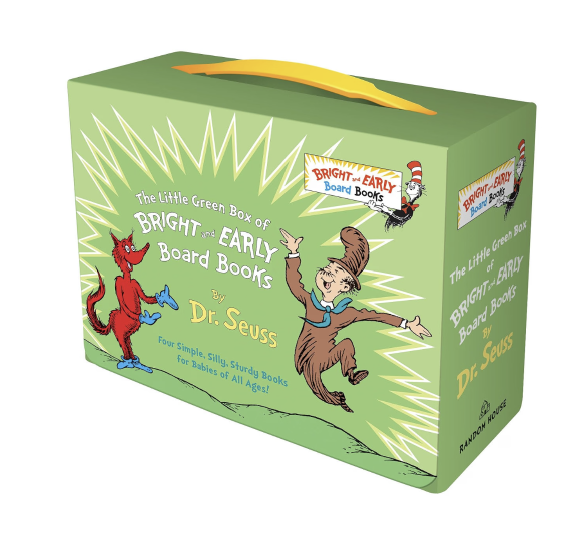
-
Moo! Boom! Pop! Rhyme, repeat, and TALK! 📚💜
If there's one thing I love, it's a book that encourages children to make sounds, play with words, and participate in the story!
And this little collection offers FOUR wonderful opportunities to do just that!
Little Green Box of Bright and Early Board Books brings together four abridged Dr. Seuss classics:
📗 Mr. Brown Can Moo! Can You?
📘 Fox in Socks
📙 There's a Wocket in My Pocket!
📕 Dr. Seuss's ABC
Each book introduces language in a playful, engaging way.
Some focus on silly sounds.
Others introduce rhyming words, letters, imaginative vocabulary, and playful sound combinations.
And here's what I especially love:
Children don't have to speak in complete sentences to participate!
A child can imitate an animal sound.
Point to a picture.
Finish a familiar phrase.
Make a silly noise.
Identify an object.
Or simply laugh when you say something unexpected!
All of these are meaningful opportunities for communication.
At 24–36 months, many children are beginning to combine words into longer phrases, expand their vocabulary, and participate more actively in shared reading.
These books provide natural opportunities to encourage those developing skills.
Parents can model:
“Cow says MOO!”
“Can YOU say moo?”
“That's a BIG sound!”
“Look! A fox!”
“Where's the sock?”
“I see TWO socks!”
“What's in the pocket?”
“It's a silly creature!”
“B says /b/!”
“Ball starts with /b/!”
And don't forget about repetition!
Young children often LOVE hearing the same books again and again.
Each time you read, your child may notice something new, imitate another sound, or begin anticipating a familiar word.
Four little books can create countless opportunities for sound play, vocabulary development, early phonological awareness, and wonderful conversations!
🧠 Did You Know?
Playing with sounds is an important part of early speech and language development!
Long before children learn to read, they begin noticing the sounds and patterns of spoken language.
They hear animal noises.
They imitate environmental sounds.
They enjoy silly words.
They recognize familiar rhymes.
And eventually, they begin noticing that words are made up of smaller sounds.
This developing ability is called phonological awareness.
Phonological awareness includes recognizing and playing with the sound structures of spoken language, such as words, syllables, rhymes, and individual speech sounds.
At 24–36 months, the emphasis should be on playful listening, imitation, and participation, not formal instruction or mastery of rhyming or letter sounds.
These four books offer opportunities to support several important developmental skills.
Receptive Language: Understanding words, simple directions, questions, and familiar concepts.
Expressive Language: Imitating sounds, labeling pictures, combining words, and making comments.
Speech Sound Development: Practicing a variety of sounds through playful imitation.
Early Phonological Awareness: Hearing rhymes, repeated sounds, and sound patterns.
Auditory Attention: Listening for familiar sounds and anticipating what comes next.
Vocabulary Development: Learning names, actions, descriptions, and concepts.
Joint Attention: Looking at books, sharing excitement, and participating with another person.
Early Literacy: Developing positive experiences with books, pictures, print, and storytelling.
💜 Why Environmental Sounds Matter
Environmental sounds are often wonderful starting points for encouraging vocal imitation.
Think about sounds such as:
“Moo!”
“Beep-beep!”
“Boom!”
“Pop!”
“Buzz!”
These playful sounds can be easier and more motivating for some children to imitate than longer words.
For example, if your child sees a picture of a cow, you might say:
“Cow!”
“Moooo!”
Pause.
“Your turn!”
If your child makes any attempt to imitate, respond enthusiastically!
“You said moo!”
Then expand:
“The cow says moo!”
Miss Angie's Tip: Don't turn every page into a question!
Instead of repeatedly asking, “What's that?” try making comments.
“Look at that silly fox!”
“He has SOCKS!”
“Those are BIG socks!”
Then pause and give your child an opportunity to respond.
Sometimes, a simple comment encourages more communication than another question.
💜 Let's Play! (24–36 Months)
🐮 1. Can YOU Make That Sound?
Book: Mr. Brown Can Moo! Can You?
This book is a wonderful opportunity to encourage playful vocal imitation!
As you read, emphasize the environmental sounds.
Use an animated voice.
“MOOOO!”
“BOOM!”
“POP!”
Pause before repeating a familiar sound.
“Mr. Brown can moo! Can YOU?”
Give your child time to respond.
They may imitate the sound, smile, gesture, or attempt part of it.
Accept and celebrate their participation.
If your child says:
“Moo!”
You can expand:
“Yes! The cow says MOO!”
Try changing your voice.
“Can you make a BIG moo?”
“What about a little moo?”
Encourage your child to experiment with loud and quiet sounds.
Keep the activity playful and avoid requiring repeated productions.
Language Focus: Environmental sound imitation, vocal play, auditory attention, expressive language, and early speech sound development.
🥁 2. Listen! What's Making That Noise?
Book: Mr. Brown Can Moo! Can You?
Gather a few safe household objects that make familiar sounds.
Examples might include a spoon tapping a plastic bowl, paper crinkling, or a toy making a gentle noise.
Say:
“Listen!”
“Tap, tap, tap!”
“What made that sound?”
Encourage your child to look, point, or name the object.
Then allow them to make the sound.
“Your turn!”
“Tap, tap!”
“That's LOUD!”
“Now let's make a QUIET sound!”
Try making a sound while the object is out of sight.
“Did you hear that?”
“Where did it come from?”
For children ready for more language, model short phrases.
“I hear tapping!”
“The paper is crinkling!”
Language Focus: Auditory discrimination, sound imitation, object identification, descriptive vocabulary, and two- to four-word phrases.
🦊 3. Silly Socks!
Book: Fox in Socks
Gather a few pairs of colorful socks.
As you read, point to the fox and his socks.
Say:
“Look! A fox!”
“He has socks!”
“Where are YOUR socks?”
Encourage your child to identify and find socks.
Then play a simple matching game.
“Find the red sock!”
“Where's the other one?”
“Two socks!”
“Same!”
“Different!”
Put socks on a stuffed animal or doll.
“Teddy has socks!”
“Let's take them OFF!”
“Now put them ON!”
For children ready for longer phrases:
“The fox has blue socks!”
Language Focus: Vocabulary, matching, colors, same/different, on/off, and early sentence development.
👂 4. Listen to Those Silly Words!
Book: Fox in Socks
Dr. Seuss uses playful language, repeated sounds, and rhyming patterns.
At this age, children don't need to repeat complicated tongue twisters.
Instead, help them enjoy the sounds!
Read a short section slowly and expressively.
Emphasize repeated sounds.
“Fox!”
“Socks!”
Pause and smile.
“Those words sound funny!”
Repeat the words.
“Fox... socks!”
Encourage your child to listen and participate.
You can also introduce simple familiar rhyming pairs during play.
“Cat... hat!”
“Bee... tree!”
“Boat... goat!”
For children who enjoy movement, clap or bounce gently to the rhythm of the words.
Language Focus: Auditory attention, exposure to rhyme, sound patterns, speech sound awareness, and playful verbal imitation.
👖 5. What's in My Pocket?
Book: There's a Wocket in My Pocket!
Create your own mystery pocket!
Use a large pocket, small bag, or container with a few age-appropriate familiar objects.
Say:
“What's inside?”
“Let's look!”
Encourage your child to reach inside and find an object.
“Oh! A car!”
“You found a car!”
“What does the car do?”
“Beep-beep!”
Repeat with other objects.
“It's a ball!”
“Roll the ball!”
“It's a spoon!”
“Stir, stir, stir!”
For children ready for more complex language, model:
“I found a little car!”
“The spoon was in the bag!”
Language Focus: Object naming, requesting, action vocabulary, in/out, joint attention, and sentence expansion.
🏠 6. Where Is the Silly Creature?
Book: There's a Wocket in My Pocket!
This book is filled with imaginative creatures in unexpected places.
Use a stuffed animal or toy figure to create a simple hiding game.
Say:
“Where's Teddy?”
“Is he UNDER the chair?”
“Is he ON the couch?”
“Is he IN the box?”
Encourage your child to find the toy.
“There he is!”
“He's under the chair!”
Then let your child hide the toy.
Ask:
“Where did Teddy go?”
Encourage short responses.
“Under!”
“In box!”
“On chair!”
Expand naturally.
“Yes! Teddy is IN the box!”
Language Focus: Spatial concepts, WH questions, receptive language, expressive language, and early sentence structure.
🔤 7. ABC Sound Play!
Book: Dr. Seuss's ABC
At this age, the goal isn't to memorize the alphabet or master letter sounds.
Instead, use the book to introduce playful sound associations.
Point to a familiar letter or picture.
Say:
“B!”
“B says /b/!”
“B-b-ball!”
Encourage your child to imitate the sound if they're interested.
Try familiar examples.
“Mmm! Milk!”
“B-b-ball!”
“P-p-pop!”
“D-d-dog!”
You can pair the sounds with real objects or toys.
“Here's a BALL!”
“B-b-ball!”
If your child is interested in letters, point to them while you talk.
If they're more interested in the pictures, follow their lead!
Language Focus: Sound imitation, early letter-sound exposure, vocabulary, auditory attention, and speech sound development.
🧺 8. Find Something That Starts Like...
Book: Dr. Seuss's ABC
Gather a few familiar toys or household objects.
For example:
Ball, baby doll, car, cup, and spoon.
Choose two objects that begin with the same sound.
“Ball!”
“Baby!”
“Listen! B-b-ball! B-b-baby!”
Then compare them with another object.
“Car!”
“That's a different sound!”
Let your child explore the objects.
For younger toddlers, simply model the sounds and words.
For children showing readiness, ask:
“Can you find the ball?”
“Where's the baby?”
“Which two start with /b/?”
Do not expect children this age to consistently identify initial sounds independently.
The goal is to provide playful exposure and opportunities to listen.
Language Focus: Vocabulary, auditory attention, early sound awareness, categorization, and receptive language.
🎭 9. Make a Silly Sound Story!
Books: All Four!
Choose a few favorite sounds, objects, or characters from the collection.
Create a short pretend story together.
For example:
“One day, a fox went for a walk.”
“Then he saw a cow!”
“The cow said MOO!”
“The fox was surprised!”
Encourage your child to add sounds or actions.
“What did the cow say?”
“Moo!”
“What did the fox do?”
“Run!”
Expand your child's responses.
“Yes! The fox ran away!”
Use stuffed animals or toys to act out the story.
For children who are beginning to combine words:
“Fox run!”
“Cow moo!”
“Big cow!”
Language Focus: Early narrative development, sequencing, sound imitation, action vocabulary, and two- to four-word phrases.
📚 10. You Finish It!
Books: All Four!
Choose a book your child has heard several times.
Read a familiar section and pause before an anticipated sound or word.
For example:
“Mr. Brown can...”
Pause.
Give your child an opportunity to participate.
They might make a sound, say a word, point, or gesture.
Respond to their attempt.
“Yes! MOO!”
Try the same activity with familiar pictures.
“Look! The fox has...”
Pause.
“Socks!”
Or:
“What's in the...”
Pause.
“Pocket!”
If your child doesn't respond, simply provide the word and continue reading.
Avoid turning the activity into a test.
For children ready for longer phrases, encourage expansions.
“Fox has socks!”
“The cow says moo!”
“I found a car!”
Language Focus: Anticipatory language, auditory memory, expressive vocabulary, joint attention, and phrase development.
🌱 Grow With Me! — Same Books, New Skills!
3–5 Years: Rhyming, Sound Awareness, and Early Literacy
As children enter the preschool years, these same books can support more advanced phonological awareness, vocabulary, and early literacy skills.
🎵 Recognize Rhyming Words
Use Fox in Socks and There's a Wocket in My Pocket! to introduce rhyme recognition.
Say two words.
“Cat... hat!”
“Do those words sound alike at the end?”
Begin with obvious rhymes and playful examples.
🔤 Identify Beginning Sounds
Use Dr. Seuss's ABC to explore initial sounds.
“Ball starts with /b/!”
“What else starts with /b/?”
Encourage children to identify familiar objects that begin with the same sound.
👏 Clap the Syllables
Choose familiar words from the books.
“Pup-py!”
“Ba-by!”
“El-e-phant!”
Clap or tap each syllable.
🧠 Build Auditory Memory
Read a short section and ask your child to remember two or three details.
“What did Mr. Brown do?”
“Where was the silly creature hiding?”
💬 Expand Descriptive Language
Encourage children to describe characters using size, color, location, and actions.
“The little fox is wearing bright blue socks.”
🎤 Create Silly Rhymes
Encourage children to invent their own playful rhyming words.
Real words and silly made-up words are both welcome!
📖 Retell a Favorite Part
Ask your child to explain what happened in a familiar book.
Support sequencing with:
First, next, then, and last.
🎭 Act Out the Story
Use stuffed animals, household objects, and pretend play to recreate favorite scenes.
Encourage dialogue and complete sentences.
6+ Years: Advanced Phonological Awareness, Reading, and Word Play
Older children can revisit these books as playful starting points for more advanced literacy activities.
🔎 Identify Individual Speech Sounds
Choose familiar words and ask children to identify the first or last sound.
“What sound do you hear at the beginning of fox?”
“What sound do you hear at the end of sock?”
🧩 Segment and Blend Sounds
Practice breaking short words into individual sounds.
For example:
“Fox” — /f/ /ɒ/ /k/ /s/ (four sounds in many American English pronunciations, with the vowel varying by dialect).
“Sock” — /s/ /ɑ/ /k/ in many American English dialects.
Then blend the sounds back together.
🔄 Change One Sound
Practice simple phoneme manipulation.
“Say cat.”
“Now change /k/ to /h/.”
“What word do you have?”
“Hat!”
🎵 Create Rhyming Families
Explore word families such as:
Cat, hat, bat, mat.
Sock, rock, clock.
Encourage children to generate additional rhymes.
✍️ Write a Silly Dr. Seuss-Inspired Poem
Have your child create an original poem using rhyme, repetition, and alliteration.
Encourage creative vocabulary and playful sentence structure.
📚 Compare the Board Books with Full-Length Editions
For older children, compare an abridged board book with its longer original version.
Discuss differences in vocabulary, story details, rhyme patterns, and length.
🗣️ Practice Speech Sounds
Use selected words and phrases for individualized speech practice.
Examples include:
/s/: socks, silly, sound, see
/f/: fox, funny, find, four
/r/: rhyme, read, red, roar
/l/: little, look, loud, listen
/sh/: show, wish, fish
/th/: think, three, this, that
Choose targets that match your child's speech goals and current skill level.
📝 Create a Silly Creature Dictionary
Inspired by There's a Wocket in My Pocket!, have your child invent new creatures.
Give each creature a name, describe its appearance, explain where it lives, and write a sentence about what it does.
These little board books can grow from sound imitation and early vocabulary into rhyming, phonological awareness, reading, writing, and creative language activities!
💜 Miss Angie's Reminder
It's not just the book—it's how you use it!
One of the things I love most about these Dr. Seuss board books is that they invite children to participate.
And participation doesn't have to mean saying every word correctly!
Your child might:
Point to a picture.
Make a silly sound.
Imitate one word.
Finish a familiar phrase.
Laugh at a funny rhyme.
Or simply snuggle beside you and listen.
All of those moments can support shared attention, communication, and a love of books!
Remember to follow your child's lead.
If your child says:
“Moo!”
You can expand:
“Yes! The cow says MOO!”
If your child says:
“Fox!”
You might respond:
“That's a fox! He's wearing socks!”
If your child says:
“In pocket!”
You can model:
“There's something silly in the pocket!”
And if your child wants to read the same book three times in a row?
Go for it!
Repetition helps children become familiar with words, sounds, and patterns.
You may notice that after hearing a book several times, your child begins anticipating a familiar sound or finishing a phrase.
That's wonderful!
Don't worry about reading every word on every page.
Sometimes, it's more valuable to stop, point to a picture, make a comment, or let your child turn the pages.
For children who are not yet speaking, model words and sounds while responding to their gestures, expressions, signs, or AAC selections.
And remember:
Rhyming and sound awareness develop gradually. At 24–36 months, our goal is playful exposure—not formal testing!
Read together.
Make silly sounds.
Laugh.
Repeat favorite pages.
And celebrate every opportunity to connect.
Four little books, countless silly sounds, and wonderful opportunities for speech, language, early literacy, and learning! 💜📚
Safety Reminder: These sturdy board books are designed for young children, but adult supervision is recommended, particularly if a child chews or tears book materials. Use only age-appropriate objects for extension activities and avoid small items that could present choking hazards. Keep shared reading relaxed, interactive, and enjoyable.
3–5 Years: Learning Through Pretend Play
🌱 Step2 Best Chefs Kitchen — Pretend Play Kitchen with Accessories
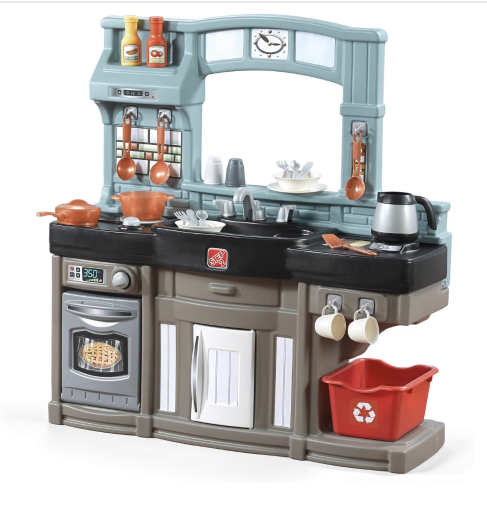
-
What's cooking? Let's turn pretend play into a language-learning adventure! 🍳💜
If there's one toy that can keep children engaged while encouraging a wide variety of speech, language, and cognitive skills, it's a pretend kitchen!
The Step2 Best Chefs Kitchen includes a pretend stovetop with lights and sounds, an oven, refrigerator, sink, storage areas, and a 25-piece accessory set.
And here's what I particularly love:
Children get to create the action themselves!
They can pretend to prepare meals, serve customers, wash dishes, organize ingredients, and act out familiar experiences from everyday life.
The lights and sounds are fun additions, but the real learning happens through the child's imagination and interactions with others.
At 3–5 years, children are developing increasingly complex sentences, understanding multistep directions, using more sophisticated vocabulary, and participating in cooperative pretend play.
This kitchen provides opportunities to practice those skills naturally.
Parents can model:
“What are we cooking today?”
“First, let's wash our hands.”
“I'm making soup for dinner!”
“Can you put the pot on the stove?”
“The soup is too hot!”
“Let's wait for it to cool.”
“Who wants to order lunch?”
“I would like a sandwich, please!”
“Let's clean up before we close the restaurant!”
I also love that this kitchen encourages children to take on different roles.
One day, your child may be the chef.
Another day, they may be the customer.
And the next day, they may be running an entire restaurant!
The possibilities for language and imagination are nearly endless!
Product Note: The standard kitchen includes a 25-piece accessory set, but pretend food is not included. Families can use age-appropriate play food or other safe pretend ingredients they already own.
🧠 Did You Know?
Pretend play provides opportunities for children to develop language, thinking, and social communication skills together!
When children pretend to cook, they're doing much more than moving pots and pans around.
They're practicing skills such as:
Planning: Deciding what to make and what materials they need.
Sequencing: Understanding the order of familiar activities.
Problem-solving: Figuring out what to do when something is missing.
Symbolic thinking: Pretending one object represents something else.
Vocabulary development: Learning words for foods, utensils, actions, and descriptions.
Grammar: Practicing pronouns, verb tenses, plurals, and increasingly complex sentences.
Social communication: Taking turns, asking questions, negotiating roles, and responding to others.
Narrative development: Creating stories with characters, events, problems, and solutions.
And here's something I especially love about kitchen play:
It connects directly to children's everyday experiences!
Children watch adults prepare meals, wash dishes, put groceries away, and set the table.
During pretend play, they can recreate those familiar experiences while practicing the language associated with them.
For example, a child might say:
“Soup!”
A parent can expand:
“Yes! You're making soup!”
Or:
“Hot soup!”
A parent can respond:
“The soup is very hot! Let's blow on it.”
This technique is called language expansion.
By adding a little more information to what your child says, you're modeling increasingly complex language without interrupting the play.
Miss Angie's Tip: Rather than asking your child question after question, join their pretend world!
If your child announces, “I'm making pizza!” you might respond:
“Yum! I love pizza! What should we put on top?”
Then follow their lead.
The goal is to create a conversation, not a quiz!
💜 Let's Play! (3–5 Years)
🍽️ 1. Welcome to My Restaurant!
Turn the kitchen into a pretend restaurant.
Let your child be the chef while you become the customer.
Say:
“Hello! Is your restaurant open?”
“I'd like to order lunch, please.”
“What are you serving today?”
Your child can pretend to take your order, prepare the meal, and serve it.
Encourage natural conversation:
“What would you like to drink?”
“Would you like anything else?”
“Here's your food!”
“Thank you!”
“Have a nice day!”
Then switch roles.
Language Focus: Social communication, conversational turn-taking, asking and answering questions, role-playing, and sentence development.
🥣 2. What's Cooking?
Gather the kitchen accessories and any additional age-appropriate pretend food.
Encourage your child to describe what they're making.
Model:
“I'm making soup!”
“First, I need a pot.”
“I'm putting the pot on the stove.”
“Now I'm stirring the soup.”
“It smells delicious!”
Introduce action words:
Stir, pour, mix, cook, bake, wash, serve, taste, cut, and clean.
Encourage your child to combine actions with objects.
“Stir the soup!”
“Pour the water!”
“Wash the dishes!”
For children ready for longer sentences:
“I'm stirring the soup because it's cooking.”
Language Focus: Action vocabulary, sentence expansion, present progressive verbs, and descriptive language.
📋 3. Follow the Recipe!
Pretend you're preparing a special meal.
Give your child simple directions.
Begin with two steps:
“Get the pot and put it on the stove.”
“Pick up the spoon and stir the soup.”
Then increase the complexity:
“First, get the cup, then put it on the table, and finally bring me the spoon.”
You can also reverse roles.
Let your child become the chef and give YOU directions!
Encourage the use of:
“First...”
“Next...”
“Then...”
“Last...”
Language Focus: Following multistep directions, auditory memory, sequencing, temporal concepts, and expressive language.
🍴 4. Set the Table!
Pretend you're getting ready for a family dinner.
Gather cups, plates, utensils, and other safe accessories.
Say:
“We need to set the table!”
“Put the plate in front of Teddy.”
“Put the cup next to the plate.”
“Put the spoon beside the cup.”
Introduce spatial concepts:
On, under, beside, next to, between, in front of, and behind.
You can also introduce quantity concepts:
“We need two cups!”
“Everyone gets one plate.”
“Do we have enough spoons?”
Language Focus: Spatial concepts, following directions, quantity vocabulary, categorization, and problem-solving.
🔍 5. Something's Missing!
Arrange a few familiar kitchen accessories on the counter.
Allow your child to look at them.
Then ask them to close their eyes while you remove one item.
Say:
“Oh no! Something is missing!”
“What disappeared?”
“Where did it go?”
Encourage your child to identify the missing object.
For example:
“The spoon is missing!”
“We need the spoon!”
“Let's find it!”
For an additional challenge, hide an item and give clues.
“It's something we use to drink.”
“It's next to the refrigerator.”
Language Focus: Visual memory, object functions, descriptive language, WH questions, and problem-solving.
🥕 6. Let's Sort the Groceries!
Use pretend food if available, or safe pictures of familiar foods.
Pretend you've just returned from the grocery store.
Say:
“We need to put everything away!”
“Where should the apples go?”
“Which foods belong together?”
Encourage your child to sort items into categories.
For example:
Fruits
Vegetables
Drinks
Breakfast foods
Foods we cook
Then ask:
“Why did you put those together?”
“How are they alike?”
“Which one doesn't belong?”
For younger preschoolers, begin with just two familiar categories.
Language Focus: Categorization, semantic relationships, vocabulary, reasoning, and expressive language.
🧸 7. Teddy's Special Dinner!
Invite a favorite stuffed animal or doll to dinner.
Pretend Teddy is hungry.
Say:
“Oh no! Teddy is hungry!”
“What should we make?”
“Let's cook dinner for Teddy!”
Encourage your child to plan the meal, prepare it, and serve it.
Then introduce a small problem.
“Teddy doesn't like soup!”
“What else could we make?”
Or:
“Teddy spilled his drink!”
“What should we do?”
Encourage your child to suggest solutions.
Language Focus: Perspective-taking, emotional vocabulary, problem-solving, sequencing, and imaginative storytelling.
🗣️ 8. Who's Doing What?
Use kitchen play to practice pronouns and verb forms.
Take turns acting out different actions.
Say:
“I'm cooking.”
“You're washing.”
“He is eating.”
“She is stirring.”
“They are cleaning.”
You can also introduce past-tense verbs after completing an activity.
“What did we do?”
“We cooked dinner!”
“I washed the dishes!”
“Teddy ate his food!”
For children working on more complex grammar, introduce:
“Before we ate, we cooked the food.”
“After we finished dinner, we washed the dishes.”
Language Focus: Pronouns, verb tenses, subject-verb agreement, sentence structure, and temporal language.
🤔 9. Kitchen Problem-Solvers!
Create simple pretend problems during play.
For example:
“Oh no! We don't have a spoon!”
“The refrigerator is full!”
“Our customer wants something different!”
“We made too much food!”
Ask:
“What should we do?”
“How can we fix it?”
“What could we use instead?”
Encourage your child to explain their ideas.
For children needing support, offer two possible solutions.
“Should we find another spoon or use a fork?”
Then act out the solution together.
Language Focus: Problem-solving, reasoning, flexible thinking, cause-and-effect relationships, and expressive language.
🧼 10. Clean-Up Crew!
Pretend the restaurant is closing.
Say:
“The restaurant is closing!”
“Time to clean up!”
“First, let's wash the dishes.”
“Next, let's put away the cups.”
“Then, let's close the refrigerator.”
“Finally, let's turn off the lights.”
Encourage your child to describe what they're doing.
“I'm washing!”
“I'm putting the cups away!”
“The kitchen is clean!”
You can also introduce:
Dirty/clean, wet/dry, full/empty, open/closed.
Language Focus: Sequencing, following directions, opposites, action words, and functional language.
🌱 Grow With Me! — Same Toy, New Skills!
6+ Years: Building Advanced Communication Skills
As children grow, the same pretend kitchen can support more sophisticated language, literacy, mathematics, and cognitive activities.
📖 Create a Restaurant Menu
Have your child design a menu with food categories, descriptions, and prices.
Practice reading, writing, categorization, and descriptive vocabulary.
📝 Write a Recipe
Encourage your child to write or dictate a simple recipe.
Use sequencing words such as first, next, then, after, and finally.
Practice giving clear, organized directions.
💰 Restaurant Math
Assign pretend prices to menu items.
Practice adding totals, comparing costs, making change, and budgeting.
🗣️ Take Customer Orders
Have your child listen to a multistep order and repeat it accurately.
Introduce modifications:
“I'd like a sandwich without cheese and a drink with ice.”
This supports auditory memory, listening comprehension, and following complex directions.
🤔 Solve Restaurant Problems
Introduce more challenging situations.
“What happens if we run out of ingredients?”
“What if two customers want the last piece of pizza?”
“What if someone has a food allergy?”
Encourage children to explain possible solutions and consider different perspectives.
📚 Create a Restaurant Story
Develop a story with characters, a setting, a problem, and a solution.
For example:
“A chef opens a restaurant, but the oven stops working right before dinner!”
Encourage your child to explain what happens next.
🔤 Practice Speech Sounds
Use kitchen-related vocabulary for articulation practice when appropriate.
Examples include:
/k/: cook, cup, kitchen, cake
/s/: soup, spoon, serve, slice
/sh/: chef, dish, wash
/r/: restaurant, refrigerator, recipe
/l/: plate, bowl, lunch
Practice at the child's appropriate speech level, from individual words to sentences and conversation.
💬 Practice Complex Language
Encourage explanations using:
Because, although, unless, before, after, while, and if.
For example:
“We need to wash the dishes because they're dirty.”
“If we run out of plates, we'll need to find more.”
“Before we serve dinner, we have to finish cooking.”
One pretend kitchen can continue supporting language, literacy, reasoning, and problem-solving long after the preschool years!
💜 Miss Angie's Reminder
It's not just the toy—it's how you use it!
One of the things I love most about pretend kitchens is that they allow children to recreate familiar experiences while exploring new ideas.
And remember:
You don't have to direct every moment of play!
If your child wants to make pretend pancakes for 20 minutes, that's okay!
Join them.
“Those pancakes smell delicious!”
“Can I have one?”
“Mine is too hot!”
“Let's blow on it!”
If your child decides the kitchen is actually an ice cream shop, follow their imagination!
“What flavors do you have?”
“I'd like chocolate, please!”
“Can I have two scoops?”
And if they decide Teddy is the chef, that's wonderful too!
Follow your child's lead, model language naturally, and create opportunities for conversation.
Remember to expand on what your child says.
If your child says:
“Pizza!”
You can respond:
“Yummy pizza!”
Or:
“I'm making a big pizza!”
If your child says:
“Baby hungry!”
You can expand:
“Yes! The baby is hungry. Let's make some dinner!”
You don't need to correct every grammatical error or require your child to repeat your sentence.
Simply provide a natural model and keep the interaction going.
The best language-learning opportunities often happen when children are engaged, interested, and having fun!
One pretend kitchen, countless imaginative adventures, and wonderful opportunities for speech, language, thinking, and learning! 💜👩🍳
Safety Reminder: Follow the manufacturer's assembly, age, and supervision instructions. Check that all components are securely assembled, keep any batteries inaccessible to children, and inspect accessories regularly for damage. The standard 25-piece accessory set does not include pretend food; use only age-appropriate additional materials. Keep real hot appliances, sharp utensils, and small hazardous objects out of pretend kitchen play.
🌱 Letoiz Wooden Parking Garage — Little Drivers, Big Adventures
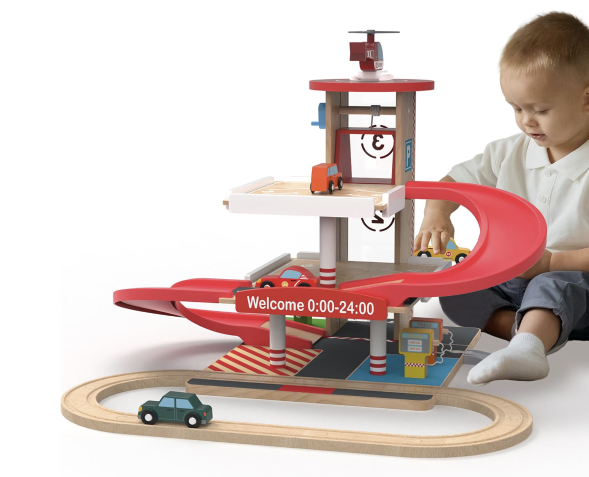
-
Ready, set, GO! Let's drive into a world of language and imagination! 🚗💜
There's something about cars, ramps, and parking garages that captures children's attention!
And when a toy encourages children to create the action themselves, rather than simply pressing a button and watching something happen, the opportunities for meaningful learning can be wonderful.
The Letoiz Wooden Parking Garage features multiple levels, winding ramps, a hand-operated elevator, parking areas, and pretend-play features such as a gas station and helicopter landing area.
Children can drive cars up and down, park vehicles, operate the elevator, and create their own transportation adventures.
But here's what I especially love:
Every movement creates an opportunity for language!
Think about the words children can learn while playing:
Up, down, around, through, over, under, beside, between, fast, slow, stop, go, first, next, and last.
And that's just the beginning!
Parents can model:
“The red car is going UP!”
“Let's bring the elevator DOWN.”
“Drive AROUND the corner!”
“STOP! There's another car!”
“Where should we park?”
“The blue car is BEHIND the yellow car.”
“First, we go up. Then, we drive down.”
“Oh no! The garage is full!”
Children can also practice requesting, describing, taking turns, asking questions, and creating stories.
One day, the garage might be a busy shopping mall.
The next day, it could be an airport parking garage.
And another day, it might become the headquarters for an exciting rescue mission!
One toy can inspire countless conversations and imaginative adventures!
🧠 Did You Know?
Spatial language plays an important role in children's understanding of directions, relationships, and early academic concepts!
Words such as above, below, between, behind, and beside help children describe where objects are located and how they move.
These concepts are important for everyday communication.
For example:
“Put your shoes under the bench.”
“Stand behind the line.”
“Find the book between the boxes.”
Parking garages provide opportunities to demonstrate these relationships through hands-on play.
When children move a car up an elevator or down a ramp, they experience the meaning of those words while hearing them used naturally.
This connection between words and actions can support language learning.
Parking garage play also encourages sequencing.
Children can practice organizing events:
“First, the car goes up.”
“Next, it parks.”
“Then, the driver gets out.”
“Finally, the car goes home.”
Sequencing is an important foundation for following directions, retelling experiences, and developing narratives.
And don't forget about cause and effect!
What happens when the elevator moves?
What happens when a car is released at the top of a ramp?
What happens when two cars try to use the same space?
Children can observe, predict, and explain what happens.
Miss Angie's Tip: Instead of simply asking, “What color is that car?” over and over, introduce a variety of language concepts.
Try:
“Where is it going?”
“What happened?”
“Why did it stop?”
“What do you think will happen next?”
And remember to pause!
Give your child time to respond, point, gesture, or demonstrate an answer.
Communication involves much more than spoken words alone.
💜 Let's Play! (3–5 Years)
🚦 1. Ready, Set, GO!
Begin with a simple car race down the ramp.
Hold a car at the top.
Say:
“Ready... set...”
Pause and wait.
Your child may say, “GO!” or signal that they're ready.
Release the car together.
“GO!”
“It's going DOWN!”
“Wow! That was FAST!”
“The car STOPPED!”
Repeat the activity while introducing new vocabulary.
“Let's go slowly.”
“Now let's go fast!”
“Stop at the bottom!”
For children using longer sentences, model:
“The red car went down the ramp really fast!”
Language Focus: Anticipatory language, action vocabulary, opposites, sentence expansion, and conversational turn-taking.
🛗 2. Up, Up, Up the Elevator!
Place a car in the elevator.
Say:
“The car is going UP!”
Move the elevator slowly.
“Up... up... up!”
“We're at the TOP!”
Then bring it down.
“Now we're going DOWN!”
“We're at the BOTTOM!”
Introduce additional directions:
“Put the car INSIDE the elevator.”
“Take it OUT.”
“Move it to the SECOND level.”
“Park it NEXT TO the blue car.”
Let your child operate the elevator and tell you where the car should go.
Language Focus: Spatial concepts, positional vocabulary, following directions, and expressive language.
🅿️ 3. Find Your Parking Space!
Pretend the cars need somewhere to park.
Give your child simple directions.
“Park the red car on the top level.”
“Put the blue car beside the yellow car.”
“Park the green car behind the red car.”
As your child becomes more successful, increase the complexity.
“First, park the red car upstairs. Then, bring the blue car down.”
You can also reverse roles.
Let your child tell YOU where to park.
If your child says, “Put it there,” ask:
“Do you mean beside the yellow car or behind it?”
This encourages more specific communication.
Language Focus: Following multistep directions, spatial concepts, color vocabulary, sentence formulation, and giving directions.
🚗 4. Traffic Jam!
Pretend several cars arrive at the same parking space.
Say:
“Oh no! There's a traffic jam!”
“Both cars want to park here!”
“What should we do?”
“Who arrived first?”
“Where else could this car park?”
Encourage your child to suggest solutions.
“We can take turns!”
“The blue car can park upstairs!”
“Let's move the red car!”
Then act out the solution.
Introduce more challenging situations:
“The elevator is busy!”
“The parking lot is full!”
“The ramp is blocked!”
Language Focus: Problem-solving, flexible thinking, reasoning, social communication, and cause-and-effect relationships.
🚁 5. Helicopter Rescue!
Pretend someone needs help.
Say:
“Oh no! A car is stuck!”
“We need a rescue team!”
“Where is the car?”
“How can we help?”
Use the helicopter or another available vehicle to create a rescue story.
Encourage your child to explain what happens.
“The helicopter is coming!”
“It landed on the roof!”
“The driver needs help!”
“We rescued the driver!”
For additional language practice, ask:
“Why was the car stuck?”
“What happened first?”
“What should happen next?”
Language Focus: Narrative development, WH questions, sequencing, problem-solving, and imaginative play.
🔍 6. The Missing Car Mystery!
Choose three or four vehicles.
Place them where your child can see them.
Name and describe each one.
“Here's the red car.”
“This one is blue.”
“The yellow car is upstairs.”
Ask your child to close their eyes while you hide one vehicle.
Say:
“Oh no! A car disappeared!”
“Which car is missing?”
“Where could it be?”
Encourage your child to describe the missing vehicle.
“The blue car is missing!”
“It's the little red car!”
Then provide clues.
“It's underneath the ramp.”
“It's beside the gas station.”
“It's on the top level.”
Language Focus: Visual memory, vocabulary retrieval, descriptive language, spatial concepts, and WH questions.
⛽ 7. Fill 'Er Up!
Turn the gas station into a pretend service stop.
Say:
“Oh no! My car needs gas!”
“Can you help me?”
“I need to fill the tank!”
Pretend to refuel the car.
“First, we stop.”
“Next, we fill the tank.”
“Then, we're ready to go!”
Encourage your child to become the gas station attendant.
“Hello! How can I help you?”
“Would you like a full tank?”
“Thank you!”
“Have a safe trip!”
Add a pretend problem.
“The gas station is closed!”
“What should we do?”
Language Focus: Functional vocabulary, social communication, sequencing, role-playing, and problem-solving.
🏎️ 8. Fast, Faster, Fastest!
Choose two or more vehicles.
Before releasing them down the ramp, make predictions.
“Which car do you think will go farther?”
“Will the red car or blue car reach the bottom first?”
Then test your predictions.
“The red car went first!”
“The blue car was slower!”
“Both cars stopped!”
Introduce comparison words:
Fast/faster/fastest, slow/slower/slowest, first/last, near/far, and same/different.
Ask:
“What happened?”
“Were you right?”
“Should we try again?”
For an additional challenge, change the starting position of the cars and compare the results.
Language Focus: Comparative vocabulary, predictions, cause and effect, observation, and reasoning.
🗣️ 9. Tell Me About Your Car!
Choose a vehicle and describe it without naming or pointing to it.
Say:
“I'm thinking of a little red car.”
“It's parked on the bottom level.”
“It's next to the blue car.”
Ask:
“Can you find it?”
Then let your child describe a vehicle for you to find.
Encourage descriptions that include:
Color
Size
Location
Vehicle type
What the vehicle does
Model complete sentences.
“It's a small blue car parked beside the elevator.”
For children ready for more advanced language, compare two vehicles.
“How are they alike?”
“How are they different?”
Language Focus: Descriptive language, vocabulary, sentence formulation, categorization, and semantic relationships.
🏁 10. A Day at the Parking Garage!
Create a complete story about a vehicle.
Say:
“Let's tell a story about the red car!”
Begin with a simple sequence.
“First, the red car drove into the garage.”
“Next, it went up the elevator.”
“Then, it parked on the top level.”
“Finally, it drove home.”
Encourage your child to add details.
“Who was driving?”
“Where was the driver going?”
“Why did the car stop?”
“What happened next?”
Introduce a problem.
“But when the driver came back, the car was missing!”
Encourage your child to create a solution and ending.
For younger preschoolers, model a simple beginning, middle, and end.
For older preschoolers, encourage more details, character feelings, and explanations.
Language Focus: Narrative organization, sequencing, story grammar, WH questions, and complex sentence development.
🌱 Grow With Me! — Same Toy, New Skills!
6+ Years: Taking Language and Thinking Skills Further
As children grow, the parking garage can become a setting for more complex storytelling, literacy, mathematics, planning, and problem-solving.
🗺️ Design a Parking Garage Map
Ask your child to draw a map of the garage.
Label the elevator, ramps, parking spaces, and other areas.
Create directions for someone to follow.
For example:
“Drive up to the second level, turn right, and park beside the elevator.”
This supports spatial language, planning, and giving precise directions.
🔢 Number the Parking Spaces
Create numbered parking spaces using small removable labels or paper signs.
Ask your child to follow directions involving numbers and locations.
“Park in space 12.”
“Find the space between 14 and 16.”
“Move three spaces forward.”
Practice counting, number recognition, and mathematical reasoning.
📝 Write Parking Tickets
Create pretend parking tickets with a vehicle description, parking location, and reason for the ticket.
Encourage your child to write complete sentences.
For example:
“The blue car parked in the wrong space.”
Then discuss how the driver could solve the problem.
💰 Open a Parking Business
Assign pretend parking fees.
“Parking costs $2 per hour.”
“If a car stays for three hours, how much does it cost?”
Use play money or written calculations.
Practice addition, subtraction, multiplication when appropriate, and real-world reasoning.
🚦 Create Traffic Rules
Ask your child to develop rules for the garage.
For example:
“Cars must stop before entering the elevator.”
“Drivers should wait until the ramp is clear.”
Discuss why the rules are important.
Encourage explanations using because, if, unless, and although.
📚 Tell a Mystery Story
Create a story about a missing vehicle.
Include:
Characters
Setting
Problem
Clues
Attempts to solve the problem
Solution
Ending
Encourage your child to retell the story in order.
🤔 Solve Complex Problems
Introduce scenarios such as:
“What if the elevator stops working?”
“What if every parking space is occupied?”
“What if two cars need to leave at the same time?”
Ask your child to explain possible solutions and consider their consequences.
🔤 Practice Speech Sounds
Vehicle and parking garage vocabulary can be used to practice speech sounds when appropriate.
Examples include:
/k/: car, crash, corner, parking
/g/: garage, go, gas, green
/s/: stop, space, station, race
/r/: red, ramp, road, race
/l/: level, light, yellow, wheel
/sh/: wash, push, station
Practice words that match your child's individual speech goals, moving from words to sentences and conversation as appropriate.
🎤 Become a Traffic Reporter
Pretend your child is reporting live from a busy parking garage.
Encourage detailed descriptions.
“There's a traffic jam on the second level!”
“The elevator stopped because a car is blocking the entrance!”
Practice organizing information, explaining causes, and describing events clearly.
🤝 Work Together to Run the Garage
Have children take turns acting as drivers, attendants, mechanics, and supervisors.
Encourage them to negotiate roles, solve disagreements, clarify directions, and cooperate.
One parking garage can grow from simple car play into a world of storytelling, reasoning, literacy, and collaborative problem-solving!
💜 Miss Angie's Reminder
It's not just the toy—it's how you use it!
Sometimes the simplest moments during play create the richest language opportunities.
When your child sends a car down the ramp, you might say:
“Wow! That car went FAST!”
When they move the elevator:
“UP, UP, UP!”
When they park a car:
“You parked the blue car next to the red one!”
And when something unexpected happens:
“Oh no! The car got stuck!”
“What should we do?”
Remember, you don't have to ask questions constantly.
Comment on what your child is doing. Expand on their words. Follow their imagination.
If your child says:
“Car go!”
You can respond:
“Yes! The car is going down!”
If your child says:
“Stuck!”
You can expand:
“Oh no! The red car is stuck on the ramp!”
If your child says:
“More cars!”
You might respond:
“You want more cars in the garage!”
And don't forget to give your child time to respond.
Sometimes a pause, a smile, or an expectant look is all that's needed to invite communication.
Whether your child is learning their first spatial concepts or creating an elaborate rescue story, the most important ingredient is your interaction!
One parking garage, endless adventures, and countless opportunities for speech, language, thinking, and learning! 💜🚗
Safety Reminder: Follow the manufacturer's age recommendation and assembly instructions. This toy is intended for children ages 3 and older. Keep small vehicles and detachable accessories away from younger children, supervise play, and inspect pieces regularly for damage or loose components. Use caution when operating moving parts such as the elevator.
🌱 Step2 All Around Playtime Patio with Canopy — Outdoor Adventures, Big Conversations!
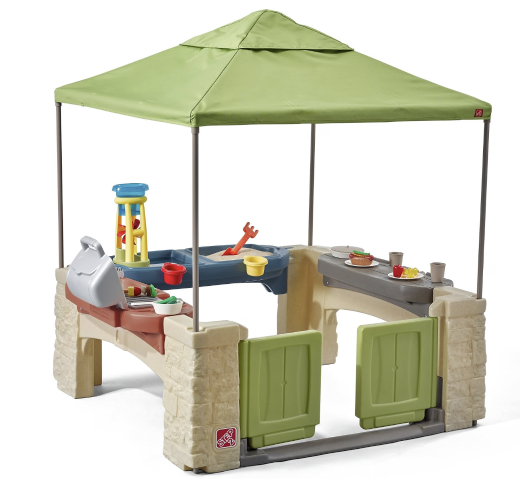
-
Welcome to the backyard! Let's cook, splash, explore, and TALK! ☀️💜
There's something wonderful about watching children create their own little world outdoors.
One minute, they're preparing a pretend barbecue.
The next minute, they're washing dishes, serving lunch, experimenting with water, or planning a picnic with their friends!
The Step2 All Around Playtime Patio with Canopy brings several play experiences together in one inviting outdoor space.
With its pretend grill, sink, snack station, sand-and-water play area, canopy, and accessories, children can explore familiar everyday activities while developing important communication and thinking skills.
But here's what I especially love:
This toy encourages children to interact with one another!
Because the play area can be accessed from multiple sides, children can participate in different activities while remaining part of the same play experience.
One child might be cooking.
Another might be washing dishes.
A third might be taking orders.
And suddenly, they're working together to run an entire backyard restaurant!
At ages 3–5, children are developing increasingly complex pretend-play skills. They're learning to negotiate roles, share materials, solve problems, and participate in longer conversations.
This play patio creates natural opportunities for all of those skills.
Parents can model:
“What are we cooking today?”
“Can you help me wash the dishes?”
“Let's fill the cup with water!”
“Who wants to be the chef?”
“First, let's make lunch. Then, we'll have a picnic!”
“Oh no! We ran out of cups!”
“What should we do?”
“Can I have a turn when you're finished?”
And don't forget the sensory experiences!
Water and sand play can encourage children to describe what they see, feel, and do.
“The sand is dry!”
“Now it's wet!”
“This cup is full!”
“Let's pour it into the other container!”
One outdoor play space can create countless opportunities for language, imagination, cooperation, and discovery!
Product Note: The patio includes a 16-piece accessory set. Sand and pretend food are not included. Families can add appropriate materials for supervised play.
🧠 Did You Know?
Combining pretend play with sensory exploration creates opportunities for children to use language while investigating how things work!
When children pour water, scoop sand, prepare pretend meals, and organize materials, they can develop several skills simultaneously.
Receptive Language: Understanding directions, vocabulary, and concepts.
Expressive Language: Describing actions, making requests, asking questions, and explaining ideas.
Social Communication: Taking turns, negotiating roles, sharing materials, and participating in conversations.
Cognitive Development: Making predictions, solving problems, sorting, comparing, and understanding cause and effect.
Sequencing: Organizing activities into meaningful steps.
Early Scientific Thinking: Observing what happens when materials are poured, mixed, transferred, or changed.
For example, imagine your child filling a cup with water.
You might say:
“Your cup is FULL!”
“Let's pour some water OUT.”
“Now it's HALF FULL!”
“Look! The water is going DOWN!”
Then ask:
“What do you think will happen if we pour it into this smaller cup?”
These simple interactions introduce concepts related to quantity, volume, comparison, and prediction.
And here's something I especially love about this play patio:
It creates opportunities for cooperative play.
Children may need to decide who will cook, who will serve, and who will wash the dishes.
They may encounter situations in which two children want the same accessory.
These moments provide natural opportunities to practice:
“Can I have a turn?”
“Let's share!”
“You can be the chef first.”
“Can you help me?”
“What should we do?”
Miss Angie's Tip: Rather than immediately stepping in when children disagree, provide language they can use to work through the situation.
For example:
“You both want the same cup. What could we do?”
“Could one person use it first?”
“Is there another cup we could use?”
Offer support as needed, but allow children opportunities to suggest solutions.
💜 Let's Play! (3–5 Years)
🍔 1. Welcome to the Backyard Restaurant!
Turn the patio into a pretend outdoor restaurant.
Let your child become the chef while you become the customer.
Say:
“Hello! Is your restaurant open?”
“I'd like to order lunch!”
“What's on the menu today?”
Encourage your child to prepare and serve a pretend meal.
“What would you like to eat?”
“Would you like something to drink?”
“Here's your lunch!”
“Thank you!”
Then switch roles.
Let your child become the customer and practice ordering.
“I would like a sandwich, please.”
“Can I have some water?”
“May I have another plate?”
For an additional challenge, introduce a problem.
“Oh no! The restaurant is out of food!”
“What should we do?”
Language Focus: Social communication, conversational turn-taking, requesting, WH questions, sentence development, and problem-solving.
💦 2. Fill It Up! Pour It Out!
Use the water-play area with child-safe cups and containers.
Encourage your child to fill, pour, and transfer water.
Model:
“Fill the cup!”
“Pour it OUT!”
“It's EMPTY!”
“Now it's FULL!”
Introduce concepts such as:
Full/empty, more/less, heavy/light, wet/dry, and big/small.
Compare containers.
“Which one holds more water?”
“Is this cup bigger or smaller?”
“What happens when we pour water into the little cup?”
Encourage predictions before experimenting.
“I think it will overflow!”
Then observe what happens together.
Language Focus: Descriptive vocabulary, opposites, quantity concepts, predictions, and cause-and-effect relationships.
🏖️ 3. Sandcastle Construction Crew!
Add appropriate play sand to the designated sand area.
Provide child-safe scoops, cups, or molds.
Pretend you're building a sandcastle.
Say:
“Let's build a castle!”
“First, we need some sand.”
“Next, let's fill the cup.”
“Then, we'll turn it over.”
“Finally, lift the cup!”
Encourage your child to describe the process.
“I'm scooping!”
“I'm filling the cup!”
“I'm making a tower!”
Introduce spatial concepts.
“Put the little tower beside the big one.”
“Make a path around the castle.”
“Place the cup behind the tower.”
Language Focus: Sequencing, action vocabulary, spatial concepts, following directions, and expressive language.
🧽 4. The Dishwashing Station!
Pretend the restaurant has finished serving lunch.
Say:
“Oh no! Look at all these dirty dishes!”
“We need to wash them!”
Use the sink area and appropriate accessories for pretend dishwashing.
Model:
“First, we wash.”
“Next, we rinse.”
“Then, we dry.”
“Finally, we put the dishes away.”
Introduce descriptive words:
Dirty/clean, wet/dry, full/empty, and hot/cold.
Use only cool or comfortably lukewarm water.
Give your child multistep directions.
“Wash the cup, rinse the plate, and put the spoon on the counter.”
Then switch roles.
Let your child give YOU directions.
Language Focus: Sequencing, following multistep directions, opposites, action vocabulary, and functional language.
🧺 5. Let's Plan a Picnic!
Pretend you're preparing a picnic.
Say:
“We're going on a picnic!”
“What should we bring?”
“Who is coming?”
“Where should we sit?”
Encourage your child to plan the event.
“We need plates!”
“Let's bring drinks!”
“Teddy wants to come!”
Create a simple checklist using pictures or words.
Then pretend to prepare the food, pack the supplies, and serve the picnic.
Introduce a problem.
“Oh no! We forgot the cups!”
“What could we do?”
For children ready for more complex language, encourage explanations.
“We need to bring water because it's hot outside.”
Language Focus: Planning, categorization, sequencing, problem-solving, WH questions, and complex sentences.
🔍 6. What's Missing from the Patio?
Arrange several familiar accessories on the patio.
Allow your child to look at them.
Then ask them to close their eyes while you remove one.
Say:
“Oh no! Something disappeared!”
“What's missing?”
“Where could it be?”
Encourage your child to identify the missing item.
“The cup is missing!”
“We need the spoon!”
Then hide an item and provide clues.
“It's something we use to drink.”
“It's underneath the counter.”
“It's beside the grill.”
For an additional challenge, encourage your child to give clues while you search.
Language Focus: Visual memory, vocabulary retrieval, object functions, descriptive language, spatial concepts, and WH questions.
🧪 7. Little Scientists: What Will Happen?
Use the water-play area to explore simple cause-and-effect relationships.
Gather a few child-safe objects that are suitable for water play.
Before placing an object in the water, ask:
“What do you think will happen?”
“Will it float or sink?”
“Why do you think that?”
Test the prediction.
“Look! It floats!”
“That one sank!”
Encourage your child to describe what happened.
“The ball stayed on top!”
“The other object went to the bottom!”
Compare the objects.
“How are they different?”
“What could we try next?”
You can also experiment with pouring water through different-sized containers.
Language Focus: Predictions, reasoning, cause and effect, descriptive vocabulary, comparing, and expressive language.
👩🍳 8. Who's Doing What?
Use pretend patio activities to practice pronouns and verb forms.
Assign different roles to family members, friends, or dolls.
Say:
“I'm cooking.”
“You're washing.”
“He is pouring.”
“She is serving.”
“They are playing.”
Encourage your child to describe what everyone is doing.
Then discuss completed actions.
“What did we do?”
“We cooked lunch!”
“I washed the dishes!”
“She poured the water!”
Introduce regular and irregular past-tense verbs naturally.
For children ready for longer sentences:
“He washed the dishes after everyone finished eating.”
Language Focus: Pronouns, present progressive verbs, past-tense verbs, sentence structure, and temporal language.
🤝 9. Let's Work Together!
Invite a sibling or friend to participate in patio play.
Assign different jobs.
“Who wants to cook?”
“Who will wash the dishes?”
“Who will serve the customers?”
Encourage children to make requests.
“Can you pass me the cup?”
“Will you help me?”
“Can I use that when you're finished?”
Introduce a pretend problem.
“Oh no! We both want to be the chef!”
Ask:
“What should we do?”
“Could we take turns?”
“Can we have two chefs?”
Encourage children to suggest solutions and negotiate roles.
Language Focus: Cooperative play, turn-taking, requesting, negotiation, flexible thinking, and social communication.
🎉 10. The Great Backyard Celebration!
Pretend you're hosting a backyard party.
Say:
“Let's have a party!”
“Who should we invite?”
“What food should we make?”
“What games should we play?”
Encourage your child to plan the event.
“First, we'll invite our friends.”
“Next, we'll prepare the food.”
“Then, we'll decorate.”
“Finally, we'll have the party!”
Act out the celebration.
Introduce an unexpected event.
“Oh no! It started raining!”
“What should we do?”
“Should we move the party inside?”
Encourage your child to develop a solution and continue the story.
Afterward, ask your child to retell what happened.
“What happened first?”
“What was the problem?”
“How did we solve it?”
Language Focus: Narrative development, sequencing, planning, problem-solving, social communication, and complex language.
🌱 Grow With Me! — Same Toy, New Skills!
6+ Years: Expanding Language, Literacy, Math, and Thinking Skills
As children grow, the same outdoor play patio can support more advanced communication, planning, scientific reasoning, and cooperative learning.
📋 Design a Restaurant Menu
Have your child create a menu with food categories, descriptions, and pretend prices.
Encourage reading, writing, categorization, and descriptive language.
💰 Run a Backyard Business
Pretend your child owns an outdoor café.
Create customer orders, calculate totals, and practice making change using play money.
Encourage polite customer interactions and problem-solving.
🧪 Conduct Water Experiments
Ask your child to predict which objects will float or sink.
Record predictions and results.
Compare outcomes and discuss why different objects behave differently.
Introduce scientific vocabulary such as predict, observe, compare, and result.
📏 Explore Measurement
Use child-safe measuring cups and containers to compare water volumes.
Practice concepts such as half, full, equal, more than, and less than.
For older children, introduce fractions and simple measurement conversions.
📝 Write a Recipe
Have your child create a pretend recipe for the outdoor café.
Encourage organized directions using:
First, next, then, after, before, and finally.
Then follow the recipe together.
🎤 Become a Weather Reporter
Pretend your child is reporting on the weather during a backyard event.
Encourage descriptions of temperature, wind, clouds, and precipitation.
Discuss how the weather might affect outdoor plans.
🤔 Solve Outdoor Challenges
Introduce scenarios such as:
“What if the restaurant runs out of water?”
“What if too many customers arrive at once?”
“What if the sand gets too wet to build a castle?”
Encourage children to explain multiple possible solutions.
✉️ Plan a Special Event
Have your child organize a pretend backyard party.
Create invitations, a guest list, a schedule, and a shopping list.
Practice planning, written language, organization, and social communication.
🔤 Practice Speech Sounds
Outdoor patio vocabulary provides opportunities to practice speech sounds when appropriate.
Examples include:
/k/: cook, cup, clean, cake
/s/: sand, sink, soap, serve
/sh/: wash, splash, dish
/r/: grill, water, pour, restaurant
/l/: fill, play, plate, little
/th/: three, thick, thin, bath
Choose words that match your child's individual speech goals and practice at an appropriate level.
🤝 Collaborate on a Larger Project
Invite siblings or friends to work together to plan and operate a pretend restaurant or outdoor celebration.
Encourage negotiation, division of responsibilities, flexible thinking, and shared problem-solving.
The same play patio that begins with simple pretend cooking and water exploration can grow into a setting for advanced language, literacy, math, science, and social communication!
💜 Miss Angie's Reminder
It's not just the toy—it's how you use it!
One of the things I love most about outdoor play is that children have opportunities to explore, experiment, and create their own adventures.
And sometimes, the most meaningful learning happens during the simplest activities.
When your child pours water from one cup to another...
When they scoop sand into a container...
When they pretend to cook dinner...
When they ask a friend to help...
When they discover that something doesn't work the way they expected...
Those are all opportunities for communication and learning!
Remember to follow your child's lead.
If your child says:
“Water!”
You can expand:
“You want more water!”
If your child says:
“Cup full!”
You might respond:
“Yes! Your cup is completely full!”
If your child says:
“Me cook!”
You can model:
“You're cooking dinner!”
And if your child announces:
“We're having a party!”
Join the fun!
“A party? How exciting! Who should we invite?”
You don't have to turn every interaction into a lesson.
Talk about what your child is doing, model new words naturally, and give them opportunities to share their ideas.
And don't forget that children communicate in many different ways.
Some children may use complete sentences.
Others may use shorter phrases, gestures, signs, or communication devices.
All of these can be meaningful ways to participate in play.
The goal is connection, communication, and shared enjoyment!
One outdoor patio, endless backyard adventures, and wonderful opportunities for speech, language, social interaction, thinking, and learning! 💜☀️
Safety Reminder: Follow the manufacturer's age, assembly, and supervision instructions. Adult supervision is essential during all water play, even with shallow amounts of water. Empty and dry water compartments immediately after use, keep sand clean and covered when not in use, and inspect the play area regularly. The canopy provides shade but does not replace appropriate sun protection. Use only age-appropriate accessories and materials.
🌱 Little Tikes Story Dream Machine — Little Stories, BIG Language Adventures!
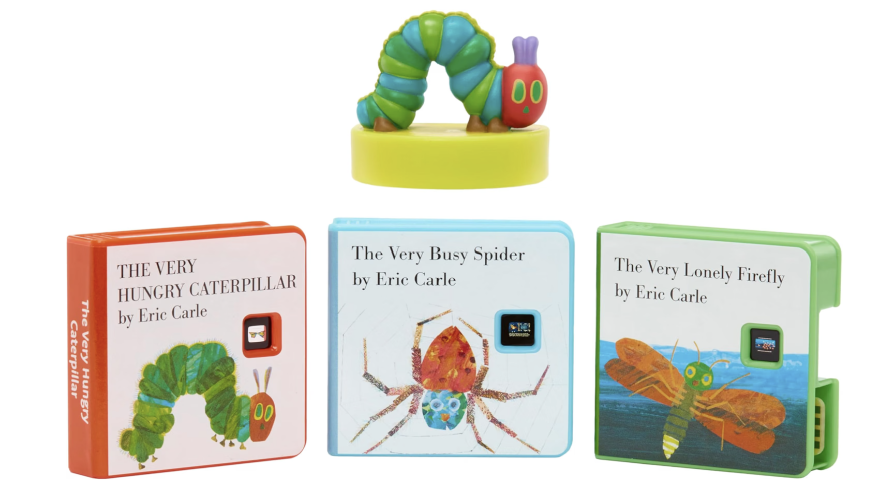
-
Once upon a time... let's listen, imagine, predict, and TALK! 📚💜
There's something magical about watching a child's face light up as a story comes to life!
The Little Tikes Story Dream Machine projects colorful story illustrations and words onto a wall while a narrator reads the story aloud.
Children can follow along as familiar characters experience adventures, encounter problems, and discover solutions.
But here's what I especially love:
The real language-learning opportunities don't end when the story is over!
In fact, some of the most valuable learning happens when parents and children TALK about what they've heard and seen.
At ages 3–5, children are developing important skills that help them understand, organize, and tell stories.
They're learning to answer questions, recall information, make predictions, recognize emotions, and explain why things happen.
The Story Dream Machine provides a wonderful starting point for these conversations.
Parents can model:
“Who is in the story?”
“Where are they going?”
“What happened first?”
“Why do you think he's sad?”
“What do you think will happen next?”
“How did they solve the problem?”
“What was your favorite part?”
And here's something important:
You don't have to wait until the story ends to talk about it!
Pause at an interesting moment.
Ask a question.
Make a prediction.
Act out an action.
Describe an illustration.
Then continue the story!
For example:
“Oh! The puppy is wandering away!”
“Where do you think he's going?”
“Do you think he'll find his way home?”
“Let's find out!”
You can even use stuffed animals or dolls to recreate the story afterward.
One story can become an entire afternoon of conversation, imagination, and learning!
The Story Dream Machine is designed for children ages 3 and older. Story collections are available separately, allowing families to explore additional books over time.
🧠 Did You Know?
Listening to stories supports skills that children will eventually use for reading comprehension, writing, and classroom learning!
Before children can independently read and understand complex stories, they need opportunities to listen, understand language, remember information, and organize events.
Shared storytelling can support several important developmental areas.
Receptive Language: Understanding vocabulary, sentence structure, and spoken information.
Expressive Language: Answering questions, describing events, explaining ideas, and retelling stories.
Auditory Memory: Remembering characters, details, and sequences of events.
Narrative Development: Understanding that stories have characters, settings, events, problems, and resolutions.
Inferencing: Using clues to figure out information that isn't directly stated.
Social-Emotional Understanding: Recognizing characters' feelings, motivations, and perspectives.
Early Literacy: Developing awareness of books, print, story structure, and the relationship between spoken and written language.
For example, imagine a character in a story drops an ice cream cone.
You might ask:
“What happened?”
“The ice cream fell!”
“How do you think the character feels?”
“Sad!”
“Why?”
“Because the ice cream is on the ground!”
“What could the character do?”
“Get another one!”
That short conversation encourages vocabulary, cause-and-effect reasoning, emotional understanding, and problem-solving.
And all of those skills contribute to language development.
💜 A Special Note About Story Projectors
The Story Dream Machine is different from a traditional book because it provides narration and projected illustrations.
That's part of its appeal!
However, listening to a story isn't quite the same as having a conversation about a story.
Children benefit when adults help them connect the words, pictures, and events.
You don't need to interrupt every sentence.
Instead, choose a few meaningful moments to pause, ask questions, make comments, or invite your child to participate.
Miss Angie's Tip: Follow your child's interests!
If your child becomes fascinated with a character, animal, or object, spend a little extra time talking about it.
And if your child wants to hear the same story again and again?
That's wonderful!
Repetition gives children opportunities to notice new details, anticipate familiar events, and become increasingly confident telling parts of the story themselves.
💜 Let's Play! (3–5 Years)
🔮 1. Pause, Predict, and Play!
Begin playing a story together.
When something interesting happens, pause the narration.
Say:
“Oh! Something is about to happen!”
“What do you think will happen next?”
Encourage your child to make a prediction.
“I think the puppy will get lost!”
“Maybe he'll find his family!”
“Maybe he'll meet another animal!”
Respond to the prediction.
“That's an interesting idea!”
“What makes you think that?”
Then continue the story.
“Let's see what happens!”
Afterward, compare the prediction with the actual event.
“You thought the puppy would go home, but he stopped to play first!”
For younger preschoolers, offer two choices.
“Do you think he'll go home or keep exploring?”
For older preschoolers, encourage explanations.
“I think he'll get lost because he's walking away from home.”
Language Focus: Predicting, inferencing, cause-and-effect reasoning, WH questions, and complex sentence development.
👀 2. Story Detective: Who, What, and Where?
Turn listening comprehension into a detective game!
Before starting, explain:
“We're going to be story detectives!”
“We need to look and listen carefully!”
Pause occasionally to ask simple questions.
“Who is in the story?”
“What is the character doing?”
“Where are they?”
“What happened?”
As your child becomes more successful, introduce more challenging questions.
“Why did the character do that?”
“How did the problem happen?”
“What might happen next?”
For children who need additional support, provide choices.
“Is the puppy in the house or outside?”
“Is he running or sleeping?”
Gradually reduce the choices as comprehension improves.
Language Focus: Listening comprehension, WH questions, auditory attention, vocabulary, and sentence formulation.
🧩 3. First, Next, Then, Last!
After listening to a story, help your child remember the order of events.
Say:
“Let's remember what happened!”
“What happened first?”
“What happened next?”
“What happened at the end?”
Begin with just three events.
For example:
“First, the puppy left home.”
“Next, he explored.”
“Last, he came back.”
As your child develops stronger sequencing skills, add more events.
Use words such as:
First, next, then, after, before, finally, and last.
You can draw simple pictures representing important events and ask your child to arrange them in order.
Then encourage your child to tell the story using the pictures.
Language Focus: Sequencing, auditory memory, temporal concepts, narrative organization, and expressive language.
😊 4. How Does the Character Feel?
Choose a story with characters experiencing different emotions.
Pause when a character encounters a problem or surprise.
Ask:
“How do you think the character feels?”
“Does she look happy or sad?”
“Why might she feel that way?”
Encourage your child to use clues from the illustrations and events.
“He's scared because he's lost!”
“She's happy because she found her friend!”
Introduce additional emotion words when appropriate.
Excited, worried, disappointed, surprised, frustrated, proud, and relieved.
Connect the story to your child's experiences.
“Have you ever felt worried?”
“What helped you feel better?”
“What could we say to the character?”
Language Focus: Emotional vocabulary, perspective-taking, inferencing, cause and effect, and social communication.
🧸 5. Act It Out!
After listening to a story, gather stuffed animals, dolls, or other age-appropriate toys.
Invite your child to recreate a favorite scene.
Say:
“Let's pretend we're in the story!”
“Who do you want to be?”
“I'll be the other character!”
Encourage your child to act out what happened.
“The puppy is walking!”
“He's looking for food!”
“Oh no! He's lost!”
Then introduce dialogue.
“Where are you going?”
“I'm looking for my family!”
“Can I help you?”
“Yes, please!”
For an additional challenge, encourage your child to create a new scene that wasn't in the original story.
Language Focus: Symbolic play, dialogue, conversational turn-taking, sequencing, expressive language, and narrative development.
🔍 6. Look Closely! What Do You See?
Pause the story on an interesting illustration.
Say:
“Let's look carefully at this picture!”
“What do you see?”
Encourage your child to describe the scene.
“I see a big tree!”
“The puppy is beside the house!”
“There are three animals!”
Expand the description with questions.
“What color is the house?”
“Where is the puppy standing?”
“What is happening behind the tree?”
Introduce descriptive concepts.
Big/small, tall/short, near/far, above/below, in front of/behind, and same/different.
For children ready for more complex language:
“The little puppy is standing beside the tall tree.”
Language Focus: Descriptive vocabulary, spatial concepts, sentence expansion, visual observation, and expressive language.
🧠 7. What Was Missing?
After finishing a familiar story, ask your child to remember specific details.
Say:
“Let's see what we remember!”
“Who was in the story?”
“What did the character find?”
“Where did they go?”
“What happened at the end?”
Then make an intentionally silly statement.
“The puppy rode a spaceship to the moon!”
Pause and see how your child responds.
“No! He didn't!”
“Oh! What really happened?”
Encourage your child to correct the statement.
For children who need support, provide choices or replay a short section.
For older preschoolers, ask them to tell YOU something silly about the story.
Language Focus: Auditory memory, listening comprehension, error detection, vocabulary retrieval, and sentence formulation.
💬 8. Let's Make the Characters Talk!
Choose a scene involving two or more characters.
Pause the story.
Say:
“I wonder what they're saying to each other!”
Encourage your child to imagine the conversation.
“Hello!”
“Where are you going?”
“I'm going home!”
“Can I come?”
“Sure!”
Model conversational exchanges and appropriate responses.
For children ready for more advanced language, introduce thoughts and feelings.
“I think the character might say, ‘I'm worried because I can't find my friend.’”
Encourage your child to explain why a character might say something.
Switch roles and create a new conversation.
Language Focus: Dialogue, social communication, perspective-taking, pronouns, sentence formulation, and conversational turn-taking.
🌈 9. Change the Ending!
After listening to a familiar story, say:
“That was a great ending!”
“But what if something different happened?”
Encourage your child to imagine an alternative ending.
“What if the puppy didn't go home?”
“What if the characters found a treasure?”
“What if a new friend appeared?”
Support your child in creating a logical sequence.
“First, the puppy found a map.”
“Then, he followed the map.”
“Finally, he discovered a hidden garden!”
Ask:
“How would the characters feel?”
“What would happen next?”
For younger children, offer two possible endings and let them choose.
For older children, encourage an entirely original ending.
Language Focus: Creative thinking, narrative development, sequencing, inferencing, flexible thinking, and complex sentences.
🎤 10. You're the Storyteller!
After your child becomes familiar with a story, invite them to tell it back to you.
Say:
“Now it's YOUR turn to tell the story!”
“You can be the storyteller!”
Turn off the narration or use the illustrations as visual supports when possible.
Encourage your child to describe what is happening.
“Once upon a time...”
“There was a little puppy...”
“One day, he went exploring...”
“Then something happened...”
Support the retelling with questions.
“Who was in the story?”
“Where did it happen?”
“What was the problem?”
“How did the character solve it?”
“How did the story end?”
Don't worry if your child leaves out details or tells events out of order.
Model an organized retelling and encourage another attempt during a future reading.
Language Focus: Narrative retelling, story grammar, expressive language, sequencing, auditory memory, and sentence organization.
🌱 Grow With Me! — Same Toy, New Skills!
6+ Years: Building Advanced Comprehension, Literacy, and Narrative Skills
As children grow, the Story Dream Machine can become a starting point for more sophisticated discussions, creative writing, critical thinking, and language activities.
📖 Identify Story Grammar Elements
Have your child identify:
Characters
Setting
Initiating event
Problem
Attempts to solve the problem
Resolution
Characters' feelings and reactions
Encourage your child to explain how these elements fit together.
🧠 Make Deeper Inferences
Ask questions that require children to use clues.
“Why do you think the character made that decision?”
“What might the character be thinking?”
“What clues helped you figure that out?”
Encourage explanations using evidence from the story.
✍️ Write an Alternative Ending
Have your child create a different ending.
Encourage a logical sequence of events, descriptive vocabulary, and complete sentences.
📚 Compare Two Stories
Listen to two different stories.
Discuss similarities and differences.
“Which characters had similar problems?”
“How were the settings different?”
“Which ending did you prefer, and why?”
🎭 Write a Short Play
Turn a favorite story into a simple script.
Assign characters, write dialogue, and act out the story with family members.
Practice reading fluency, expression, and conversational language.
📝 Create a Story Review
Ask your child to rate a story and explain their opinion.
Encourage statements such as:
“My favorite part was when...”
“I liked this character because...”
“I would recommend this story because...”
🔤 Explore Vocabulary and Word Relationships
Choose unfamiliar or interesting words from the story.
Discuss their meanings, synonyms, antonyms, and how they can be used in other sentences.
🎤 Practice Speech Sounds Through Storytelling
Choose words from the story that match your child's individual speech targets.
For example:
/r/: read, story, character, around
/s/: story, see, surprise, silly
/l/: little, look, listen, laugh
/sh/: show, wish, finish
/th/: think, three, thought, together
Practice target words in phrases, sentences, and eventually connected speech when appropriate.
🤔 Discuss Character Choices
Ask:
“Was that a good decision?”
“What else could the character have done?”
“What might have happened if they made a different choice?”
Encourage reasoning and perspective-taking.
📓 Create an Original Story
Have your child invent a new story inspired by the themes or characters they've enjoyed.
Encourage them to include a beginning, middle, and end, along with a problem and solution.
They can illustrate their story and read it aloud to family members.
A storytelling projector that begins with listening and picture discussions can grow into a wonderful tool for advanced comprehension, literacy, creative writing, and narrative development!
💜 Miss Angie's Reminder
It's not just the toy—it's how you use it!
The Little Tikes Story Dream Machine can make storytelling feel exciting and magical.
But remember:
The most important part isn't simply watching and listening to the story. It's the interaction that happens around it!
Sit with your child.
Listen together.
Pause occasionally.
Ask questions.
Make predictions.
Laugh at the silly parts.
Talk about the characters.
And encourage your child to share their own ideas!
If your child points to a picture and says:
“Dog!”
You might expand:
“Yes! That's a little brown dog!”
If your child says:
“Dog running!”
You can model:
“The dog is running through the grass!”
If your child says:
“He sad!”
You might respond:
“Yes, he looks sad because he can't find his friend.”
And if your child asks to hear the same story for the tenth time?
That's okay!
Familiar stories provide opportunities for children to anticipate events, remember vocabulary, and become more confident telling the story themselves.
You don't need to ask a question after every page.
Sometimes, simply making a comment is enough.
“Wow! Look at that enormous tree!”
“I wonder where he's going!”
“Oh no! That surprised me!”
Then pause and give your child an opportunity to respond.
The goal isn't to test your child's memory. It's to build understanding, communication, and a love of stories!
And remember, traditional books are wonderful too!
The Story Dream Machine can complement shared book reading, not replace it.
Children benefit from turning real pages, pointing to pictures, talking about illustrations, and enjoying books together.
Follow your child's lead, keep storytelling interactive, and let their imagination take the story in wonderful new directions!
One little projector, countless storytelling adventures, and wonderful opportunities for speech, language, comprehension, imagination, and early literacy! 💜📚
Safety Reminder: Recommended for ages 3 and older. Follow the manufacturer's instructions for setup, batteries, and use. Place the projector on a stable surface, supervise younger children, and avoid looking directly into the projection light. Additional story collections may be purchased separately. Keep storytime interactive and balance projector use with traditional books, active play, and other shared activities.
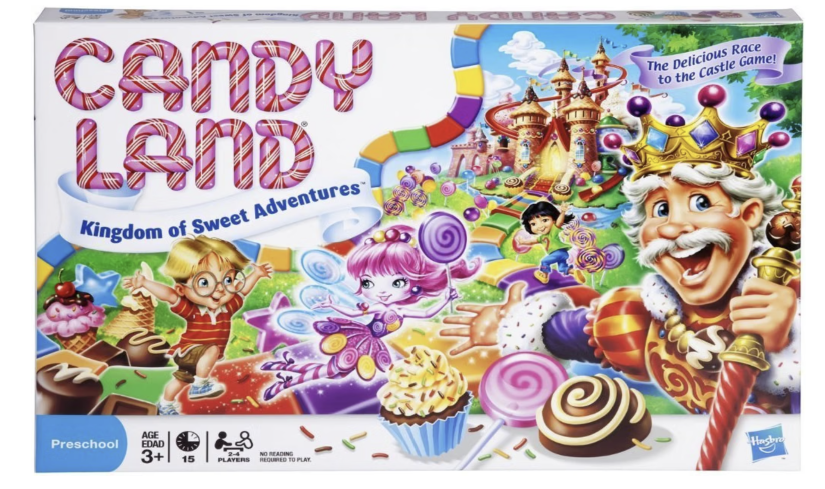
🍭 Candy Land Board Game
-
Who knew a trip through a colorful candy kingdom could offer so many opportunities for speech and language development?
Candy Land is one of my favorite introductory board games because children don't need to know how to read to participate! Instead, they follow a colorful path, match colors, take turns, and practice important communication skills along the way.
What makes Candy Land especially valuable is that it combines language development, early learning, social communication, and emotional regulation in one simple game.
Children learn to wait for their turn, follow directions, describe what they see, and celebrate others' successes. They also discover that sometimes things don't go as planned—and that's an important part of learning, too!
🧠 Did You Know?
Playing Candy Land can help develop:
Receptive Language: Understanding directions, identifying colors, and following game rules.
Expressive Language: Naming colors, describing pictures, asking questions, and producing longer sentences.
Social Communication: Turn-taking, waiting, sharing attention, encouraging others, and practicing good sportsmanship.
Early Math & Spatial Concepts: Counting, comparing positions, and understanding before, after, ahead, and behind.
Executive Functioning: Attention, impulse control, working memory, and flexible thinking.
Emotional Regulation: Identifying feelings, managing disappointment, and responding appropriately to winning or losing.
Speech Sound Development: Practicing individualized speech targets during meaningful play.
🍬 10 Ways to Play & Learn with Candy Land!
1. Color Detective! 🌈
Before moving a game piece, have your child identify the color on the card. Then challenge them to find something nearby that matches!
Try Saying: "I got yellow! Can you find something else that's yellow?"
Language Focus: Color identification, categorization, descriptive vocabulary, matching.
2. Whose Turn Is It? 👋
Encourage your child to announce whose turn comes next. Model short phrases initially, then expand into complete sentences.
Try Saying: "It's my turn! Now it's your turn!"
Language Focus: Pronouns, conversational exchanges, turn-taking, social communication.
3. Where Am I? 📍
Use the game pieces to introduce spatial vocabulary. Ask your child to describe where their piece is in relation to yours.
Try Saying: "I'm behind you!" "You're ahead of me!" "We're next to each other!"
Language Focus: Prepositions, spatial concepts, sentence formulation, comparing positions.
4. Make a Prediction! 🔮
Before drawing a card, encourage your child to predict which color they might get or which color would help them move forward.
Try Saying: "I hope I get red because the red space is far ahead!"
Language Focus: Predicting, reasoning, expressing preferences, using because.
5. Listen & Follow! 👂
Give your child one- or two-step directions using the game board.
Try Saying: "Touch the blue space, then point to your game piece."
For an additional challenge, include three related actions.
Language Focus: Auditory comprehension, following multistep directions, sequencing, attention.
6. First, Next, Last! 🔢
Have your child explain what happens during each turn.
Try Saying: "First, I pick a card. Next, I find the color. Last, I move my piece!"
Language Focus: Sequencing, temporal concepts, procedural language, sentence organization.
7. How Do You Feel? ❤️
Use the natural ups and downs of the game to talk about emotions. Model appropriate responses when someone moves ahead, falls behind, wins, or loses.
Try Saying: "I feel disappointed because I had to move backward, but I can try again!"
Language Focus: Emotion vocabulary, cause and effect, perspective-taking, social-emotional communication.
8. Sweet Descriptions! 🍭
Choose a candy-themed picture on the board and encourage your child to describe it using its color, shape, size, or other characteristics.
Try Saying: "The candy is pink, round, and sweet!"
Language Focus: Adjectives, descriptive vocabulary, attributes, sentence expansion.
9. Speech Sound Challenge! 🗣️
Choose a speech sound your child is currently practicing. Before each turn, have them say a target word containing that sound.
For example, if your child is practicing /r/, use words such as red, rainbow, and race.
For younger children, simply model the words and encourage imitation without interrupting the fun.
Language Focus: Articulation, speech sound awareness, repetition, carryover into play.
10. Be the Game Teacher! 👩🏫
Once your child understands how to play, let them become the teacher! Ask them to explain the rules to a parent, sibling, or even a favorite stuffed animal.
Try Saying: "First, choose your game piece. Then pick a card. Next, find the matching color!"
Language Focus: Organized expressive language, sequencing, explaining, conversational clarity, confidence.
🌱 Grow With Me! — Same Game, New Skills!
Ages 3–4: Learning the Basics
Keep the focus on color matching, simple directions, turn-taking, and short phrases.
Encourage your child to say "my turn," "blue card," or "go again!" Model language naturally and keep playing sessions short enough to maintain interest.
Ages 4–5: Expanding Language & Social Skills
Introduce longer sentences, spatial vocabulary, predictions, and explanations.
Ask questions such as "Who is ahead?" "What color do you need?" and "Why do you think that?"
Encourage your child to talk about feelings and practice encouraging other players.
Ages 6+: Building Higher-Level Thinking
Challenge your child to explain the rules independently, compare positions, and use more complex language.
Introduce if/then statements, such as "If I draw green, then I'll move ahead of you!"
Have children invent a new rule, explain how it works, and discuss whether it makes the game easier or more challenging.
Older children can also practice being supportive game leaders for younger siblings.
💜 Miss Angie's Reminder
It's not about who reaches the candy castle first—it's about the communication that happens along the way!
Board games provide wonderful opportunities to teach children that winning and losing are both natural parts of playing together.
If your child has difficulty waiting, following rules, or managing disappointment, begin with just a few turns. Gradually increase the length of the game as their confidence and participation improve.
Remember to model encouraging phrases such as "Good try!" "You did it!" and "That was fun!"
The most meaningful learning happens when children feel supported, connected, and excited to play again.
⚠️ Safety Note: Candy Land is recommended for ages 3 and older. Small game pieces may pose a choking hazard for children under 3. Adult supervision is recommended.
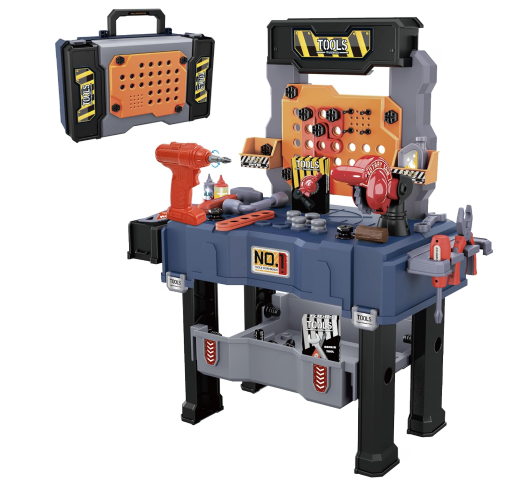
🌱 MUGEYMYD Kids' Tool Workbench — Little Builders, Big Ideas!
-
Grab your tools! We've got some building to do! 🔧💜
There's something wonderful about watching a child pick up a toy screwdriver, examine a bolt, and announce, “I can fix it!”
This pretend construction workbench encourages children to become builders, inventors, repair technicians, and problem-solvers—all while developing important speech, language, and cognitive skills.
The MUGEYMYD Kids' Tool Workbench features a collection of pretend tools and construction accessories, including a battery-powered toy drill, hammer, screwdriver, wrenches, nuts, bolts, and other building pieces. The workbench also converts into a portable toolbox, making cleanup and storage part of the fun.
But here's what I especially love:
Children aren't just playing with tools. They're learning to think, plan, explain, and solve problems!
During construction play, children naturally encounter opportunities to:
Ask for specific tools and materials.
Describe what they're building.
Follow and give directions.
Learn the names and functions of objects.
Understand spatial relationships.
Sequence steps to complete a task.
Solve problems when something doesn't work.
Negotiate roles and collaborate with others.
Practice persistence and flexible thinking.
And because children are actively manipulating objects, they can connect the words they're hearing to the actions they're performing.
Parents can model:
“I need the screwdriver!”
“Let's turn the bolt.”
“Put the screw through the hole.”
“The wrench is beside the hammer.”
“First, we need to find the right piece.”
“Oh no! This part doesn't fit!”
“What could we try instead?”
“We fixed it!”
One day, your child might build a pretend house.
The next day, they might repair a broken spaceship.
And another day, they might announce that they're opening a repair shop!
That's the beauty of open-ended pretend play. The possibilities are limited only by your child's imagination!
🧠 Did You Know?
Construction play provides opportunities for children to develop language, executive functioning, and problem-solving skills simultaneously!
When children build or repair something, they often need to make a plan, select materials, organize steps, and adjust their approach when something doesn't work.
These experiences can support developing executive functioning skills, including:
Planning: Deciding what needs to happen before beginning.
Working Memory: Remembering instructions and keeping track of the next step.
Cognitive Flexibility: Trying a different solution when the first one doesn't work.
Attention: Staying engaged with a meaningful activity.
Self-Monitoring: Checking whether the pieces fit or the task is complete.
Construction play also provides wonderful opportunities to develop spatial language.
Words such as above, below, between, beside, inside, outside, through, and around become much more meaningful when children can physically demonstrate them.
For example:
“Put the bolt through the hole.”
“Place the wrench beside the drill.”
“Find the screw under the workbench.”
“Put the tools inside the toolbox.”
Children can also practice descriptive vocabulary.
“That's a long screw!”
“This bolt is too big!”
“I need the smaller piece.”
“The hammer is heavier than the screwdriver.”
And don't forget about social communication!
Building together creates natural opportunities to request assistance, take turns, clarify instructions, negotiate ideas, and celebrate accomplishments.
Miss Angie's Tip: When your child encounters a problem, resist the urge to immediately fix it.
Instead, try:
“Hmm. That didn't work.”
“What do you think we should try?”
“Could another piece fit?”
Giving your child time to think and respond encourages both problem-solving and expressive language.
Of course, offer support when needed. The goal is shared discovery—not frustration!
💜 Let's Play! (3–5 Years)
🔧 1. What's in My Toolbox?
Begin by exploring the tools together.
Take out a few items and name them.
“Here's a hammer!”
“This is a screwdriver.”
“Look! We have a wrench!”
Then talk about what each tool does.
“We use a hammer to tap.”
“A screwdriver turns screws.”
“A wrench helps turn nuts and bolts.”
Invite your child to identify tools by their functions.
“Find something we use to turn a screw.”
“Which tool can we use to tap?”
“Show me the wrench.”
For an additional challenge, describe a tool without naming it.
“I'm thinking of something with a handle that we use to tap.”
Language Focus: Vocabulary development, object functions, receptive language, descriptive language, and categorization.
🏠 2. You Be the Builder!
Tell your child that you're starting a construction project.
Let them become the boss!
Say:
“I'm your helper today!”
“What should we build?”
“Which tool do we need first?”
Encourage your child to give you directions.
“Get the hammer.”
“Put the screw here.”
“Turn it!”
“Put the wrench away.”
Model longer directions when appropriate.
“First, get the screwdriver. Then, turn the screw.”
You can also pretend to misunderstand a vague instruction.
If your child says, “Put it there,” ask:
“Do you mean beside the toolbox or on top of the workbench?”
This creates a natural opportunity to practice giving more specific directions.
Language Focus: Expressive language, sentence formulation, giving directions, spatial concepts, and conversational repair.
🔩 3. Follow the Construction Plan!
Become the construction supervisor and give your child directions.
Begin with two steps:
“Get the wrench and put it on the workbench.”
“Pick up the screwdriver and place it beside the hammer.”
Then increase the complexity:
“First, find a bolt, then put it through the hole, and finally tighten it.”
Introduce sequencing vocabulary:
First, next, then, before, after, and last.
For an additional challenge, ask your child to repeat the directions before completing them.
Then switch roles and let your child give YOU the construction plan!
Language Focus: Following multistep directions, auditory memory, sequencing, temporal concepts, and expressive language.
🔍 4. The Missing Tool Mystery!
Place three to five familiar tools on the workbench.
Allow your child to look at them.
Then ask them to close their eyes while you remove one.
Say:
“Oh no! A tool disappeared!”
“What's missing?”
“Which tool do we need to find?”
Encourage a complete response.
“The hammer is missing!”
“The screwdriver disappeared!”
For an additional challenge, hide the missing tool and provide clues.
“It's something we use to turn screws.”
“It's underneath the workbench.”
“It's next to the toolbox.”
Language Focus: Visual memory, vocabulary retrieval, object functions, descriptive language, and WH questions.
🛠️ 5. What's Broken? Let's Fix It!
Pretend a favorite toy needs repairing.
Choose a sturdy toy that can safely participate in pretend repairs without being taken apart or damaged.
Say:
“Oh no! Teddy's wagon is broken!”
“What happened?”
“What should we do?”
“Which tool could help?”
Encourage your child to describe the problem.
“The wheel fell off!”
“The wagon won't move!”
“We need to fix it!”
Then pretend to make the repair.
“First, let's look at the wheel.”
“Next, we need our tools.”
“Now we're fixing it!”
“Hooray! We fixed the wagon!”
Introduce new pretend problems as your child becomes more confident.
Language Focus: Problem-solving, cause-and-effect relationships, sequencing, past-tense verbs, and narrative development.
📏 6. Big, Bigger, Biggest!
Gather different-sized construction accessories.
Compare them together.
“Look at these screws!”
“This one is long.”
“This one is short.”
“Which one is longer?”
“Can you find the smallest piece?”
Introduce descriptive concepts:
Big/small, long/short, wide/narrow, same/different, more/less.
Sort the pieces by size or type.
Then ask your child to explain their choices.
“Why did you put those together?”
“They're all screws!”
“These are the big ones!”
You can also compare the tools.
“The hammer is longer than the wrench.”
“Which tool is the shortest?”
Language Focus: Descriptive vocabulary, comparative and superlative forms, categorization, reasoning, and concept development.
🧩 7. It Doesn't Fit!
Choose compatible construction pieces and demonstrate how they connect.
Then introduce a piece that doesn't fit.
Say:
“Hmm. This one doesn't work!”
“Why won't it fit?”
“Is it too big?”
“Is it too small?”
“What should we try?”
Encourage your child to examine the pieces and suggest a solution.
“We need a different screw!”
“Let's try the smaller one!”
“That one fits!”
You can also intentionally select the wrong tool and let your child correct you.
“Can I use the hammer to turn this screw?”
“No! You need the screwdriver!”
Language Focus: Problem-solving, reasoning, descriptive language, negation, and flexible thinking.
👷 8. Construction Crew!
Invite a sibling, parent, or stuffed animal to join the construction crew.
Assign different roles.
“I'm the builder.”
“You're the helper.”
“Teddy is the supervisor!”
Create a simple pretend project.
“We're building a house for Teddy!”
Encourage requests and teamwork.
“Can you pass me the wrench?”
“I need your help!”
“It's your turn to use the drill.”
“Let's work together!”
Introduce opportunities to negotiate.
“We both want the screwdriver. What should we do?”
“Should we take turns?”
“Can we use another tool while we wait?”
Language Focus: Social communication, cooperative play, turn-taking, requesting, pronouns, and perspective-taking.
🗣️ 9. Tell Me What You're Doing!
Use construction play to practice action words and grammatical structures.
Narrate what you're doing.
“I'm hammering.”
“You're turning the screw.”
“He is building.”
“She is fixing the wagon.”
“They are working together.”
Encourage your child to describe their actions.
“I'm using the drill!”
“I'm putting the tools away!”
After completing a project, talk about what happened.
“What did we do?”
“We built a house!”
“I fixed the wheel!”
“You helped me!”
For children ready for longer sentences, introduce explanations.
“I used the screwdriver because I needed to tighten the screw.”
Language Focus: Action vocabulary, pronouns, present progressive verbs, past-tense verbs, and sentence expansion.
🧰 10. Close the Workshop!
At the end of playtime, pretend the construction crew is closing for the day.
Say:
“The workshop is closing!”
“We need to put everything away!”
Give simple cleanup directions.
“Put the hammer inside the toolbox.”
“Place the screwdriver next to the wrench.”
“Find all the bolts.”
“Put the tools away before we close the toolbox.”
Encourage your child to organize the pieces by type.
“Where do the screws belong?”
“Are all the tools put away?”
“What's left to do?”
Then celebrate!
“We finished our project!”
“The workshop is clean!”
“Great teamwork!”
Language Focus: Following directions, spatial concepts, categorization, sequencing, and functional communication.
🌱 Grow With Me! — Same Toy, New Skills!
6+ Years: Building More Complex Language and Thinking Skills
As children grow, the same workbench can provide opportunities to practice increasingly sophisticated language, literacy, planning, and reasoning.
📋 Create a Construction Blueprint
Ask your child to draw a plan for a pretend project.
Label the parts and identify the tools needed.
Then explain the plan before beginning.
This encourages organization, descriptive language, and planning.
📝 Write Step-by-Step Instructions
Have your child create written or dictated directions for completing a construction task.
Encourage the use of:
First, next, then, after, before, and finally.
Then have another person follow the instructions.
Were the directions clear enough?
Did any steps need to be added?
This supports sequencing, written expression, and precise communication.
🧠 Solve Construction Challenges
Introduce more complex pretend problems.
“What if the screws are too short?”
“What if we don't have the tool we need?”
“What if our project keeps falling apart?”
Ask your child to explain multiple possible solutions and compare their advantages.
📐 Measure and Compare
Use a child-safe ruler or measuring tape to compare tools and construction pieces.
Practice:
Longer than, shorter than, equal to, twice as long, and approximately.
Record measurements and organize the results.
💰 Open a Repair Business
Pretend your child operates a repair shop.
Create service tickets, assign pretend prices, and prepare invoices.
Practice reading, writing, addition, subtraction, and real-world problem-solving.
🎤 Explain How It Works
Ask your child to demonstrate how to use a tool safely.
Encourage an organized explanation.
“This is a screwdriver. We use it to turn screws. First, we put it in place. Then, we turn it.”
Introduce more complex sentences using:
Because, although, unless, before, after, and if.
📚 Create a Construction Adventure
Invent a story about a construction crew.
Include characters, a setting, a problem, attempts to solve the problem, and an ending.
For example:
“The builders were almost finished with the bridge when they discovered a missing piece!”
Encourage your child to explain what happens next.
🔤 Practice Speech Sounds
Construction vocabulary provides opportunities to practice a variety of speech sounds.
Examples include:
/k/: cut, kit, construction, connect
/s/: screw, saw, sand, set
/sh/: push, shape, finish
/r/: drill, repair, wrench
/l/: tool, bolt, build
/th/: three, thick, thin
Choose words that match your child's individual speech goals, and practice at an appropriate level.
🤝 Collaborate on a Building Project
Have two or more children plan a project together.
Encourage them to divide responsibilities, discuss different ideas, negotiate changes, and explain their decisions.
This creates opportunities for advanced social communication, flexible thinking, and teamwork.
The same workbench that begins with simple tool exploration can grow into a resource for storytelling, literacy, reasoning, and complex communication!
💜 Miss Angie's Reminder
It's not just the toy—it's how you use it!
When children play with a construction workbench, it's tempting to focus on whether they build something correctly.
But remember:
The finished project isn't the most important part of the experience!
The real learning often happens along the way.
When your child asks for a tool...
When they describe what they're building...
When they discover that a piece doesn't fit...
When they ask for help...
When they explain how they solved a problem...
Those are meaningful opportunities for language development!
If your child says:
“Drill!”
You can expand:
“You want the drill!”
Or:
“Let's use the drill to turn the screw!”
If your child says:
“Won't fit!”
You might respond:
“That screw doesn't fit! Let's find another one.”
And if your child announces:
“I fixed it!”
Celebrate!
“You did! You fixed the wagon all by yourself!”
Follow your child's lead, model language naturally, and give them opportunities to think through problems.
You don't need to turn every moment into a lesson.
Sometimes the most valuable thing you can do is sit beside your child, pick up a pretend hammer, and say:
“Hey, builder! What are we making today?”
One workbench, countless building adventures, and wonderful opportunities for speech, language, thinking, and learning! 💜🔨
Safety Reminder: This toy is intended for children ages 3 and older. It contains small construction accessories that may pose a choking hazard to younger children. Adult supervision is recommended. Follow the manufacturer's battery and assembly instructions, ensure the battery compartment is secure, and inspect tools and accessories regularly for damage. Use the tools only for pretend construction activities, not on real electrical equipment, appliances, or hazardous objects.
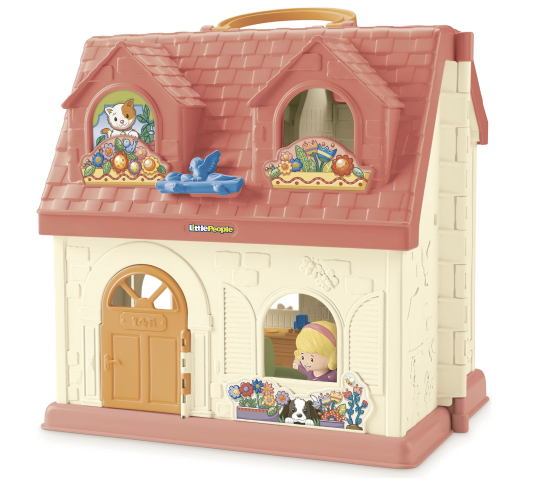
🌱 Fisher-Price Little People Surprise & Sounds Home — Little House, Big Stories!
-
Welcome home! Let's open the door to imagination, conversation, and storytelling! 🏠💜
There's something special about watching children create an entire little world with a playhouse and a few figures.
One minute, everyone's getting ready for breakfast.
The next minute, someone has lost their favorite toy.
And before you know it, the family is planning a birthday party, welcoming a visitor, or solving a very important problem!
The Fisher-Price Little People Surprise & Sounds Home provides a wonderful setting for children to act out familiar daily routines while exploring new ideas.
With its interactive rooms, doors, Little People figures, furniture, and playful sounds, children can create stories about everyday family life.
But here's what I especially love:
The children get to decide what happens next!
At ages 3–5, children are developing more elaborate pretend-play skills. They can assign roles to characters, create sequences of events, imagine problems, and act out different emotions and social situations.
A playhouse gives them a familiar setting in which to practice these skills.
Parents can model:
“Good morning! It's time to wake up!”
“Who's making breakfast today?”
“She is sitting at the table.”
“Where did Dad go?”
“Oh no! Someone spilled the milk!”
“How do you think she feels?”
“What should we do?”
“First, let's clean up. Then, we can go outside.”
“I wonder who's knocking at the door!”
Children can practice using pronouns, asking and answering questions, following directions, and telling stories.
They can also explore emotions and relationships through pretend situations.
And although the electronic sounds can be entertaining, I especially love encouraging children to create their own dialogue.
Let the Little People talk through your child's imagination!
One day, the house might be a family home.
Another day, it could be a hotel, a school, or a busy neighborhood.
One little house can become the setting for hundreds of wonderful stories!
🧠 Did You Know?
Pretend play can provide meaningful opportunities to develop social communication, emotional understanding, and narrative language!
When children use figures to act out everyday experiences, they can explore situations from different perspectives.
For example, a child might pretend that one character is upset because another character took a toy.
A parent can model:
“Oh no! She looks sad.”
“Why do you think she's upset?”
“What could her brother say?”
“How could he help her feel better?”
This creates an opportunity to discuss feelings, intentions, and possible solutions.
These conversations can support developing perspective-taking skills—understanding that other people may have different thoughts, feelings, wants, and experiences.
Playhouses also provide opportunities for practicing narrative language, or storytelling.
A story typically includes:
Characters: Who is involved?
Setting: Where and when does it happen?
Problem: What goes wrong or needs to happen?
Events: What do the characters do?
Solution: How is the problem resolved?
Ending: What happens afterward?
Even simple stories can help children begin organizing their thoughts into meaningful sequences.
For example:
“First, the family woke up.”
“Then, they made breakfast.”
“But the little boy couldn't find his shoes!”
“Everyone looked for them.”
“Finally, they found the shoes under the table.”
“Now they can go to school!”
That's an entire little story created through play!
And don't forget about grammar development.
A playhouse naturally encourages pronouns, verb tenses, possessives, prepositions, and increasingly complex sentences.
“He is sleeping.”
“She made breakfast.”
“They are going outside.”
“That's her chair.”
“He couldn't find his shoes because they were under the bed.”
Miss Angie's Tip: Don't feel that you need to ask your child questions throughout the entire activity.
Sometimes the best way to encourage language is to become one of the characters!
Pick up a Little People figure and say:
“Good morning! I'm hungry! Is anyone making breakfast?”
Then wait to see what your child does.
You may be surprised by the conversation that follows!
💜 Let's Play! (3–5 Years)
☀️ 1. Good Morning, Little People!
Begin with everyone sleeping.
Pretend the alarm clock rings.
“Ring, ring, ring!”
“Good morning!”
“It's time to wake up!”
Encourage your child to move the figures through a morning routine.
“First, we wake up.”
“Next, we get dressed.”
“Then, we eat breakfast.”
“Finally, we leave the house.”
Ask your child to decide what happens next.
“Who's getting up first?”
“What should we do before breakfast?”
“Where are we going today?”
For an additional challenge, intentionally mix up the routine.
“Let's eat breakfast before we wake up!”
See whether your child notices and explains why that doesn't make sense.
Language Focus: Sequencing, temporal concepts, daily routine vocabulary, reasoning, and expressive language.
👨👩👧 2. Who's Home?
Choose the Little People figures and assign each one a role.
You might pretend they're family members, friends, neighbors, or roommates.
Say:
“She's the mom.”
“He's the brother.”
“They're friends.”
“Where is everyone?”
Encourage your child to describe what each character is doing.
“He is sitting.”
“She is cooking.”
“They are eating.”
Then introduce possessives.
“Whose chair is this?”
“It's her chair!”
“Where is his bed?”
For children ready for longer sentences, model:
“He is sitting at the table because he's hungry.”
Language Focus: Pronouns, possessives, sentence structure, action words, and character identification.
🍳 3. Time for Dinner!
Pretend the family is preparing dinner.
Say:
“It's almost dinnertime!”
“Who's cooking?”
“Where should everyone sit?”
“Let's get the table ready!”
Encourage your child to organize the figures and furniture.
“Put her beside him.”
“Move the chair closer to the table.”
“Everyone needs a seat.”
Introduce a pretend problem.
“Oh no! We don't have enough chairs!”
“What should we do?”
“Can someone share?”
“Should we find another chair?”
Let your child suggest a solution.
Language Focus: Spatial concepts, quantity vocabulary, problem-solving, social communication, and sentence expansion.
🔍 4. Where Did Emma Go?
Choose a Little People figure and give the character a pretend name.
For example, Emma.
Hide Emma somewhere inside the house while your child looks away.
Say:
“Oh no! Emma is missing!”
“Where could she be?”
“Is she upstairs?”
“Is she behind the door?”
“Could she be in the kitchen?”
Encourage your child to search using location words.
“She's behind the door!”
“She's inside the house!”
“She's next to the table!”
Then switch roles.
Let your child hide Emma and give you clues.
For an additional challenge, encourage more detailed descriptions.
“Emma is hiding in the room where we eat dinner.”
Language Focus: Spatial concepts, WH questions, descriptive language, inferencing, and expressive language.
😢 5. How Do They Feel?
Create simple situations involving the Little People figures.
For example:
“One character dropped their favorite toy.”
“Someone is having a birthday party.”
“A little girl can't find her blanket.”
“A friend came over to play.”
Ask:
“How do you think she feels?”
“Why is he excited?”
“What made her sad?”
“What could we do to help?”
Introduce emotional vocabulary:
Happy, sad, excited, worried, frustrated, surprised, disappointed, and proud.
Encourage your child to act out the emotions using their voice and facial expressions.
For example:
“Oh no! I lost my teddy bear!”
“I'm so happy you found it!”
Language Focus: Emotional vocabulary, perspective-taking, inferencing, cause and effect, and social communication.
🚪 6. A Surprise Visitor!
Pretend someone is knocking at the door.
“Knock, knock, knock!”
“Who's there?”
“Hello! Can I come inside?”
Let your child decide who is visiting and why.
Perhaps it's a neighbor, a friend, a delivery person, or a grandparent.
Encourage conversational exchanges.
“Hello!”
“How are you?”
“Would you like to come in?”
“Can I get you something to drink?”
“Thank you for inviting me!”
Then introduce a small problem.
“The visitor brought a present, but nobody knows who it's for!”
“What should we do?”
Language Focus: Social greetings, conversational turn-taking, asking and answering questions, role-playing, and problem-solving.
🛏️ 7. Bedtime Routines!
Pretend it's time for the Little People family to go to bed.
Say:
“It's getting late!”
“Everyone is tired!”
“What should we do before bedtime?”
Encourage your child to organize the bedtime routine.
“First, we clean up.”
“Next, we brush our teeth.”
“Then, we put on pajamas.”
“Finally, we go to sleep.”
Use the figures to act out the routine.
Introduce a problem.
“Oh no! Someone isn't sleepy!”
“What could help?”
“Should we read a story?”
“Could we sing a lullaby?”
For children ready for more complex language, ask:
“Why do we brush our teeth before bed?”
Language Focus: Sequencing, daily routines, temporal concepts, reasoning, and expressive language.
🗣️ 8. What Happened Yesterday?
Use the Little People figures to practice talking about past events.
Act out a simple activity.
For example, a character makes breakfast.
Say:
“She is making breakfast!”
Afterward, ask:
“What did she do?”
“She made breakfast!”
Continue with other actions.
“He is eating.”
“He ate.”
“They are playing.”
“They played.”
“She is sleeping.”
“She slept.”
Introduce both regular and irregular past-tense verbs naturally.
For children ready for longer sentences:
“Yesterday, the family went to the park.”
“They played outside because the weather was nice.”
You can also ask your child to compare what happened yesterday with what might happen tomorrow.
Language Focus: Past-tense verbs, sentence formulation, temporal vocabulary, and narrative language.
🤔 9. Uh-Oh! We Have a Problem!
Create a simple problem in the house.
For example:
“The refrigerator is empty!”
“Someone spilled their drink!”
“The door won't open!”
“Two people want the same chair!”
Ask:
“What happened?”
“Why is that a problem?”
“What should we do?”
“What else could we try?”
Encourage your child to think of more than one possible solution.
Then act out the solution together.
For example:
“Oh no! The refrigerator is empty!”
“We need groceries!”
“Let's make a shopping list!”
“Then we can go to the store!”
For an additional challenge, ask your child to explain why one solution might work better than another.
Language Focus: Problem-solving, reasoning, flexible thinking, cause-and-effect relationships, and complex sentences.
📖 10. Once Upon a Time... at the Little People House!
Create an entire story using the playhouse.
Begin by choosing characters.
“Who lives here?”
“What's happening today?”
“Where are they going?”
Then introduce a problem.
“One morning, the family woke up and discovered that their puppy was missing!”
Encourage your child to develop the story.
“Where did they look?”
“Who helped?”
“What happened next?”
“How did they find the puppy?”
Support a beginning, middle, and end.
Beginning: The family wakes up and discovers the puppy is missing.
Middle: Everyone searches the house and asks for help.
End: They find the puppy sleeping behind the couch!
Encourage your child to retell the story after acting it out.
For younger preschoolers, provide sentence starters.
“First...”
“Then...”
“But...”
“Finally...”
For older preschoolers, encourage character feelings, explanations, and additional details.
Language Focus: Story grammar, narrative organization, sequencing, WH questions, inferencing, and complex language.
🌱 Grow With Me! — Same Toy, New Skills!
6+ Years: Developing More Advanced Language and Thinking Skills
As children grow, the Little People house can become a setting for more sophisticated storytelling, social problem-solving, literacy, and communication.
📚 Create a Little People Storybook
Ask your child to invent a story using the characters.
Have them draw pictures or take photographs of the scenes.
Then write or dictate sentences for each page.
Encourage a clear beginning, middle, problem, solution, and ending.
🎭 Explore Different Perspectives
Create a situation in which two characters disagree.
For example:
“One character wants to watch television, but another wants to play a game.”
Ask:
“What does each person want?”
“Why might they disagree?”
“How could they solve the problem fairly?”
Encourage children to consider more than one perspective.
📝 Write a Daily Schedule
Have your child create a written schedule for the family.
Include times, activities, and locations.
For example:
“7:00 — Wake up.”
“8:00 — Eat breakfast.”
“9:00 — Go to school.”
Discuss what happens if the schedule changes.
💬 Practice Complex Sentences
Use pretend situations to encourage sentences containing:
Because, although, unless, before, after, while, and if.
Examples:
“She was upset because her brother took her toy.”
“Before they went outside, they cleaned their room.”
“If it rains, they'll have to play inside.”
“Although he was tired, he wanted to finish his game.”
🔍 Become a Little People Detective
Create a mystery involving a missing object.
Provide clues and encourage your child to make predictions.
Ask:
“What evidence do we have?”
“Who might know what happened?”
“Why do you think the object is there?”
Encourage logical explanations.
✉️ Write Letters and Invitations
Pretend the family is planning a birthday party or special event.
Have your child create invitations, thank-you notes, or letters to other characters.
Practice organizing written messages and using appropriate social language.
🏠 Design a New House
Ask your child to draw plans for an imaginary house.
Encourage descriptions of the rooms, their purposes, and how the spaces connect.
Practice spatial vocabulary, planning, and explanations.
🎤 Become a Family News Reporter
Pretend your child is reporting on events happening in the house.
For example:
“Breaking news! The family has adopted a puppy!”
Encourage them to explain:
Who was involved?
What happened?
When did it happen?
Where did it happen?
Why was it important?
How did everyone feel?
🔤 Practice Speech Sounds
Everyday household vocabulary can provide opportunities to practice speech sounds when appropriate.
Examples include:
/k/: kitchen, cook, cup, clean
/s/: sit, soup, sink, sister
/sh/: wash, shower, dishes
/r/: room, refrigerator, read, ready
/l/: little, light, living, pillow
/th/: think, three, bath, brother
Choose words that match your child's individual speech goals and practice at an appropriate level.
🤝 Create More Complex Social Stories
Introduce situations involving friendship, sharing, misunderstandings, disappointment, or unexpected changes.
Encourage children to explain what happened, consider how each character feels, and develop possible solutions.
One little house can grow from simple pretend routines into a wonderful resource for storytelling, social reasoning, literacy, and complex communication!
💜 Miss Angie's Reminder
It's not just the toy—it's how you use it!
One of the things I love most about a playhouse is that children can use it to recreate experiences from their own lives.
They can pretend to make breakfast.
They can put someone to bed.
They can welcome visitors.
They can celebrate birthdays.
And they can explore feelings, relationships, and everyday problems in a safe, imaginative setting.
But remember:
You don't have to control the storyline!
If your child decides that everyone is sleeping in the kitchen, that's okay!
You might say:
“Oh! Everyone is sleeping in the kitchen tonight!”
“I wonder why they chose that room!”
If your child decides the refrigerator is actually a spaceship, follow their imagination!
“Wow! Where is our spaceship going?”
“Who is coming with us?”
“What should we pack?”
And if your child spends the entire playtime opening and closing the doors, you can still create language opportunities.
“The door is OPEN!”
“Now it's CLOSED!”
“Who's coming inside?”
“Knock, knock!”
Remember to expand on what your child says.
If your child says:
“Baby sleep!”
You can respond:
“Yes! The baby is sleeping in bed!”
If your child says:
“Daddy cooking!”
You can expand:
“Daddy is cooking dinner for everyone!”
If your child says:
“She sad!”
You might respond:
“She feels sad because she lost her favorite toy.”
You don't need to correct every grammatical error or insist that your child repeat your model.
Simply provide natural language during meaningful interactions.
And while the playhouse has electronic features, don't let the toy do all the talking!
Use the sounds as a starting point for conversation, then allow your child to create the dialogue and decide what happens next.
Follow your child's lead, model language naturally, and let their imagination guide the adventure!
One little house, countless family adventures, and wonderful opportunities for speech, language, social communication, thinking, and learning! 💜🏠
Safety Reminder: Follow the manufacturer's age recommendations and instructions. Although this playset is marketed for younger children, Miss Angie features it in the 3–5-year-old section for its more advanced pretend-play and language opportunities. Supervise play, inspect figures and accessories regularly, and ensure the battery compartment is secure. Use only manufacturer-approved accessories and keep any added small items away from younger siblings.
🌱 Dreamon Baby Doll Playset with Bassinet — Little Caregivers, Big Conversations!
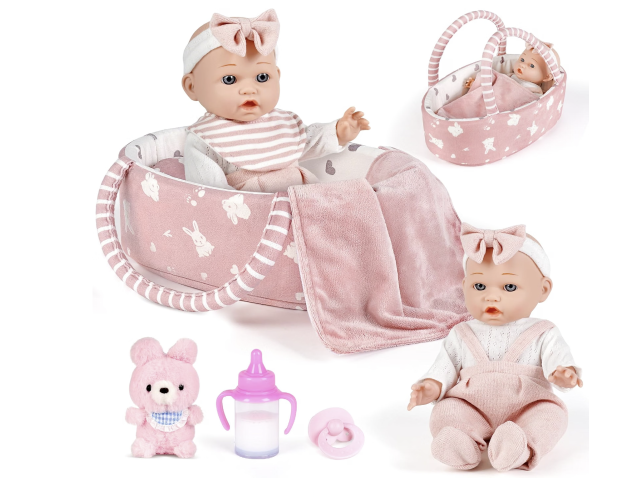
-
Shhh! The baby's sleeping! Let's cuddle, care, pretend, and TALK! 👶💜
There's something wonderful about watching a child gently rock a baby doll, tuck it into bed, or announce, “My baby is hungry!”
Baby dolls are among my favorite toys for encouraging pretend play because they allow children to recreate familiar everyday experiences while exploring emotions, relationships, and communication.
The Dreamon Baby Doll Playset includes a baby doll, bassinet, and caregiving accessories such as a bottle, pacifier, diaper, and blanket.
Children can pretend to feed, change, comfort, dress, and put their baby to sleep.
But here's what I especially love:
Baby doll play encourages children to communicate with a purpose!
When a child pretends that a baby is hungry, tired, or upset, they have an opportunity to identify a problem, consider another person's needs, and decide what to do.
And every caregiving routine creates opportunities for language.
Parents can model:
“Oh no! The baby is crying!”
“What does the baby need?”
“I think she's hungry!”
“Let's get her bottle.”
“First, we'll feed her. Then, we'll change her diaper.”
“She's sleepy!”
“Let's wrap her in the blanket.”
“Shhh! The baby is sleeping!”
Children can practice action words, pronouns, descriptive vocabulary, sequencing, and increasingly complex sentences.
They can also explore feelings such as happiness, sadness, frustration, excitement, and comfort.
One day, the baby might need a checkup.
Another day, the family might be going on vacation.
And the next day, the baby might be celebrating a birthday!
One baby doll can become the center of countless language-rich adventures!
🧠 Did You Know?
Pretend caregiving provides opportunities to develop language, social understanding, and early perspective-taking skills!
When children care for a baby doll, they practice recognizing and responding to someone else's imagined needs.
For example:
“The baby is crying.”
“Why is she crying?”
“Maybe she's hungry.”
“What could we do to help?”
These simple conversations encourage children to think about emotions, causes, and possible solutions.
Baby doll play also provides opportunities to practice sequencing familiar routines.
Children can act out the steps involved in feeding, bathing, changing, dressing, and putting a baby to sleep.
For example:
“First, we get the bottle.”
“Next, we feed the baby.”
“Then, we burp her.”
“Finally, we put her to bed.”
Sequencing is important for following directions, organizing experiences, and developing storytelling skills.
And don't forget about grammar development!
Baby doll play naturally encourages pronouns, possessives, action words, and verb tenses.
“She is sleeping.”
“He needs his blanket.”
“Her bottle is empty.”
“We changed the diaper.”
“The baby cried because she was hungry.”
These everyday situations make language meaningful because children can see and act out what the words represent.
Miss Angie's Tip: Give your child opportunities to decide what the baby needs.
Instead of immediately announcing, “The baby is hungry,” try:
“Oh! I hear the baby crying!”
Pause.
“What do you think is wrong?”
Your child might say:
“Hungry!”
You can expand:
“You think the baby is hungry! Let's get her bottle.”
This encourages children to express ideas, make predictions, and participate in problem-solving.
And remember, children may communicate through words, gestures, signs, or AAC devices. All meaningful communication deserves a response!
💜 Let's Play! (3–5 Years)
🍼 1. Baby's Hungry!
Pretend the baby is crying because it's time to eat.
Say:
“Oh no! The baby is hungry!”
“What should we do?”
“Where's her bottle?”
Encourage your child to find the bottle and pretend to feed the baby.
Model:
“Let's feed the baby.”
“She's drinking her milk!”
“The bottle is almost empty.”
“All done!”
Then introduce a simple problem.
“Oh no! We can't find the bottle!”
“Where should we look?”
Encourage your child to describe what they're doing.
“I'm feeding her!”
“She drank her milk!”
Language Focus: Action vocabulary, requesting, WH questions, pronouns, present progressive verbs, and problem-solving.
🛏️ 2. Shhh! It's Nap Time!
Pretend the baby is getting sleepy.
Say:
“Oh! The baby is yawning!”
“I think she's tired.”
“What should we do?”
Encourage your child to prepare the bassinet.
“First, let's get the blanket.”
“Next, put the baby in her bed.”
“Then, cover her gently.”
“Finally, say goodnight!”
Introduce spatial concepts.
“Put the baby inside the bassinet.”
“Place the blanket over her.”
“Put the bottle beside the bed.”
Encourage your child to create a bedtime routine.
Maybe the baby needs a story or lullaby!
Language Focus: Sequencing, spatial concepts, daily routine vocabulary, temporal concepts, and expressive language.
👶 3. Time for a Diaper Change!
Pretend the baby needs a diaper change.
Say:
“Uh-oh! The baby's diaper needs changing!”
“What do we need?”
“Let's get a clean diaper.”
Encourage your child to act out the routine using the doll's accessories.
Model:
“First, we take off the old diaper.”
“Next, we put on a clean diaper.”
“Then, we get the baby dressed.”
“All clean!”
Introduce opposites:
Clean/dirty, wet/dry, on/off, and open/closed.
For children ready for longer sentences:
“We changed the baby's diaper because it was wet.”
Language Focus: Sequencing, action words, opposites, following directions, and complex sentence development.
😢 4. Why Is Baby Crying?
Pretend the baby begins to cry.
“Wah! Wah!”
“Oh no! The baby is upset!”
Ask:
“Why do you think she's crying?”
“What might she need?”
“How can we help?”
Encourage your child to suggest possibilities.
“She's hungry!”
“She needs her blanket!”
“She wants a hug!”
Then act out a solution.
“Let's rock her gently.”
“Maybe she'll feel better.”
“Look! She's happy now!”
Introduce emotional vocabulary:
Sad, happy, tired, worried, upset, calm, and comfortable.
For an additional challenge, create different situations.
“The baby dropped her favorite toy!”
“The baby heard a loud noise!”
“The baby is excited to see Grandma!”
Language Focus: Emotional vocabulary, perspective-taking, inferencing, cause and effect, and problem-solving.
🧸 5. Where's Baby's Blanket?
Gather several familiar baby accessories.
Place them where your child can see them.
Name each item.
“Here's the bottle.”
“This is the blanket.”
“Here's the pacifier.”
Ask your child to close their eyes while you hide one item.
Say:
“Oh no! Something is missing!”
“What's gone?”
“Where could it be?”
Encourage your child to identify the missing item.
“The blanket is missing!”
“We need to find it!”
Then provide clues.
“It's underneath the bassinet.”
“It's beside the chair.”
“It's behind the pillow.”
Switch roles and let your child hide an accessory for you to find.
Language Focus: Vocabulary retrieval, visual memory, object functions, spatial concepts, descriptive language, and WH questions.
🩺 6. Baby's Doctor Appointment!
Pretend the baby needs a checkup.
You can use a separate age-appropriate pretend doctor's kit if available, or simply act out the visit.
Say:
“The baby has a doctor's appointment today!”
“Let's see how she's feeling.”
“Does she have a cough?”
“Is she feeling better?”
Encourage your child to become the doctor.
“Hello! How can I help?”
“Let's listen to your heart.”
“Open wide!”
“Everything looks good!”
Introduce a pretend problem.
“The baby has a tummy ache!”
“What should we do?”
Encourage your child to explain what happens during the appointment.
Language Focus: Role-playing, conversational exchanges, body-part vocabulary, WH questions, sequencing, and problem-solving.
🗣️ 7. He, She, They — Who's Taking Care of Baby?
Use the baby doll and other available dolls or stuffed animals to practice pronouns.
Assign caregiving roles.
Say:
“She is feeding the baby.”
“He is getting the blanket.”
“They are helping.”
“I'm holding the baby.”
“You're putting her to bed.”
Then introduce possessives.
“Whose bottle is this?”
“It's her bottle!”
“Where is his blanket?”
“That's the baby's bed.”
After completing an activity, practice past-tense verbs.
“She fed the baby.”
“He changed the diaper.”
“They helped the baby.”
Language Focus: Pronouns, possessives, present progressive verbs, past-tense verbs, and sentence formulation.
🧺 8. Pack the Diaper Bag!
Pretend you're taking the baby on an outing.
Say:
“We're going to the park!”
“What should we bring?”
“Let's pack everything we need!”
Gather the doll's accessories and a small bag or basket.
Encourage your child to make a plan.
“We need the bottle!”
“Don't forget the diaper!”
“Let's bring the blanket!”
Give multistep directions.
“First, put the bottle in the bag. Then, get the blanket.”
“Put the diaper beside the bottle and close the bag.”
Introduce a problem.
“Oh no! We forgot something!”
“What could it be?”
Language Focus: Planning, categorization, following multistep directions, auditory memory, and problem-solving.
🎂 9. Baby's First Birthday!
Pretend the baby is having a birthday party.
Say:
“It's the baby's birthday!”
“How old is she?”
“Who should we invite?”
“What do we need for the party?”
Encourage your child to plan the celebration.
“Let's make a cake!”
“We need decorations!”
“Let's invite Teddy!”
“Everyone can sing!”
Use safe pretend materials to act out the party.
Introduce a problem.
“Oh no! We forgot the birthday candles!”
“What should we do?”
After the celebration, encourage your child to retell what happened.
“First, we decorated.”
“Then, everyone came to the party.”
“Finally, we sang Happy Birthday!”
Language Focus: Planning, sequencing, social communication, WH questions, narrative development, and imaginative play.
📖 10. A Day in Baby's Life!
Create an entire story about the baby.
Begin with a familiar routine.
“One morning, the baby woke up!”
Ask:
“What happened next?”
Encourage your child to develop the story.
“First, she ate breakfast.”
“Then, she got dressed.”
“Next, she went to the park.”
Introduce a problem.
“But when it was time to go home, the baby's blanket was missing!”
Ask:
“Where should we look?”
“Who could help?”
“How will we find it?”
Encourage your child to create a solution.
“Finally, we found the blanket in the stroller!”
For younger preschoolers, model a simple beginning, middle, and end.
For older preschoolers, encourage more details about the characters, setting, feelings, and events.
Language Focus: Story grammar, sequencing, narrative organization, WH questions, inferencing, and complex sentence development.
🌱 Grow With Me! — Same Toy, New Skills!
6+ Years: Developing Advanced Language, Literacy, and Social Understanding
As children grow, baby doll play can become a setting for more sophisticated storytelling, problem-solving, literacy, planning, and social communication.
📋 Create a Baby Care Schedule
Have your child develop a daily schedule for the baby.
Include feeding times, naps, playtime, and bedtime.
Practice reading, writing, sequencing, and understanding time.
📝 Write a Babysitting Checklist
Ask your child to create a list of everything a pretend babysitter needs to do.
Include directions such as:
“Feed the baby before putting her to bed.”
“Check the diaper after she wakes up.”
Encourage clear, organized instructions.
📚 Create a Baby's Adventure Storybook
Use the baby doll to invent a story.
Have your child draw pictures or photograph scenes.
Then write or dictate sentences for each page.
Include characters, a setting, a problem, attempts to solve it, and an ending.
💬 Explore Feelings and Perspectives
Create situations in which the baby or caregiver experiences different emotions.
For example:
“The baby is upset because her favorite toy is missing.”
Ask:
“How does the baby feel?”
“How might the caregiver feel?”
“What could help both of them?”
Encourage children to consider different perspectives.
🤔 Solve More Complex Problems
Introduce pretend situations such as:
“What if the family forgets the diaper bag?”
“What if the baby won't fall asleep?”
“What if the baby's favorite blanket is in the washing machine?”
Encourage children to explain multiple possible solutions and predict what might happen.
✉️ Write a Note to the Babysitter
Have your child create written instructions for someone who will pretend to care for the baby.
Practice organizing information, writing complete sentences, and communicating clearly.
🎤 Become a Parenting Reporter
Pretend your child is reporting on the baby's day.
Encourage an organized summary.
“Today, the baby visited the park. First, she played on the swings. Then, she had a snack. Finally, she went home for a nap.”
Practice answering who, what, when, where, why, and how questions.
🔤 Practice Speech Sounds
Baby care vocabulary provides opportunities to practice a variety of speech sounds.
Examples include:
/b/: baby, bottle, bed, blanket
/p/: pacifier, play, nap, diaper
/s/: sleep, soap, sit, sister
/sh/: wash, shower, shampoo
/r/: rock, carry, ready, room
/l/: lullaby, little, love, pillow
/th/: bath, three, brother
Choose words that match your child's individual speech goals and practice at an appropriate level.
🤝 Practice Cooperative Caregiving
Invite siblings or friends to take on different pretend caregiving roles.
Encourage children to divide responsibilities, ask for help, negotiate roles, and work together.
🧠 Use More Complex Language
Encourage sentences using:
Because, although, unless, before, after, while, and if.
Examples:
“The baby cried because she was hungry.”
“Before we go outside, we need to pack the diaper bag.”
“If the baby gets tired, we'll put her down for a nap.”
“Although the baby was sleepy, she wanted to keep playing.”
The same baby doll that begins with simple caregiving routines can grow into a wonderful resource for storytelling, literacy, emotional understanding, and complex communication!
💜 Miss Angie's Reminder
It's not just the toy—it's how you use it!
One of the things I love most about baby doll play is that children can practice caring for someone else while using language in meaningful ways.
And remember:
You don't have to direct every moment of play!
If your child decides the baby needs five bottles in a row, that's okay!
You might say:
“Wow! Your baby must be really hungry!”
If your child decides the baby is going on vacation, follow their imagination!
“Where is she going?”
“What should we pack?”
“Who's coming with her?”
And if your child decides the baby is actually a superhero, that's wonderful too!
“What special powers does she have?”
“Who is she going to help?”
Remember to expand on what your child says.
If your child says:
“Baby hungry!”
You can respond:
“Yes! The baby is hungry. Let's get her bottle!”
If your child says:
“Baby sleep!”
You might expand:
“The baby is sleeping in her bassinet.”
If your child says:
“She crying!”
You can model:
“She is crying because she lost her blanket.”
You don't need to correct every grammatical error or require your child to repeat your sentence.
Simply provide natural models and keep the interaction going.
And remember that nurturing play isn't limited to any particular child. Baby dolls can encourage imagination, communication, and caregiving skills for all children!
Follow your child's lead, model language naturally, and let their imagination guide the adventure!
One baby doll, countless caregiving adventures, and wonderful opportunities for speech, language, emotional understanding, thinking, and learning! 💜👶
Safety Reminder: This particular playset is intended for children ages 3 and older. Small accessories, including the pacifier and other detachable pieces, may present choking hazards for younger children. Follow the manufacturer's instructions, supervise play, and inspect accessories regularly. Keep small items away from younger siblings. The doll's bassinet and accessories are toys only and should never be used for a real infant.
🌱 See You Later, Alligator! — Silly Goodbyes, BIG Language Adventures!
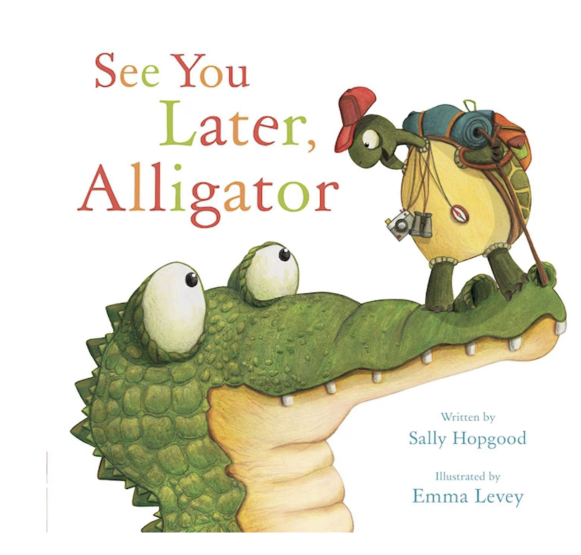
-
See you later, alligator! After a while, crocodile! 🐊💜
Who knew saying goodbye could be so much FUN?
See You Later, Alligator! by Sally Hopgood, illustrated by Emma Levey, is a delightful story about a tortoise who is preparing to leave on an adventure.
But before he can go, he has to say goodbye to his animal friends!
And those goodbyes become increasingly silly as the story unfolds.
What I especially love about this book is how naturally it encourages children to participate.
At ages 3–5, children are developing increasingly sophisticated language skills. They're learning to use longer sentences, understand and answer questions, participate in conversations, and recognize patterns in spoken language.
This book creates opportunities to practice all of those skills while enjoying a humorous story.
Parents can model:
“Where is Tortoise going?”
“Who is he saying goodbye to?”
“What do you think he'll say next?”
“Why hasn't he left yet?”
“That's a silly goodbye!”
“Can YOU think of another one?”
And here's one of my favorite things about this book:
It encourages children to play with WORDS!
Rhyming, rhythm, and silly expressions help children begin noticing how words sound.
Children can listen for familiar sound patterns, repeat favorite phrases, and eventually invent their own playful goodbyes.
“See you later, alligator!”
“After a while, crocodile!”
And maybe your child invents something completely unexpected!
That's wonderful!
We want children to experiment with language, even when their ideas are silly.
Because language development isn't just about saying words correctly. It's also about using words creatively, socially, and meaningfully!
This book also provides opportunities to talk about friendship, routines, feelings, and the excitement of going somewhere new.
One little tortoise, lots of animal friends, and countless opportunities for speech, language, and early literacy development!
🧠 Did You Know?
Recognizing rhymes is one of the early phonological awareness skills that helps prepare children for reading!
Phonological awareness is the ability to notice and work with the sound patterns of spoken language.
It includes skills such as recognizing rhymes, identifying syllables, and eventually recognizing individual sounds within words.
At ages 3–5, children are beginning to develop these skills through songs, nursery rhymes, stories, and playful word games.
Books with repeated phrases and rhyming language provide opportunities for children to hear sound patterns again and again.
And repetition is important!
When children hear familiar rhymes, they may begin anticipating what comes next.
They might finish a phrase.
Repeat a funny word.
Recognize that two words sound alike.
Or create a silly rhyme of their own.
These are all opportunities to develop sound awareness.
But this book offers much more than rhyming!
Social Communication: Practicing greetings, goodbyes, conversational exchanges, and appropriate responses.
Receptive Language: Understanding story vocabulary, questions, and events.
Expressive Language: Describing pictures, answering questions, and creating original phrases.
Narrative Development: Identifying characters, settings, events, and the sequence of a story.
Inferencing: Using clues to understand why characters behave in certain ways.
Emotional Understanding: Discussing how characters feel about leaving, saying goodbye, and beginning an adventure.
Early Literacy: Developing an appreciation for books, language patterns, and storytelling.
💜 A Special Note About Rhyming
Children don't have to produce rhyming words independently to benefit from hearing them.
In fact, recognizing that two words rhyme generally develops before consistently generating rhymes.
For a younger preschooler, you might say:
“Cat... hat!”
“Listen! They sound alike!”
For an older preschooler, you might ask:
“What rhymes with cat?”
“Hat!”
And for a child who isn't quite ready?
Simply enjoy the rhyme together!
There's no need to turn reading into a test.
Miss Angie's Tip: Read the silly goodbyes with expression!
Change your voice.
Pause before a familiar word.
Smile when something sounds funny.
Then give your child an opportunity to participate.
The more enjoyable the experience, the more likely your child will want to join in!
💜 Let's Play! (3–5 Years)
🐊 1. Silly Goodbye, Your Turn!
After reading the book, introduce a playful goodbye game.
Say:
“Let's make up our own silly goodbyes!”
Begin with familiar examples.
“See you later, alligator!”
“After a while, crocodile!”
Then invite your child to choose an animal.
“Which animal should we say goodbye to?”
“A bear!”
“Goodbye, bear!”
Encourage your child to invent something silly.
For younger preschoolers, focus on using a greeting or goodbye phrase with an animal name.
“Bye-bye, bear!”
“See you, bunny!”
For older preschoolers, encourage playful rhyming phrases.
“Take care, bear!”
“See you soon, raccoon!”
Don't worry if every phrase rhymes perfectly.
The goal is to encourage children to experiment with sounds and language.
Language Focus: Rhyming, phonological awareness, creative language, vocabulary, and social communication.
🧳 2. Pack Your Bags, Tortoise!
Pretend you're getting ready for an adventure, just like Tortoise.
Gather a small bag and several age-appropriate objects.
Say:
“Tortoise is going on a trip!”
“What should he bring?”
“Does he need a toothbrush?”
“What about a blanket?”
“Should he pack a giant pumpkin?”
Encourage your child to decide which items are useful.
“We need clothes!”
“He needs a snack!”
“Let's bring water!”
Then introduce sequencing.
“First, we'll pack the bag.”
“Next, we'll say goodbye.”
“Then, we'll go on our adventure!”
For an additional challenge, ask:
“Why do we need a toothbrush?”
“Because we have to brush our teeth!”
Language Focus: Categorization, planning, sequencing, reasoning, WH questions, and sentence development.
🐢 3. Who Did Tortoise Say Goodbye To?
After reading, help your child remember the animals Tortoise encounters.
Say:
“Let's remember who was in the story!”
“Who did Tortoise talk to?”
“Who did he say goodbye to?”
Use the book's illustrations to help your child recall the characters.
For younger preschoolers, provide choices.
“Was that a crocodile or a puppy?”
For older preschoolers, encourage more detailed responses.
“Tortoise said goodbye to his animal friends before leaving.”
Then ask:
“Who did he meet first?”
“Who came next?”
“Who did he see at the end?”
Encourage your child to retell the events in order.
Language Focus: Auditory memory, character identification, sequencing, WH questions, and narrative retelling.
🎭 4. Let's Act Out the Story!
Gather stuffed animals or toy figures.
Choose one to represent Tortoise.
Let your child decide which animal friends will appear.
Say:
“Let's pretend Tortoise is going on an adventure!”
“Who will he visit first?”
Encourage your child to move Tortoise from one animal to another.
“Hello, Bear!”
“Hi, Tortoise!”
“I'm going on a trip!”
“Goodbye!”
“See you later!”
Switch roles so your child has opportunities to initiate and respond during conversations.
For an additional challenge, introduce a problem.
“Oh no! Tortoise forgot his bag!”
“What should he do?”
Encourage your child to suggest a solution and continue the story.
Language Focus: Symbolic play, dialogue, conversational turn-taking, sequencing, and problem-solving.
👂 5. Do These Words Rhyme?
Choose familiar word pairs.
Begin with obvious rhymes.
“Cat... hat!”
“Dog... frog!”
“Bear... chair!”
Say:
“Listen carefully!”
“Do those words sound alike at the end?”
Then introduce a nonrhyming pair.
“Cat... dog!”
“Do those rhyme?”
For children who need support, exaggerate the ending sounds and provide clear examples.
For children ready for more advanced practice, ask them to choose which word rhymes.
“What rhymes with cat?”
“Hat or sun?”
Encourage your child to explain their choice if appropriate.
Language Focus: Rhyme recognition, auditory discrimination, phonological awareness, and listening skills.
😊 6. How Does Tortoise Feel?
Use the story to explore emotions and perspective-taking.
Ask:
“How do you think Tortoise feels about going on his adventure?”
“Is he excited?”
“Could he feel nervous?”
“How might his friends feel when he says goodbye?”
Encourage your child to use clues from the illustrations and story events.
Then connect the discussion to real experiences.
“Have you ever gone on a trip?”
“How did you feel?”
“Were you excited?”
“Did you miss anyone?”
Introduce emotional vocabulary.
Excited, happy, sad, worried, nervous, surprised, and disappointed.
For children ready for more complex language:
“Tortoise might feel excited because he's going somewhere new.”
Language Focus: Emotional vocabulary, perspective-taking, inferencing, personal connections, and complex sentences.
🗺️ 7. Where Should Tortoise Go?
Pretend Tortoise is planning a new adventure.
Ask:
“Where should Tortoise go?”
“To the beach?”
“To the mountains?”
“To the zoo?”
Encourage your child to choose a destination.
Then discuss what Tortoise might see or do.
“If he goes to the beach, what will he need?”
“What animals might he see at the zoo?”
“What should he wear if it's cold?”
Use pictures, toys, or drawings to create a pretend destination.
For an additional challenge, encourage your child to explain their choices.
“He should bring a jacket because it's cold in the mountains.”
Language Focus: Planning, categorization, reasoning, conditional language, vocabulary, and imaginative play.
💬 8. Hello! Goodbye! Let's Talk!
Use the book to practice social communication.
Pretend you're meeting different animal friends.
Say:
“Hello!”
“Hi! How are you?”
“I'm fine, thank you!”
“Where are you going?”
“I'm going on a trip!”
“Have fun!”
“Goodbye!”
Encourage your child to participate in both sides of the conversation.
Then introduce different social situations.
“What could we say when we arrive at Grandma's house?”
“What could we say when it's time to leave?”
“What could we say if we're leaving a friend's birthday party?”
Practice greetings, goodbyes, and appropriate responses.
For older preschoolers, encourage conversations with several exchanges.
Language Focus: Pragmatic language, greetings, farewells, conversational turn-taking, question formulation, and social routines.
🔍 9. Animal Detective!
Look closely at the illustrations.
Choose an animal and describe it without naming it.
Say:
“I'm thinking of an animal!”
“It has four legs.”
“It has a shell.”
“It moves slowly.”
“What animal am I thinking of?”
“Tortoise!”
Then let your child choose an animal and give clues.
Encourage descriptions involving:
Size, color, body parts, movement, habitat, and other attributes.
For younger preschoolers, provide sentence starters.
“It has...”
“It can...”
“It lives...”
For older preschoolers, encourage multiple clues.
“It's a large animal with a long tail, and it lives near water.”
Language Focus: Descriptive vocabulary, categorization, inferencing, word retrieval, and sentence formulation.
📖 10. A New Adventure for Tortoise!
After reading the story, invite your child to create an entirely new adventure.
Say:
“Tortoise finally finished saying goodbye!”
“Where should he go next?”
Encourage your child to develop a story.
“Once upon a time, Tortoise went to the beach.”
“First, he packed his bag.”
“Next, he said goodbye to his friends.”
“Then, he traveled to the beach.”
Introduce a problem.
“Oh no! Tortoise forgot his sunscreen!”
“What should he do?”
Encourage your child to create a solution.
“Finally, he found some sunscreen and enjoyed his day!”
For younger preschoolers, model a simple beginning, middle, and end.
For older preschoolers, encourage more details about the setting, characters, problem, feelings, and resolution.
Language Focus: Narrative development, story grammar, sequencing, problem-solving, creative thinking, and complex language.
🌱 Grow With Me! — Same Book, New Skills!
6+ Years: Advanced Phonological Awareness, Literacy, and Storytelling
As children grow, See You Later, Alligator! can become a starting point for more sophisticated sound awareness, reading, writing, and language activities.
🎵 Create Your Own Rhyming Goodbyes
Have your child invent original goodbye phrases.
Encourage them to listen for rhyming patterns and experiment with different words.
Real words and silly invented words can both be part of the fun!
🔤 Identify Beginning and Ending Sounds
Choose animal names or familiar words from the story.
Ask:
“What sound do you hear at the beginning of tortoise?”
“What sound do you hear at the end of bear?”
Encourage children to identify and compare individual sounds.
👏 Count the Syllables
Practice clapping the syllables in animal names.
“All-i-ga-tor!”
“Cro-co-dile!”
“Tor-toise!”
Compare longer and shorter words.
🧩 Segment and Blend Sounds
Choose simple words related to the story.
Practice breaking them into individual sounds and blending them back together.
For example:
“Cat” — /k/ /æ/ /t/
“Trip” — /t/ /r/ /ɪ/ /p/
✍️ Write a Silly Goodbye Poem
Encourage your child to create a poem featuring different animals and playful rhyming phrases.
Practice vocabulary, rhyme generation, sentence construction, and creative writing.
📚 Compare Two Stories
Choose another book about animals, friendship, or adventures.
Discuss similarities and differences.
“How are the main characters alike?”
“What problems do they experience?”
“How do the stories end?”
📝 Write a Postcard from Tortoise
Pretend Tortoise has arrived at his destination.
Have your child write a postcard to one of his animal friends.
Include where he is, what he's doing, and how he feels.
🤔 Explore Character Motivation
Ask:
“Why does Tortoise keep saying goodbye?”
“Does he really want to leave?”
“What might happen if he forgets to say goodbye to someone?”
Encourage explanations supported by story clues.
🎭 Create a Play
Turn the story into a short performance.
Assign animal characters, create dialogue, and act out the events.
Encourage expressive reading and conversational language.
🔤 Practice Speech Sounds
Choose words from the book or related activities that match your child's individual speech targets.
Examples include:
/s/: see, say, silly, soon
/l/: later, alligator, leave, hello
/r/: tortoise, trip, friend, crocodile
/th/: think, three, together, thank
/sh/: wish, share, show
/k/: crocodile, come, can, cookie
Practice at the word, phrase, sentence, or conversational level depending on your child's needs.
One silly story about saying goodbye can grow into advanced phonological awareness, literacy, creative writing, and complex language activities!
💜 Miss Angie's Reminder
It's not just the book—it's how you use it!
One of the things I love most about See You Later, Alligator! is that it reminds us how much FUN language can be!
Children love silly words.
They love predictable phrases.
They love making adults laugh.
And they often love hearing the same funny expression again and again!
So join in!
Use silly voices.
Pause before a familiar rhyme.
Act out the story.
Make up your own goodbyes.
And don't worry if your child's rhyme doesn't make perfect sense!
Sometimes, the silliest ideas create the best conversations.
If your child says:
“Alligator!”
You can expand:
“Yes! See you later, alligator!”
If your child says:
“Tortoise go!”
You might respond:
“Tortoise is going on a big adventure!”
If your child says:
“Bye-bye, bear!”
You can model:
“Goodbye, Bear! We'll see you again soon!”
And if your child invents a completely unexpected goodbye?
Celebrate that creativity!
You don't need to correct every word or require perfect rhymes.
Instead, model language naturally and keep the conversation going.
The goal is to encourage communication, creativity, and enjoyment—not to test your child's rhyming skills!
And remember that every child develops at their own pace.
Some children may enjoy repeating the silly phrases.
Others may prefer looking at the pictures, naming animals, or acting out the story.
All of those are meaningful ways to participate.
Follow your child's lead, make reading interactive, and let the silly language adventures begin!
One little tortoise, lots of funny goodbyes, and wonderful opportunities for speech, language, phonological awareness, imagination, and learning! 💜🐊
Safety Reminder: Recommended for shared reading with preschool-age children. Supervise any activities involving small toy figures or other accessories, particularly when younger siblings are present. Keep reading relaxed, enjoyable, and appropriate for your child's developmental level.
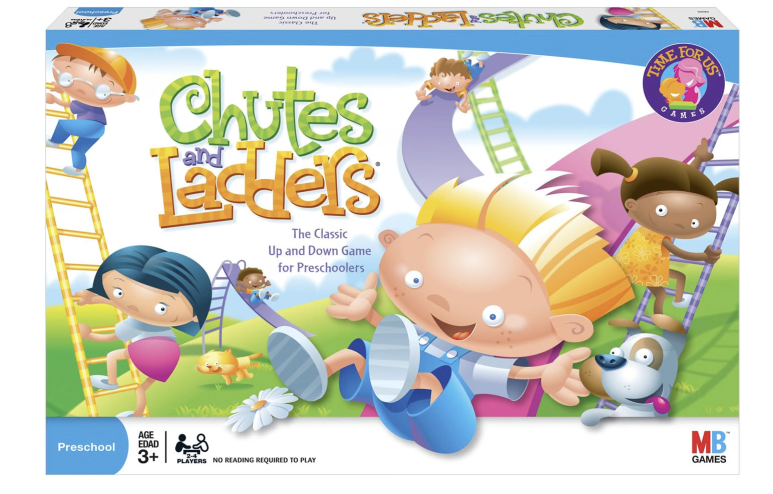
🛝 Chutes and Ladders Board Game
-
Up the ladders and down the chutes! Who knew a simple board game could create so many opportunities for speech, language, and social-emotional development?
Chutes and Ladders is a wonderful introduction to counting, number recognition, following directions, and turn-taking. But what I especially love about this classic game is how naturally it teaches children about cause and effect, sequencing, emotional regulation, and problem-solving.
Unlike games that rely primarily on matching colors, Chutes and Ladders introduces number concepts and movement along a numbered path. Children begin to understand that numbers represent quantities and that moving forward or backward changes their position.
The illustrations also provide opportunities to discuss everyday behaviors, choices, and consequences. Children can explain what characters are doing, predict what might happen next, and talk about how different situations make people feel.
And let's not forget those unexpected slides down the chutes! They're perfect opportunities to practice patience, flexibility, and good sportsmanship.
🧠 Did You Know?
Playing Chutes and Ladders can help develop:
Receptive Language: Understanding game rules, following directions, and identifying numbers and spatial concepts.
Expressive Language: Describing actions, explaining events, making predictions, and producing increasingly complex sentences.
Early Math Skills: Number recognition, counting, one-to-one correspondence, and understanding numerical order.
Sequencing & Narrative Development: Describing what happened first, next, and last while explaining events on the board.
Cause & Effect: Understanding how actions lead to consequences and how one event influences another.
Social Communication: Turn-taking, waiting, encouraging others, and practicing appropriate responses during competitive play.
Executive Functioning: Attention, impulse control, cognitive flexibility, and working memory.
Emotional Regulation: Managing disappointment, celebrating success, and learning to cope with unexpected changes.
Speech Sound Development: Practicing individualized articulation targets through meaningful game vocabulary.
🎲 10 Ways to Play & Learn with Chutes and Ladders!
1. Spin, Count & Move! 🔢
Have your child spin the spinner, identify the number, and count each space aloud as they move their game piece.
Encourage them to touch or point to each space while counting to reinforce one-to-one correspondence.
Try Saying: "I spun a four! One, two, three, four! I moved four spaces!"
Language Focus: Number recognition, counting, one-to-one correspondence, auditory sequencing.
2. Up, Up, Up! 🪜
When your child lands at the bottom of a ladder, encourage them to describe what happens as their game piece moves upward.
Introduce spatial vocabulary such as up, down, higher, lower, top, and bottom.
Try Saying: "I'm climbing up the ladder! Now I'm higher than you!"
Language Focus: Spatial concepts, comparative vocabulary, prepositions, sentence expansion.
3. Oh No! Down We Go! 🛝
When a player lands at the top of a chute, talk about what happens next.
Encourage your child to explain the event using complete sentences.
Try Saying: "I landed on a chute, so I have to slide down!"
Language Focus: Cause and effect, sentence formulation, connecting words such as because and so.
4. What Happened First? ⏳
After climbing a ladder or sliding down a chute, ask your child to explain the sequence of events.
Begin with two steps and gradually increase to three or more.
Try Saying: "First, I spun the spinner. Next, I moved three spaces. Last, I climbed the ladder!"
Language Focus: Sequencing, temporal concepts, narrative organization, expressive language.
5. What's Happening in the Picture? 🖼️
Look closely at the illustrations on the game board. Ask your child to describe what the characters are doing.
Encourage the use of action words and complete sentences.
Try Saying: "The boy is helping someone!" or "The girl is cleaning up her toys!"
Language Focus: Action vocabulary, present progressive verbs, sentence structure, picture description.
6. What Happens Next? 🔮
Before moving a game piece, ask your child to predict what might happen.
You can also discuss what might happen to the characters pictured on the board.
Try Saying: "If I land on that ladder, I'll climb closer to the finish!"
Language Focus: Predicting, conditional statements, future tense, reasoning.
7. Good Choices & Consequences! 🤔
Use the illustrations to talk about helpful and unhelpful behaviors.
Ask your child to explain why an action might have a positive or negative consequence. Keep the conversation focused on understanding choices rather than labeling children as good or bad.
Try Saying: "He helped clean up the toys. How do you think that made his friend feel?"
Language Focus: Cause and effect, inferencing, perspective-taking, social reasoning, answering why questions.
8. How Would You Feel? ❤️
Use the excitement of climbing ladders and the disappointment of sliding down chutes to introduce emotional vocabulary.
Help your child recognize that it's okay to feel frustrated while still responding appropriately.
Try Saying: "I feel disappointed because I slid down, but I can try again!"
Language Focus: Emotion vocabulary, self-expression, perspective-taking, social-emotional communication.
9. Speech Sound Adventure! 🗣️
Choose a speech sound your child is practicing and incorporate a few target words into the game.
For example:
/l/: ladder, look, long, little
/s/: spin, slide, space, six
/sh/: share, she, show
/r/: red, right, race, reach
Have your child practice a word before taking a turn, or model the words naturally during play.
Language Focus: Articulation, speech sound awareness, repetition, generalization into conversational speech.
10. Be the Game Leader! 👩🏫
Once your child understands the rules, let them take charge!
Encourage them to explain how to play, remind others whose turn comes next, and help younger players count their spaces.
Try Saying: "First, spin the spinner. Then count your spaces. If you land on a ladder, climb up!"
Language Focus: Procedural language, sequencing, organized expressive language, leadership, social communication.
🌱 Grow With Me! — Same Game, New Skills!
Ages 3–4: Learning the Basics
Focus on taking turns, recognizing small numbers, counting spaces, and understanding simple spatial concepts such as up and down.
Help your child count by pointing to each space as they move. Model short phrases such as "go up," "slide down," and "my turn!"
Keep games short when needed, and celebrate participation rather than winning.
Ages 4–5: Expanding Language & Early Math Skills
Encourage your child to count independently, recognize printed numbers, and compare positions on the board.
Introduce vocabulary such as higher, lower, ahead, behind, before, and after.
Ask questions such as "Why did you slide down?" "What happened first?" and "How many spaces did you move?"
Use the illustrations to encourage complete sentences, predictions, and explanations of cause-and-effect relationships.
Ages 6+: Building Higher-Level Thinking
Challenge older children to use more advanced reasoning and mathematical language.
Ask them to calculate how many spaces separate two players, determine how far they moved after climbing a ladder or sliding down a chute, or predict where they might land on their next turn.
Introduce more complex sentences using if, then, because, although, and however.
For example: "Although I was ahead, I landed on a chute, so now you're closer to winning!"
Encourage children to explain the consequences illustrated on the board, consider alternative choices, and discuss different perspectives.
Older children can also practice explaining the rules and supporting younger players.
💜 Miss Angie's Reminder
Sometimes we climb, and sometimes we slide backward—and that's okay!
One of the most valuable lessons children can learn from Chutes and Ladders has nothing to do with numbers or counting. It's learning how to handle unexpected changes.
For young children, sliding down a long chute after getting close to the finish can be genuinely frustrating!
Rather than immediately trying to make the disappointment disappear, acknowledge the feeling and model an appropriate response.
Try saying, "Oh no! That was disappointing. Let's see what happens on your next turn!"
Remember that children develop emotional regulation gradually. Some may need shorter games, additional support, or a few practice turns before they're ready to play an entire game.
Celebrate effort, communication, and flexibility just as much as reaching the finish line.
The real goal isn't getting to square 100 first—it's building the language, confidence, and social skills children will use long after the game is over!
⚠️ Safety Note: Chutes and Ladders is generally recommended for ages 3 and older. Small game pieces may present a choking hazard for children under 3. Adult supervision is recommended.
🏡 Little Tikes Cape Cottage Playhouse
-
Welcome home! Sometimes the simplest toys create the biggest opportunities for imagination, communication, and learning!
The Little Tikes Cape Cottage Playhouse is one of those toys that encourages children to do what they naturally love—pretend! With its working doors, windows, and charming cottage design, children can create their very own little world filled with conversations, adventures, and everyday experiences.
What I especially love about a playhouse is that it encourages children to use language for a real purpose. Instead of simply naming objects or answering questions, children can greet visitors, invite friends inside, make requests, assign roles, and act out familiar routines.
A playhouse also creates wonderful opportunities for cooperative play. Children learn to negotiate roles, share ideas, solve problems, and understand that other people may have different thoughts and preferences.
And because children can physically move in and out of the cottage, they're learning spatial concepts through hands-on experiences!
Whether they're pretending to run a restaurant, welcome guests, care for a baby, or operate a little neighborhood store, the possibilities for language development are nearly endless!
🧠 Did You Know?
Playing with a pretend cottage can help develop:
Receptive Language: Following directions, understanding spatial concepts, identifying household vocabulary, and responding to questions.
Expressive Language: Using action words, asking questions, making requests, describing events, and expanding sentence length.
Social Communication: Greeting others, taking turns, negotiating roles, maintaining conversations, and practicing cooperative play.
Pretend & Symbolic Play: Representing familiar experiences, assigning imaginary roles, and creating increasingly complex play scenarios.
Narrative Development: Creating stories with characters, settings, problems, and solutions.
Sequencing: Organizing familiar routines such as getting ready for school, preparing meals, and welcoming visitors.
Problem-Solving: Planning activities, making decisions, negotiating with play partners, and adapting when situations change.
Spatial Concepts: Understanding inside, outside, behind, beside, through, between, and next to.
Speech Sound Development: Practicing individualized articulation targets during natural conversations and imaginative play.
Gross Motor Development: Moving through the doorway, reaching for windows, and coordinating whole-body movements during active play.
🏡 10 Ways to Play & Learn with the Cape Cottage!
1. Knock, Knock! Who's There? 🚪
Take turns being the homeowner and the visitor. Encourage your child to knock, greet the person inside, and ask to come in.
Begin with simple phrases and gradually expand the conversation.
Try Saying: "Knock, knock!" "Who's there?" "It's Grandma!" "Come on in!"
For older preschoolers, encourage complete conversational exchanges.
Language Focus: Greetings, asking and answering questions, conversational turn-taking, social communication.
2. Where Should I Go? 📍
Use the cottage to teach spatial concepts through movement.
Give your child directions involving the doors, windows, and different sides of the playhouse.
Try Saying: "Go inside the house!" "Stand behind the door!" "Look through the window!"
For an additional challenge, combine two or three directions.
Language Focus: Spatial concepts, prepositions, following directions, receptive language.
3. Welcome to My Restaurant! 🍽️
Transform the cottage into a pretend restaurant!
One person can be the customer while another takes orders, prepares imaginary meals, and serves food.
Try Saying: "Welcome to my restaurant! What would you like to eat?" "I'd like pizza and juice, please!"
Encourage your child to ask follow-up questions and use polite social phrases.
Language Focus: Functional communication, requesting, question formulation, vocabulary, conversational exchanges.
4. Let's Get Ready for the Day! ☀️
Pretend the cottage is your family's home and act out familiar daily routines.
Encourage your child to describe the order of events, such as waking up, getting dressed, eating breakfast, and leaving for school.
Try Saying: "First, we wake up. Next, we eat breakfast. Then we go to school!"
Language Focus: Sequencing, temporal concepts, action vocabulary, narrative organization.
5. Who Lives Here? 👨👩👧👦
Encourage your child to create an imaginary family or group of characters who live in the cottage.
Ask questions about their names, relationships, personalities, and daily activities.
Try Saying: "This is my sister. She lives here with me. She likes to play outside!"
Introduce pronouns such as he, she, they, his, her, and their.
Language Focus: Pronouns, character development, descriptive language, sentence expansion, pretend play.
6. Special Delivery! 📬
Pretend to deliver letters, packages, or groceries to the cottage.
Have your child request items, describe packages, and explain where deliveries should go.
Try Saying: "I have a big package for you!" "Please put it beside the door!"
For an added challenge, give directions involving two or more objects.
Language Focus: Descriptive vocabulary, spatial concepts, requesting, following directions, functional language.
7. What's the Problem? 🤔
Introduce simple pretend problems that your child must help solve.
Perhaps someone has lost their keys, a visitor can't find the house, or the family needs to prepare for a rainy day.
Try Saying: "Oh no! I can't find my keys! What should we do?"
Encourage your child to suggest solutions and explain their reasoning.
Language Focus: Problem-solving, inferencing, reasoning, cause and effect, expressive language.
8. Let's Tell a Story! 📖
Use the cottage as the setting for an imaginative adventure.
Help your child create a story with a beginning, middle, and end.
Try Saying: "One morning, a little girl heard a knock at her door. When she opened it, she saw a puppy!"
Ask questions such as "Who came to visit?" "What happened next?" and "How did the story end?"
Language Focus: Narrative development, story grammar, sequencing, imagination, sentence formulation.
9. Speech Sound Scavenger Hunt! 🗣️
Choose a speech sound your child is currently practicing and incorporate target words into pretend play.
For example:
/p/: play, puppy, package, please
/b/: big, baby, box, behind
/k/: come, cookie, kitchen, knock
/s/: sit, see, sister, outside
/sh/: she, shop, shoes, share
/r/: room, red, rain, ready
Encourage your child to use the words naturally during play rather than turning every interaction into a drill.
Language Focus: Articulation, speech sound awareness, repetition, carryover into connected speech.
10. Let's Open a Business! 🛍️
Turn the cottage into a pretend grocery store, bakery, veterinary clinic, post office, or neighborhood shop!
Encourage your child to choose a business, assign roles, and decide what items or services will be offered.
Try Saying: "Welcome to my bakery! We have cookies, cupcakes, and bread. What would you like?"
Older children can create signs, pretend prices, menus, or shopping lists.
Language Focus: Categorization, vocabulary, planning, social communication, sequencing, problem-solving, functional literacy.
🌱 Grow With Me! — Same Toy, New Skills!
Ages 2–3: Exploring & Beginning Pretend Play
Although this playhouse is featured in the 3–5 Years category, younger toddlers can enjoy it with developmentally appropriate support.
Focus on simple actions, familiar vocabulary, and short phrases.
Encourage your child to open and close the door, look through the windows, and move in and out of the cottage.
Model words such as open, close, in, out, knock, and bye-bye.
Use simple phrases such as "Open door!" "Come in!" and "Bye-bye, Daddy!"
Imitate your child's actions and gradually introduce simple pretend routines, such as knocking on the door or putting a baby doll to sleep.
Ages 3–5: Expanding Imagination & Communication
Encourage more elaborate pretend-play scenarios involving multiple characters, familiar routines, and cooperative activities.
Introduce conversational exchanges, questions, pronouns, spatial concepts, and increasingly complex sentences.
Help your child organize play sequences using first, next, then, and last.
Encourage them to assign roles, describe what characters are doing, and explain how different people might feel.
For example, "I'm the doctor, and you're the patient. First, I'll check your temperature!"
Ages 6+: Building Higher-Level Language & Social Skills
Challenge older children to transform the cottage into an imaginative business, clubhouse, restaurant, or community center, provided they still fit and can use the structure safely.
Encourage planning, negotiation, problem-solving, and more complex storytelling.
Children can create signs, menus, schedules, invitations, and pretend money.
Introduce hypothetical situations such as "What would happen if the store ran out of food?" or "How could we make sure everyone gets a turn?"
Encourage children to explain their ideas, consider different perspectives, and work together to solve problems.
Older children may also enjoy directing pretend plays or creating stories to perform for family members.
💜 Miss Angie's Reminder
You don't need an elaborate collection of toys to create meaningful learning opportunities. Sometimes all a child needs is a little house and a big imagination!
When children engage in pretend play, they're doing much more than entertaining themselves. They're practicing communication, exploring relationships, organizing their thoughts, and learning how the world works.
One of the best things parents can do is follow their child's lead.
If your child decides the cottage is a spaceship instead of a house, go along with it! If they want to pretend it's a veterinary clinic, become the pet owner. If they simply want to open and close the door repeatedly, use that opportunity to model action words and simple directions.
Rather than asking question after question, try commenting on what your child is doing.
Say, "You're opening the door!" or "Wow! The puppy is sleeping inside!"
These natural language models help children learn new vocabulary and sentence structures without interrupting their play.
And remember, you don't always have to be the director of the activity. Sometimes the richest communication happens when children are given the freedom to create their own adventures.
A little cottage can open the door to a whole world of language, imagination, and connection!
⚠️ Safety Note: The Little Tikes Cape Cottage Playhouse is generally recommended for ages 2 and older. Follow the manufacturer's assembly instructions, age recommendations, and occupancy guidance. Place the playhouse on a level, stable surface and supervise young children during play. Check doors, windows, and other components regularly to ensure they remain securely attached.
6+ Years — Growing Minds, Big Ideas & Endless Possibilities!
🎲 Games & Social Skills
🩺 Operation Board Game
-
Calling all future doctors! It's time to scrub in, grab your tweezers, and get ready for some giggles!
Operation is a classic game that combines hand-eye coordination, concentration, and problem-solving with plenty of opportunities for speech, language, and social development.
What I especially love about Operation is that children must slow down, plan their movements, and think carefully before acting. One little slip of the tweezers, and BUZZ! The patient's red nose lights up!
But here's what makes this game particularly valuable from a speech-language perspective: Every turn creates opportunities to describe, predict, explain, problem-solve, and communicate with others.
Children can practice asking questions, giving directions, describing body parts, and using increasingly complex vocabulary. The game also provides natural opportunities to develop emotional regulation, especially when the buzzer sounds just as they're about to remove a piece!
And unlike many games where children are simply moving pieces around a board, Operation encourages focused attention, motor planning, and self-monitoring.
It's a wonderful reminder that learning doesn't always have to look like learning!
🧠 Did You Know?
Playing Operation can help develop:
Receptive Language: Understanding directions, identifying body parts, and following game rules.
Expressive Language: Describing actions, explaining strategies, asking questions, and using precise vocabulary.
Vocabulary Development: Learning body-part names, medical terminology, positional words, and descriptive language.
Fine Motor Coordination: Developing hand-eye coordination, controlled movements, and precision when manipulating small objects.
Executive Functioning: Sustained attention, impulse control, planning, self-monitoring, and cognitive flexibility.
Problem-Solving: Evaluating challenges, adjusting strategies, and learning from unsuccessful attempts.
Social Communication: Taking turns, encouraging others, asking for help, and practicing good sportsmanship.
Emotional Regulation: Managing frustration, disappointment, excitement, and unexpected outcomes.
Sequencing & Procedural Language: Explaining the steps involved in completing a task.
Speech Sound Development: Practicing individualized articulation targets through meaningful game vocabulary and conversation.
🩺 10 Ways to Play & Learn with Operation!
1. Doctor, Doctor! 👩⚕️
Before beginning the game, encourage your child to pretend they're a doctor preparing for surgery.
Have them explain what they need to do and what tools they'll use.
Try Saying: "I'm the doctor! First, I need my tweezers. Then I'll carefully remove the piece!"
For older children, encourage more detailed explanations using appropriate medical vocabulary.
Language Focus: Pretend play, role-playing, vocabulary development, sequencing, expressive language.
2. Where Does It Hurt? 📍
Use the game board to practice identifying body parts and describing locations.
Ask your child to explain where a particular piece is located using specific spatial vocabulary.
Try Saying: "The funny bone is near his elbow!" or "The piece is below his shoulder!"
Encourage increasingly precise descriptions rather than simply pointing.
Language Focus: Body-part vocabulary, spatial concepts, prepositions, descriptive language.
3. Tell Me Your Plan! 🧠
Before attempting to remove a piece, ask your child to explain how they plan to do it.
Encourage them to think about the position of the piece and the movements needed to remove it successfully.
Try Saying: "I'm going to move the tweezers slowly because the opening is narrow!"
Language Focus: Planning, reasoning, cause and effect, sentence formulation, using because.
4. Slow and Steady! 🐢
Encourage your child to describe their actions while carefully removing a piece.
Introduce vocabulary such as slowly, gently, carefully, steadily, and precisely.
Try Saying: "I'm moving very slowly so I don't touch the sides!"
For an additional challenge, ask your child to compare what happens when they move too quickly versus when they slow down.
Language Focus: Adverbs, descriptive vocabulary, self-monitoring, cause and effect.
5. What Happened? ⚡
When the buzzer sounds, encourage your child to explain what happened and why.
Rather than simply saying "Oops!", help them describe the event using complete sentences.
Try Saying: "The buzzer went off because my tweezers touched the metal!"
For older children, encourage them to explain what they might do differently next time.
Language Focus: Cause and effect, past-tense verbs, reasoning, sentence expansion.
6. First, Next, Last! 🔢
After completing a turn, ask your child to explain the sequence of actions.
Try Saying: "First, I picked up the tweezers. Next, I reached for the piece. Last, I pulled it out!"
Challenge older children to include additional details and more complex transitional words such as before, after, while, and finally.
Language Focus: Sequencing, temporal concepts, procedural language, narrative organization.
7. What Would You Do? 🤔
Present a simple problem related to the game and ask your child to suggest a solution.
Try Saying: "This piece is really difficult to remove. What could you do to make it easier?"
Encourage your child to explain their reasoning rather than simply providing an answer.
Language Focus: Problem-solving, inferencing, flexible thinking, reasoning, expressive language.
8. How Are You Feeling? ❤️
Use the excitement and frustration of the game to talk about emotions.
When the buzzer sounds or a player successfully removes a difficult piece, encourage children to identify and describe their feelings.
Try Saying: "I feel frustrated because the buzzer keeps going off, but I'm going to try again!"
Discuss appropriate ways to respond when things don't go as planned.
Language Focus: Emotional vocabulary, self-expression, perspective-taking, social-emotional communication.
9. Speech Sound Surgery! 🗣️
Choose a speech sound your child is currently practicing and incorporate target words into the game.
For example:
/s/: surgery, slow, steady, side, success
/r/: remove, reach, careful, try
/l/: look, lift, slowly, light
/sh/: shake, shoulder, sharp
/th/: think, three, thumb, healthy
Have your child practice a word or sentence before attempting to remove a piece.
For children working on carryover, encourage natural conversation using their target sounds.
Language Focus: Articulation, speech sound production, sentence-level practice, generalization into conversation.
10. Be the Surgeon & the Teacher! 👩🏫
Once your child understands the game, have them teach someone else how to play.
Encourage them to explain the rules, demonstrate how to use the tweezers, and provide helpful directions.
Try Saying: "First, choose a piece. Then carefully use the tweezers to lift it out. Don't touch the metal sides!"
Older children can practice giving clear, organized instructions without demonstrating every step.
Language Focus: Procedural language, sequencing, organized expressive language, social communication, confidence.
🌱 Grow With Me! — Same Game, New Skills!
Ages 6–8: Building Attention, Vocabulary & Self-Control
Focus on understanding the rules, identifying body parts, following directions, and using descriptive language.
Encourage your child to explain what they're doing using complete sentences.
Introduce vocabulary such as carefully, slowly, gently, above, below, and beside.
Practice emotional regulation by modeling appropriate responses when the buzzer sounds.
Ask simple questions such as "What happened?" "Why did it buzz?" and "What could you try next?"
Ages 9–12: Expanding Reasoning & Problem-Solving
Encourage more detailed explanations, predictions, and problem-solving strategies.
Have your child compare which pieces are easier or harder to remove and explain why.
Introduce more complex language using although, however, unless, and therefore.
For example: "Although this piece looks easy, the opening is narrow, so I need to move carefully."
Encourage children to evaluate their performance and explain what strategies helped them succeed.
Ages 12+: Developing Higher-Level Language & Executive Functioning
For older children who still enjoy the game, introduce more advanced challenges involving planning, reasoning, and communication.
Have them explain the most efficient way to remove a difficult piece, evaluate alternative strategies, or describe how they would improve the game's design.
Encourage hypothetical reasoning with questions such as "What would happen if the opening were smaller?" or "How could you redesign the tweezers to make them easier to control?"
Older players can also practice giving precise verbal instructions to another player without touching the game themselves.
These activities encourage higher-level expressive language, executive functioning, and flexible thinking.
💜 Miss Angie's Reminder
Sometimes the most important learning happens when the buzzer goes off!
Operation is a wonderful opportunity to teach children that mistakes are a natural part of learning.
For some children, the unexpected buzzing sound can be exciting. For others, it may be frustrating, startling, or overwhelming.
If your child becomes upset, acknowledge their feelings and help them develop a plan for trying again.
Try saying, "That surprised you! Let's see what we can do differently next time."
Remember that success doesn't always mean removing every piece without setting off the buzzer.
Sometimes success means waiting patiently, explaining a strategy, asking for help, or remaining calm when something doesn't go as expected.
And don't forget to model your own mistakes! When children see adults laugh, problem-solve, and try again, they learn that making mistakes is part of the process.
The goal isn't to become the world's best surgeon—it's to develop the communication, confidence, patience, and problem-solving skills that help children succeed in everyday life!
⚠️ Safety Note: The classic Operation board game is generally recommended for ages 6 and older. It contains small pieces that may present a choking hazard for younger children. Adult supervision is recommended. Follow the manufacturer's battery and safety instructions. The buzzer may be startling for children who are sensitive to sudden sounds.
🧠 Memory Blast Game
-
Ready, set, remember! Who knew a memory challenge could be so much fun while giving children's brains a workout?
Memory Blast is a wonderful game for encouraging children to pay attention, remember information, recognize patterns, and respond to increasingly challenging sequences.
What I especially love about memory games is that they encourage children to actively use information rather than simply repeat what they hear or see. Children must focus, hold information in their minds, and recall it when needed.
These skills are important for everyday activities such as following classroom directions, remembering instructions, participating in conversations, and completing multistep tasks.
From a speech-language perspective, Memory Blast also creates opportunities to practice auditory and visual memory, sequencing, descriptive language, problem-solving, and self-monitoring.
And when children play with family members or friends, they're also practicing turn-taking, encouraging others, and managing the excitement and frustration that come with challenging games.
Best of all, memory games can be adapted to different developmental levels, making them useful long after children have mastered the basics!
🧠 Did You Know?
Playing Memory Blast can help develop:
Auditory Memory: Remembering spoken information, verbal instructions, and sequences of words or numbers.
Visual Memory: Remembering pictures, colors, patterns, and the order in which visual information is presented.
Working Memory: Holding information in mind while using it to complete a task.
Receptive Language: Understanding directions, following game rules, and processing increasingly complex information.
Expressive Language: Describing patterns, explaining strategies, asking questions, and recalling information using complete sentences.
Sequencing: Remembering and reproducing information in the correct order.
Attention & Concentration: Maintaining focus, attending to relevant information, and reducing impulsive responses.
Executive Functioning: Planning, self-monitoring, cognitive flexibility, and developing strategies for remembering information.
Problem-Solving: Recognizing patterns, evaluating mistakes, and adjusting strategies.
Social Communication: Turn-taking, encouraging others, asking for clarification, and practicing good sportsmanship.
Emotional Regulation: Managing frustration, celebrating success, and developing persistence when tasks become challenging.
🎮 10 Ways to Play & Learn with Memory Blast!
1. Watch, Listen & Remember! 👀
Begin by playing the game according to its instructions. Encourage your child to focus carefully on the information presented before responding.
Start with shorter, easier sequences and gradually increase the difficulty as your child becomes more successful.
Try Saying: "Watch carefully! What happened first? What came next?"
Language Focus: Attention, visual and auditory memory, sequencing, receptive language.
2. Say It Before You Do It! 🗣️
Before responding to a sequence, encourage your child to describe or verbally rehearse what they remember.
If the game presents a sequence of colors, for example, have your child say the colors aloud before responding.
Try Saying: "Red, blue, yellow! I need to remember red, blue, yellow!"
Language Focus: Verbal rehearsal, expressive language, sequencing, working memory.
3. First, Next, Then, Last! 🔢
After completing a sequence, ask your child to explain the order of events using temporal vocabulary.
Begin with two or three steps and gradually increase the number of details.
Try Saying: "First came red. Next came green. Then came blue. Last came yellow!"
Language Focus: Sequencing, temporal concepts, organized expressive language, auditory recall.
4. What's Your Memory Trick? 💡
Encourage your child to develop a strategy for remembering information.
Some children may repeat information aloud, create a visual picture, group items together, or associate a sequence with something familiar.
Try Saying: "I remembered the colors by saying them quietly to myself!"
Discuss which strategies work best and why.
Language Focus: Metacognition, explaining strategies, reasoning, executive functioning.
5. Repeat After Me! 👂
Add a verbal memory challenge between turns.
Say a short sequence of familiar words and ask your child to repeat them in the same order.
For example, begin with "dog, ball, tree" and gradually increase the number of words as appropriate.
Try Saying: "Listen carefully: apple, chair, puppy. Now tell me the words in the same order!"
Language Focus: Auditory memory, verbal sequencing, listening comprehension, attention.
6. Backward Blast! 🔄
Once your child can remember short sequences in the correct order, challenge them to repeat the information backward.
Begin with two items before moving to longer sequences.
Try Saying: "I said red, blue, green. Can you tell me those colors backward?"
For older children, try short number sequences or familiar words.
Language Focus: Working memory, mental manipulation, auditory processing, cognitive flexibility.
7. What Changed? 🔍
Create a simple memory challenge using objects or pictures.
Place several familiar objects in front of your child and allow them time to study the arrangement. Then ask them to close their eyes while you remove or rearrange one item.
Try Saying: "Look carefully! Now close your eyes. What changed?"
Encourage your child to describe the difference using complete sentences.
Language Focus: Visual memory, descriptive language, comparing and contrasting, attention to detail.
8. Give Me the Directions! 🧭
Let your child become the teacher!
Ask them to explain how the game works or describe a sequence for another player to remember.
Encourage clear directions and organized explanations.
Try Saying: "First, watch the pattern. Then remember the order. Last, repeat the sequence!"
For older children, encourage more detailed explanations without demonstrations.
Language Focus: Procedural language, sequencing, sentence organization, expressive language.
9. Speech Sound Memory Challenge! 🗣️
Incorporate speech sounds your child is currently practicing into a verbal memory activity.
Choose several words containing the target sound and ask your child to repeat them in the correct order.
For example:
/r/: red, rain, rabbit, road
/s/: sun, soup, sock, seven
/l/: lion, leaf, ladder, light
/sh/: shoe, shell, sheep, shop
/th/: think, thumb, three, thunder
For an additional challenge, have your child use the words in a sentence or create a short story.
Language Focus: Articulation, auditory memory, phonological awareness, sentence formulation, speech sound carryover.
10. Tell Me How You Did It! 🏆
After completing a challenging round, ask your child to reflect on their performance.
Encourage them to explain what helped them remember the sequence and what they might do differently next time.
Try Saying: "I remembered the first three colors, but I forgot the last one. Next time, I'll say them quietly to myself!"
Help your child recognize that mistakes provide information about which strategies may be helpful.
Language Focus: Self-monitoring, reasoning, problem-solving, expressive language, executive functioning.
🌱 Grow With Me! — Same Game, New Skills!
Ages 6–8: Building Attention, Recall & Sequencing
Focus on remembering short sequences, following directions, and developing basic memory strategies.
Encourage your child to repeat information aloud, identify patterns, and describe what they remember.
Introduce temporal vocabulary such as first, next, then, and last.
Begin with manageable challenges and gradually increase the amount of information as your child becomes more confident.
Ask simple questions such as "What came first?" "What did you remember?" and "What helped you?"
Ages 9–12: Strengthening Working Memory & Executive Functioning
Introduce longer sequences and activities requiring children to manipulate information rather than simply repeat it.
Challenge your child to recall information backward, identify patterns, group related items, or explain strategies.
Encourage them to compare different memory techniques and determine which ones are most effective.
Introduce more complex language using because, although, however, and therefore.
For example: "Although the sequence was longer, I remembered it because I grouped the colors into pairs."
These activities support higher-level reasoning, self-monitoring, and organized expressive language.
Ages 12+: Developing Advanced Memory Strategies & Metacognition
For older children who enjoy memory challenges, increase the complexity by combining memory tasks with reasoning and problem-solving.
Challenge them to remember longer sequences while explaining their strategies, identify patterns, or compare different approaches.
Introduce real-world applications such as remembering classroom instructions, organizing information for studying, and recalling important details from conversations.
Encourage children to evaluate their performance and identify which strategies are most helpful for different types of information.
For example, discuss when repeating information aloud might be useful versus creating a visual image or grouping information into smaller parts.
These activities encourage independence, metacognitive awareness, and executive functioning.
💜 Miss Angie's Reminder
Memory isn't just about remembering more—it's about learning how to remember!
Children develop attention, working memory, and organizational strategies at different rates. Some may easily remember visual patterns but have more difficulty recalling spoken information, while others demonstrate the opposite pattern.
That's why I love incorporating different types of memory challenges into play!
If your child becomes frustrated, reduce the difficulty and help them experience success before increasing the challenge again.
Model helpful strategies such as repeating information aloud, grouping items together, or creating a mental picture.
And remember, a child who forgets a sequence isn't necessarily failing to pay attention. Memory tasks can be challenging for many reasons, including the amount of information presented, the speed of presentation, and the child's developmental level.
Celebrate effort, persistence, and the use of effective strategies—not just perfect recall.
You can also connect these skills to everyday life by encouraging your child to remember short shopping lists, follow multistep directions, or explain the events of their day.
The goal isn't to have a perfect memory—it's to help children develop the confidence, communication, and strategies they need to become more independent learners!
⚠️ Safety Note: Follow the manufacturer's age recommendations and instructions for your specific Memory Blast game. If the version uses batteries, lights, or sounds, supervise use as appropriate and follow battery safety guidance. Some electronic games may be uncomfortable for children who are sensitive to bright lights or sudden sounds. Adjust the activity to your child's comfort and developmental abilities.
🔴🟡 Connect 4 Board Game
-
Four in a row wins! Sounds simple, right? But there's a whole lot of thinking, planning, and communicating happening behind those colorful red and yellow discs!
Connect 4 is one of my favorite classic strategy games because it encourages children to think ahead, anticipate what others might do, and make decisions based on changing information.
Unlike games that rely primarily on luck, Connect 4 gives children opportunities to develop strategies, recognize patterns, and consider the consequences of their choices.
From a speech-language perspective, this game is especially valuable for developing higher-level language, reasoning, problem-solving, and social communication.
Children can explain their strategies, make predictions, describe spatial relationships, and practice using complex sentences. They also learn that understanding another person's perspective can help them anticipate what might happen next.
And because each game is relatively short, children have repeated opportunities to practice winning, losing, adjusting their strategies, and trying again!
Best of all, Connect 4 can grow with your child. What begins as a simple game of matching colors and recognizing patterns can become an increasingly sophisticated exercise in planning, reasoning, and flexible thinking.
🧠 Did You Know?
Playing Connect 4 can help develop:
Receptive Language: Understanding game rules, following directions, and interpreting increasingly complex verbal information.
Expressive Language: Explaining strategies, describing actions, making predictions, and organizing thoughts into complete sentences.
Spatial Concepts: Understanding above, below, beside, between, across, diagonal, horizontal, and vertical.
Visual Perception & Pattern Recognition: Identifying relationships between objects, recognizing patterns, and anticipating how arrangements may change.
Executive Functioning: Planning ahead, impulse control, working memory, cognitive flexibility, and self-monitoring.
Problem-Solving & Reasoning: Evaluating choices, anticipating outcomes, and adjusting strategies.
Inferencing & Perspective-Taking: Considering another player's intentions and predicting their next move.
Social Communication: Turn-taking, negotiating, asking questions, explaining decisions, and practicing good sportsmanship.
Emotional Regulation: Managing frustration, accepting unexpected outcomes, and learning from mistakes.
Speech Sound Development: Practicing individualized articulation targets during meaningful conversation and game play.
🎯 10 Ways to Play & Learn with Connect 4!
1. Ready, Set, Drop! 🔴🟡
Begin by introducing the game pieces and demonstrating how they drop into the grid.
Encourage your child to describe what they're doing as they place each disc.
Try Saying: "I'm dropping my red disc into this column!"
For younger or beginning players, focus on naming colors, identifying positions, and using complete sentences.
Language Focus: Color vocabulary, action words, sentence formulation, following directions.
2. Where Did It Go? 📍
Use the grid to introduce and reinforce spatial concepts.
Ask your child to describe where a disc is located in relation to another disc.
Try Saying: "My yellow disc is above your red disc!" or "Your disc is between two yellow discs!"
Introduce increasingly complex terms such as horizontal, vertical, and diagonal as your child becomes more familiar with the game.
Language Focus: Spatial concepts, prepositions, descriptive language, receptive and expressive language.
3. Three in a Row! What's Next? 🔮
When a player has three discs in a row with an available winning space, pause and ask your child to predict what might happen next.
Encourage them to identify possible winning moves or ways to block an opponent.
Try Saying: "You have three yellow discs in a row! What could happen if you put another one beside them?"
Language Focus: Predicting, reasoning, inferencing, cause and effect.
4. Tell Me Your Strategy! 🧠
Before placing a disc, ask your child to explain why they're choosing a particular column.
Encourage them to think about both their own moves and their opponent's possible responses.
Try Saying: "I'm putting my disc here because I want to make four in a row!"
For older children, encourage explanations involving multiple possible outcomes.
Language Focus: Reasoning, explaining, sentence formulation, using because and so.
5. If I Do This... 🤔
Introduce hypothetical situations by asking your child to think about what might happen if a disc is placed in a particular column.
Try Saying: "If I put my red disc here, then you might be able to win!"
Challenge your child to explain alternative moves and their possible consequences.
Language Focus: Conditional statements, cause and effect, predicting, higher-level reasoning.
6. Think Like Your Opponent! 👀
Encourage your child to consider what the other player might be planning.
Ask them to look at the board from their opponent's perspective before making a move.
Try Saying: "If you were playing with my red discs, where would you put your next piece?"
Discuss how recognizing another person's possible intentions can help with decision-making.
Language Focus: Perspective-taking, inferencing, predicting, social reasoning.
7. Explain the Pattern! 🔍
Challenge your child to identify and describe different arrangements of discs.
Look for horizontal, vertical, and diagonal patterns.
Try Saying: "I have three red discs going diagonally from the bottom left to the top right!"
For an additional challenge, ask your child to explain how the pattern could be completed.
Language Focus: Descriptive vocabulary, spatial relationships, pattern recognition, organized expressive language.
8. What Went Wrong? 🔄
After a missed opportunity or an unsuccessful move, encourage your child to reflect on what happened.
Help them identify a different strategy they could try next time.
Try Saying: "I didn't notice you had three in a row. Next time, I'll check your discs before I make my move!"
Encourage children to view mistakes as opportunities to learn rather than reasons to become discouraged.
Language Focus: Self-monitoring, problem-solving, past-tense verbs, reasoning, cognitive flexibility.
9. Speech Sound Strategy! 🗣️
Incorporate your child's speech sound targets into the game through short phrases, sentences, and natural conversation.
For example:
/r/: red, row, right, ready, around
/s/: strategy, space, six, side, across
/l/: yellow, look, line, left, below
/sh/: show, should, wish, finish
/th/: think, three, fourth, both
Encourage your child to use their target sounds while explaining their moves.
For children working on carryover, focus on accurate production during spontaneous conversation rather than isolated word practice.
Language Focus: Articulation, speech sound awareness, sentence-level practice, generalization into connected speech.
10. Be the Game Coach! 👩🏫
Once your child understands the rules and strategies, have them teach someone else how to play.
Encourage them to explain the objective, demonstrate how the discs are placed, and describe ways to win.
Try Saying: "First, choose your color. Then take turns dropping discs into the grid. The first person to get four in a row wins!"
Older children can explain more advanced strategies or coach a younger player through possible moves.
Language Focus: Procedural language, sequencing, organized expressive language, social communication, leadership.
🌱 Grow With Me! — Same Game, New Skills!
Ages 6–8: Building Spatial Language & Beginning Strategy
Focus on understanding the rules, recognizing patterns, and using spatial vocabulary.
Encourage your child to identify horizontal, vertical, and diagonal arrangements.
Ask simple questions such as "Where should your disc go?" "How many do you have in a row?" and "What could happen next?"
Help your child begin to recognize opportunities to create four in a row or block an opponent.
Introduce simple explanations using because.
For example: "I put my disc here because I want to make a line!"
Ages 9–12: Expanding Reasoning & Strategic Thinking
Encourage children to plan several moves ahead and consider different possible outcomes.
Challenge them to explain their strategies using more complex language.
Introduce conditional statements and connecting words such as although, however, unless, and therefore.
For example: "Although I could put my disc in the middle, I need to block your row first!"
Encourage children to compare strategies, recognize patterns, and explain why one move may be more effective than another.
Discuss how anticipating an opponent's decisions can influence their own choices.
Ages 12+: Developing Advanced Problem-Solving & Executive Functioning
For older children and teens who enjoy strategy games, introduce more complex challenges involving planning, flexible thinking, and evaluating alternatives.
Encourage players to analyze the board before each move and explain multiple possible outcomes.
Ask questions such as "What are the advantages and disadvantages of this move?" or "How might your opponent respond if you choose that column?"
Challenge children to identify patterns, develop strategies, and explain their reasoning without relying on trial and error.
Older players can also practice teaching younger children how to recognize patterns and plan ahead.
These activities support higher-level language, executive functioning, metacognition, and strategic reasoning.
💜 Miss Angie's Reminder
Sometimes the best move isn't the one that helps you win immediately—it's the one that shows you're thinking ahead!
Connect 4 is a wonderful opportunity to help children understand that good decisions often require patience, planning, and considering different possibilities.
For younger children, the excitement of dropping a disc into the grid may be enough to keep them engaged. As they mature, encourage them to pause, look at the board, and think about what might happen next.
Rather than immediately pointing out a missed opportunity, try asking, "What do you notice?" or "Is there another place you could put your disc?"
These open-ended questions encourage independent problem-solving and help children develop confidence in their own thinking.
And remember, winning isn't the only measure of success!
A child who recognizes a pattern, explains a strategy, considers another person's perspective, or calmly adjusts after making a mistake is developing valuable skills that extend far beyond the game board.
Four in a row might win the game, but communication, reasoning, and flexible thinking are the real victories!
⚠️ Safety Note: Classic Connect 4 is generally recommended for ages 6 and older. Game discs may present a choking hazard for younger children. Adult supervision is recommended, particularly when younger siblings are present. Follow the manufacturer's age and safety recommendations.
🧱 Building & Creative Play
🧱 LEGO Building Adventures — Imagine, Create & Discover!
-
Sometimes the most powerful learning opportunities come from a pile of colorful bricks and a child's imagination!
LEGO is one of my favorite building toys because there's no limit to what children can imagine, create, and communicate! Whether they're following instructions to construct a vehicle, designing their own dream house, or inventing an entirely new world, LEGO encourages children to think, plan, problem-solve, and express their ideas.
What I especially love about LEGO is that it combines hands-on creativity with meaningful opportunities for speech, language, and cognitive development.
Children practice following multistep directions, understanding spatial relationships, describing their creations, and explaining how things work. When building with others, they also develop important social communication skills such as negotiating, sharing ideas, asking for help, and working toward a common goal.
And here's something I particularly appreciate: LEGO encourages children to learn through trial and error! When a structure falls apart or a piece doesn't fit, children must evaluate what happened, adjust their plan, and try again.
These are the same problem-solving and executive functioning skills children use in school and everyday life.
Whether your child enjoys building from detailed instructions or creating something entirely from their imagination, LEGO offers endless opportunities to learn through play!
🧠 Did You Know?
Building with LEGO can help develop:
Receptive Language: Following multistep directions, understanding spatial concepts, and interpreting verbal and visual instructions.
Expressive Language: Describing creations, explaining ideas, asking questions, and using increasingly complex sentences.
Spatial Concepts: Understanding above, below, beside, between, underneath, across, behind, horizontal, and vertical.
Sequencing & Procedural Language: Organizing steps, explaining construction processes, and using temporal vocabulary.
Executive Functioning: Planning, organization, working memory, sustained attention, self-monitoring, and cognitive flexibility.
Problem-Solving & Critical Thinking: Identifying challenges, testing solutions, evaluating outcomes, and adjusting strategies.
Fine Motor Development: Strengthening finger dexterity, hand-eye coordination, bilateral coordination, and precise manipulation of small objects.
Visual-Spatial Reasoning: Recognizing shapes, patterns, symmetry, size relationships, and how individual pieces fit together.
Narrative Development: Creating characters, settings, problems, and solutions through imaginative construction and storytelling.
Social Communication: Collaborating, negotiating, requesting materials, giving directions, and considering others' perspectives.
Early Math & STEM Concepts: Exploring measurement, counting, symmetry, patterns, engineering, and cause-and-effect relationships.
Speech Sound Development: Practicing individualized articulation targets through meaningful vocabulary and spontaneous conversation.
🧱 10 Ways to Play & Learn with LEGO!
1. Build It, Tell Me About It! 🏗️
Encourage your child to create something using their imagination. Once they've finished, ask them to describe what they've built.
Rather than simply asking, "What is it?", encourage descriptions involving size, shape, color, function, and special features.
Try Saying: "I built a tall tower with four windows and a blue roof!"
For older children, encourage detailed explanations of how their creation works.
Language Focus: Descriptive vocabulary, attributes, sentence expansion, organized expressive language.
2. Follow the Blueprint! 📋
Choose a LEGO set with building instructions and encourage your child to follow the steps in order.
Have them describe what they're doing before completing each step.
Try Saying: "First, I need two long blue pieces. Then I'll connect them to the bottom!"
For an additional challenge, ask your child to explain why certain steps must happen before others.
Language Focus: Following multistep directions, sequencing, temporal concepts, receptive and expressive language.
3. Where Does It Go? 📍
Use LEGO bricks to practice spatial vocabulary.
Give directions involving the placement of different pieces.
Try Saying: "Put the red brick underneath the yellow one!" or "Place the blue piece between the two green bricks!"
Gradually introduce more complex directions involving multiple spatial relationships.
Language Focus: Prepositions, spatial concepts, following directions, descriptive language.
4. Be My Building Partner! 🤝
Work together to create a LEGO structure.
Encourage your child to explain their ideas, request specific pieces, and negotiate decisions about the design.
Try Saying: "Can you hand me the long yellow brick?" or "Let's build the garage first, then add the driveway!"
For older children, assign different construction responsibilities and encourage collaborative planning.
Language Focus: Social communication, requesting, conversational exchanges, negotiation, cooperative problem-solving.
5. What Went Wrong? 🔍
Intentionally create a small building problem, such as a structure that isn't stable or two pieces that don't fit together.
Ask your child to identify the problem and suggest possible solutions.
Try Saying: "Our tower keeps falling over! What could we change to make it stronger?"
Encourage your child to test different solutions and explain which one worked best.
Language Focus: Problem-solving, reasoning, cause and effect, predicting, flexible thinking.
6. First, Next, Then, Last! 🔢
After completing a LEGO creation, ask your child to explain how they built it.
Encourage them to organize their explanation using sequencing words.
Try Saying: "First, I built the bottom. Next, I added the walls. Then I made the roof. Finally, I put on the door!"
Older children can explain more complex construction processes using before, after, while, meanwhile, and finally.
Language Focus: Sequencing, procedural language, temporal concepts, narrative organization.
7. Create a LEGO Adventure! 📖
Use completed LEGO structures, vehicles, or characters to create an imaginative story.
Encourage your child to develop a setting, characters, a problem, and a solution.
Try Saying: "One day, a firefighter drove through the city when suddenly a bridge collapsed!"
Ask questions such as "What happened next?" "Why did that happen?" and "How did they solve the problem?"
Language Focus: Narrative development, story grammar, inferencing, creativity, sentence formulation.
8. The Mystery Builder! 🕵️
Have one person build a small LEGO structure without showing it to the other player.
The builder must then describe the structure while the other person attempts to recreate it using verbal directions alone.
Try Saying: "Start with a long green brick. Put two small yellow bricks on top, one at each end!"
Compare the finished structures and discuss which directions were helpful or confusing.
For older children, increase the number of pieces and complexity of the design.
Language Focus: Precise descriptive language, auditory comprehension, perspective-taking, clarification, following directions.
9. Speech Sound Building Challenge! 🗣️
Choose a speech sound your child is currently practicing and incorporate target words into the building activity.
For example:
/r/: red, roof, road, bridge, garage
/s/: stack, space, small, square, strong
/l/: LEGO, long, little, yellow, tall
/sh/: shape, share, shop, spaceship
/th/: three, thick, thin, together
Encourage your child to use target words in phrases, sentences, or spontaneous explanations about their creations.
For children working on carryover, focus on accurate speech production during natural conversation rather than isolated repetition.
Language Focus: Articulation, speech sound awareness, sentence-level practice, generalization into connected speech.
10. Invent Something New! 💡
Challenge your child to design an original LEGO creation that solves a pretend problem.
Perhaps they need to build a bridge strong enough for a vehicle, a house for an unusual animal, or a machine that helps people complete a task.
Try Saying: "I invented a machine that picks up toys! It has a long arm that reaches across the room!"
Encourage your child to explain how their invention works, why they designed it that way, and what they might improve.
Language Focus: Creative thinking, problem-solving, explaining, reasoning, complex sentence formulation, executive functioning.
🌱 Grow With Me! — Same Toy, New Skills!
Ages 4–5: Exploring Building & Beginning Language Skills
Although this collection is featured in the 6+ Years category, younger children can enjoy age-appropriate LEGO building products, such as larger LEGO DUPLO bricks or LEGO sets specifically labeled for their age.
Focus on matching colors, identifying shapes, following simple directions, and building basic structures.
Encourage your child to use short phrases such as "big tower," "red block," and "put on top!"
Introduce simple spatial concepts such as up, down, on, under, and next to.
Help your child create familiar objects such as houses, cars, and animals while modeling descriptive vocabulary and pretend play.
Ages 6–8: Building Sequencing, Language & Problem-Solving
Encourage children to follow increasingly detailed building instructions and explain their actions.
Introduce more complex spatial vocabulary, multistep directions, and procedural language.
Ask questions such as "What comes next?" "Why do you think this piece goes here?" and "What could you do if it doesn't fit?"
Encourage imaginative storytelling using completed LEGO creations.
For cooperative activities, have children work together to plan and construct a shared project.
Ages 9–12: Expanding Reasoning, Planning & Creativity
Challenge children to complete more complex LEGO sets involving multiple stages of construction.
Encourage them to organize materials, plan ahead, monitor their progress, and independently solve building problems.
Introduce more advanced language using although, however, unless, therefore, and in order to.
For example: "Although this design looks stronger, I need to reinforce the bottom so it doesn't collapse."
Challenge children to compare different designs, explain their reasoning, and evaluate the strengths and weaknesses of their creations.
Encourage collaborative projects requiring negotiation, planning, and shared decision-making.
Ages 12+: Developing Advanced Executive Functioning & Higher-Level Language
For older children and teens who enjoy LEGO, introduce more sophisticated construction and engineering challenges using age-appropriate sets.
Encourage independent planning, interpreting complex instructions, evaluating design choices, and troubleshooting problems.
Challenge them to design original structures or mechanisms and explain the reasoning behind their decisions.
Ask questions such as "What modifications would improve the stability of this structure?" or "How could you redesign this to use fewer pieces?"
Older builders can also practice giving detailed verbal instructions, presenting their creations, and explaining engineering concepts to younger children.
These activities support advanced reasoning, metacognition, organization, and complex expressive language.
💜 Miss Angie's Reminder
Sometimes the best LEGO creation is the one that doesn't turn out exactly as planned!
One of the things I love most about LEGO is that there isn't just one way to play.
Some children enjoy carefully following instructions and completing a specific model. Others prefer dumping out a box of bricks and creating something entirely from their imagination.
Both approaches offer valuable developmental opportunities!
If your child becomes frustrated because a piece doesn't fit or a structure falls apart, resist the urge to immediately fix it.
Instead, try asking, "What do you think happened?" or "What could we try differently?"
Give your child time to think, experiment, and develop their own solution.
And remember, you don't have to ask questions throughout the entire activity to encourage language development.
Sometimes simply commenting on what your child is doing is enough.
Try saying, "Wow! You made that bridge really long!" or "I noticed you changed the bottom to make it stronger!"
These natural conversations encourage children to describe, explain, and expand their ideas without interrupting their creativity.
Whether your child is building a tiny car, an elaborate castle, or an imaginary world, the real value isn't just in the finished creation.
It's in the thinking, communicating, planning, and problem-solving that happens one brick at a time!
⚠️ Safety Note: LEGO sets have different manufacturer-recommended ages depending on piece size, complexity, and design. Many standard LEGO sets contain small parts that pose a choking hazard for children under 3. Always follow the age recommendation and safety instructions for each individual set. Keep small pieces away from younger siblings and supervise building activities as appropriate.
🏖️🚜 Sandbox & Construction Adventures — Dig, Build, Imagine & Explore!
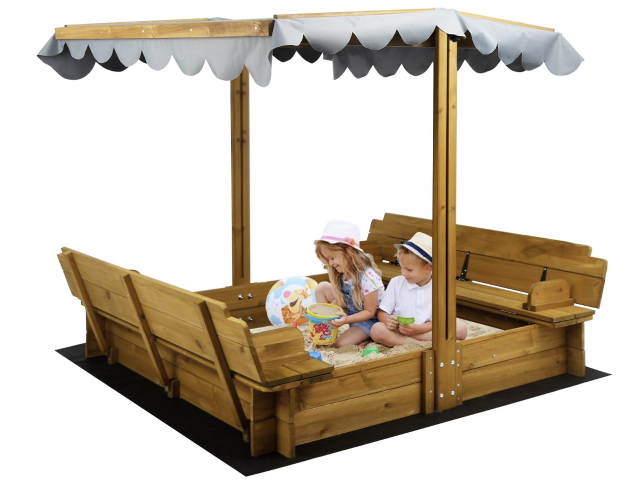
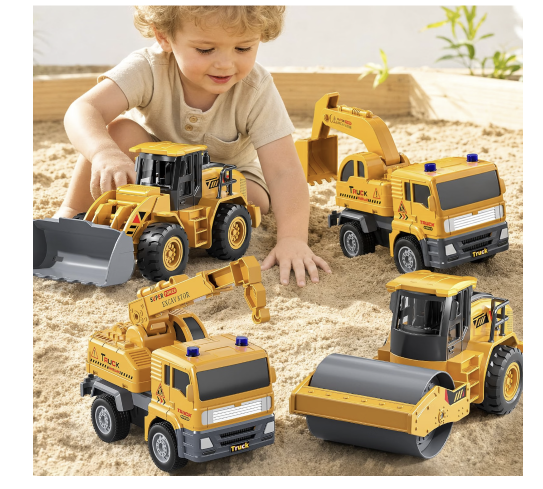
-
There's something magical about giving children a sandbox, a few construction vehicles, and the freedom to create!
Whether they're digging for buried treasure, building roads and bridges, filling dump trucks, or designing an entire construction site, sand play offers endless opportunities for creativity, communication, and hands-on learning.
What I especially love about sandboxes and construction vehicles is that they transform simple play into meaningful opportunities for speech, language, and cognitive development!
Children aren't just moving sand from one place to another. They're planning, experimenting, making predictions, solving problems, and learning how the world works.
A child building a sandcastle might be practicing spatial concepts such as above, below, beside, and between. Another child operating a pretend excavator may be developing sequencing skills while explaining how to dig, scoop, lift, and dump.
And when two children work together to build a road or construction site, they're practicing important social communication skills such as negotiating, sharing ideas, giving directions, and solving problems together.
From a speech-language perspective, sand play is particularly valuable because it naturally encourages action words, descriptive vocabulary, sequencing, storytelling, reasoning, and cooperative communication.
I also love how versatile these activities can be!
A traditional outdoor sandbox provides room for imaginative play and collaborative construction. A smaller construction-themed sandbox can offer a more focused building experience. And construction vehicles can be enjoyed in either sandbox or incorporated into other imaginative play activities.
Best of all, there's no single correct way to play! Children can follow their own ideas, experiment with different materials, and create something entirely new each time.
Sometimes the simplest toys create the richest learning experiences!
🧠 Did You Know?
Sandbox and construction play can help develop:
Receptive Language: Following directions, understanding action words, and learning spatial and descriptive vocabulary.
Expressive Language: Describing actions, explaining ideas, asking questions, and using increasingly complex sentences.
Vocabulary Development: Learning words such as excavate, transport, scoop, dump, level, compact, construct, foundation, and demolish.
Spatial Concepts: Understanding inside, outside, above, below, between, beside, underneath, behind, and across.
Sequencing & Procedural Language: Explaining steps involved in building roads, creating structures, and operating pretend construction equipment.
Cause & Effect: Discovering what happens when sand is poured, packed, moved, or combined with water.
Problem-Solving & Reasoning: Identifying construction challenges, testing solutions, and making adjustments.
Executive Functioning: Planning, organizing materials, maintaining attention, working memory, and flexible thinking.
Fine Motor Development: Strengthening hand muscles, bilateral coordination, grasping, scooping, pouring, and manipulating tools.
Sensory Exploration: Experiencing different textures and learning about the properties of dry and damp sand.
Social Communication: Sharing equipment, negotiating roles, collaborating, and practicing conversational turn-taking.
Narrative Development: Creating imaginative construction scenarios with characters, problems, and solutions.
Early Math & STEM Concepts: Exploring volume, measurement, weight, comparison, balance, and basic engineering principles.
Speech Sound Development: Practicing individualized articulation targets through meaningful vocabulary and natural conversation.
🚜 10 Ways to Play & Learn with Sandboxes & Construction Vehicles!
1. Welcome to the Construction Site! 🏗️
Turn the sandbox into a busy construction site!
Encourage your child to use construction vehicles to dig, scoop, push, transport, and dump sand.
Introduce the names and functions of different vehicles, such as excavators, bulldozers, dump trucks, and road rollers.
Try Saying: "The excavator digs the sand. The dump truck carries it away. The bulldozer pushes the sand into a pile!"
For older children, discuss why different vehicles are needed for different jobs.
Language Focus: Action vocabulary, categorization, sentence formulation, describing functions, receptive and expressive language.
2. First, Next, Then, Last! 🔢
Encourage your child to explain the steps involved in completing a construction project.
For example, they might dig a hole, fill a truck, transport the sand, and dump it in another location.
Try Saying: "First, I dig the sand. Next, I fill the truck. Then I drive to the other side. Last, I dump the sand!"
For older children, introduce more complex sequencing vocabulary such as before, after, while, meanwhile, and finally.
Language Focus: Sequencing, temporal concepts, procedural language, sentence organization.
3. Where Should It Go? 📍
Use construction vehicles, buckets, and sand structures to practice spatial concepts.
Give directions involving the placement of vehicles and materials.
Try Saying: "Park the dump truck beside the bulldozer!" or "Drive the excavator behind the sandcastle!"
Increase the difficulty by combining multiple directions.
For example: "Put the yellow truck behind the castle, then move the bulldozer between the two roads."
Language Focus: Spatial concepts, prepositions, following multistep directions, auditory comprehension.
4. Build a Road, Bridge or Tunnel! 🌉
Challenge your child to design and construct a road, bridge, or tunnel using sand and available materials.
Encourage them to think about what will make their structure stable and functional.
Try Saying: "Our bridge keeps falling! What could we do to make it stronger?"
Ask your child to explain their ideas and test different solutions.
Language Focus: Problem-solving, predicting, cause and effect, reasoning, complex sentence formulation.
5. Fill It Up, Dump It Out! 🪣
Use buckets, scoops, trucks, and containers to explore quantity and measurement.
Encourage your child to compare how much sand different containers can hold.
Try Saying: "This bucket holds more sand than the little truck!" or "The dump truck is almost full, but the bucket is only half full!"
Introduce vocabulary such as more, less, equal, empty, full, half-full, heavier, and lighter.
For older children, encourage predictions about which container will hold the greatest amount of sand.
Language Focus: Quantitative concepts, comparing and contrasting, descriptive vocabulary, predicting, early math language.
6. Construction Crew Communication! 👷
Assign different construction roles and work together to complete a project.
One person might operate the excavator while another drives the dump truck or supervises the construction site.
Encourage children to communicate what they need and explain their plans.
Try Saying: "Can you bring me another load of sand?" or "We need to finish the road before the trucks can drive across!"
For older children, introduce construction challenges that require cooperation and negotiation.
Language Focus: Social communication, requesting, conversational exchanges, collaborative planning, perspective-taking.
7. What Happened to Our Sandcastle? 🏰
Build a sandcastle, tower, or other structure and experiment with ways to make it stronger.
Explore the differences between dry and damp sand.
Encourage your child to predict what might happen before testing an idea.
Try Saying: "I think the damp sand will hold its shape better because it sticks together!"
If a structure collapses, discuss possible reasons and solutions.
Language Focus: Predicting, reasoning, cause and effect, scientific vocabulary, explaining.
8. Create a Construction Adventure! 📖
Use the sandbox and construction vehicles to create an imaginative story.
Perhaps a bridge has collapsed, a truck is stuck in the sand, or a construction crew must build a new road before a storm arrives.
Encourage your child to develop characters, a setting, a problem, and a solution.
Try Saying: "One morning, the construction crew discovered that the road was blocked by a giant pile of sand!"
Ask questions such as "What happened next?" "Why did the truck get stuck?" and "How can the workers solve the problem?"
Language Focus: Narrative development, story grammar, inferencing, problem-solving, organized expressive language.
9. Speech Sound Construction Challenge! 🗣️
Incorporate your child's speech sound targets into natural construction play.
Choose words related to the activity and encourage accurate production during phrases, sentences, and conversation.
For example:
/r/: road, roller, truck, tractor, gravel
/s/: sand, scoop, stack, smooth, construction
/l/: load, lift, level, shovel, bulldozer
/sh/: shovel, push, smash, shape
/th/: thick, thin, three, through, beneath
Encourage your child to use the target words while describing their actions.
Try Saying: "The truck is carrying a load of gravel across the road!"
For children working on speech sound carryover, emphasize natural conversation rather than interrupting play for constant correction.
Language Focus: Articulation, speech sound awareness, sentence formulation, generalization into connected speech.
10. Design Your Dream Construction Project! 💡
Challenge your child to plan and build an original project using the sandbox and construction vehicles.
They might create an entire city, a highway system, a construction site, or a pretend archaeological excavation.
Before beginning, ask your child to explain what they want to build and which materials they'll need.
Try Saying: "I'm going to build a city with two roads, a bridge, and a parking area for the construction trucks!"
Afterward, encourage your child to evaluate their design.
Ask questions such as "What worked well?" "What would you change?" and "How could you improve your construction next time?"
Language Focus: Planning, executive functioning, reasoning, problem-solving, procedural language, self-monitoring.
🌱 Grow With Me! — Same Toys, New Skills!
Ages 2–3: Exploring Sensory Play & Early Language
Although this collection is featured in the 6+ Years category, younger children can enjoy appropriately designed sand play equipment and larger construction vehicles under close adult supervision.
Focus on simple actions such as dig, scoop, pour, push, pull, and dump.
Model short phrases such as "big truck," "more sand," "dump it out," and "truck goes!"
Introduce early spatial concepts such as in, out, up, and down.
Encourage imitation of actions and sounds while following your child's interests.
Use larger, age-appropriate tools and vehicles without detachable small parts.
Ages 3–5: Expanding Vocabulary, Pretend Play & Early Problem-Solving
Encourage children to create simple construction scenes, build sand structures, and engage in imaginative play.
Introduce descriptive vocabulary, basic sequencing, and two- or three-step directions.
Ask questions such as "Where should the truck go?" "What do we need next?" and "Why did the tower fall?"
Encourage children to use longer sentences while explaining their actions.
Introduce cooperative activities that involve sharing equipment, taking turns, and completing a project together.
Ages 6–8: Building Sequencing, Reasoning & Cooperative Communication
Encourage children to plan more detailed construction projects and explain the steps involved.
Introduce increasingly complex spatial vocabulary and multistep directions.
Challenge them to build roads, bridges, tunnels, and structures that serve a specific purpose.
Ask children to make predictions, solve construction problems, and explain their reasoning.
Encourage collaborative projects requiring communication, negotiation, and shared decision-making.
For example: "We need to make the road wider because the dump truck won't fit!"
Ages 9–12: Developing Engineering Concepts & Higher-Level Language
Challenge children to design more complex construction projects involving measurement, planning, and experimentation.
Encourage them to compare different building methods, test structural stability, and evaluate results.
Introduce more advanced vocabulary such as foundation, stability, excavation, erosion, compression, and reinforcement.
Encourage complex sentences using although, however, unless, therefore, and in order to.
For example: "Although the bridge looked strong, it collapsed because the sand underneath wasn't packed tightly enough."
Introduce challenges that require children to explain their design decisions and evaluate alternative solutions.
Ages 12+: Applying Advanced Planning, Reasoning & STEM Concepts
For older children and teens who enjoy construction and engineering activities, encourage more sophisticated design challenges using appropriately sized materials and tools.
Challenge them to create scale models, test different construction techniques, or design structures with specific requirements.
Encourage them to research real-world construction methods and explain how engineering principles apply to their projects.
Ask questions such as "How could you improve the stability of this structure?" or "What changes would help prevent erosion?"
These activities encourage advanced problem-solving, critical thinking, planning, and complex expressive language.
💜 Miss Angie's Reminder
Some of the best learning happens when children get their hands a little sandy!
One of the things I love most about sand play is that it allows children to explore, experiment, and create without worrying about making something perfect.
A road that doesn't stay together, a tower that collapses, or a truck that gets stuck in the sand isn't necessarily a problem.
It's an opportunity to think, communicate, and try something new!
When your child encounters a challenge, resist the urge to immediately provide the solution.
Instead, try asking, "What do you think happened?" or "What else could we try?"
These simple questions encourage reasoning, flexible thinking, and independent problem-solving.
And remember, you don't have to turn every play activity into a lesson!
Sometimes the most effective way to support language development is simply to join your child's play and talk naturally about what they're doing.
You might say, "Wow! That dump truck is carrying a huge load!" or "I noticed you made the road wider so both trucks could fit!"
These comments provide meaningful language models without interrupting your child's creativity.
Whether your child is digging a small hole, building an elaborate sandcastle, or operating an entire pretend construction crew, they're developing skills that extend far beyond the sandbox.
Because every scoop, every truckload, and every imaginative construction project is another opportunity to build communication, creativity, and confidence!
⚠️ Safety Note: Always follow the manufacturer's age and safety recommendations for each sandbox, construction vehicle, and accessory. Supervise sand play, especially with younger children, and prevent children from putting sand in their mouths or throwing it. Use clean, play-grade sand intended for children's sandboxes, keep sandboxes covered when not in use, and inspect sand regularly for debris, animal contamination, and moisture-related problems. Provide shade, hydration, and sun protection for outdoor play. Construction vehicles may contain small or detachable parts that pose choking hazards for younger children. For wooden sandboxes, inspect surfaces for splinters and follow the manufacturer's assembly, maintenance, and weight-limit instructions.
🎨 Art Easel Adventures — Draw, Write, Imagine & Create!
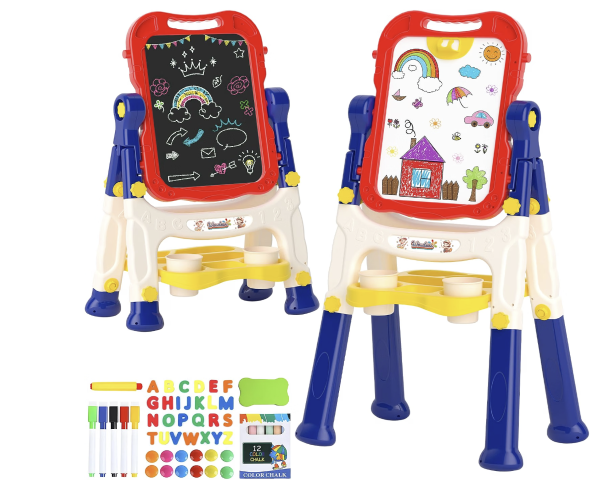
-
Sometimes all a child needs is a blank surface, a few colorful markers, and the freedom to let their imagination take over!
An art easel is one of my favorite creative learning tools because it gives children so many different ways to express themselves—through drawing, writing, storytelling, and conversation!
Whether your child is drawing a family portrait, creating a pretend restaurant menu, practicing letters, or illustrating an imaginative story, an easel offers wonderful opportunities to develop speech, language, and early literacy skills.
What I especially love about a double-sided easel is its versatility!
Children can use the whiteboard to draw and erase, experiment with the chalkboard, arrange magnetic letters to create words, or attach paper for longer art projects.
And because there's no single correct way to create, children can explore their own ideas while developing confidence in their communication skills.
From a speech-language perspective, an easel provides natural opportunities to practice descriptive language, vocabulary, sequencing, phonological awareness, storytelling, and sentence formulation.
Children can explain what they're drawing, describe their characters, create stories, and even teach someone else how to complete a picture.
The vertical drawing surface also encourages shoulder stability, arm movement, and visual-motor coordination, which support developing writing and drawing skills.
And here's something I particularly appreciate: an easel encourages children to slow down, plan their ideas, and communicate what they're thinking!
A simple drawing can turn into an entire conversation, and a few magnetic letters can become the beginning of an exciting literacy adventure.
🧠 Did You Know?
Playing and creating with an art easel can help develop:
Expressive Language: Describing pictures, explaining ideas, answering questions, and creating increasingly complex sentences.
Receptive Language: Following drawing directions, identifying letters, understanding spatial vocabulary, and listening to descriptions.
Vocabulary Development: Learning colors, shapes, attributes, action words, emotions, and descriptive concepts.
Phonological Awareness: Identifying beginning sounds, recognizing rhymes, blending sounds, and manipulating spoken words.
Early Literacy: Recognizing letters, connecting letters with sounds, building words, and exploring the relationship between spoken and written language.
Narrative Development: Creating characters, settings, problems, solutions, and organized stories.
Sequencing: Explaining the steps involved in drawing, creating, and completing projects.
Fine Motor & Visual-Motor Skills: Developing controlled movements, hand-eye coordination, grasp, and prewriting skills.
Executive Functioning: Planning, organizing materials, sustaining attention, self-monitoring, and adjusting ideas.
Problem-Solving & Creativity: Experimenting with designs, developing solutions, and thinking flexibly.
Social Communication: Sharing materials, requesting assistance, collaborating, and discussing creative ideas.
Speech Sound Development: Practicing individualized articulation targets through meaningful drawing and literacy activities.
🖍️ 10 Ways to Play & Learn with an Art Easel!
1. Draw It & Describe It! 🎨
Encourage your child to draw anything they choose.
Once they've finished, ask them to tell you about their picture.
Rather than simply asking, "What is it?", encourage descriptions involving colors, shapes, size, location, and function.
Try Saying: "I drew a big purple house with three windows and a red door!"
For older children, encourage more detailed explanations about why they included certain features.
Language Focus: Descriptive vocabulary, attributes, sentence expansion, organized expressive language.
2. Listen & Draw! 👂
Give your child verbal directions to create a picture.
Begin with simple instructions and gradually increase the number of steps.
Try Saying: "Draw a big circle. Put a small triangle above it. Now draw two squares underneath the circle!"
For older children, introduce more complex spatial relationships and multistep directions.
Language Focus: Auditory comprehension, following directions, spatial concepts, working memory.
3. Magnetic Letter Detectives! 🔤
Use magnetic letters to explore letter recognition and sound awareness.
Ask your child to find letters that represent the beginning sounds of familiar words.
Try Saying: "Sun starts with /s/. Can you find the letter that makes the /s/ sound?"
For older children, use the letters to build simple words, change beginning or ending sounds, and explore word families.
For example, change cat to bat, then bat to bag.
Language Focus: Phonological awareness, letter-sound correspondence, phonemic awareness, early literacy.
4. Create a Picture Story! 📖
Encourage your child to draw a picture that represents an imaginary event.
Ask them to describe the characters, setting, and what is happening.
Try Saying: "One day, a little puppy got lost in the forest. He met a friendly rabbit who helped him find his way home!"
For older children, encourage stories with a clear beginning, middle, and end.
Language Focus: Narrative development, story grammar, sequencing, sentence organization.
5. First, Next, Then, Last! 🔢
Choose a familiar object and encourage your child to explain the steps involved in drawing it.
For example, they might draw a house, flower, animal, or vehicle.
Try Saying: "First, I drew a square. Next, I added a triangle for the roof. Then I drew the windows. Last, I colored the door!"
For older children, introduce more complex sequencing words such as before, after, while, and finally.
Language Focus: Procedural language, sequencing, temporal concepts, expressive organization.
6. Guess My Drawing! 🕵️
Take turns drawing a familiar object while the other person guesses what it is.
Encourage your child to give verbal clues without immediately naming the object.
Try Saying: "It has four legs, a long tail, and whiskers. It likes to chase mice!"
For older children, encourage clues involving categories, functions, attributes, and comparisons.
Language Focus: Categorization, describing, inferencing, word retrieval, semantic relationships.
7. Speech Sound Art Challenge! 🗣️
Choose a speech sound your child is currently practicing and create pictures containing that sound.
For example:
/r/: rainbow, rabbit, robot, road, rocket
/s/: sun, snake, star, snow, sandwich
/l/: lion, leaf, ladder, lemon, balloon
/sh/: shoe, ship, shell, shark, fish
/th/: thumb, three, thunder, bath, tooth
Encourage your child to name the pictures, use the words in sentences, and create a story incorporating several target words.
Try Saying: "The red rocket raced across the rainbow!"
For children working on carryover, encourage accurate speech sounds during natural conversation.
Language Focus: Articulation, phonological awareness, sentence formulation, speech sound generalization.
8. Let's Open a Pretend Business! 🏪
Turn the easel into a pretend restaurant, grocery store, classroom, or doctor's office.
Encourage your child to create signs, menus, schedules, or advertisements.
Try Saying: "Welcome to my restaurant! Today's special is pizza with extra cheese!"
Take turns being the customer and the business owner.
For older children, encourage them to write descriptions, explain prices, and solve pretend customer problems.
Language Focus: Functional language, social communication, role-playing, vocabulary, early writing.
9. How Are They Feeling? 😊
Draw faces showing different emotions.
Encourage your child to identify the emotions and explain what might cause someone to feel that way.
Try Saying: "This girl looks disappointed because her ice cream fell on the ground!"
For older children, discuss more complex emotions such as frustrated, embarrassed, nervous, proud, and disappointed.
Encourage your child to explain how someone might respond to a particular situation.
Language Focus: Emotional vocabulary, inferencing, perspective-taking, cause and effect, social communication.
10. Invent, Design & Explain! 💡
Challenge your child to design something entirely new.
Perhaps they want to invent a futuristic vehicle, create a playground, design a dream bedroom, or develop a machine that solves a problem.
Encourage them to draw their invention and explain how it works.
Try Saying: "I invented a robot that cleans my room! It has long arms that pick up toys and put them away!"
For older children, encourage explanations involving the purpose, features, advantages, and possible improvements of their invention.
Language Focus: Creative thinking, reasoning, problem-solving, complex sentences, organized expressive language.
🌱 Grow With Me! — Same Easel, New Skills!
Ages 3–5: Exploring Creativity & Early Language
Focus on drawing simple pictures, naming colors, identifying shapes, and experimenting with different art materials.
Encourage your child to describe what they're creating using short phrases and sentences.
Introduce early spatial concepts such as up, down, beside, inside, and under.
Use magnetic letters to explore letter recognition and beginning sounds without requiring formal spelling.
Model simple language such as "big blue circle," "draw a line," and "put the letter on top!"
Encourage imaginative play by drawing familiar people, animals, and objects.
Ages 6–8: Building Literacy, Sequencing & Storytelling
Encourage children to create more detailed pictures and explain their ideas using complete sentences.
Use magnetic letters to practice sound-letter relationships, spelling patterns, and word building.
Introduce activities involving rhyming, sound blending, and changing sounds within words.
Encourage children to draw a series of pictures and organize them into a story with a beginning, middle, and end.
Challenge them to follow increasingly complex drawing directions involving multiple steps and spatial relationships.
Ask questions such as "What happened first?" "Why did your character do that?" and "What might happen next?"
Ages 9–12: Expanding Higher-Level Language & Creative Expression
Encourage children to use the easel for planning, organizing, and presenting ideas.
Challenge them to create comic strips, diagrams, advertisements, storyboards, or illustrated explanations.
Introduce more complex vocabulary and sentence structures using although, however, therefore, unless, and in order to.
For example: "Although the character was frightened, she decided to explore the mysterious cave because she wanted to find her missing dog."
Encourage children to compare ideas, explain their reasoning, and evaluate different solutions.
Use the easel to create visual organizers for stories, school assignments, or problem-solving activities.
Ages 12+: Developing Advanced Communication & Organizational Skills
For older children and teens who enjoy drawing and visual expression, use the easel to support brainstorming, planning, and presenting information.
Encourage them to develop storyboards, mind maps, diagrams, and visual presentations.
Challenge them to organize information into categories, explain complex ideas, and summarize important concepts.
Introduce activities involving persuasive language, comparing viewpoints, and supporting opinions with evidence.
For example, ask them to design an advertisement for an imaginary product and explain why someone should purchase it.
These activities support higher-level expressive language, executive functioning, critical thinking, and organization.
💜 Miss Angie's Reminder
A blank board isn't empty—it's full of possibilities!
One of the things I love most about art activities is that children can communicate in so many different ways.
Some children may immediately begin drawing elaborate pictures and telling imaginative stories. Others may prefer making lines, experimenting with colors, or arranging magnetic letters.
And that's perfectly fine!
The goal isn't to create a masterpiece. It's to encourage exploration, creativity, and meaningful communication.
Rather than asking your child to identify every color, shape, or letter, try commenting naturally on what they're doing.
You might say, "I see you made a really long blue line!" or "Wow! Your dinosaur has enormous teeth!"
These comments model language without turning the activity into a quiz.
And if your child draws something you don't recognize, resist the urge to guess immediately.
Instead, try saying, "Tell me about your picture!"
This gives your child an opportunity to share their own ideas and helps them understand that their thoughts and creativity are important.
For children who have difficulty expressing themselves verbally, drawing can also provide a wonderful visual support for communication.
They can point to pictures, show relationships between objects, and use their artwork to help explain ideas.
Remember, the most important part of an art activity isn't what ends up on the board—it's the thinking, communicating, and creating that happens along the way!
⚠️ Safety Note: Follow the manufacturer's recommended age and safety instructions. This easel includes magnetic letters and other accessories that may contain small parts and present choking hazards for children under 3. Supervise younger children, inspect magnets and accessories regularly, and discontinue use of any damaged pieces. Keep loose or exposed magnets away from children. Use age-appropriate, washable art supplies and ensure the easel is stable and properly assembled before use. Adult supervision is recommended when using markers, chalk, and other art materials.
📚 Books & Reading Adventures
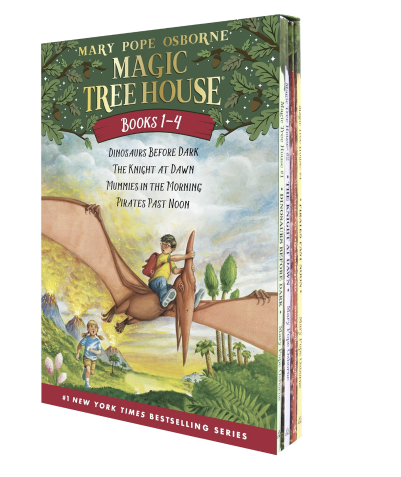
📚🌳 Magic Tree House — Adventures Through Time! (Books 1–4)
-
💜 Why Miss Angie Loves It!
What if you could climb into a tree house and suddenly find yourself surrounded by dinosaurs, exploring a medieval castle, discovering ancient Egyptian pyramids, or sailing with pirates?
That's exactly what happens to Jack and Annie in Mary Pope Osborne's wonderful Magic Tree House series!
This boxed set introduces children to the first four adventures:
Dinosaurs Before Dark — Book 1
The Knight at Dawn — Book 2
Mummies in the Morning — Book 3
Pirates Past Noon — Book 4
What I especially love about Magic Tree House is how it introduces children to chapter books while making reading feel like an exciting adventure rather than an assignment!
The chapters are manageable, the stories are engaging, and the combination of mystery, history, and imagination encourages children to keep reading.
From a speech-language perspective, these books provide wonderful opportunities to develop reading comprehension, vocabulary, sequencing, inferencing, predicting, and narrative language.
Children learn to remember important details, follow events across chapters, understand characters' motivations, and explain how problems are solved.
I also love how Jack and Annie approach situations differently. Their personalities provide natural opportunities to discuss emotions, perspectives, decision-making, and problem-solving.
And because each adventure introduces a different historical setting, children encounter new vocabulary and ideas that can inspire additional conversations and learning.
These books are especially valuable for children transitioning from picture books to chapter books because they offer opportunities to build reading confidence while developing increasingly sophisticated language skills.
One little tree house opens the door to a whole world of language and learning!
🧠 Did You Know?
Reading Magic Tree House can help develop:
Reading Comprehension: Understanding story events, recalling details, identifying main ideas, and answering questions.
Vocabulary Development: Learning new words related to history, geography, science, emotions, and descriptive language.
Inferencing: Using clues from the text and illustrations to understand information that isn't directly stated.
Predicting: Anticipating future events based on what has already happened.
Narrative Development: Identifying characters, settings, problems, actions, and solutions.
Sequencing: Organizing events in the correct order and explaining what happened first, next, and last.
Cause & Effect: Understanding why events happen and how one action influences another.
Perspective-Taking: Recognizing differences in characters' thoughts, feelings, and motivations.
Working Memory: Remembering important information across chapters and connecting events.
Expressive Language: Retelling stories, explaining opinions, answering questions, and summarizing information.
Phonological Awareness & Literacy: Supporting sound-letter knowledge, decoding, word recognition, and reading fluency through appropriately supported reading practice.
Critical Thinking: Evaluating character decisions, comparing solutions, and explaining reasoning.
📖 10 Ways to Read & Learn with Magic Tree House!
1. Predict the Adventure! 🔮
Before beginning a new book, look at the cover and read the title together.
Ask your child to predict where Jack and Annie might travel and what they could discover.
Try Saying: "I see a dinosaur on the cover! I think Jack and Annie might travel back to prehistoric times!"
After reading, revisit the predictions and discuss which ones were accurate.
Language Focus: Predicting, inferencing, reasoning, expressive language.
2. Meet Jack & Annie! 👧👦
Discuss the two main characters and how their personalities influence their decisions.
Encourage your child to compare how Jack and Annie respond to different situations.
Try Saying: "Jack likes to stop and think, but Annie is often ready to explore!"
Ask your child which character they relate to and why.
Language Focus: Comparing and contrasting, character traits, perspective-taking, explaining opinions.
3. First, Next, Then, Last! 🔢
After reading a chapter, encourage your child to retell the important events in order.
Begin with a few key details and gradually increase the complexity.
Try Saying: "First, Jack and Annie found the tree house. Next, they discovered the books. Then something magical happened!"
For older children, encourage retellings that include the characters' motivations and the consequences of their actions.
Language Focus: Sequencing, temporal concepts, narrative organization, expressive language.
4. Word Detective Challenge! 🔍
Choose interesting or unfamiliar vocabulary from each adventure.
Encourage your child to use the surrounding sentences and illustrations to determine what the words might mean.
For example, discuss words related to dinosaurs, castles, pyramids, and ships.
Try Saying: "The knight wore armor. What do you think armor is used for?"
Encourage your child to explain the word and use it in a new sentence.
Language Focus: Vocabulary development, context clues, categorization, semantic relationships.
5. What Happens Next? 🤔
Pause at an exciting moment and ask your child to predict what might happen.
Encourage them to explain their reasoning using clues from the story.
Try Saying: "Jack and Annie heard a strange noise. What do you think made it?"
For older children, encourage multiple predictions and discuss which is most likely.
Language Focus: Inferencing, predicting, reasoning, cause and effect.
6. How Are They Feeling? ❤️
Discuss the emotions Jack, Annie, and other characters experience throughout their adventures.
Encourage your child to explain why a character might feel a particular way.
Try Saying: "Annie looks excited, but Jack seems nervous. Why do you think they feel differently?"
Introduce more complex emotional vocabulary such as anxious, relieved, curious, disappointed, and determined.
Language Focus: Emotional vocabulary, perspective-taking, inferencing, social reasoning.
7. Cause & Effect Connections! 🔗
Choose an important event and discuss why it happened.
Encourage your child to explain how one event leads to another.
Try Saying: "Because Jack and Annie opened the book, they traveled to another time!"
Introduce connecting words such as because, so, therefore, and as a result.
Language Focus: Cause and effect, reasoning, complex sentence formulation, comprehension.
8. Compare the Adventures! ⚖️
After reading two or more books, encourage your child to compare the settings, characters, and challenges.
Try Saying: "In one adventure, Jack and Annie visited dinosaurs. In another, they explored a castle!"
Discuss similarities and differences in the problems the characters encounter.
For older children, encourage more detailed comparisons involving character decisions and story structure.
Language Focus: Comparing and contrasting, categorization, higher-level reasoning, expressive organization.
9. Become the Storyteller! 🎭
Encourage your child to retell an exciting scene from the perspective of Jack, Annie, or another character.
Try Saying: "I was walking through the forest when I suddenly heard a dinosaur roar!"
Encourage your child to include thoughts, emotions, and descriptive details.
For children who enjoy acting, use simple props or drawings to recreate the scene.
Language Focus: Narrative development, perspective-taking, pronouns, verb tense, descriptive language.
10. Create Your Own Magic Tree House Adventure! ✨
Invite your child to invent an original adventure for Jack and Annie.
Ask them to choose a destination, develop a problem, and decide how the characters will solve it.
Try Saying: "Jack and Annie traveled to the Arctic, where they had to help a lost polar bear find its family!"
Encourage your child to draw pictures, write a short story, or tell the adventure aloud.
For older children, introduce more complex plots, dialogue, and unexpected challenges.
Language Focus: Creative storytelling, narrative organization, sequencing, problem-solving, complex sentence formulation.
🌱 Grow With Me! — Same Books, New Skills!
Ages 5–6: Building Listening Comprehension & Early Story Skills
Younger children who aren't yet ready to read chapter books independently can still enjoy Magic Tree House through shared reading.
Read short sections aloud and pause to discuss the characters, setting, and important events.
Ask simple questions such as "Who is in the story?" "Where are they?" and "What happened?"
Use illustrations and verbal explanations to support unfamiliar vocabulary.
Encourage your child to predict what might happen next and retell simple events.
Ages 6–8: Developing Independent Reading & Story Comprehension
Encourage children to read independently when appropriate for their reading abilities.
Take turns reading aloud or alternate between independent and shared reading.
Discuss important events, unfamiliar vocabulary, and character motivations.
Encourage children to summarize chapters, identify problems and solutions, and explain cause-and-effect relationships.
Introduce increasingly complex questions such as "Why do you think Jack made that decision?" and "What clues helped you figure that out?"
Ages 8–10: Strengthening Inferencing & Higher-Level Language
Encourage more detailed discussions about character development, problem-solving, and story structure.
Challenge children to compare adventures, evaluate character decisions, and explain their opinions.
Introduce complex sentence structures using although, however, unless, and therefore.
For example: "Although Jack was frightened, he continued exploring because he wanted to help Annie."
Encourage children to connect historical information in the stories with real-world knowledge.
Ages 10+: Expanding Critical Thinking & Literary Analysis
For older children who enjoy the series or benefit from accessible chapter books, encourage more sophisticated discussions about themes, character motivations, and historical settings.
Challenge them to distinguish fictional elements from historical facts.
Encourage children to compare the adventures, identify recurring themes, and evaluate how the author creates suspense.
Older readers can write book reviews, create alternative endings, or research the historical topics introduced in the stories.
These activities support higher-level comprehension, critical thinking, organized expressive language, and written communication.
💜 Miss Angie's Reminder
The goal isn't just to finish a book—it's to help children fall in love with reading!
One of the things I appreciate most about Magic Tree House is that the adventures are engaging without being overwhelming for many beginning chapter-book readers.
Children can experience the excitement of completing a chapter, remembering what happened, and looking forward to the next adventure.
And those small successes help build confidence!
When reading with your child, remember that comprehension develops through meaningful conversations, not just answering questions.
Rather than stopping after every paragraph to ask what happened, allow your child to become immersed in the story.
Pause occasionally to share a thought, explain an unfamiliar word, or wonder aloud about what might happen next.
You might say, "I wonder why Jack is being so careful!" or "I can't wait to find out what's inside that castle!"
These natural conversations model curiosity, reasoning, and language without making reading feel like a test.
If your child has difficulty reading independently, continue reading aloud together. Listening to a story while following along in the book can provide valuable exposure to vocabulary, sentence structure, and narrative organization.
And don't worry if your child wants to read a favorite adventure more than once!
Repeated reading can support familiarity, comprehension, and reading fluency when practiced appropriately.
Most importantly, let your child's interests guide the experience.
Because when children discover the joy of reading, every book becomes a doorway to new words, new ideas, and endless adventures!
📚 Reading Note: The publisher recommends this boxed set for ages 6–9. Reading readiness varies, so consider your child's decoding skills, comprehension, and interests. Shared reading, adult read-alouds, and audiobooks can help children enjoy the adventures even when independent reading is still developing.
📚🔎 The Boxcar Children — Mysteries, Adventures & Teamwork!
-
Four siblings, an abandoned boxcar, and a world full of mysteries waiting to be solved!
The Boxcar Children series by Gertrude Chandler Warner introduces readers to Henry, Jessie, Violet, and Benny Alden—four resourceful siblings whose adventures encourage curiosity, independence, and teamwork.
What I especially love about The Boxcar Children is that these stories encourage children to think like detectives!
As the Alden children discover clues, encounter unexpected challenges, and work together to solve mysteries, readers must pay attention to important details, make predictions, draw conclusions, and connect information across chapters.
From a speech-language perspective, this series provides wonderful opportunities to strengthen reading comprehension, inferencing, vocabulary, narrative development, sequencing, and higher-level reasoning.
Children learn to distinguish important clues from less relevant information, understand cause-and-effect relationships, and explain how different events contribute to solving a mystery.
I also love the strong emphasis on cooperation!
Each sibling brings different strengths to the group, providing natural opportunities to discuss perspective-taking, communication, problem-solving, and the importance of listening to others' ideas.
And because the stories feature recurring characters, children can become familiar with their personalities while developing confidence as chapter-book readers.
Whether your child reads independently or enjoys listening to the stories with a parent, The Boxcar Children offers engaging opportunities to build language, literacy, and critical-thinking skills.
Every mystery becomes an opportunity to ask questions, discover clues, and develop stronger communication skills!
🧠 Did You Know?
Reading The Boxcar Children can help develop:
Reading Comprehension: Identifying main ideas, recalling important details, and understanding events across chapters.
Inferencing: Combining story clues with background knowledge to understand information that isn't directly stated.
Predicting: Anticipating what might happen next and developing possible explanations for a mystery.
Vocabulary Development: Learning descriptive words, unfamiliar expressions, and vocabulary related to different settings and situations.
Narrative Development: Identifying characters, settings, initiating events, problems, actions, and solutions.
Sequencing: Organizing events in the correct order and explaining how one event leads to another.
Cause & Effect: Understanding why characters make decisions and how those decisions influence the story.
Critical Thinking: Evaluating clues, comparing possibilities, and explaining conclusions.
Perspective-Taking: Understanding characters' thoughts, feelings, motivations, and different viewpoints.
Working Memory: Remembering clues, characters, and important information across multiple chapters.
Expressive Language: Summarizing, retelling, explaining opinions, and supporting ideas with details.
Social Communication: Discussing cooperation, teamwork, negotiation, and respectful communication.
🔎 10 Ways to Read & Learn with The Boxcar Children!
1. Become a Mystery Detective! 🕵️
As you read, encourage your child to identify clues that might help solve the mystery.
Ask them to distinguish important information from details that may not be relevant.
Try Saying: "I think this clue is important because the characters noticed something unusual!"
For older children, encourage them to explain how multiple clues might be connected.
Language Focus: Inferencing, identifying relevant details, reasoning, reading comprehension.
2. What Happens Next? 🔮
Pause at an exciting moment and ask your child to predict what might happen.
Encourage them to explain their predictions using evidence from the story.
Try Saying: "I think the children will discover something inside the old building because they found a strange key!"
Revisit predictions as the story progresses.
Language Focus: Predicting, reasoning, inferencing, expressive language.
3. First, Next, Then, Last! 🔢
After reading a chapter, encourage your child to retell the important events in order.
Begin with three or four events and gradually increase the complexity.
Try Saying: "First, the children discovered a clue. Next, they investigated the area. Then they found something unexpected!"
For older children, encourage retellings that explain why events happened.
Language Focus: Sequencing, temporal concepts, narrative organization, expressive language.
4. Character Detectives! 👧👦
Discuss the four Alden siblings and their different personalities.
Encourage your child to describe each character's strengths and explain how they contribute to solving problems.
Try Saying: "Jessie is organized and helpful, while Benny is curious and often asks lots of questions!"
Ask your child which character they relate to most and why.
Language Focus: Character traits, comparing and contrasting, perspective-taking, descriptive language.
5. Word Detective Challenge! 📖
Choose unfamiliar or interesting vocabulary from the story.
Encourage your child to use surrounding sentences to determine the meaning.
Try Saying: "The children were relieved when they discovered everyone was safe. What do you think relieved means?"
Discuss the meaning and encourage your child to use the word in a new sentence.
Language Focus: Vocabulary development, context clues, semantic relationships, sentence formulation.
6. Cause & Effect Connections! 🔗
Choose an important event and discuss why it happened.
Encourage your child to explain how one action influenced another.
Try Saying: "Because the children noticed the missing object, they decided to investigate!"
Introduce connecting words such as because, so, therefore, and as a result.
Language Focus: Cause and effect, complex sentence formulation, reasoning, comprehension.
7. What Would You Do? 🤔
Ask your child to imagine being one of the Alden children.
Present a problem from the story and encourage them to explain how they would respond.
Try Saying: "If you found a mysterious note, would you tell someone immediately or try to figure out what it means first? Why?"
Encourage children to consider different possibilities and consequences.
Language Focus: Problem-solving, perspective-taking, conditional language, reasoning.
8. Compare the Mysteries! ⚖️
After reading more than one book, encourage your child to compare the mysteries.
Discuss similarities and differences in settings, clues, problems, and solutions.
Try Saying: "Both mysteries involved missing objects, but the children solved them in different ways!"
For older children, compare how the characters' problem-solving strategies change across stories.
Language Focus: Comparing and contrasting, categorization, higher-level reasoning, organized expressive language.
9. Retell the Mystery! 🗣️
Challenge your child to summarize an entire mystery without giving unnecessary details.
Encourage them to identify the main characters, setting, problem, important clues, and solution.
Try Saying: "The children discovered something unusual while exploring. They followed several clues and eventually solved the mystery!"
For older children, encourage more detailed summaries that explain how the clues fit together.
Language Focus: Summarization, narrative organization, identifying main ideas, working memory.
10. Create Your Own Boxcar Mystery! ✨
Invite your child to invent an original mystery for the Alden children to solve.
Ask them to choose a setting, develop a problem, create clues, and decide how the mystery will be solved.
Try Saying: "The children visited an old lighthouse where they discovered a mysterious message hidden inside a wooden box!"
Encourage your child to write the story, illustrate important scenes, or tell the mystery aloud.
For older children, introduce misleading clues, multiple suspects, and unexpected solutions.
Language Focus: Creative storytelling, narrative organization, sequencing, inferencing, problem-solving, complex sentence formulation.
🌱 Grow With Me! — Same Books, New Skills!
Ages 5–6: Building Listening Comprehension & Early Story Skills
Younger children who aren't ready to read chapter books independently can enjoy the stories through adult read-alouds.
Read short sections and pause occasionally to discuss characters, settings, and important events.
Ask simple questions such as "Who is in the story?" "What happened?" and "Where did they go?"
Use pictures, verbal explanations, and familiar experiences to support comprehension.
Encourage children to make simple predictions and retell important events.
Ages 7–8: Developing Independent Reading & Comprehension
Encourage children to read independently when appropriate for their abilities.
Discuss important clues, character decisions, and unfamiliar vocabulary.
Ask questions such as "Why do you think the children did that?" and "What clue helped them figure it out?"
Encourage children to summarize chapters and explain how events are connected.
Introduce increasingly complex sentences using because, although, and so.
Ages 9–10: Strengthening Inferencing & Critical Thinking
Encourage children to identify subtle clues and develop possible explanations for mysteries.
Challenge them to support their predictions with details from the text.
Discuss character motivations, relationships, and problem-solving strategies.
Introduce more sophisticated vocabulary and complex sentence structures.
For example: "Although the children suspected one person, they changed their minds after discovering another clue."
Encourage children to compare different mysteries and evaluate how the characters reached their conclusions.
Ages 11+: Expanding Higher-Level Language & Literary Analysis
For older children who enjoy the series or benefit from accessible chapter books, encourage more advanced discussions about themes, character development, and mystery structure.
Challenge them to distinguish facts from assumptions, evaluate evidence, and explain how different clues contribute to the solution.
Discuss themes such as independence, perseverance, cooperation, honesty, and responsibility.
Encourage children to write book reviews, develop alternative endings, or create original mysteries.
These activities support critical thinking, organized expressive language, and written communication.
💜 Miss Angie's Reminder
A great mystery doesn't just keep children turning pages—it keeps them thinking!
One of the things I love most about The Boxcar Children is that the stories encourage readers to become active participants in solving problems.
Children aren't simply waiting to find out what happens next. They're gathering information, considering possibilities, and trying to make sense of the clues.
And those are valuable skills that extend far beyond reading!
When enjoying these books with your child, encourage curiosity rather than focusing only on correct answers.
You might say, "That's an interesting clue!" or "I wonder why that character behaved that way!"
These comments invite discussion without making reading feel like a quiz.
If your child makes an incorrect prediction, that's perfectly fine!
Encourage them to explain their reasoning and consider how new information might change their thinking.
This helps children develop cognitive flexibility and understand that changing an opinion when presented with new evidence is an important part of learning.
And remember, children don't have to read every word independently to benefit from a good story.
Shared reading, taking turns reading aloud, and discussing chapters together all provide meaningful opportunities for language development.
Most importantly, allow your child to enjoy the adventure!
Because the greatest discovery in every mystery isn't just the solution—it's the confidence, communication, and critical-thinking skills children develop along the way!
📚 Reading Note: The original Boxcar Children chapter books are generally appropriate for elementary-age readers, often around ages 7–10, depending on the edition and individual reading ability. Choose books based on your child's decoding skills, comprehension, and interests rather than age alone. Shared reading and audiobooks can make the stories accessible to younger or developing readers.
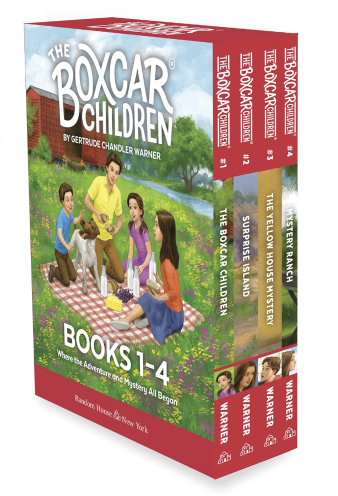
📚💜 Junie B. Jones — Big Feelings, Big Laughs & Big Learning Adventures!
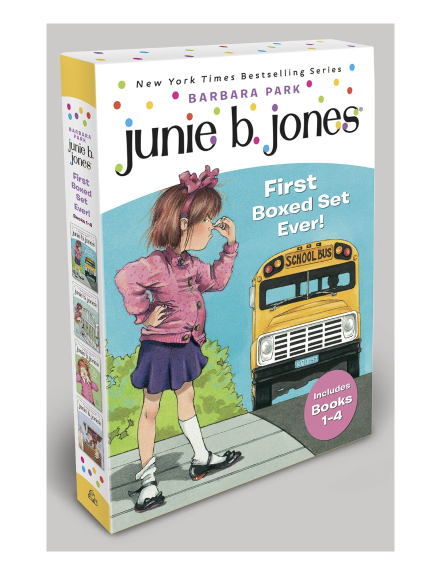
-
Meet Junie B. Jones—a spirited, outspoken, imaginative little girl who has a LOT to say about the world around her!
Created by author Barbara Park, Junie B. Jones takes readers on hilarious adventures through kindergarten and first grade, where everyday experiences become opportunities for laughter, discovery, and learning.
Whether she's navigating friendships, adjusting to classroom expectations, dealing with misunderstandings, or trying to figure out why grown-ups say such confusing things, Junie B. approaches life with an unforgettable personality!
What I especially love about Junie B. Jones is that these books make language, emotions, and social situations come alive!
Children can often relate to Junie B.'s experiences, even when her reactions are exaggerated or her decisions don't turn out quite as planned.
From a speech-language perspective, this series provides wonderful opportunities to develop reading comprehension, vocabulary, inferencing, perspective-taking, social communication, and narrative language.
Junie B. frequently interprets situations in unexpected ways, providing natural opportunities to discuss what people mean versus what they actually say.
Her interactions with classmates, teachers, and family members also encourage conversations about emotions, friendships, problem-solving, and understanding different points of view.
And because the stories are filled with humor, children have opportunities to explore why something is funny, recognize misunderstandings, and distinguish between literal and intended meanings.
I also appreciate the series' accessible chapter-book format, which can help developing readers build confidence and stamina.
One important feature of these books is that Junie B. uses intentionally unconventional grammar and childlike expressions as part of her character's voice. This creates a valuable opportunity to discuss the difference between playful character dialogue and the language children use in school writing.
With Junie B. Jones, every funny misunderstanding can become a meaningful conversation about language, friendship, and growing up!
🧠 Did You Know?
Reading Junie B. Jones can help develop:
Reading Comprehension: Understanding story events, identifying important details, and recalling information across chapters.
Inferencing: Using context and character behavior to understand thoughts, feelings, and information that isn't directly stated.
Perspective-Taking: Recognizing that different people can interpret the same situation in different ways.
Social Communication: Discussing friendships, conversational expectations, classroom behavior, and appropriate ways to express thoughts and feelings.
Emotional Vocabulary: Identifying and describing feelings such as embarrassed, frustrated, disappointed, excited, jealous, and proud.
Figurative & Nonliteral Language: Exploring humor, exaggeration, idioms, and the difference between literal and intended meanings.
Narrative Development: Identifying characters, settings, problems, actions, and solutions.
Sequencing: Retelling events in order and explaining how one event leads to another.
Cause & Effect: Understanding how characters' words and actions influence what happens next.
Expressive Language: Summarizing, explaining opinions, making predictions, and discussing social situations.
Critical Thinking: Evaluating character decisions and considering alternative ways to solve problems.
Language Awareness: Recognizing differences between informal speech, character dialogue, and conventional written grammar.
📖 10 Ways to Read & Learn with Junie B. Jones!
1. What Is Junie B. Thinking? 🤔
As you read, pause during an interesting situation and ask your child what Junie B. might be thinking.
Encourage them to explain their answers using clues from the story.
Try Saying: "Junie B. looks upset because she thinks something unfair happened. What do you think she's thinking?"
Discuss how her thoughts might be different from those of another character.
Language Focus: Inferencing, perspective-taking, emotional vocabulary, social reasoning.
2. Big Feelings Detective! ❤️
Encourage your child to identify emotions Junie B. experiences throughout the story.
Move beyond basic feelings such as happy, sad, and mad.
Introduce words such as frustrated, embarrassed, nervous, disappointed, jealous, and relieved.
Try Saying: "Junie B. was embarrassed because everyone was looking at her!"
Ask your child how they might feel in a similar situation.
Language Focus: Emotional vocabulary, cause and effect, perspective-taking, expressive language.
3. What Could She Say Instead? 🗣️
Choose a situation where Junie B. has difficulty expressing herself or communicating appropriately.
Discuss different ways she could communicate her thoughts or feelings.
Try Saying: "Instead of yelling, Junie B. could say, 'I feel frustrated because I wanted a turn.'"
Encourage your child to practice alternative responses through role-playing.
Language Focus: Social communication, self-advocacy, sentence formulation, emotional regulation.
4. First, Next, Then, Last! 🔢
After reading a chapter, encourage your child to retell the important events in order.
Begin with a few key events and gradually increase the complexity.
Try Saying: "First, Junie B. went to school. Next, something unexpected happened. Then she tried to solve the problem!"
For older children, encourage explanations that include the characters' motivations and the consequences of their actions.
Language Focus: Sequencing, temporal concepts, narrative organization, expressive language.
5. That's Not What I Meant! 😄
Junie B. sometimes misunderstands what adults or other children are trying to communicate.
Use these moments to discuss literal and intended meanings.
Try Saying: "The teacher said something that Junie B. understood differently. What do you think the teacher really meant?"
Discuss how tone of voice, context, and facial expressions can help us understand messages.
Language Focus: Figurative language, nonliteral language, inferencing, pragmatic language.
6. Word Detective Challenge! 🔍
Choose unfamiliar or interesting vocabulary from the story.
Encourage your child to use surrounding sentences to determine what the word means.
Try Saying: "Junie B. was furious! What do you think furious means? Is it a little angry or very angry?"
Discuss synonyms, antonyms, and differences in word intensity.
Language Focus: Vocabulary development, semantic relationships, context clues, descriptive language.
7. What Would You Do? 💭
Pause during a social situation and ask your child how they would respond.
Encourage them to explain their reasoning and consider possible consequences.
Try Saying: "If your friend accidentally hurt your feelings, what could you say?"
Discuss how different responses might affect the situation.
Language Focus: Problem-solving, perspective-taking, social reasoning, conditional language.
8. Cause & Effect Connections! 🔗
Choose an important event and ask your child to explain why it happened.
Encourage them to identify how Junie B.'s actions influenced the outcome.
Try Saying: "Because Junie B. misunderstood the directions, she did something different from what the teacher expected!"
Introduce connecting words such as because, so, therefore, and as a result.
Language Focus: Cause and effect, reasoning, complex sentence formulation, comprehension.
9. Junie B. the Storyteller! 🎭
Encourage your child to retell an event from Junie B.'s perspective.
Then challenge them to describe the same event from another character's point of view.
Try Saying: "Junie B. thought the situation was unfair, but her teacher may have seen it differently!"
Discuss how two people can experience the same event but have different thoughts and feelings.
Language Focus: Narrative development, perspective-taking, pronouns, verb tense, expressive organization.
10. Create Your Own Junie B. Adventure! ✨
Invite your child to invent an original school adventure involving Junie B. Jones.
Ask them to choose a setting, develop a problem, and decide how the characters will respond.
Try Saying: "Junie B. arrived at school and discovered that her classroom had been turned into a pretend zoo!"
Encourage your child to include funny misunderstandings, unexpected events, and a satisfying ending.
For older children, introduce dialogue, character motivations, and more complex story problems.
Language Focus: Creative storytelling, narrative organization, sequencing, social reasoning, complex sentence formulation.
🌱 Grow With Me! — Same Books, New Skills!
Ages 5–6: Building Listening Comprehension & Social Awareness
Younger children who aren't ready to read chapter books independently can enjoy Junie B. Jones through adult read-alouds.
Read short sections and pause occasionally to discuss characters, emotions, and important events.
Ask simple questions such as "Who is in the story?" "What happened?" and "How does Junie B. feel?"
Use facial expressions, gestures, and familiar experiences to support understanding.
Discuss basic social situations such as sharing, taking turns, asking for help, and expressing feelings.
Ages 6–8: Developing Independent Reading & Social Language
Encourage children to read independently when appropriate for their abilities.
Discuss Junie B.'s experiences and how her words and actions affect other people.
Introduce increasingly complex emotional vocabulary and perspective-taking questions.
Ask questions such as "Why do you think Junie B. said that?" and "How might her friend feel?"
Encourage children to summarize chapters, explain cause-and-effect relationships, and suggest alternative solutions to social problems.
Ages 8–10: Strengthening Inferencing & Higher-Level Language
Encourage more sophisticated discussions about character motivations, misunderstandings, and social expectations.
Challenge children to distinguish between what Junie B. believes and what the reader knows.
Introduce complex sentence structures using although, however, unless, and therefore.
For example: "Although Junie B. thought she was helping, her actions caused a misunderstanding because she didn't listen to the entire explanation."
Discuss humor, exaggeration, figurative language, and how authors create entertaining characters.
Ages 10+: Developing Critical Thinking & Language Awareness
For older children who enjoy the series or benefit from accessible chapter books, encourage deeper discussions about character development, social situations, and authorial style.
Challenge them to evaluate different perspectives and explain how misunderstandings could have been prevented.
Discuss the difference between Junie B.'s intentionally unconventional language and standard written English.
Encourage children to rewrite selected sentences using conventional grammar while preserving the intended meaning.
Older readers can also compare characters, write book reviews, create alternative endings, or analyze how humor influences the story.
These activities support critical thinking, metalinguistic awareness, higher-level comprehension, and written communication.
💜 Miss Angie's Reminder
Sometimes the funniest stories create the most meaningful conversations!
One of the things I love most about Junie B. Jones is that her experiences provide opportunities to discuss situations children may encounter in their own lives.
Friendship challenges, misunderstandings, disappointment, excitement, and learning classroom expectations are all part of growing up.
And Junie B. certainly experiences her share of them!
When reading these books with your child, encourage conversation rather than focusing only on whether they remember the details.
You might say, "I wonder why Junie B. reacted that way!" or "That was a funny misunderstanding! What do you think really happened?"
These comments invite children to think about language, emotions, and different perspectives.
If your child laughs at something Junie B. says, ask what made it funny.
Understanding humor often requires children to recognize that a character's interpretation differs from what was intended.
And remember, fictional characters don't always demonstrate the best communication skills—and that's part of what makes them useful for learning!
Rather than simply labeling Junie B.'s behavior as good or bad, discuss what she might have been feeling, what she was trying to communicate, and what other choices were available.
This encourages empathy, flexible thinking, and social problem-solving.
One additional consideration: Junie B.'s unconventional grammar is an intentional part of her character's voice. For children learning conventional grammar, gently explain that authors sometimes write dialogue differently to show how a character speaks.
Most importantly, allow your child to enjoy the humor!
Because when children laugh, think, and talk about what they're reading, they're developing language skills that extend far beyond the pages of a book!
📚 Reading Note: Junie B. Jones books are generally appropriate for early elementary readers, often ages 6–9, depending on the individual child's reading ability and the specific boxed set. The stories include intentionally unconventional grammar, exaggerated reactions, and occasional unkind language as part of the character's personality. Parents can use these moments to discuss appropriate communication, social expectations, and the difference between fictional dialogue and conventional written language.
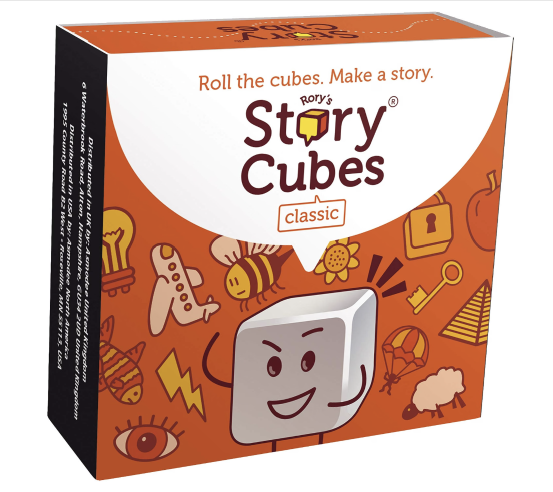
🎲✨ Rory's Story Cubes — Roll, Imagine & Tell a Story!
-
Nine little dice, dozens of pictures, and an endless world of stories waiting to be told!
Rory's Story Cubes is one of those wonderfully simple games that can encourage an incredible amount of language development.
The Classic set includes nine dice featuring 54 different illustrations. Children roll the dice, look at the pictures, and use their imaginations to create a story.
What I especially love about Rory's Story Cubes is that it turns storytelling into a fun, creative experience without requiring children to read or write!
For children who struggle to think of ideas, organize their thoughts, or tell a complete story, the pictures provide visual inspiration and a starting point.
And for children who already love storytelling, the possibilities are practically endless!
From a speech-language perspective, this game is particularly valuable for developing narrative language, sequencing, sentence formulation, vocabulary, inferencing, and higher-level reasoning.
Children learn to connect ideas, describe characters and settings, create problems and solutions, and explain why events happen.
The dice also encourage flexible thinking because children must find meaningful connections between pictures that may initially seem unrelated.
A picture of a castle, a key, and a lightning bolt could become a mysterious adventure involving a hidden treasure and a powerful storm!
I also love that there's no single correct story.
Two children can roll the exact same pictures and create completely different adventures.
That makes Rory's Story Cubes a wonderful activity for encouraging creativity, confidence, and individual expression.
And because the game can be played independently, with a parent, or with a group of friends, it offers opportunities for both individual language development and social communication.
Sometimes all it takes is one little picture to unlock a child's imagination!
🧠 Did You Know?
Playing Rory's Story Cubes can help develop:
Narrative Language: Creating organized stories with characters, settings, initiating events, problems, actions, and solutions.
Expressive Language: Formulating sentences, describing events, explaining ideas, and organizing thoughts into meaningful messages.
Sequencing: Arranging story events in a logical order using temporal vocabulary.
Vocabulary Development: Learning and using descriptive words, action verbs, emotions, and more sophisticated vocabulary.
Sentence Complexity: Combining ideas using conjunctions such as because, although, while, unless, and therefore.
Inferencing: Making connections between pictures and developing explanations for events.
Cause & Effect: Understanding why something happens and how one event influences another.
Executive Functioning: Planning, organizing ideas, maintaining attention, working memory, and cognitive flexibility.
Perspective-Taking: Considering characters' thoughts, feelings, motivations, and different viewpoints.
Social Communication: Taking turns, listening to others, contributing ideas, and building stories cooperatively.
Creative Thinking: Generating original ideas, exploring possibilities, and adapting to unexpected story elements.
Speech Sound Development: Practicing individualized articulation targets through storytelling and connected speech.
🎲 10 Ways to Play & Learn with Rory's Story Cubes!
1. Once Upon a Time... 📖
Begin with just three dice.
Roll them and encourage your child to create a simple story using all three pictures.
Help them include a character, something that happens, and an ending.
Try Saying: "Once upon a time, a little boy found a mysterious key. He used it to open a castle door and discovered a hidden treasure!"
As your child becomes more confident, gradually increase the number of dice.
Language Focus: Narrative development, sequencing, sentence formulation, expressive organization.
2. First, Next, Then, Last! 🔢
Roll four dice and encourage your child to arrange them in the order they want to use them.
Ask them to create a story using sequencing vocabulary.
Try Saying: "First, the girl found a map. Next, she traveled through the forest. Then she discovered a cave. Finally, she found the treasure!"
Encourage older children to include additional details explaining how the events are connected.
Language Focus: Sequencing, temporal concepts, narrative organization, expressive language.
3. Build a Better Sentence! 🗣️
Roll one or two dice and encourage your child to create a sentence using the pictures.
Begin with a simple sentence and gradually expand it.
Try Saying:
"The dog ran."
"The little brown dog ran."
"The little brown dog ran through the forest because he heard a strange noise."
Encourage your child to add descriptive words, locations, reasons, and additional details.
Language Focus: Sentence expansion, grammar, descriptive vocabulary, complex sentence formulation.
4. What Happens Next? 🔮
Roll three dice and create the beginning of a story.
Before revealing another die, ask your child to predict what might happen next.
Then roll an additional die and incorporate the new picture into the story.
Try Saying: "The pirate found a mysterious box. What do you think might be inside?"
Encourage your child to explain why their prediction makes sense.
Language Focus: Predicting, inferencing, reasoning, expressive language.
5. The Story Problem Challenge! 🤔
Roll several dice and ask your child to create a story involving a problem that must be solved.
Encourage them to explain what went wrong, how the characters responded, and how the problem was resolved.
Try Saying: "The astronaut's spaceship broke down on a strange planet. How could the astronaut get home?"
For older children, encourage multiple possible solutions and discussion of their consequences.
Language Focus: Problem-solving, narrative structure, cause and effect, reasoning.
6. How Does the Character Feel? ❤️
Choose a die and use the picture to create a character or situation.
Ask your child to describe how the character might feel and why.
Try Saying: "The little girl found herself alone in a dark forest. She felt nervous because she didn't know how to get home."
Encourage children to use more specific emotional vocabulary such as anxious, relieved, frustrated, disappointed, curious, and proud.
Language Focus: Emotional vocabulary, perspective-taking, inferencing, complex sentences.
7. Pass the Story! 🤝
Play with two or more people.
The first player rolls a die and begins the story. The next player rolls another die and adds a new event.
Continue taking turns until the group has created a complete adventure.
Try Saying: "One day, a dragon flew over a village..."
The next player might add, "Suddenly, the dragon spotted a mysterious castle!"
Encourage players to listen carefully and connect their ideas to what has already happened.
Language Focus: Social communication, turn-taking, auditory comprehension, working memory, collaborative storytelling.
8. Because, Although & However! 🔗
Roll several dice and challenge your child to create sentences using specific connecting words.
Begin with because, so, and but, then introduce more complex conjunctions.
Try Saying:
"The knight ran into the castle because a storm was coming."
"Although the bridge was broken, the travelers found another way across."
"The pirate wanted to open the treasure chest; however, he couldn't find the key."
Language Focus: Complex sentence formulation, conjunctions, cause and effect, higher-level expressive language.
9. Speech Sound Story Challenge! 🗣️
Use the dice to create stories that incorporate your child's speech sound targets.
Choose a target sound and encourage your child to include words containing that sound.
For example:
/r/: rabbit, rainbow, rocket, river, treasure
/s/: sun, snake, castle, spaceship, forest
/l/: lion, ladder, lightning, balloon, castle
/sh/: ship, shell, shadow, treasure, wish
/th/: thunder, three, think, path, earth
Try Saying: "The rabbit raced across the river to find a rainbow!"
For children working on carryover, encourage accurate production during spontaneous storytelling rather than interrupting every sentence.
Language Focus: Articulation, sentence formulation, narrative development, speech sound generalization.
10. The Ultimate Storytelling Challenge! 🌟
Once your child is comfortable creating shorter stories, roll all nine dice.
Challenge them to create an organized story incorporating every picture.
Encourage them to plan the story before beginning.
Ask them to identify the characters, setting, problem, important events, and solution.
Try Saying: "My story takes place in a magical kingdom. The main character is a young explorer who must find a missing treasure before sunset!"
For older children, encourage dialogue, unexpected plot twists, and detailed descriptions.
Afterward, ask your child to retell the story or write it down.
Language Focus: Advanced narrative organization, planning, working memory, creativity, complex expressive language.
🌱 Grow With Me! — Same Game, New Skills!
Ages 4–5: Exploring Pictures & Beginning Storytelling
Although the manufacturer recommends Rory's Story Cubes for ages 6 and older, younger children may participate in simplified, closely supervised storytelling activities when developmentally appropriate.
Use only one or two dice at a time.
Encourage your child to name the pictures, describe what they see, and create simple sentences.
Model short stories using familiar characters and events.
For example: "The dog found a ball. He played in the park!"
Introduce basic sequencing concepts such as first, next, and last.
Provide choices and verbal models when children have difficulty generating ideas.
Ages 6–8: Building Narrative Structure & Sentence Organization
Begin with three or four dice and encourage children to create stories with a clear beginning, middle, and end.
Help them identify characters, settings, problems, and solutions.
Encourage the use of descriptive vocabulary, sequencing words, and complete sentences.
Ask questions such as "Who is in your story?" "What happened?" "Why did that happen?" and "How did the problem get solved?"
Gradually increase the number of dice as children's storytelling abilities develop.
Ages 9–12: Expanding Complex Language & Creative Reasoning
Challenge children to create longer, more detailed stories using six to nine dice.
Encourage complex sentence structures, character motivations, dialogue, and cause-and-effect relationships.
Introduce more sophisticated vocabulary and connecting words such as although, however, meanwhile, therefore, and unless.
For example: "Although the explorer was frightened by the mysterious noise, she continued through the forest because she was determined to find the missing treasure."
Encourage children to develop unexpected plot twists while maintaining a logical story structure.
Challenge them to retell stories from different characters' perspectives.
Ages 12+: Developing Advanced Narrative & Executive Functioning Skills
For older children and teens, introduce more sophisticated storytelling challenges involving planning, organization, reasoning, and flexible thinking.
Challenge them to create stories in specific genres such as mystery, science fiction, fantasy, or comedy.
Encourage detailed character development, dialogue, complex conflicts, and meaningful resolutions.
Introduce timed storytelling activities or require children to incorporate unexpected pictures without losing the overall organization of the story.
Older children can also use the dice as creative writing prompts, developing short stories, scripts, or illustrated narratives.
These activities support advanced expressive language, metacognition, executive functioning, and creative writing.
💜 Miss Angie's Reminder
Every child has a story to tell—sometimes they just need a little help getting started!
One of the things I love most about Rory's Story Cubes is that the pictures take away some of the pressure children may feel when asked to create a story from nothing.
For children who struggle with language organization, the visual prompts provide ideas they can build upon.
And for children who already love storytelling, the dice introduce unexpected possibilities that encourage creativity and flexible thinking.
Remember, the goal isn't to create the longest or most elaborate story.
It's to help children communicate their ideas clearly and confidently.
If your child has difficulty getting started, model a simple sentence or offer two possible ideas.
You might say, "I see a castle and a key. Maybe someone is trying to open a secret door!"
Then give your child an opportunity to add to the story.
Avoid correcting every grammatical error while your child is speaking. Instead, model the correct sentence naturally.
For example, if your child says, "The boy goed to the castle," you might respond, "Yes! The boy went to the castle, and then he discovered something amazing!"
This provides a helpful language model without interrupting the flow of the story.
And don't forget to join in the fun!
Take turns creating silly adventures, unexpected characters, and imaginative endings.
Sometimes the most memorable stories are the ones that make everyone laugh!
Because when children learn to organize their thoughts, connect their ideas, and share their imaginations, they're building communication skills that last far beyond the game!
⚠️ Safety Note: Rory's Story Cubes Classic is recommended for ages 6 and older. The set contains nine small dice that may pose a choking hazard for children under 3. Keep the dice away from younger siblings and supervise play as appropriate. For children who need additional support, begin with fewer dice and gradually increase the complexity of the storytelling activities.
🔬 Science & Discovery
🌱🦕 National Geographic Light-Up Dinosaur Terrarium — Grow, Discover & Explore!
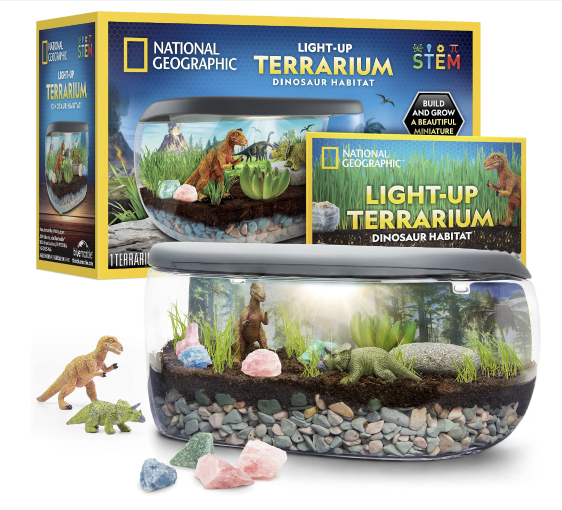
-
What happens when you combine dinosaurs, real growing plants, beautiful gemstones, and a little imagination?
You create a miniature prehistoric world that's full of opportunities for learning!
The National Geographic Light-Up Dinosaur Terrarium Kit allows children to build their own dinosaur habitat while discovering the fascinating process of growing plants.
Children begin by arranging pebbles, preparing the growing medium, planting chia and ryegrass seeds, and decorating their miniature world with dinosaur figures, gemstones, and other accessories.
Then comes one of my favorite parts—watching what happens next!
Over the following days, children can observe their seeds sprouting, notice changes in the plants, and learn how water, light, and proper care contribute to growth.
The terrarium even includes a USB-powered light-up lid, making the finished habitat a fun display that children can continue to enjoy.
What I especially love about this activity is that it encourages children to observe, question, predict, describe, and explain—five important foundations of both scientific thinking and language development!
From a speech-language perspective, this kit offers opportunities to strengthen vocabulary, sequencing, following directions, describing, comparing and contrasting, predicting, and cause-and-effect reasoning.
Children encounter scientific concepts such as germination, roots, stems, moisture, habitats, and plant growth while participating in a meaningful hands-on activity.
And because the plants change over time, the opportunities for conversation continue long after the terrarium is assembled!
I also appreciate how the dinosaur figures encourage imaginative storytelling. Children can create adventures within their miniature habitat while practicing narrative organization, descriptive language, and problem-solving.
Best of all, this activity encourages children to slow down, notice details, and develop curiosity about the natural world.
One little terrarium can grow a whole lot more than plants—it can grow language, curiosity, and confidence!
🧠 Did You Know?
Building and caring for a terrarium can help develop:
Scientific Vocabulary: Learning words such as seed, germinate, sprout, root, stem, soil, moisture, habitat, and growth.
Following Directions: Listening to, understanding, and completing multistep instructions during assembly and plant care.
Sequencing: Explaining the order of planting, watering, sprouting, and growing.
Descriptive Language: Using words to describe colors, shapes, sizes, textures, positions, and changes.
Comparing & Contrasting: Identifying similarities and differences between seeds, plants, gemstones, and dinosaurs.
Predicting: Making educated guesses about when seeds will sprout and how plants may change.
Cause & Effect: Understanding how water, light, and environmental conditions influence plant growth.
Inferencing: Using observations and background knowledge to explain why something may be happening.
Expressive Language: Explaining procedures, sharing observations, answering questions, and describing discoveries.
Narrative Development: Creating imaginative stories involving dinosaurs and their prehistoric habitat.
Executive Functioning: Planning, organizing materials, remembering steps, monitoring progress, and developing responsibility.
Early Scientific Reasoning: Asking questions, making observations, recording information, and drawing conclusions.
🌱 10 Ways to Play & Learn with the Dinosaur Terrarium!
1. Let's Build a Dinosaur World! 🦕
Before beginning, spread out the materials and explore the different pieces together.
Encourage your child to identify the items, describe their characteristics, and explain what they think each piece will be used for.
Try Saying: "We have pebbles, soil, seeds, and dinosaurs! What do you think we should put inside the terrarium first?"
As you assemble the habitat, model sequencing vocabulary such as first, next, then, and finally.
Language Focus: Following directions, sequencing, vocabulary, planning, expressive language.
2. The Planting Sequence Challenge! 🔢
After completing the terrarium, ask your child to explain the steps involved in planting the seeds.
Encourage them to describe the process in the correct order.
Try Saying: "First, we prepared the soil. Next, we sprinkled the seeds. Then we misted them with water. Finally, we put the terrarium in a suitable place to grow!"
For older children, encourage explanations that include why each step was important.
Language Focus: Sequencing, temporal concepts, procedural language, narrative organization.
3. Little Scientist Predictions! 🔮
Before the seeds begin growing, encourage your child to predict what will happen.
Ask questions that require them to explain their reasoning.
Try Saying: "I predict the seeds will begin to sprout in a few days because they have moisture and the right growing conditions!"
Write down or draw the predictions and revisit them as the plants grow.
Language Focus: Predicting, reasoning, future tense, cause and effect.
4. The Daily Observation Challenge! 🔍
Encourage your child to examine the terrarium regularly and describe what has changed.
Use a notebook, drawing, or simple observation chart to record discoveries.
Try Saying: "Yesterday, I couldn't see any sprouts. Today, I can see three tiny green shoots!"
Encourage more specific descriptions using words such as taller, shorter, thinner, thicker, brighter, and smaller.
Language Focus: Descriptive language, comparing and contrasting, observation, expressive language.
5. Why Do Plants Need Water? 💧
Use plant care as an opportunity to discuss cause-and-effect relationships.
Ask your child what might happen if the soil becomes too dry or too wet.
Try Saying: "Plants need water to grow, but too much water can cause problems because the soil may stay overly wet."
Encourage your child to explain how different conditions might influence the plants.
Language Focus: Cause and effect, scientific reasoning, complex sentence formulation, problem-solving.
6. Compare the Growing Plants! 🌿
As the chia and ryegrass grow, encourage your child to compare their appearance.
Discuss similarities and differences in color, shape, height, and growth patterns.
Try Saying: "Both plants are green, but one has thinner leaves while the other looks different!"
Encourage older children to record measurements and compare growth over time.
Language Focus: Comparing and contrasting, adjectives, measurement vocabulary, scientific observation.
7. Dinosaur Habitat Adventures! 🦖
Use the decorative dinosaur figures to create imaginative stories within the terrarium.
Encourage your child to invent characters, describe the setting, and develop a problem and solution.
Try Saying: "The triceratops was searching for food when it discovered a mysterious valley filled with giant plants!"
Ask questions such as "What happened next?" and "How did the dinosaur solve the problem?"
Language Focus: Narrative development, sequencing, descriptive language, imagination, problem-solving.
8. Where Does It Belong? 📍
Use the terrarium's decorations to practice spatial concepts.
Ask your child to describe where different objects are located.
Try Saying: "The dinosaur is beside the rock. The gemstone is in front of the plant. The small pebble is between two larger stones."
Introduce increasingly complex location words such as behind, between, underneath, beside, across from, and in the center.
Language Focus: Spatial concepts, prepositions, receptive language, expressive language.
9. Become a Science Reporter! 🎤
Invite your child to pretend they're a scientist reporting on their latest discovery.
Encourage them to explain what they planted, how they cared for it, and what they observed.
Try Saying: "Today I discovered that several seeds have sprouted! The plants are growing taller, and I noticed new green leaves!"
For older children, encourage a more detailed presentation including predictions, observations, and conclusions.
Language Focus: Expository language, summarization, sentence organization, scientific vocabulary, public speaking.
10. The Plant Growth Experiment! 🧪
For children ready for more advanced scientific reasoning, use the terrarium as inspiration for a simple experiment.
With adult assistance, plant additional seeds in separate labeled containers and compare one growing condition at a time.
For example, compare different amounts of water while keeping the seed type, light exposure, and other conditions as similar as possible.
Try Saying: "My hypothesis is that the seeds with the right amount of water will grow better than seeds that don't receive enough water."
Encourage your child to record observations and explain whether the results supported their prediction.
Language Focus: Hypothesizing, comparing and contrasting, cause and effect, reasoning, scientific explanation.
🌱 Grow With Me! — Same Terrarium, New Skills!
Ages 6–8: Exploring Plant Growth & Building Scientific Vocabulary
At this age, focus on hands-on exploration, simple observations, and basic scientific concepts.
Help your child follow the instructions while assembling the terrarium.
Introduce vocabulary such as seed, soil, water, root, stem, leaf, and sprout.
Encourage children to describe what they see using complete sentences.
Ask simple questions such as "What changed?" "What color are the sprouts?" and "What do plants need to grow?"
Use drawings or photographs to document growth.
Encourage imaginative dinosaur stories to connect scientific exploration with creative language development.
Ages 9–12: Developing Scientific Reasoning & Complex Language
Encourage children to take more responsibility for assembling and maintaining their terrarium.
Introduce more advanced vocabulary such as germination, moisture, nutrients, environment, and photosynthesis.
Challenge children to make predictions and explain their reasoning.
Encourage comparisons between plant varieties and measurements of growth.
Introduce complex sentence structures using because, although, however, and therefore.
For example: "Although both seeds received the same amount of water, one variety appeared to grow more quickly than the other."
Encourage children to maintain an observation journal and summarize their findings.
Ages 12+: Expanding Scientific Inquiry & Analytical Language
For older children and teens, use the terrarium as a starting point for more advanced scientific investigations.
Discuss plant biology, environmental conditions, photosynthesis, and the role of water and nutrients in plant growth.
Encourage children to develop hypotheses, design simple controlled experiments, collect measurements, and interpret results.
Introduce scientific vocabulary such as variables, observations, data, hypothesis, evidence, and conclusion.
Challenge children to create graphs showing plant growth or write short scientific reports.
Discuss how the miniature planted habitat differs from a complete, self-sustaining ecosystem.
Encourage children to evaluate their results and identify additional questions for investigation.
These activities support scientific literacy, higher-level reasoning, expository language, and executive functioning.
💜 Miss Angie's Reminder
Some of the most meaningful learning happens when children have time to watch, wonder, and discover!
One of the things I especially appreciate about growing plants is that the learning doesn't end when the activity is finished.
Instead, the experience continues as children observe changes over several days or weeks.
And every new discovery provides an opportunity for language development!
When your child notices something different, encourage them to describe it.
You might say, "I noticed something new today!" or "I wonder why that plant is growing faster!"
These simple comments model observation, curiosity, and scientific thinking.
Remember, you don't need to know every scientific answer!
It's perfectly fine to say, "That's a great question! Let's find out together!"
In fact, modeling curiosity and a willingness to learn can be just as valuable as providing an immediate explanation.
Encourage your child to make predictions, even when those predictions turn out to be incorrect.
Scientific learning involves observing, testing ideas, and sometimes changing our thinking when new information becomes available.
And don't forget the imaginative side of this activity!
Those little dinosaur figures can inspire wonderful stories, creative adventures, and opportunities to practice narrative language.
Because when children plant a seed of curiosity, they're also growing the language, reasoning, and confidence to explore the world around them!
⚠️ Safety Note: Recommended for ages 6 and older. This kit contains small decorative pieces, including gemstones and pebbles, that may present a choking hazard for children under 3. Adult supervision is recommended during assembly and when handling the growing medium, seeds, and electrical components. Wash hands after handling planting materials, avoid overwatering, and follow the manufacturer's instructions for lighting and plant care. If visible mold develops, have an adult address it safely. The dinosaur figures are decorative, and the terrarium is not intended to house live animals.
🌊🐬 Ocean Light-Up Terrarium — Dive Into an Underwater World of Discovery!
-
What if your child could create an entire underwater world filled with sharks, dolphins, whales, sea turtles, and colorful ocean scenery?
With the Ocean Light-Up Terrarium Kit, children can become ocean explorers, habitat designers, and imaginative storytellers—all while learning about the fascinating world beneath the waves!
This hands-on craft kit includes an assortment of 18 sea-animal figures, decorative sand, artificial marine plants, and ocean-themed accessories that children can arrange inside a clear display container.
Once their underwater scene is complete, the colorful LED lighting transforms their creation into a glowing ocean display!
What I especially love about this activity is how it combines hands-on creativity with opportunities for scientific vocabulary, language development, and imaginative play.
Children can identify marine animals, compare their characteristics, describe where they live, and discuss how they survive in different ocean environments.
From a speech-language perspective, this kit provides opportunities to strengthen categorization, descriptive language, spatial concepts, sequencing, comparing and contrasting, inferencing, and higher-level reasoning.
I particularly appreciate the opportunities for classification.
Children can sort animals according to their characteristics, such as whether they have fins, flippers, shells, or tentacles.
They can also explore the difference between fish and marine mammals, learn about ocean habitats, and discuss predator-prey relationships.
And because children are creating their own underwater scene, the activity naturally encourages planning, following directions, problem-solving, and explaining their decisions.
The sea-animal figures also provide wonderful opportunities for storytelling!
A curious dolphin might discover a hidden underwater cave, a sea turtle might become separated from its family, or a shark might encounter an unexpected visitor.
These imaginative adventures help children practice creating characters, developing problems, sequencing events, and explaining solutions.
Unlike a plant-growing terrarium, this kit creates a decorative marine scene rather than a living ecosystem. That makes it especially useful for exploring marine biology concepts, animal classification, habitat vocabulary, and creative storytelling.
One little ocean display can inspire a whole sea of language, learning, and imagination!
🧠 Did You Know?
Creating and exploring an ocean-themed habitat can help develop:
Scientific Vocabulary: Learning words such as marine, habitat, ecosystem, predator, prey, coral, tentacles, fins, flippers, and adaptation.
Categorization: Grouping animals according to shared characteristics, habitats, or biological classifications.
Descriptive Language: Explaining differences in animal appearance, size, color, shape, and movement.
Comparing & Contrasting: Identifying similarities and differences between marine animals.
Spatial Concepts: Understanding and using words such as above, below, beside, between, behind, and underneath.
Following Directions: Listening to and completing multistep instructions during habitat construction.
Sequencing: Explaining the steps involved in designing and assembling an underwater scene.
Inferencing: Using knowledge and clues to explain animal behavior and habitat relationships.
Cause & Effect: Understanding how changes in an environment can affect marine life.
Narrative Development: Creating imaginative stories with characters, settings, problems, events, and solutions.
Executive Functioning: Planning, organizing materials, making decisions, and adapting designs.
Social Communication: Sharing ideas, negotiating placement, collaborating, and explaining choices.
🌊 10 Ways to Play & Learn with the Ocean Terrarium!
1. Let's Build an Ocean Habitat! 🐠
Before assembling the terrarium, spread out the materials and explore the different pieces together.
Encourage your child to identify the animals, describe the decorations, and explain how they want to arrange their underwater world.
Try Saying: "First, let's arrange the sand. Next, we can add the ocean plants. Then we'll decide where the sea animals should go!"
Ask your child to explain why they chose particular locations.
Language Focus: Following directions, sequencing, planning, spatial vocabulary, expressive language.
2. Ocean Animal Detective! 🔍
Choose one sea-animal figure and encourage your child to describe it without naming it.
Other players must guess which animal is being described.
Try Saying: "This animal has eight arms, a soft body, and can squeeze into small spaces. What is it?"
For older children, introduce scientific characteristics and more detailed descriptions.
Language Focus: Descriptive language, categorization, vocabulary, inferencing.
3. Fish or Mammal? 🐬
Use the sea-animal figures to introduce basic animal classification.
Discuss which animals are fish, which are mammals, and which belong to other groups.
Try Saying: "A dolphin lives in the ocean, but it isn't a fish. It's a mammal because it breathes air with lungs and feeds milk to its babies!"
Discuss how sharks, dolphins, whales, turtles, and octopuses differ.
Language Focus: Categorization, scientific vocabulary, comparing and contrasting, explaining.
4. Where Does It Belong? 📍
Use the figures and decorations to practice spatial concepts.
Ask your child to place animals in different positions within the display before the final arrangement.
Try Saying: "Put the turtle beside the coral. Place the dolphin above the rocks. Now move the octopus behind the seaweed!"
Encourage your child to give directions as well.
Language Focus: Spatial concepts, prepositions, receptive language, expressive language.
5. Compare the Sea Creatures! ⚖️
Choose two animals and encourage your child to explain how they are alike and different.
Try Saying: "Both dolphins and sharks swim in the ocean, but dolphins are mammals and sharks are fish!"
For younger children, compare visible characteristics such as size, color, and shape.
For older children, discuss breathing, reproduction, diet, and movement.
Language Focus: Comparing and contrasting, categorization, descriptive vocabulary, complex sentences.
6. Who Eats What? 🍽️
Introduce the concept of marine food chains using the animal figures.
Discuss what different ocean animals eat and how they obtain food.
Try Saying: "Some sharks eat fish, while many sea turtles eat jellyfish, seagrass, or other foods depending on the species!"
Encourage children to think about what might happen if an important food source became scarce.
Language Focus: Scientific vocabulary, cause and effect, reasoning, inferencing.
7. Underwater Adventure Stories! 🐙
Use the sea-animal figures to create imaginative ocean adventures before arranging them permanently in the display.
Encourage your child to invent characters, describe the setting, develop a problem, and explain how it is solved.
Try Saying: "A young dolphin was exploring the coral reef when it discovered a mysterious underwater cave!"
Ask questions such as "What happened next?" and "How did the dolphin solve the problem?"
Language Focus: Narrative development, sequencing, descriptive language, problem-solving.
8. The Ocean Habitat Challenge! 🪸
Ask your child to imagine that one of the marine animals needs a safe place to live.
Encourage them to design a habitat and explain their choices.
Try Saying: "The little fish needs somewhere to hide from larger predators, so I'm going to place it near the coral!"
For older children, discuss how different species have different habitat requirements.
Explain that the decorative display is an imaginary scene and may not represent the natural habitat of every animal included.
Language Focus: Problem-solving, inferencing, cause and effect, scientific explanation.
9. Become a Marine Biologist! 🎤
Invite your child to pretend they're a marine biologist presenting information about an ocean animal.
Encourage them to describe its appearance, habitat, diet, and interesting characteristics.
Try Saying: "Today I'm studying octopuses! They have eight arms, can change color, and are very good at hiding!"
For older children, encourage research using age-appropriate nonfiction books or trusted educational resources.
Language Focus: Expository language, summarization, scientific vocabulary, organized expressive language.
10. Save Our Oceans! 🌎
Use the completed terrarium as a starting point for conversations about protecting marine environments.
Discuss pollution, plastic waste, habitat destruction, and ways people can help protect ocean animals.
Try Saying: "If plastic trash enters the ocean, some animals might mistake it for food. That's why keeping our beaches and waterways clean is important!"
Encourage your child to suggest ways families can reduce waste and protect the environment.
For older children, discuss how human activities can affect marine food webs and ecosystems.
Language Focus: Cause and effect, problem-solving, critical thinking, persuasive language.
🌱 Grow With Me! — Same Ocean Terrarium, New Skills!
Ages 4–5: Exploring Ocean Animals & Beginning Language Skills
Although this product is featured in the 6+ section of Miss Angie's Toy Box, the manufacturer also markets it for younger children.
With close adult supervision, younger children can participate in simplified activities appropriate to their developmental abilities.
Focus on identifying sea animals, naming colors, describing basic characteristics, and practicing simple spatial concepts.
Ask questions such as "Where is the fish?" "Which animal is bigger?" and "Can you find the turtle?"
Model short descriptive sentences.
For example: "The shark is big. The dolphin is gray. The turtle swims!"
Adults should handle small decorative pieces and lighting components as needed.
Ages 6–8: Building Scientific Vocabulary & Descriptive Language
Encourage children to take a more active role in designing their ocean scene.
Introduce vocabulary such as marine, habitat, coral, predator, prey, and ecosystem.
Practice categorizing animals, comparing their characteristics, and describing where they live.
Encourage complete sentences and explanations.
For example: "The octopus has eight arms, but the dolphin has flippers!"
Use the figures to create simple stories with a beginning, middle, and end.
Ages 9–12: Developing Scientific Reasoning & Higher-Level Language
Encourage children to research marine animals and explain how their physical characteristics help them survive.
Introduce concepts such as adaptation, food chains, food webs, and environmental relationships.
Challenge children to compare different ocean habitats, such as coral reefs, coastal waters, and the deep sea.
Encourage complex sentences using although, however, because, and therefore.
For example: "Although dolphins and sharks both live in the ocean, dolphins must surface to breathe air because they are mammals."
Invite children to present their findings or create informational reports.
Ages 12+: Expanding Marine Biology & Critical Thinking
For older children and teens, use the terrarium as a visual model for exploring more advanced marine science concepts.
Discuss biodiversity, ocean conservation, food webs, animal adaptations, and the effects of environmental changes.
Encourage children to research specific marine species and evaluate how their habitats differ.
Challenge them to identify scientific inaccuracies in their decorative display and explain how a realistic habitat might be different.
Older children can also create presentations, research reports, or persuasive writing projects about protecting marine environments.
These activities support scientific literacy, higher-level reasoning, expository language, and critical thinking.
💜 Miss Angie's Reminder
Children don't have to visit the ocean to begin exploring the amazing world beneath its surface!
One of the things I love most about ocean-themed activities is how naturally they inspire questions.
Why do dolphins come to the surface?
How do octopuses hide?
What makes a shark different from a whale?
Where do sea turtles live?
Every question creates an opportunity for conversation, vocabulary development, and scientific discovery.
And you don't have to know every answer!
You might say, "That's a wonderful question! Let's find out together!"
Encourage your child to describe what they notice, explain their ideas, and ask additional questions.
If your child gives an incomplete answer, model a slightly more detailed response.
For example, if your child says, "Shark big," you might respond, "Yes! The shark is big, and it has sharp teeth!"
For older children, encourage more detailed explanations and discussions.
Remember, this activity doesn't have to be completed in one sitting.
Children can spend time exploring the figures, planning their display, learning about the animals, and creating stories before assembling the final scene.
And once their ocean display is complete, it can continue to inspire conversations about marine life, habitats, and conservation.
Because when children dive into discovery, they're building a whole ocean of vocabulary, imagination, reasoning, and communication skills!
⚠️ Safety Note: This ocean-themed craft kit contains small animal figures and decorative materials that may pose a choking hazard for young children. Follow the age guidance and warnings on the specific product packaging, and supervise assembly as appropriate. Adults should assist with electrical or battery-powered lighting components. Keep batteries and remote-control battery compartments secured and inaccessible to young children. This is a decorative model containing artificial marine scenery, not an aquarium for live animals or a kit for growing plants. Follow the manufacturer's instructions for assembly, lighting, and safe use.
💎🔍 National Geographic Rock Collection — Discover the Hidden Treasures of Our Earth!

-
What if your child could hold a piece of Earth's history right in the palm of their hand?
With the National Geographic Rock Collection, children can become young geologists as they explore genuine rocks, minerals, crystals, and beautiful gemstones from the natural world!
This fascinating collection includes a variety of specimens to examine, compare, identify, and organize. With the help of a magnifying glass and educational guide, children can investigate differences in color, texture, shape, and mineral characteristics.
Selected versions also include geodes that reveal beautiful crystals hidden inside ordinary-looking rocks!
What I especially love about this collection is that it transforms something children naturally enjoy—collecting interesting rocks—into an opportunity for meaningful scientific discovery and language development!
From a speech-language perspective, this activity is particularly valuable for strengthening descriptive language, categorization, comparing and contrasting, vocabulary development, inferencing, and higher-level reasoning.
Children learn to observe carefully and explain what makes one specimen different from another.
Is it smooth or rough? Transparent or opaque? Shiny or dull? Does it have visible crystals, layers, or interesting patterns?
These observations provide opportunities to expand vocabulary and formulate increasingly detailed sentences.
I also appreciate the opportunities for classification.
Children can organize their specimens by color, size, texture, appearance, or mineral type. As their knowledge develops, they can learn to distinguish rocks from minerals and explore how different geological materials form.
And because there are so many different specimens to examine, the possibilities for investigation continue long after the collection is first opened.
Children can create their own displays, develop identification systems, research unfamiliar specimens, and even begin collecting interesting rocks they discover outdoors.
One little rock collection can open the door to a lifetime of curiosity, discovery, and scientific exploration!
🧠 Did You Know?
Exploring rocks, minerals, and gemstones can help develop:
Scientific Vocabulary: Learning words such as geology, mineral, crystal, gemstone, geode, sediment, erosion, transparent, opaque, and formation.
Descriptive Language: Using precise adjectives to explain colors, textures, shapes, sizes, patterns, and physical characteristics.
Categorization: Sorting and classifying specimens according to shared attributes and scientific properties.
Comparing & Contrasting: Identifying similarities and differences between rocks, minerals, and crystals.
Inferencing: Using observable characteristics and background knowledge to make educated guesses.
Following Directions: Understanding and completing steps for identification, organization, and scientific activities.
Sequencing: Explaining the steps involved in examining, sorting, and identifying specimens.
Cause & Effect: Exploring how geological processes influence the formation and appearance of rocks and minerals.
Expressive Language: Describing observations, explaining discoveries, answering questions, and presenting information.
Executive Functioning: Organizing collections, planning investigations, maintaining attention, and developing classification systems.
Critical Thinking: Evaluating evidence, testing ideas, and revising conclusions when new information becomes available.
Expository Language: Explaining scientific information in a clear, organized, and meaningful way.
💎 10 Ways to Play & Learn with the Rock Collection!
1. Become a Rock Detective! 🔍
Choose one specimen and examine it carefully using the magnifying glass.
Encourage your child to describe everything they notice.
Discuss its color, shape, texture, size, and any unusual features.
Try Saying: "This rock is dark gray, has a rough surface, and contains tiny sparkling crystals!"
Encourage increasingly detailed descriptions as your child's vocabulary develops.
Language Focus: Descriptive language, adjectives, observation, expressive language.
2. The Great Rock Sorting Challenge! 🪨
Spread several specimens across a table and encourage your child to sort them into groups.
Begin with simple categories such as color, size, or texture.
Then introduce more complex classification systems.
Try Saying: "I'm putting these rocks together because they're smooth and shiny. These belong in another group because they're rough!"
Ask your child to explain why each specimen belongs in a particular category.
Language Focus: Categorization, comparing and contrasting, reasoning, explaining.
3. Same or Different? ⚖️
Choose two specimens and encourage your child to identify similarities and differences.
Try Saying: "Both rocks are pink, but one is smooth and polished while the other has a rough, uneven surface!"
For older children, introduce more advanced comparisons involving mineral composition, crystal structure, or formation.
Language Focus: Comparing and contrasting, descriptive vocabulary, complex sentence formulation.
4. Guess My Gemstone! 💎
Choose a specimen without showing it to the other player.
Describe its characteristics and encourage the listener to guess which specimen you're holding.
Try Saying: "I'm thinking of a mineral that is purple, sometimes transparent, and often forms beautiful crystals!"
Take turns providing clues and making guesses.
For older children, encourage the use of more precise scientific vocabulary.
Language Focus: Descriptive language, inferencing, auditory comprehension, semantic relationships.
5. What's Inside a Geode? 🔮
If your selected kit includes unopened geodes, discuss what your child thinks might be inside before an adult opens one using the manufacturer's safety instructions.
Encourage predictions based on the geode's external appearance.
Try Saying: "The outside looks rough and ordinary, but I predict there might be sparkling crystals inside!"
After the geode has been safely opened, compare the prediction with the actual discovery.
Language Focus: Predicting, inferencing, scientific vocabulary, comparing and contrasting.
6. The Rock Identification Challenge! 📖
Use the included learning guide to help identify different specimens.
Encourage your child to compare the specimen's characteristics with the descriptions and photographs in the guide.
Try Saying: "I think this might be rose quartz because it has a pink color and looks similar to the picture!"
Explain that some minerals can look alike and may require additional testing for accurate identification.
Language Focus: Reading comprehension, visual discrimination, reasoning, scientific vocabulary.
7. How Did It Form? 🌋
Choose a specimen and research how that type of rock or mineral forms.
Introduce concepts such as cooling magma, sediment accumulation, heat, pressure, and crystal growth.
Try Saying: "Some rocks form when melted rock cools and hardens. Others form when layers of sediment become compacted over time!"
Encourage your child to explain the process using sequencing words.
Language Focus: Cause and effect, sequencing, expository language, scientific reasoning.
8. Create Your Own Rock Museum! 🏛️
Invite your child to organize their favorite specimens into a miniature museum display.
Use small containers or labeled spaces to arrange the collection.
Encourage your child to create identification cards describing each specimen.
Try Saying: "This is my quartz collection. Quartz is a mineral, and it can appear in many different colors!"
Invite family members to visit the museum while your child acts as the tour guide.
Language Focus: Categorization, organization, descriptive language, public speaking, expository language.
9. Become a Junior Geologist! 🎤
Ask your child to select a favorite specimen and prepare a short presentation about it.
Encourage them to include its name, appearance, interesting characteristics, and where it may be found.
Try Saying: "Today I'm going to tell you about amethyst! It's a purple variety of quartz, and it can form beautiful crystals!"
For older children, encourage research about mineral formation, geographic locations, and everyday uses.
Language Focus: Research skills, summarization, scientific vocabulary, organized expressive language.
10. Start a Family Rock-Hunting Adventure! 🌎
Take your child's interest beyond the collection by looking for interesting rocks during outdoor walks or family trips.
Only collect specimens where permitted and safe.
Encourage your child to describe the rocks they discover and compare them with the specimens in their collection.
Try Saying: "I found a smooth gray rock near the stream. I wonder if the moving water helped make its edges rounded!"
Create a journal recording where each rock was found, what it looks like, and what your child thinks it might be.
Language Focus: Observation, descriptive language, inferencing, comparing and contrasting, scientific inquiry.
🌱 Grow With Me! — Same Collection, New Skills!
Ages 6–7: Exploring Colors, Shapes & Basic Classification
Although the manufacturer recommends this collection for ages 8 and older, younger children can explore basic geology concepts using appropriately sized specimens selected and handled by an adult.
Focus on simple observations and descriptive vocabulary.
Encourage children to identify colors, compare sizes, and describe textures.
Introduce words such as smooth, rough, shiny, dull, heavy, and light.
Practice sorting objects according to one characteristic at a time.
Ask simple questions such as "Which rock is bigger?" "Which one is smoother?" and "How are these two alike?"
Use photographs and adult demonstrations rather than allowing younger children to handle small specimens or participate in geode-breaking activities.
Ages 8–10: Building Scientific Vocabulary & Classification Skills
Encourage children to examine, sort, and identify specimens using the learning guide.
Introduce vocabulary such as mineral, crystal, gemstone, geode, transparent, and opaque.
Challenge children to classify specimens using more than one characteristic.
Encourage complete sentences that explain similarities and differences.
For example: "Both specimens contain quartz, but one is purple while the other is pink."
Invite children to organize their collection and create simple identification labels.
Ages 11–12: Developing Scientific Reasoning & Complex Language
Introduce more advanced geology concepts such as the rock cycle, mineral formation, erosion, and geological processes.
Encourage children to research how different rocks and minerals form.
Challenge them to explain their observations using evidence.
Introduce complex sentence structures using although, however, because, and therefore.
For example: "Although these two minerals look similar, they may have different physical properties and chemical compositions."
Encourage children to create charts, compare specimens, and present their findings.
Ages 13+: Expanding Geological Knowledge & Analytical Thinking
For older children and teens, use the collection as a starting point for more advanced scientific investigations.
Explore concepts such as mineral composition, crystal structure, geological time, the rock cycle, and the identification of rocks and minerals.
Discuss how scientists use properties such as hardness, streak, luster, and crystal form to help identify minerals.
Encourage research projects, detailed classification systems, and written scientific reports.
Challenge children to explain how geological processes influence Earth's surface and natural resources.
These activities support scientific literacy, analytical reasoning, technical vocabulary, and expository language.
💜 Miss Angie's Reminder
Sometimes the most fascinating discoveries are hiding in the simplest things around us!
One of the things I love most about rocks and minerals is that children can explore them using their natural curiosity.
They don't need expensive laboratory equipment or complicated experiments to begin thinking like scientists.
They simply need opportunities to look closely, ask questions, make comparisons, and share what they discover.
When your child finds an interesting specimen, encourage them to describe what makes it special.
You might say, "I noticed that this one has tiny sparkling pieces!" or "I wonder why these two rocks have different colors!"
These simple observations create meaningful opportunities for vocabulary development and conversation.
And remember, you don't have to know the name of every rock!
It's perfectly fine to say, "I'm not sure what this is. Let's look it up together!"
This models curiosity, problem-solving, and a willingness to learn.
Encourage children to make educated guesses and explain their reasoning.
If they identify a specimen incorrectly, help them compare its characteristics with the information in the guide.
The goal isn't simply to memorize mineral names.
It's to develop the ability to observe carefully, organize information, describe discoveries, and think critically.
And don't forget to celebrate your child's enthusiasm!
Whether they're fascinated by sparkling crystals, unusual textures, colorful gemstones, or rocks they find in the backyard, their interests can become the starting point for meaningful language and learning experiences.
Because every rock has a story—and every curious child deserves the opportunity to discover it!
⚠️ Safety Note: Manufacturer-recommended age: 8 years and older. This collection contains small rocks, gemstones, and mineral specimens that may present choking hazards. Keep all specimens away from children under 3 and anyone who may place objects in their mouth. Some rocks and crystals may have sharp edges or break into fragments. If your kit includes unopened geodes, an adult should supervise and handle the breaking process according to the manufacturer's instructions, using appropriate eye protection and containing flying fragments. Avoid inhaling mineral dust, wash hands after handling specimens, and never taste or place rocks or minerals in the mouth. Use the magnifying glass only for observation, never to concentrate sunlight. Do not assume that every specimen is safe to place in water or clean with household chemicals.
🔧🏗️ 732-Piece STEM Engineering Building Set — Imagine, Build & Discover!
-
What happens when you give a child a collection of building pieces, an engineering challenge, and the freedom to create?
You open the door to an exciting world of imagination, problem-solving, and discovery!
This 732-piece STEM engineering building set encourages children to explore how different components fit together to create structures and mechanical models.
Children can follow building instructions, investigate how pieces connect, and experiment with their own designs.
But what I especially love is that the learning doesn't stop when the model is finished!
Children can examine their creations, explain how they work, identify problems, make adjustments, and explore new building possibilities.
From a speech-language perspective, construction activities are wonderful opportunities to strengthen receptive language, expressive language, sequencing, spatial concepts, problem-solving, and executive functioning.
Think about how much communication takes place during a building project!
Children must interpret directions, locate specific pieces, understand positional vocabulary, organize steps, and explain what they're doing.
They might need to ask for help, describe a missing component, clarify instructions, or explain why something isn't working.
And when a design doesn't turn out as expected, children have opportunities to practice flexible thinking, frustration tolerance, and problem-solving language.
I particularly appreciate how engineering activities encourage children to use more precise vocabulary.
Rather than saying, "Put that thing over there," children can learn to say, "Attach the longer piece horizontally between the two supports."
That's a significant difference in language complexity!
Building activities also introduce scientific and mathematical concepts such as balance, stability, force, measurement, symmetry, and structural design.
And because children can revisit their creations, make modifications, and attempt increasingly challenging projects, the opportunities for learning can grow with their abilities.
One building set can help children become designers, engineers, problem-solvers, and confident communicators!
🧠 Did You Know?
Engineering construction activities can help develop:
Following Directions: Understanding and completing increasingly complex multistep instructions.
Receptive Language: Interpreting positional words, descriptive vocabulary, quantities, and relationships between objects.
Expressive Language: Explaining ideas, describing construction steps, asking questions, and communicating solutions.
Spatial Concepts: Understanding words such as above, below, between, beside, underneath, parallel, perpendicular, and diagonal.
Sequencing: Organizing construction steps and explaining procedures in the correct order.
Problem-Solving: Identifying challenges, generating solutions, testing ideas, and making adjustments.
Cause & Effect: Understanding how changing one component can influence the performance or stability of a design.
Scientific Vocabulary: Learning words such as structure, support, stability, balance, force, tension, compression, and mechanism.
Comparing & Contrasting: Evaluating different materials, structures, designs, and solutions.
Executive Functioning: Planning, organizing materials, maintaining attention, monitoring progress, and adapting strategies.
Social Communication: Collaborating, negotiating ideas, taking turns, and explaining decisions.
Critical Thinking: Evaluating evidence, making predictions, and determining why a particular design succeeds or fails.
Fine Motor Coordination: Manipulating components, aligning pieces, and coordinating hand movements during assembly.
🔧 10 Ways to Play & Learn with the Engineering Building Set!
1. Become a Junior Engineer! 🏗️
Before beginning a project, encourage your child to examine the building materials and discuss their purpose.
Ask them to identify different shapes, sizes, and types of components.
Try Saying: "These pieces are different lengths. Which one do you think would make the strongest support?"
Encourage your child to explain their choices before beginning construction.
Language Focus: Descriptive language, comparing and contrasting, predicting, scientific vocabulary.
2. First, Next, Then, Last! 🔢
Choose an age-appropriate construction project and follow the instructions together.
Encourage your child to describe each step before completing it.
Try Saying: "First, we need to find the base pieces. Next, we'll connect the supports. Then we can attach the upper section!"
After finishing, ask your child to explain how the model was assembled.
Language Focus: Following directions, sequencing, temporal concepts, procedural language.
3. The Direction Detective Challenge! 📍
Use the building components to practice understanding and giving precise directions.
Begin with simple instructions and gradually increase the complexity.
Try Saying: "Place the shorter piece above the base and connect it between the two vertical supports."
Then switch roles and let your child give the directions.
For older children, introduce words such as horizontal, vertical, diagonal, parallel, and perpendicular.
Language Focus: Spatial concepts, receptive language, expressive language, auditory comprehension.
4. Describe It, Don't Show It! 🗣️
One player creates a simple structure without allowing the other player to see it.
Then they describe the design while the other person attempts to recreate it.
Try Saying: "Start with two long pieces placed parallel to each other. Connect them with a shorter piece at one end."
Compare the completed structures and discuss whether the directions were clear.
Language Focus: Descriptive language, clarification, perspective-taking, precise communication.
5. The Problem-Solving Workshop! 🤔
When a structure doesn't fit together correctly or seems unstable, encourage your child to identify the problem before making changes.
Ask questions that promote reasoning.
Try Saying: "The structure keeps leaning to one side. What do you think is causing that?"
Encourage your child to suggest possible solutions and test them.
Language Focus: Problem-solving, inferencing, cause and effect, reasoning.
6. Build It Stronger! 💪
Challenge your child to construct a simple freestanding structure using appropriate pieces from the kit.
Discuss what might make it more stable.
Try Saying: "I predict a wider base will make this structure more stable because it provides more support."
With adult supervision, compare different designs using safe, gentle tests.
Encourage your child to explain what worked and what could be improved.
Language Focus: Predicting, cause and effect, comparing and contrasting, scientific reasoning.
7. Because, Although & However! 🔗
Use building challenges to practice complex sentence formulation.
Encourage your child to explain decisions using connecting words.
Try Saying:
"I used a longer piece because the supports were farther apart."
"Although the first design looked strong, it wasn't very stable."
"The pieces fit together; however, the structure needed additional support."
Language Focus: Complex sentences, conjunctions, cause and effect, expressive language.
8. The Engineering Team Challenge! 🤝
Work together to complete a construction project.
Assign different roles such as designer, parts organizer, builder, and inspector.
Encourage children to request materials, offer suggestions, and clarify instructions.
Try Saying: "Could you please find two matching pieces? I need them to finish the next section."
Switch roles throughout the activity so everyone has opportunities to communicate.
Language Focus: Social communication, turn-taking, requesting, collaboration, conversational repair.
9. Design Your Own Invention! 💡
Encourage your child to create an original design using the available building materials.
Begin by discussing what they want to make and what purpose it will serve.
Try Saying: "I'm designing a machine that could help move heavy objects from one place to another!"
Ask your child to explain how the invention would work and what problems it might solve.
For older children, encourage sketches and written plans before construction.
Language Focus: Creative thinking, planning, descriptive language, problem-solving, expository language.
10. Present Your Engineering Masterpiece! 🎤
Once a project is complete, invite your child to present their creation to family members.
Encourage them to explain what they built, how they assembled it, what challenges they encountered, and how they solved them.
Try Saying: "I designed this structure using several different supports. At first, it wasn't stable, so I changed the base to make it stronger!"
For older children, encourage more detailed explanations using engineering vocabulary.
Language Focus: Summarization, sequencing, expository language, public speaking, organized expressive language.
🌱 Grow With Me! — Same Building Set, New Skills!
Ages 6–8: Exploring Basic Construction & Spatial Language
For children whose developmental abilities and the manufacturer's age guidance make the set appropriate, begin with simple projects and close adult assistance.
Focus on identifying components, comparing sizes, and understanding basic spatial vocabulary.
Introduce words such as long, short, wide, narrow, above, below, beside, and between.
Encourage children to follow short sequences of instructions and describe what they're doing.
Try Saying: "First, find two matching pieces. Next, connect them to the base."
Model simple problem-solving language such as "It doesn't fit," "Let's try again," and "What could we change?"
If the kit is rated for older children, use a more age-appropriate construction toy instead.
Ages 9–12: Developing Engineering Skills & Complex Language
Encourage children to complete increasingly challenging construction projects with greater independence.
Introduce vocabulary such as structure, stability, balance, support, force, and mechanism.
Challenge children to explain how different components work together.
Encourage predictions before making changes.
Try Saying: "I think adding another support will make the structure more stable because it will help distribute the weight."
Practice complex sentences using because, although, however, and therefore.
Encourage children to identify mistakes, explain their reasoning, and evaluate possible solutions.
Ages 12–14: Strengthening Analytical Thinking & Design Skills
Introduce more sophisticated engineering challenges involving planning, testing, and modifying designs.
Encourage children to sketch their ideas before beginning construction.
Discuss concepts such as structural integrity, load distribution, mechanical advantage, and efficiency at an age-appropriate level.
Challenge children to compare different solutions and explain the advantages and disadvantages of each.
Try Saying: "Although the first design used fewer pieces, the second design provided better support and was more stable."
Encourage written instructions, design journals, and detailed presentations.
Ages 15+: Expanding Engineering Concepts & Advanced Communication
For older children and teens, use the construction set as a foundation for more advanced engineering investigations.
Explore concepts such as mechanical systems, structural design, forces, and design optimization.
Encourage children to develop hypotheses, evaluate performance, and revise their designs based on observations.
Challenge them to document their work using diagrams, measurements, written explanations, and presentations.
Introduce technical vocabulary and encourage precise explanations.
These activities support scientific literacy, executive functioning, analytical reasoning, and higher-level expressive language.
💜 Miss Angie's Reminder
Sometimes the most valuable part of building something is figuring out what to do when it doesn't work!
One of the things I especially love about engineering activities is that they provide natural opportunities for children to practice persistence, flexible thinking, and problem-solving.
And those skills are closely connected to communication!
When a child encounters a challenge, encourage them to describe what's happening.
Instead of immediately fixing the problem, try asking, "What do you notice?" or "What do you think we could try differently?"
These questions encourage children to organize their thoughts, explain their reasoning, and consider possible solutions.
And remember, frustration is a normal part of learning something challenging.
If your child becomes overwhelmed, help break the task into smaller, more manageable steps.
You might say, "Let's just work on this section first. Once we've finished it, we'll move on to the next part."
Celebrate effort, creativity, and problem-solving rather than focusing only on completing the model.
It's also important to allow children to make their own design decisions when appropriate.
A structure doesn't always have to look exactly like the picture to become a meaningful learning experience!
Sometimes an unexpected design leads to an entirely new discovery.
And don't forget the language opportunities that occur when building together.
Ask questions, describe what you're doing, explain your reasoning, and encourage your child to share their ideas.
Because when children learn to plan, build, test, and try again, they're developing much more than engineering skills—they're building the confidence and communication skills to solve problems throughout their lives!
⚠️ Safety Note: This is a large, multicomponent construction kit. Verify and follow the manufacturer's age recommendation for the exact product purchased. Small connectors, fasteners, and other components may present choking hazards, especially for children under 3. Some components or tools may have sharp edges or require careful handling. Adult supervision is recommended during assembly, particularly for younger or less experienced builders. Keep loose pieces organized and away from younger siblings. If the selected version includes powered components, follow the manufacturer's electrical and battery safety instructions. Do not use completed models for climbing, supporting body weight, or other unintended purposes.